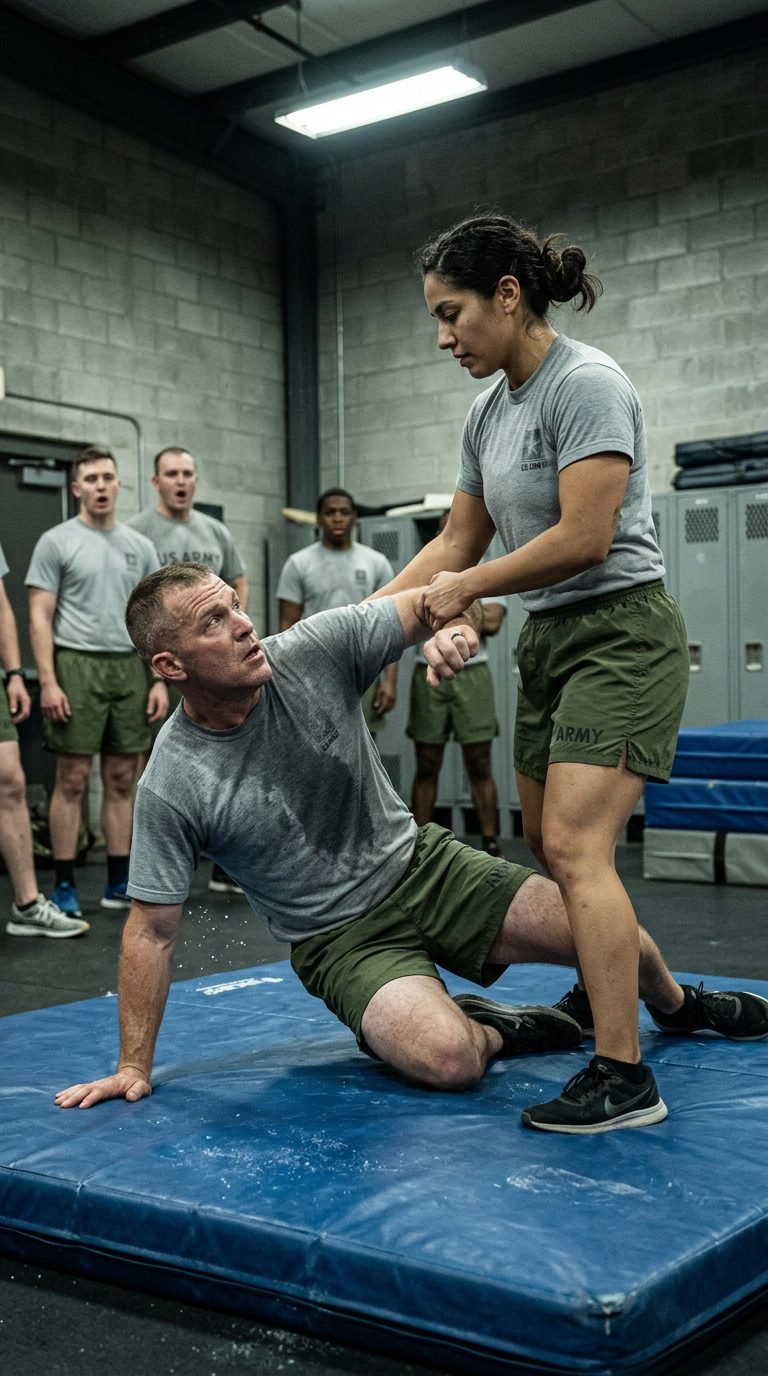

“Step off my mat.”
Sergeant Knox planted himself at the center of the training room, arms crossed, filling the space like a wall.
The young woman in a plain gray Army shirt looked up without flinching.
“I was told to report here.”
Knox laughed – the short, dismissive kind.
“To watch, maybe. Not to train.”
Around the mat, soldiers went quiet.
Her eyes moved to the bruised recruit sitting against the wall, back straight, jaw tight, trying not to show it.
“That man looks hurt.”
Knox glanced over his shoulder.
“That man needs to toughen up.”
“Or someone needs to teach safer.”
His face hardened.
“You got a problem with my class?”
“I have a question.”
“Ask it from the back.”
She stepped onto the mat instead.
A few soldiers held their breath. Nobody moved.
Knox closed the distance slowly, letting the silence work for him.
“You think confidence makes you dangerous?”
“No, Sergeant.” Her voice was even. “I think ego does.”
The room went still.
Knox smiled – the cold kind, the kind that meant he’d already decided how this ended.
“Fine. Show me what you know.”
He lunged, grabbing her sleeve hard and fast, the way he’d done it a hundred times to make recruits stumble.
She didn’t stumble.
In one unhurried movement, she stepped into him, turned his wrist, swept his balance, and lowered him to the mat – controlled, deliberate, without a single unnecessary motion. No slam. No spectacle.
Knox stared up at the ceiling, blinking.
She released him immediately and stepped back.
“Control first. Force last.”
Before he could find his voice, the gym doors swung open.
Colonel Hayes walked in beside a training officer. Every soldier in the room snapped to attention. Knox scrambled to his feet.
“Sir!”
The colonel looked past him.
“Captain Rivera. Report.”
The color left Knox’s face.
Captain Rivera lifted a folder from the bench as though she’d set it there an hour ago – because she had.
“Three injuries in six weeks, sir. Same instructor. Same complaint. Soldiers were being punished harder than they were being trained.”
No one breathed.
Colonel Hayes turned to Knox.
“She was sent by division to inspect this program. Quietly.”
Knox’s throat moved.
“Sir – I was building toughness.”
Rivera looked at the injured recruit against the wall. Then back at Knox.
“Toughness is not fear. Training is not revenge. And a soldier too scared to speak is not becoming stronger – he’s becoming broken.”
The colonel faced the class.
“This room changes today.”
Rivera turned to Knox. Her voice carried no triumph, only the flat weight of fact.
“You know how to fight, Sergeant. Now learn how to lead.”
Knox lowered his eyes.
“Yes, Captain.”
She looked out at the soldiers – some still rigid, some exhaling for the first time in an hour.
“Back on the mat.” A pause. “This time, nobody gets humiliated for learning.”
The Room Nobody Talked About
Fort Dillard’s Building 14 had a reputation.
Not the kind that gets written up in after-action reports. The kind that moves through a post by word of mouth, in the chow line, in the barracks at 2200 when the lights are out and guys are staring at the ceiling. Don’t draw Knox. That was the shorthand. Three words. Everybody knew what they meant.
Sergeant First Class Derek Knox had been running the hand-to-hand combat program at Dillard for going on four years. Before that he’d done two tours in Afghanistan, one in Iraq, and somewhere in between he’d picked up the idea that pain was the only teacher worth listening to. He wasn’t wrong about everything. He knew how to fight. He’d been in situations where that mattered, where the difference between going home and not going home came down to whether you could control a body that was trying to kill you. He understood that.
What he didn’t understand, or maybe what he’d stopped caring about, was the difference between hardening someone and breaking them.
The recruit against the wall was Private First Class Marcus Webb. Twenty-two years old, out of Dayton. He’d taken an elbow to the ribs during a ground drill four days earlier, the kind of move Knox liked to run fast and hard to “simulate real conditions.” Webb had two cracked ribs. He was sitting in that room because Knox had told him to sit there. Not because he needed to be there. Because Knox wanted him visible. A reminder of what happened when you didn’t move fast enough.
That was the third injury in six weeks.
The first two had been a sprained wrist and a shoulder separation. Both logged as training accidents. Both soldiers had declined to file formal complaints, which Knox had probably counted on.
Webb hadn’t filed one either. But Webb had a squad leader named Corporal Dena Pruitt who had a cousin who worked in division admin. And Pruitt had made a phone call.
That phone call had eventually reached a desk in the division training office, and the person sitting at that desk was Captain Elena Rivera.
The Folder on the Bench
Rivera had been at Dillard for eleven days before she walked into Building 14.
She’d spent the first three days reading. Injury logs, training schedules, after-action notes from Knox’s sessions going back eighteen months. She’d talked to the post surgeon, who’d treated Webb and the two soldiers before him. She’d talked to a staff sergeant in a different unit who’d gone through Knox’s program eight months ago and described it, carefully, as “not what I’d call training.”
She’d also done her homework on Knox himself.
Twelve years in. Decorated. Technically proficient. His evaluations called him demanding, which is the word you use when you don’t want to say something else. He’d had one formal complaint filed against him in 2019, a young private who said Knox had targeted him specifically during sessions. The complaint had been reviewed and closed. The private had left the Army six months later.
Rivera had noted all of it. She’d also noted that Knox’s program produced soldiers who could pass their hand-to-hand qualifications. Numbers looked fine on paper. The problem with paper is it doesn’t show you the guy sitting against the wall trying to breathe without wincing.
She’d set the folder on the bench at 0630, before anyone arrived.
Then she’d gone to the back of the room, changed into a plain gray shirt, and waited.
She hadn’t announced herself. Division had sent word only that an inspector would be coming sometime in the week. Not which day. Not who. Knox had been told to expect a review. He’d apparently decided that meant he had time to keep doing things his way.
He’d been wrong about that.
What Knox Thought He Was Looking At
When Rivera walked in that morning, Knox saw a woman in a gray shirt with no rank showing, no name tape, nothing that told him who she was. His brain did what it had been doing for twelve years: it sorted people into categories. Threat or not a threat. Worth his time or not worth his time.
He’d put her in the second column.
That was the first mistake.
The second mistake was the silence. Knox knew how to use silence, how to let it stretch out until it became pressure, until whoever was standing in it started to shrink. He’d done it to recruits, to junior NCOs, to officers he’d decided didn’t know what they were doing. It was one of his tools. He reached for it automatically.
Rivera had not shrunk.
She’d watched him close the distance with the same expression you’d use to watch someone demonstrate a technique you already knew. Patient. Not bored, exactly. Just not impressed.
When he’d said you think confidence makes you dangerous, he’d meant it as a warning. A little theater for the recruits watching. Let her hear what was coming.
She’d answered him in four words and the room had gone sideways.
He’d lunged because there was no other move left. Twelve years of muscle memory. Grab the sleeve, hard and fast, break their balance before they know it’s happening. He’d put bigger men on that mat with that grip.
She hadn’t been bigger than him. She’d just been better.
The ceiling of Building 14 had a water stain in the shape of something he couldn’t identify. He’d stared at it for about two seconds, which felt much longer, and then he’d heard the doors.
Three Injuries, Six Weeks
Colonel Hayes had the kind of face that didn’t do a lot of extra work. He was fifty-one, gray at the temples, and he’d been at Dillard long enough to know which buildings had reputations. He’d heard about Knox the same way everyone heard about Knox. Word of mouth. Chow line. Lights out.
He’d been waiting for something he could act on.
Rivera’s report gave him that.
She read it standing, the folder open, her voice flat and factual. Three injuries. Same root cause each time: excessive force during controlled drilling, insufficient correction of technique before escalating intensity, a training environment where soldiers were afraid to report discomfort because discomfort was treated as weakness.
She didn’t editorialize. She didn’t need to.
Webb was sitting against the wall with two cracked ribs.
Knox heard the whole thing with his face going through several colors. Red first. Then something closer to gray. He was smart enough, by the end, to stop arguing. The I was building toughness had come out before he could stop it, some leftover reflex, and Rivera had answered it without raising her voice.
Toughness is not fear.
Simple sentence. Knox had heard a lot of simple sentences in his career. Most of them hadn’t done much to him. That one landed differently.
Not because it was clever. Because it was true and he knew it and he’d been choosing not to think about it for a long time.
After the Colonel Left
Hayes pulled Knox aside for twenty minutes in the hallway. Rivera didn’t know exactly what was said. She had a reasonable idea.
When Knox came back into the room, he looked smaller. Not physically. He was still the same size, still took up the same amount of space. But something in how he carried it had changed. Like a bag that had been emptied out.
He stood at the edge of the mat and looked at his soldiers.
Some of them were watching him. Some of them were watching Rivera. Webb, against the wall, was watching the floor.
Knox walked over to Webb.
He stood there for a second. Then he crouched down to eye level, which was not something anyone in that room had ever seen him do.
“You good to sit there, or you want to go to the aid station?”
Webb looked up. Surprised. Trying to read it.
“I’m good, Sergeant.”
Knox nodded. Stood up. Didn’t say anything else.
It wasn’t an apology. It wasn’t enough. Rivera knew that. Knox probably knew that too.
But it was something.
Back on the Mat
Rivera ran the rest of the session herself.
Two hours. She started from the beginning, the way you’d start with people who’d been taught badly and needed to unlearn before they could learn. Stance. Weight distribution. How to fall without getting hurt, which Knox had apparently skipped in favor of just letting people get hurt.
She was patient. She corrected people without making them feel stupid about needing correction. When a soldier got something right, she said so, once, plainly, and moved on.
Knox sat on the bench and watched.
She made him watch. She hadn’t said it in those words. She’d just told him to observe and take notes, and he’d sat down with a notepad he’d pulled from his pocket and he’d been writing in it for an hour and a half.
At one point she demonstrated a wrist control technique on a soldier twice her size, a big kid from Kansas named Private Garrett Scholl who outweighed her by about seventy pounds. She walked him through it slow, let him feel where the leverage was, then had him try it on her.
He got it wrong the first time.
“Again,” she said. “You’re using your arm. Use your whole body.”
He tried again. Better.
“There it is.”
Scholl grinned. He hadn’t grinned once in Knox’s class, not in the six weeks he’d been in the program.
At the end of the session Rivera dismissed the soldiers. They filed out, quieter than they’d come in. Not the silence of people trying not to get noticed. Something different. Like they were carrying something they needed to think about.
Webb was last. He moved carefully, favoring his left side, and when he got to the door he stopped and looked back at Rivera.
He didn’t say anything. She didn’t say anything.
He nodded once and left.
Knox was still on the bench.
Rivera picked up her folder. She didn’t look at him when she spoke.
“Same time Thursday. I’ll run it again. You’ll assist.”
A pause.
“After that it’s yours. But I’ll be back.”
Knox said nothing for a moment.
“Understood, Captain.”
She walked out.
The water stain on the ceiling was still there. Knox looked at it for a while before he got up.
—
If this one stayed with you, pass it along to someone who needed to read it today.
If you’re looking for more stories about underestimation and unexpected skill, check out what happened when the range went quiet the moment she put the card on the bench, or when she stepped up to the line and no one on it knew who she was. And for another tale of proving everyone wrong, read about when she walked into the Kill House and he stacked on the wrong side of the door.