The paper target was still swinging when every man at the firing line stopped breathing.
Not because Amanda Reed had yelled.
Not because she had argued.
Not because she looked like someone who needed permission to be there.
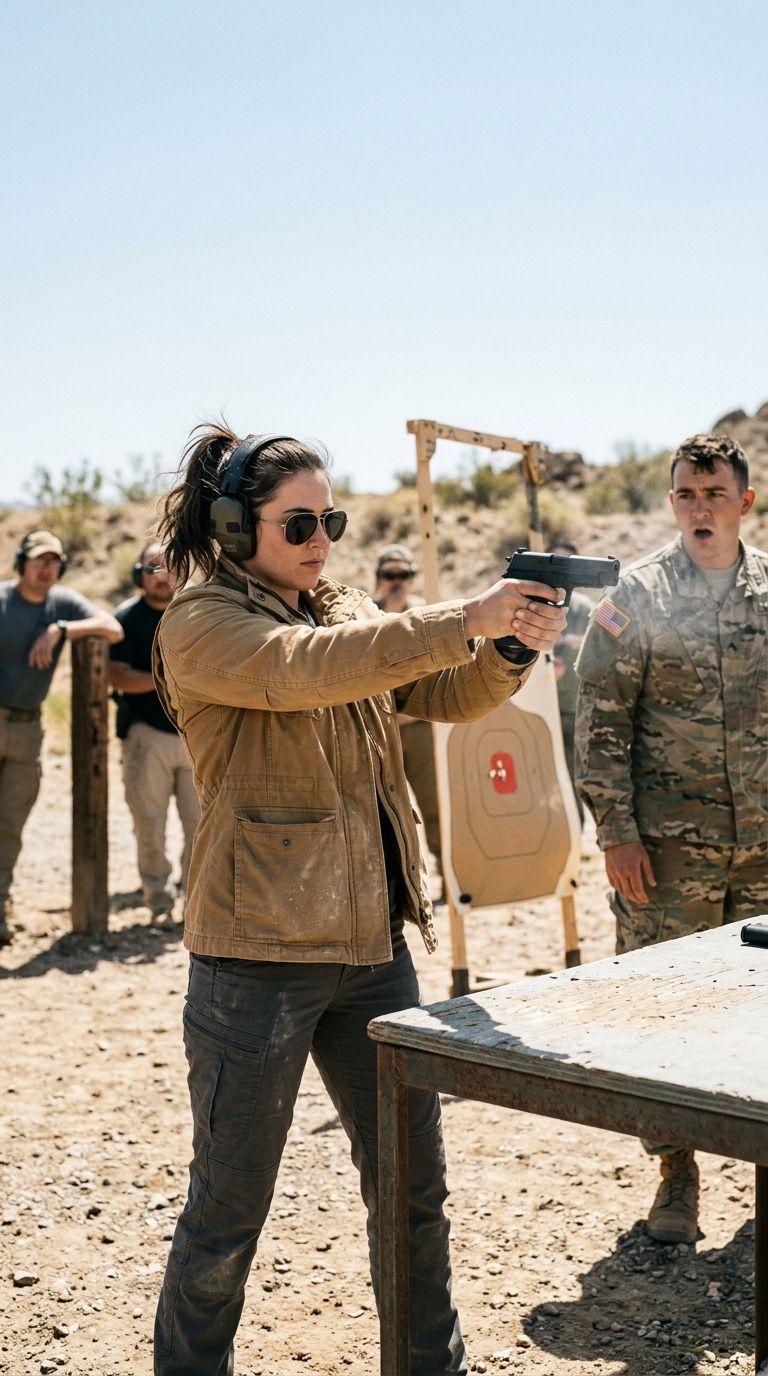
She simply stood in the hard Southwest sun – dust on her tan jacket, sunglasses hiding her eyes, a stillness so complete it made Lieutenant Grant Harris laugh under his breath.
He had the uniform. The flag patch. The particular hard stare of a man who had long ago decided the whole range belonged to him.
And in front of everyone, he treated Amanda like a mistake that had wandered into the wrong lane.
“Careful,” he said, pitching his voice so the nearby shooters would be sure to catch it. “This is a real competition.”
Nobody defended her. Nobody corrected him. Nobody noticed the way her hand stayed perfectly steady on the bench.
Then Amanda looked downrange at the single bullseye drifting in the wind – unhurried, almost lazy in its movement – and something shifted in the air around her. Not anger. Not defiance. Something quieter and considerably more dangerous than either.
She didn’t make a speech. She didn’t beg to be taken seriously.
She offered one sentence, flat and certain as the desert floor beneath their boots.
“Center hit,” she said. “And you owe me fifty.”
Harris smiled the smile of a man who believed he had just been handed an easy humiliation.
Then a single shot cracked through the dry air and rolled out across the flats until the silence swallowed it whole.
When the paper finally stopped moving, the man who had mocked her stood with his mouth open and nothing behind it – no comeback, no laugh, no explanation for what the target was now showing the entire firing line.
Just a hole. Dead center.
Right where she said it would be.
The Range at Picacho
The Picacho Flats Regional Shooting Competition runs every third Saturday in October, out past the truck stops and the last gas station before the road goes honest desert. No shade. No grandstand. A row of plywood benches, some orange cones, and a range officer named Dale who checks IDs and doesn’t much care who you are as long as you keep the muzzle pointed downrange.
Amanda had been coming here for six years.
Not every year did she enter the open division. Some years she came to watch her friend Connie Pruitt shoot, or to help set targets, or just because the drive out was the one hour of the week where her phone didn’t ring. She liked the flat light. She liked the smell of the place, which was mostly cordite and dry grass and the particular dusty nothing of the Sonoran floor.
She had won the open division twice. She had placed in the top three four other times. Her name was on the laminated sheet tacked to the corkboard inside the registration tent, twice circled in red marker.
Grant Harris had never once looked at that corkboard.
He’d shown up that morning in a pickup so clean it was almost insulting out here, a Department of Public Safety range bag over one shoulder, his instructor credentials on a lanyard he had not bothered to tuck in. He was forty-four, thick through the neck, and he had the kind of voice that expected rooms to quiet down when he used it.
They usually did.
He didn’t know Amanda. He saw a woman in her late thirties setting up alone at lane seven, no partner, no instructor, no one to explain what she was doing. He made an assessment. It took him about three seconds, and it was wrong in every particular.
What She Didn’t Say
Amanda Reed had started shooting at eleven years old, in the garage of her uncle’s house in Tucson, with a .22 rifle that had a cracked stock held together with electrical tape. Her uncle, a man named Dennis who smelled like motor oil and spoke in single syllables, had shown her once how to breathe before the trigger, and then never mentioned it again. He figured if you showed someone the right way once, you’d done your part.
She figured that too.
She shot competitively through high school, through two years of community college, through the years when she was working double shifts at the hospital and could only get to the range twice a month. She never talked about it at work. She didn’t have a sticker on her car. She didn’t have a social media account dedicated to it, or a YouTube channel, or a hat.
She just knew how to do it.
The particular shot Harris had interrupted her setting up for was a 200-yard single-target cold bore. One shot. No warm-up. The wind was coming from the northwest at about eight miles per hour, gusting occasionally to twelve, and the target was a standard IPSC silhouette with a six-inch bullseye. She had already done the math. She had already settled into her breathing. She was three minutes from pulling the trigger when he materialized at her elbow.
“You registered for the open?” he said.
“Yes.” She didn’t look up.
“That’s the advanced field.” He said it the way you’d tell someone they’d parked in a fire lane. Informative, with a little edge of pleasure in the informing.
“I know.”
He looked at her setup. He looked at her rifle, which was a Remington 700 in .308 that she’d had for nine years and rebarreled twice and which was not impressive to look at. He looked at the way she was positioned on the bench. He decided something.
“Careful,” he said, loud enough. “This is a real competition.”
The Fifty Dollars
She’d heard variations of this her whole life.
Not always this blunt. Sometimes it was just a certain kind of helpfulness, someone appearing at her shoulder to explain how to adjust her scope, or asking if she needed a spotter, or laughing a little too quickly when she mentioned her division. Sometimes it was the silence after she posted a score that was better than the men around her. The silence was almost worse. Like the number didn’t count if they didn’t acknowledge it.
Harris was just the loud version.
She looked at him for the first time. He had his arms crossed and he was smiling. A couple of the men from the adjacent lanes were watching now. Dale, the range officer, was pretending to examine a clipboard thirty feet away.
“You want to make it interesting?” she said.
Harris spread his hands. Sure, why not. Easy money.
“I call the shot before I take it,” she said. “Center hit. You spot it. Fifty dollars says I’m right.”
He laughed. One short sound. “You haven’t even fired a warm-up.”
“I know.”
He pulled two twenties and a ten from his wallet and set them on the bench beside her gear. The men from the adjacent lanes drifted a little closer. Someone said something quiet that she didn’t catch.
She looked at the target, 200 yards out, swinging a few degrees in the northwest wind.
She settled.
She breathed.
One Shot
Here is what nobody watching understood, except maybe Dale, who had been running this range for eleven years and had seen some things:
Amanda wasn’t performing. She wasn’t trying to make a point. She wasn’t thinking about Harris or his money or the men watching from the adjacent lanes.
She was just shooting.
The rifle was familiar under her hands the way a steering wheel is familiar, or a doorknob, or your own name. She’d put somewhere north of four thousand rounds through it. She knew exactly how the trigger broke, knew the way the stock settled against her shoulder, knew the small muscular adjustment required for an eight-mile-per-hour crosswind at this distance.
She gave it about two seconds.
Then she said, flat, not even turning her head: “Center hit. And you owe me fifty.”
And she fired.
The shot went out across the flats and the echo came back off the low ridge to the east a half-second later. The target swung wide and then settled. At 200 yards you can’t see a hole with the naked eye. Harris had a spotting scope set up at his lane. He walked to it.
Long pause.
The men from the adjacent lanes were very quiet.
Harris stood up from the scope. He wasn’t smiling. He looked at the target. He looked at Amanda, who had set the rifle down and was already noting something in a small spiral notebook she kept in her jacket pocket.
She didn’t look up.
What the Spotter Showed
Dead center. Not close to center. Not close enough that you could be generous about it.
The kind of center that makes experienced shooters go quiet and do the arithmetic in their heads, factoring for wind and distance and cold bore and the fact that she hadn’t even rolled her neck before she pulled the trigger.
Harris reached into his pocket.
He put the fifty on the bench next to her notebook.
She picked it up without ceremony, folded it once, put it in her jacket pocket. She made another small note in the spiral notebook. She did not smile at him. She did not say anything. She did not look around at the men from the adjacent lanes to see their faces.
Dale, from thirty feet away, cleared his throat and called the range hot again.
Harris picked up his bag. He didn’t leave, exactly. He just relocated. Down to lane two, which was as far from lane seven as you could get without leaving the property.
Nobody said much.
Connie Pruitt, who had been watching all of this from the registration tent with a paper cup of terrible coffee, walked over about ten minutes later.
“You want me to go say something to him?” Connie asked.
“No,” Amanda said.
“He’s probably going to tell people you got lucky.”
“He can tell people whatever he wants.” She was already resetting. New target. Different distance. The notebook open again, pencil moving. “I know what I did.”
The Rest of the Morning
She shot four more times in the open division that morning.
She placed first.
Her aggregate score was the highest posted on the range that day, including Harris’s, which was good but not good enough and which he did not seem to want to discuss.
The drive back to Tucson took forty-five minutes. She had the windows down. The desert smelled like dry grass and something faintly like rain that wasn’t coming. She stopped at the gas station for a Coke and sat on the hood of her car for a while, watching a hawk work a thermal above the ridge.
She thought about her uncle Dennis. He’d died eight years ago, a Tuesday in February, quietly, the way he’d done most things. She still had the .22 with the taped stock in a case in her closet. She’d never shot it again after he died. It just sat there.
She thought he would have appreciated the morning. Not the drama of it. Not the fifty dollars. Just the shot.
The clean fact of it.
She finished the Coke, got back in the car, and drove home.
—
If this one hit right, pass it along to someone who’d appreciate it.
If you enjoyed this story about an unexpected expert, you might also like the tale of when she stepped onto his mat or the time the range went quiet because of one woman, and don’t miss when she stepped up to the line and surprised everyone.