
“Sergeant, you may want to rethink this.”
The words were quiet.
Still, they cut through the firing range hard enough to stop every conversation in midair.
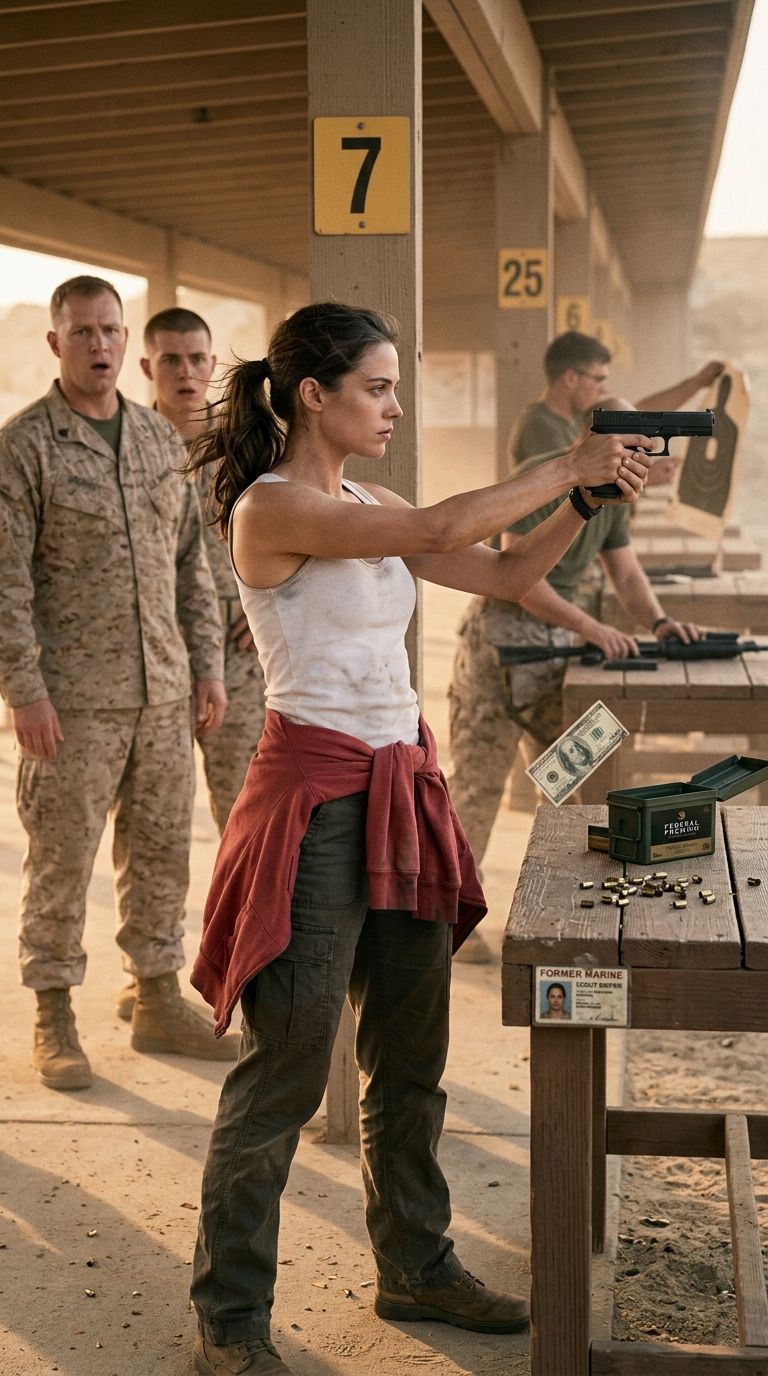
No one fired. No one laughed. Even the wind seemed to pause as Sergeant Cole Bennett stood beside Lane Seven, still wearing the smile of a man who believed the afternoon belonged to him.
The hundred-dollar bill trembled on the bench beneath an ammunition box, its corner lifting in the coastal breeze as though trying to escape before the truth arrived.
The woman beside the lane did not look at the money.
She pressed another round into the Glock magazine.
Click.
Slow. Steady. Unbothered.
Cole had spent the last ten minutes carefully constructing the way everyone else saw her. A civilian. A weekend shooter. A woman in a white tank top with a faded red jacket tied around her waist, standing among Marines like she had wandered into the wrong building.
“Five shots,” he had said, sliding the bill across the bench. “Twenty-five yards. Four seconds. Try not to embarrass yourself too badly, sweetheart.”
The younger Marines had laughed because Cole expected them to. Because he was the instructor. Because he was broad-shouldered, sharp-jawed, sunburned, and thoroughly accustomed to being admired.
But one Marine had stopped laughing sooner than the rest.
Private Mason Hale was watching the woman’s hands.
Not her face. Not her clothes. Her hands.
The thin scars across her wrists. The calm, unhurried way she loaded. The grip that was too practiced, too clean, too deeply familiar to belong to someone pretending.
The smell of burnt powder hung in the warm air, layered with sunscreen, brass, sweat, and salt drifting in from the ocean. Shooters from nearby lanes had turned to watch. A man stopped taping his target. Another lowered his rifle. The entire range went quiet around them, slowly and without anyone deciding to make it so.
“I’ve been watching you,” Cole said, pitching his voice for the crowd. “You seem pretty comfortable around firearms.”
The woman pushed the final round into the magazine.
Click.
Then she raised her eyes. They were gray-blue. Still, but not soft.
“Is that your professional opinion?” she asked.
A nervous laugh escaped from somewhere behind Cole. His jaw tightened.
“Sergeant Cole Bennett,” he said. “Marksmanship instructor. Marine Corps Recruit Depot San Diego.”
She blinked once.
“That must feel important.”
The silence that followed landed harder than an insult. Cole’s smile held its shape, but something behind it quietly shifted. He hated being dismissed. He hated it more in front of men who looked up to him.
He lifted the hundred-dollar bill and held it between two fingers.
“You beat me, it’s yours,” he said. “You lose, you’re buying drinks.”
Her gaze touched the money for half a second, then returned to him.
There was always a moment like this. A moment when someone looked at her and decided they already knew the whole story.
Civilian. Soft. Harmless. Easy.
A flicker crossed her face – there and gone before most people could catch it.
Years ago, in another country, a young lieutenant had smiled that same smile and told her not to worry about the wind. The men will handle it, he had said. Three days later, he was gone. She had handled it herself, as she had handled most things, and she had not thought about him in a long time.
The memory vanished almost as quickly as it came.
Almost no one noticed.
Mason did. He watched her reach into the inside pocket of her red jacket and remove a small identification card, which she set beside the ammunition box without ceremony or explanation.
The range officer saw it first.
His posture changed instantly. Not politely. Not gradually.
Instantly. Like recognition had struck him somewhere deep in the spine.
“Sergeant,” he said carefully. “You may want to rethink this.”
Cole laughed without turning. “Why?”
The woman stepped into Lane Seven. Her shoulders settled. Her breathing slowed. Her stance locked into place with the quiet, unhurried certainty of someone who had done this ten thousand times in conditions far worse than a sunny afternoon on a coastal range.
It was not the posture of someone shooting for pride.
It looked like someone returning to a life she had already survived.
Cole finally glanced sideways. He saw the range officer’s face. Then Mason’s expression, pale and still. Then the identification card resting on the bench beside the ammunition box.
Former Marine Scout Sniper.
For the first time that afternoon, the confidence drained from Cole’s face. The smile disappeared completely, like a light switched off in an empty room.
The wind lifted the corner of the hundred-dollar bill.
Nobody moved. Nobody breathed.
And then she raised the pistol.
What Happened in the Next Four Seconds
The first shot hit before most people registered she had fired.
Dead center. The paper target at twenty-five yards barely moved, just a clean hole opening up in the silhouette’s chest like a period at the end of a sentence. The second came so fast after the first that a few of the younger Marines thought they’d imagined a gap between them. The third, fourth, and fifth were mechanical. Unhurried. Identical.
Five shots.
Four and a half seconds, maybe. Hard to say exactly because no one had thought to watch the clock.
She lowered the pistol, dropped the magazine, cleared the chamber, and set the weapon on the bench. The brass casings were still rolling across the concrete.
Nobody spoke.
The man who had stopped taping his target was still standing with the tape roll in his hand, arm half-raised, completely forgotten. A woman two lanes down had pressed her ear protection up off one ear to hear better, even though there was nothing left to hear.
Cole stood exactly where he had been standing. He had not moved. His hand still held the hundred-dollar bill between two fingers.
The range officer walked to Lane Seven, pulled the target line back, and looked at the grouping.
He turned it toward the crowd without a word.
Five holes. You could have covered them with a silver dollar, with room to argue about the edges. Dead center of the silhouette’s chest. Not a pattern that looked like luck. A pattern that looked like something else entirely, like the outcome of a decision made before she ever stepped up to the lane.
Cole set the money on the bench.
She didn’t pick it up right away.
Her Name Was Diane Pruitt
She was forty-three. She had grown up in Bakersfield, the middle daughter of a man who ran a hardware store and a woman who taught fourth grade. She had joined the Marines at nineteen because the recruiter at her high school had said she’d wash out in eight weeks and she had wanted, badly, to prove someone wrong.
She hadn’t washed out.
She had gone to Camp Pendleton, then to Quantico, then to places that weren’t discussed at family dinners. She had spent eleven years in service, three of them in a role that the official paperwork described in language that was technically accurate and completely misleading.
Scout Sniper. One of the first women to qualify, back when that distinction still made certain people’s faces do complicated things.
She had separated from the Marines at thirty, quietly, without ceremony. Took a job in Phoenix doing private security consulting. Moved to San Diego two years ago because she liked the water and because her sister lived there and because she was tired of being somewhere that didn’t feel like anything.
She came to the range on Saturdays. Sometimes Sundays. Nobody here had known who she was, and she had not told them, and that had suited her fine.
Until today.
She picked up the hundred-dollar bill and folded it once and slid it into the pocket of her red jacket.
The Part Where Cole Had a Choice
He could have laughed it off. That was the play. Shake his head, say something self-deprecating, buy the story where he was just a guy who got outshot and was gracious about it. Some of the younger Marines might have respected him more for it.
He didn’t do that.
“Lucky grouping,” he said.
It came out quieter than he intended. Not aggressive. Almost uncertain, which was worse.
Diane looked at him for a moment. Not with contempt. Not with satisfaction. Just looking.
“You want to go again?” she asked.
Mason Hale, standing six feet back and slightly to the left, would later describe the expression on Cole’s face as the look of a man who had just understood a joke at his own expense. Not angry. Not humiliated. Just finally, reluctantly, in possession of information he hadn’t had before.
“Thirty yards,” Diane said. “Four shots. Dominant hand only.”
She wasn’t showing off. That was the thing Mason kept coming back to later, trying to explain it to his bunkmate that night. She wasn’t trying to grind Cole into the concrete. She said it the way you’d offer someone a second cup of coffee. Matter-of-fact. Take it or leave it.
Cole set his jaw.
“Fine,” he said.
Thirty Yards
He shot first. Four shots, good grouping, tight enough to be respectable. The kind of score that would have impressed everyone in that room twenty minutes ago. Cole had been shooting for fifteen years. He was genuinely good. That part had never been the lie.
Diane loaded four rounds.
She rolled her left shoulder once, a small private motion that had nothing to do with the performance of it. An old habit. She’d taken a fragment hit there in 2009, a bad day in a bad province, and the muscle still tightened up in cold air or when she’d been sitting too long. Today was warm. It barely bothered her.
She raised the Glock with her right hand.
Shot one.
Shot two.
Shot three.
Four.
She cleared the weapon and stepped back from the lane.
When the range officer pulled her target back, the grouping was tighter than Cole’s. Not dramatically. Not insultingly. Just tighter, clean and irrefutable, the way a fact is irrefutable, without any malice in it.
Cole looked at the target for a long time.
Then he looked at her.
“Where?” he asked. Just that one word.
She understood the question.
“Helmand,” she said. “Mostly.”
Cole nodded slowly. His jaw worked once like he was chewing on something difficult.
“Bennett,” he said, and stuck out his hand.
She shook it.
“Pruitt,” she said.
What Mason Hale Carried Out of There
Mason was twenty-one. He had been in the Marines for fourteen months. He was from a small town outside Knoxville and he had grown up around guns and he thought he understood what it meant to be good at something.
He understood it differently after that afternoon.
It wasn’t the shooting. He had seen excellent shooting before. It was the quiet. The complete absence of anything to prove. He had watched Diane Pruitt load that magazine and he had known, in some instinctive way he couldn’t have articulated at the time, that he was looking at someone who had already paid for what she knew.
The scars on her wrists. The way her eyes went still when Cole made the joke. The flicker of something old and finished that crossed her face before she put it away.
He didn’t know her story. Not the details. Not the province, not the years, not the specific weight of what she’d carried.
But he knew the shape of it.
He thought about that a lot in the months after. When training got hard. When he felt the particular temptation to be loud about what he could do. He thought about a woman in a white tank top and a faded red jacket who had set a card on a bench and not said a word and let the facts speak in the plainest possible language.
He thought: that’s what it looks like when it’s real.
The Hundred Dollars
She stopped at the gas station on Rosecrans on her way home, bought a bottle of water and a bag of peanuts, and spent $4.17 of Cole’s hundred.
The rest she folded into an envelope that night and dropped in the collection box at the veterans’ resource center on Midway Drive. She had been doing that most Saturdays for a year and a half. Nobody there knew it was her.
She got home around five. Her sister called at five-thirty, asked how the range was.
“Fine,” Diane said. “Ran into some people.”
“Anyone interesting?”
She thought about Cole’s face when he finally stuck out his hand. The way Mason Hale had watched her the whole time with that specific expression, the one where a young person is quietly revising something they thought they already knew.
“Not really,” she said.
She ate dinner, watched half a documentary about ocean currents, fell asleep on the couch before nine.
The hundred-dollar bill was already gone.
She didn’t think about it again.
—
If this one stuck with you, pass it along to someone who needs to see it.
For more tales of unexpected turns and powerful moments, check out what happened when she stepped up to the line and no one on it knew who she was, or when she walked into the kill house and he stacked on the wrong side of the door. And if you’re curious about a sergeant who made a big mistake, read about the time a sergeant told me to get out of his chow hall, but he didn’t know my name.