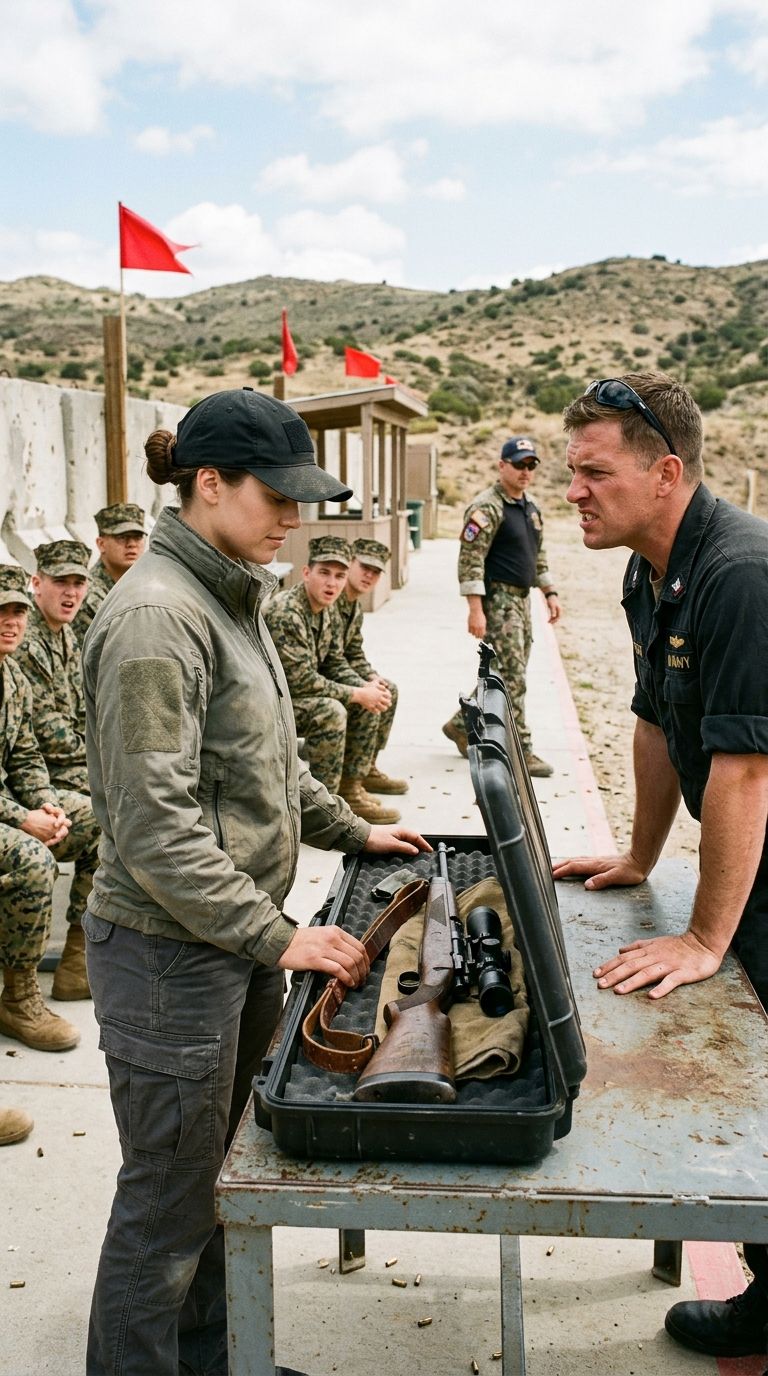

“This range isn’t for lost civilians,” Lieutenant Marcus Hale said, stepping into Serena Vale’s path with one arm extended.
The twelve trainees behind him laughed before she even stopped walking.
She came to a halt, an old black rifle case hanging at her side. Wind dragged dust across the Coronado firing line and snapped the American flag above the command hut. Hale stood close enough that his shadow covered her boots. His sunglasses hid his eyes, but not his smirk.
“Ma’am.” He said it louder this time. “You walked through the wrong gate.”
Serena didn’t respond. Her hand stayed wrapped around the worn handle of the case. Its metal corners were dulled with age. The leather strap had been repaired more than once. Nothing about it looked expensive. Everything about it looked heavily used.
Hale glanced at it and chuckled. “Let me guess. You’re here to return your husband’s gear.”
Laughter rolled across the prep tables. A sandy-haired trainee leaned back and slapped the table. Another shook his head as if the joke had already won.
Serena looked past Hale toward the long concrete lanes. Steel targets stood beyond the markers, dark against the white glare – some close enough for warmups, others far enough away to punish mistakes. She studied them without moving her head.
Hale noticed. He shifted left, blocking her view.
“You hear me?”
“I heard you,” Serena said.
Her voice was steady. It carried no anger. That calm irritated him more than fear would have. He wanted embarrassment. He wanted retreat. He wanted obedience before he finished speaking.
Instead, she stood still in a faded tactical jacket. No visible badge. No unit patch on her shoulder. No visitor pass around her neck. Her black hoodie hung loose beneath the jacket. Her cargo pants were dust-stained at the knees. Her boots looked like they had crossed hard ground for years.
Hale pointed toward the gate behind her. “Then turn around.”
“I was told to report here.”
“By who?”
Serena glanced toward the range office. Master Chief Adrian Stone stood under a shade awning, holding a clipboard – gray-haired, hard-faced, motionless in the way of a man who sees everything. He had been reviewing the schedule when the laughter started. Now he watched from fifty feet away, his gaze moving from Serena to Hale before settling on the rifle case.
Serena turned back. “Someone who knew this place.”
The trainees laughed again, but quieter. The answer landed differently. Hale sensed the shift and smiled wider to cover it.
“Everyone knows this place,” he said. “Doesn’t mean they belong here.”
A trainee near the ammo table muttered, “Maybe she’s here for the tour.”
Another added, “Or the gift shop.”
The laughter sharpened. Hale fed on it. He turned halfway toward the group. “You see this? This is why gate guards need coffee.”
Serena lowered the rifle case carefully to the ground. It touched concrete without a thud.
Hale noticed the precision. For some reason, it annoyed him.
“What’s in there?” he asked. “A museum piece?”
She said nothing. Hale tapped the case with his boot. It scraped across the grit several inches. The sound cut through the laughter like stone splitting.
Serena moved before it could tip. Her hand caught the handle smoothly – no stumble, no gasp, no anger. Only control.
The trainees laughed harder, mistaking control for fear.
Hale pointed at the case. “Don’t bring junk onto my line.”
“It isn’t junk,” Serena said.
Her voice was quiet. It carried farther than his shouting.
Hale slowly removed his sunglasses. His eyes were pale with irritation. “Say that again.”
“It isn’t junk.”
He tilted his head. “You always this calm when you’re out of place?”
“I try to stay calm around weapons.”
The sentence changed the air. A few trainees stopped smiling. Adrian Stone lowered his clipboard. He still didn’t move – range discipline mattered, but timing mattered more. Hale liked audiences too much. Stone had watched that flaw deepen over months of evaluations. A man performing for approval could become careless. A man humiliating others on the line needed watching.
Hale stepped closer. He was nearly a foot taller and used it deliberately. “You have five seconds. Walk back to the gate.”
“I only need one lane.”
The sandy-haired trainee whispered, “Damn.”
Hale snapped his head around. “Quiet.” Silence dropped immediately.
Serena lifted the case and moved to step past him. Hale reached for the handle, aiming to pull it away. His fingers closed on empty air. She had already shifted it behind her leg – the motion small and clean, not flashy, not aggressive. Just precise.
Hale stared at his hand for a beat. The trainees saw it. So did Stone.
Confusion crossed Hale’s face. Then pride buried it.
“Quick hands,” he said. “Weekend tactical class teach you that?”
“No.”
“No what?”
“No class.”
The trainees made a low sound. Not laughter. Surprise. Hale heard it and hated it. He snapped toward the tables. “Everybody keep prepping.” No one moved immediately. His jaw tightened. “Now.”
They returned to their rifles, though their attention stayed on Serena.
Stone stepped out from the shade, a few feet closer. He wanted to see what Hale would do without an audience to perform for.
Morning light turned the firing lane almost white. Beyond the concrete, scrubland stretched behind barriers and parked vehicles. The Pacific sat somewhere past the buildings. Wind carried salt, dust, and hot oil.
Serena moved toward an empty table. Hale walked beside her, always close enough to crowd her.
“Set it down,” he said.
She placed the case on the table. Hale leaned over it. “Open it.”
Serena looked at him. “Is that an order?”
“You’re on a military range.”
“And are you the commanding authority?”
A trainee coughed to hide a laugh. Hale’s gaze snapped toward him. The trainee looked down.
Hale turned back. “You’re brave for someone without a badge.”
“Bravery isn’t the same as volume.”
The words hit harder than shouting. Hale’s neck reddened.
Stone noticed Serena’s right hand stayed near the case. Not fear. Protection. The case mattered – not for money, but for memory. He understood that difference. He had seen it before.
Hale planted both hands on the table. “Open the case, ma’am.”
Serena held his gaze. Then she clicked the first latch. Metal snapped softly, the sound carrying farther than expected. A second latch opened. Then a third.
Several trainees stopped pretending to work.
Hale leaned in. The lid lifted.
Inside lay an old precision rifle wrapped in dark cloth. Its finish was worn with years of use. The scope looked older than modern issue. The sling had faded to gray.
Hale laughed. “You have got to be kidding me.”
Serena folded back the cloth carefully.
“Don’t touch it,” Hale said.
“I wasn’t offering.”
His smirk faded. The sandy-haired trainee turned his head. Another whispered, “That thing still fires?”
Serena lifted the rifle from the case. The laughter returned, but weaker now. Hale forced a grin toward the group. “Gentlemen, we have a history demonstration.”
Some laughed out of habit.
Serena checked the rifle without looking at him. Her movements were exact – no hesitation, no waste. She inspected the chamber, checked the bolt, aligned the scope. She moved like someone recalling a song they had never forgotten.
Stone stepped closer again, eyes narrowing. The rifle triggered something – not a complete memory, only fragments. A training photo long removed from the wall. A black-and-white image beside a man whose name had a way of silencing rooms.
Hale watched her work. The longer it went on, the less he liked it.
“We have modern equipment here,” he said.
“I know.”
“Then why bring that?”
“Because I was told to.”
“By your mysterious friend?”
Serena paused. Her fingers rested on the stock. “He wasn’t my friend.”
Stone stopped moving. The wind snapped the flag again.
Hale felt the shift but didn’t understand it. “Then who was he?”
Serena looked toward the targets.
“A man who didn’t waste words.”
What Stone Remembered
Adrian Stone had been at Coronado for eleven years. He had seen every kind of person walk through that gate – decorated officers, washed-out recruits, civilians who thought proximity to the military made them interesting. He had a system for reading people fast because the range demanded it. Slow readers got people hurt.
He read Serena Vale in about forty seconds.
The way she’d caught the case. The way she’d shifted it from Hale’s reach without looking. The way her breathing hadn’t changed through any of it. Those weren’t learned behaviors. They were old ones, worn smooth.
And the rifle.
Stone moved closer now, close enough to see the stock properly. There was a small mark near the grip – not a manufacturer’s stamp, something else. Something hand-engraved. He’d need another few feet to read it, but he didn’t need to read it. He already knew the shape of it.
He’d seen that mark once before, in a photograph taken at a range not unlike this one. Nineteen seventy-eight, or thereabouts. A man standing behind a table in desert light, holding a rifle across his chest the way you hold something you built yourself.
The man’s name was Raymond Vale.
Stone’s stomach went flat.
The Name Nobody Said Twice
Raymond Vale had been dead for six years. Stone had attended the service – small, private, at a chapel outside San Diego. No media. No ceremony beyond what the family wanted. A handful of men who’d known him from different eras of a career that spanned four decades, two wars, and at least one operation that still didn’t have a declassified name.
Stone had stood in the back. He hadn’t introduced himself to the family. It hadn’t felt like his place.
But he remembered the woman at the front. Dark hair, early forties, straight-backed in a black dress. She hadn’t cried during the service. Not once. He’d noticed because everyone else had, at some point. Even the hard men in the back row.
He was looking at her now.
Serena Vale – Raymond’s daughter, not his wife. Stone had the math wrong for a moment, then corrected it. She’d been maybe thirty-eight at the service. That made her mid-forties now. The gray threading her hair at the temples was new, or he’d missed it from the back of that chapel.
Hale was still talking. Stone wasn’t listening to Hale anymore.
One Lane
Serena set the rifle on the table’s rubber mat and began adjusting the scope with a small tool she pulled from her jacket pocket. The adjustment was minor – a quarter turn, maybe less. Her eye stayed close to the glass for a moment, then she straightened.
“The scope drifts in heat,” she said, to no one in particular.
Hale blinked. “What?”
“The scope drifts. It always did. He compensated manually, but I like to adjust first.”
Hale looked at the trainees. They looked back at him. The sandy-haired one, whose name was Garrett, had stopped moving entirely.
“Who compensated?” Hale asked.
Serena didn’t answer. She loaded the magazine with the deliberate economy of someone who had done it ten thousand times – not fast, not slow, just exactly as fast as it needed to be. She seated it without slapping it. Racked the bolt once. Set the safety.
Then she looked down the lane.
The far targets were set at eight hundred meters. That was the evaluation distance for the advanced group. Hale had placed them there this morning specifically because he wanted his trainees to struggle. Struggle built something, he believed. Or he said he believed it. Mostly he liked watching people fall short of a standard he named.
Eight hundred meters with a rifle that old, with a scope that drifted, in a crosswind coming off the Pacific.
Hale crossed his arms. “You’re not cleared to fire on this range.”
“Master Chief Stone,” Serena said.
She didn’t raise her voice. She didn’t look away from the lane.
Stone was already walking. He covered the distance in about ten seconds and stopped beside the table. Hale turned to him, ready to speak. Stone held up one hand – not aggressive, just a flat stop.
He looked at the rifle. Up close now, he could read the engraving on the stock.
R.V. – For what it costs.
That was Raymond. Cryptic even in the things he built with his own hands.
Stone looked at Serena. “When did he give you this?”
“He didn’t,” she said. “He left it.”
Stone absorbed that. “When did you last fire it?”
“Four years ago. Before he got sick.”
Hale started, “Master Chief, this woman has no authorization to – “
“Lieutenant.” Stone’s voice didn’t go up. It went down, and it went flat, and Hale stopped. “Step back.”
A beat. Hale stepped back.
Eight Hundred Meters
Stone cleared Serena for the lane himself, signed the log himself, and stood two feet behind her left shoulder when she went prone on the mat.
The trainees had gathered without being told to. Garrett was closest. He was twenty-three, a good shot, probably the best in the group, and he had enough sense to recognize when something was worth watching.
Serena settled into position the way water settles into a container. No adjustment, no fidgeting. Her breathing slowed. The wind was running about twelve knots left to right, gusting to maybe fifteen. The flag above the command hut confirmed it. She watched the flag for a moment, then looked back through the scope.
Hale stood off to the side, arms still crossed. His jaw was tight. He was doing the math, Stone knew – trying to calculate how badly this could go wrong for him, how much ground he’d already lost, whether there was still a version of this morning where he came out intact.
There wasn’t.
Serena fired.
The shot was clean. The rifle cracked across the lane and the steel plate at eight hundred meters rang – a sound like a hammer on a pipe, delayed by distance, arriving a half-second after the shot. A clean center hit.
Garrett said, “Jesus.”
She fired again. Same target. Same sound. Then she shifted to the second plate, three feet left, and put two rounds into it without pausing between them.
Four shots. Four hits. Eight hundred meters. A rifle from 1971 with a scope that drifted in heat.
Serena came up off the mat slowly, the way a person does when their knees aren’t twenty-five anymore. She engaged the safety, set the rifle down, and turned to Stone.
“He said the line hadn’t changed much,” she said.
“It hasn’t,” Stone told her.
“He said if I ever needed to remember what he taught me, this was the place to come.” She looked at the targets. “I needed to remember.”
Stone didn’t ask why. He understood why. Grief had its own schedule and its own requirements, and sometimes the requirement was this: a specific place, a specific rifle, a specific distance. Proof that the thing he built in you was still there.
Hale hadn’t moved. His arms had dropped to his sides somewhere during the second shot. He was looking at the targets.
Stone watched him work through it – the calculation, the realization, the slow arrival at the obvious conclusion he should have reached forty minutes ago when a woman walked through his gate carrying a rifle case like it was the most important thing she owned.
Which it was.
After
Serena Vale repacked the rifle the same way she’d unpacked it. Dark cloth folded back over the stock. Three latches clicked shut. She lifted the case, and Stone noticed again how she held it – close to her side, handle firm, not letting it swing.
Hale was quiet. Stone would talk to him later, privately, without an audience. That conversation would not be comfortable, but it would be honest, and Hale would either hear it or he wouldn’t. Stone had seen both outcomes before.
Garrett stepped forward as Serena turned to leave. He was holding his own rifle by the grip, and he looked like he wasn’t sure he should speak, but he did anyway.
“Ma’am,” he said. “Who was he?”
Serena looked at the kid. He had the right kind of face for the question – open, not performing, actually wanting to know.
“My father,” she said.
Garrett nodded. “Was he good?”
She considered that for a moment. The flag snapped above them. Salt in the wind.
“He was the best I ever saw,” she said. “And he would’ve told you that meant nothing without the hours.”
She walked back toward the gate.
Stone watched her go. The rifle case swung once at her side, then steadied.
Behind him, twelve trainees stood at their tables. Nobody was laughing. Nobody was looking at their phones. They were all watching the gate, watching the woman in the faded tactical jacket walk through it, watching the way she carried something old and worn and irreplaceable like it weighed nothing at all.
Garrett looked down at his own rifle.
Then he went back to work.
—
If this one got you, pass it along to someone who’d feel it.
For more stories of unexpected power and surprising turns, check out what happened when They Forced the Silent Rookie to Her Feet at the Wrong Table or when The Colonel Stepped Out of the Shadows and Nobody on That Parade Ground Made a Sound. You might also be interested in the moment My Sergeant Grabbed a Stranger’s Hair in the Mess Hall. Then She Stood Up.