
They had labeled her a political project long before her boots touched the coastal base.
The tag was invisible but permanent, following her through the joint training detachment like a shadow she couldn’t outrun – past the Navy operators, past the Marine special operations platoon, past every table in every chow hall where conversations dropped half a register when she walked in. Staff Sergeant Travis Rourke hadn’t invented the skepticism. He’d simply made it loud.
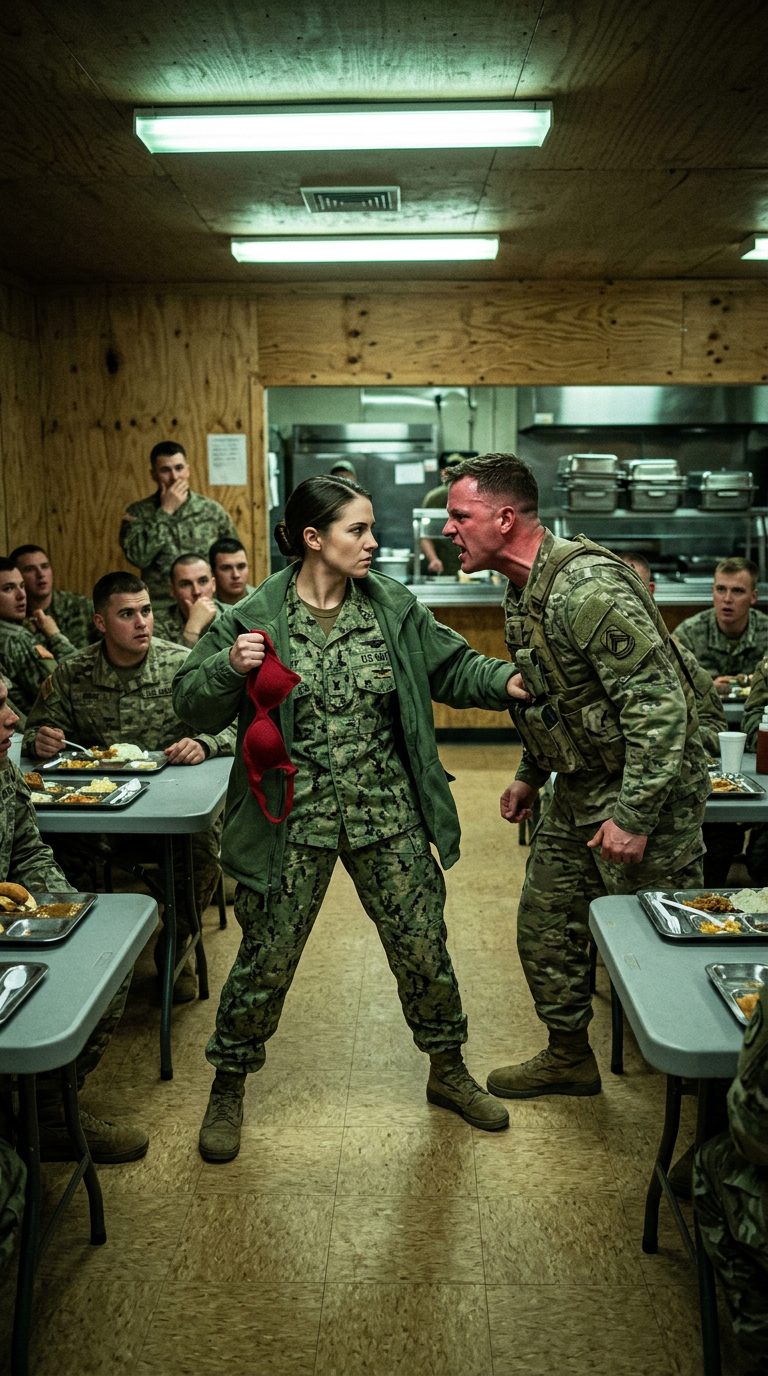
It started the first week. The trident pinned to her chest caught the harsh overhead lights as she crossed the threshold with her tray, and the usual clatter of metal and boots against linoleum dissolved into something deliberate and waiting. She set her tray down. The plastic made a sharp, solitary sound in the quiet.
Rourke leaned back in his chair and made sure his voice carried.
“Look at that,” he said, the corner of his mouth pulling upward. “A lady SEAL. Guess standards aren’t what they used to be.”
Easy, practiced laughter rippled through the surrounding tables.
Lieutenant Maya Collins did not turn her head. She picked up her fork, finished her meal, and stood without hurrying. No muscle in her jaw tightened. The absolute stillness of her departure left the laughter dying somewhere in the middle distance, unsure of itself.
He stopped looking for a reaction after that. He simply waited for a failure instead.
The chow hall jabs evolved into quiet wagers. Someone had a number on how many weeks before she requested reassignment. Someone else bet on a formal complaint. Rourke didn’t participate in the pool. He had a longer view. In his experience, people like her – people handed things they hadn’t bled for – eventually revealed themselves under real pressure, in real conditions, where no one could intervene on their behalf.
The team lead seemed to share the instinct, if not the motive. He arranged a performance evaluation designed to cut through the noise: a shoot-house run, full kit, live conditions. No panels, no advocates, no politics. Just the narrow corridors and whatever you were actually made of.
The coastal humidity pressed against the exterior walls of the kill house, but inside the atmosphere shifted to something colder and more exact. Maya moved through the staging area with a different rhythm than Rourke, methodical and unhurried, inspecting her rifle the way a surgeon checks instruments before an incision – not from anxiety, but from discipline.
Rourke tightened his last strap, rolled his shoulders, and turned.
“You ready for this, Lieutenant?” The scent of spent brass hung thick between them. “Try not to slow me down.”
Maya finished her chamber check. She didn’t look up immediately. When she did, her expression held nothing he could use.
“After you, Staff Sergeant.”
—
The first room went to him on time and on target. He moved well – she’d give him that. Controlled aggression, clean angles, the kind of muscle memory that came from years of doing this for real. She followed his lead and matched his pace without crowding him, reading the space the way she’d been trained, the way she’d practiced until the geometry of a room became instinct.
The second room was where it shifted.
He stacked on the wrong side of the door. A small error, the kind that evaporated in training and got people killed in application. Maya saw it in the half-second before entry and adjusted without announcement, repositioning smoothly, taking the angle he’d left exposed. The targets went down in sequence. Clean.
He didn’t acknowledge it when they cleared the final room and stepped back into the humidity.
The evaluator made notes on his clipboard. Rourke pulled off his helmet and ran a hand across his scalp, jaw set. Maya unclipped her chin strap and waited.
“Good run,” the evaluator said, without elaborating on who he meant.
Rourke walked past her toward the equipment bay. She watched him go, then looked back at the kill house, its plywood walls ordinary and indifferent in the afternoon light.
The wagers, she suspected, were about to get more expensive.
What Nobody Talked About That Night
The debrief lasted forty minutes and said almost nothing.
The evaluator, a Chief Petty Officer named Garland who’d done three combat deployments and had the face of a man who’d stopped being surprised by anything around 2009, walked them through the run room by room. He noted the timing. He noted the target acquisition sequence. He noted, without emphasis, that the entry angle on room two had been modified mid-stack.
He didn’t say by whom.
Rourke sat across the folding table with his arms crossed and his eyes on a fixed point somewhere past Garland’s left shoulder. Maya sat two seats down and kept a notepad open in front of her even though she wasn’t writing anything. Old habit from the Academy. It gave her hands something to do.
After Garland dismissed them, the room emptied fast. That was normal. People had gear to clean, chow to eat, calls home to make. Nobody lingered.
Except Petty Officer Second Class Dennis Pruitt, who fell into step beside Maya in the corridor outside and said, low and without looking at her, “He knew.”
She kept walking. “Knew what.”
“That he was on the wrong side.” Pruitt’s voice stayed flat. “He does it sometimes. In training. Tests his partner.”
Maya considered that for about three steps.
“And?”
“And you didn’t freeze up or defer. You just fixed it.” He glanced sideways at her then. “He wasn’t expecting that.”
She didn’t respond. Pruitt peeled off toward the armory and she continued down the corridor alone, past the bulletin board with its outdated safety notices and a laminated copy of the base’s no-cell-phone policy that everyone ignored.
She filed the information away without attaching much to it. Maybe Rourke had been testing her. Maybe he’d made a genuine mistake and was too proud to own it. Either way the room had gotten cleared and nobody had caught a simulated round in the back of the skull. That was the whole point.
She wasn’t here to figure out Travis Rourke.
The Pool Shifts
By Thursday the number on her requesting reassignment had dropped from six weeks to nine, which was a strange direction for confidence to move. Petty Officer First Class Jerry Hatch explained this to her without being asked, sitting across from her at a corner table in the chow hall she’d been eating at alone for two weeks.
Hatch was a big man with a gray mustache he’d been growing since Clinton’s second term and the unhurried quality of someone who’d long ago made peace with how slowly institutions change. He set his coffee down and said, “You picking up the pool movement?”
“I wasn’t tracking it.”
“Nine weeks now. Was six.” He wrapped both hands around his mug. “That’s movement in the wrong direction if you’re betting against you.”
“Who’s still in?”
Hatch shrugged one shoulder. “Couple guys from the Marine det. Rourke’s not in it, like I said. He’s got his own thing going.”
“What’s his thing?”
Hatch looked at her for a moment, working something over. Then: “He’s waiting for you to do something that makes him right. Not quit. Not file a complaint. Something in the field. Something he can point to.” He picked up his coffee. “Man needs to be right more than he needs to be fair. That’s just how he’s built.”
Maya ate for a moment. Outside through the narrow windows the afternoon light was doing that thing it did on coastal bases, going flat and white before it went gold, the ocean somewhere behind the tree line turning the sky a color that had no name worth using.
“He’s been doing this fifteen years,” she said.
“Sixteen.”
“And he’s never been wrong about a person.”
Hatch set his mug down. “He was wrong about Kowalski.”
She didn’t know that name. She waited.
“Kid from Bravo element. 2019. Rourke had him pegged as a washout from day one. Kowalski was small, quiet, had this way of moving that looked almost lazy until you watched him in a confined space.” Hatch’s mouth moved in a way that wasn’t quite a smile. “Rourke rode him hard for four months. Kowalski made the team. Did two rotations. Got a Bronze Star with V in Erbil.” He paused. “Rourke never said a word about it either way.”
Maya looked down at her tray.
“So he doesn’t adjust,” she said.
“He adjusts. He just doesn’t announce it.” Hatch stood, picked up his tray. “That’s the difference between him and the guys who are just assholes.”
The Night Run
The exercise that actually mattered came three weeks later, unannounced, which was how the team lead preferred his real tests.
2:47 in the morning. A scenario involving a compromised safe house, a non-compliant subject, and a two-man clearance team operating without comms support. The kind of thing that existed in the gap between the clean doctrine they trained to and the actual texture of bad situations.
Maya got the assignment sheet slid under her door at 2:31. The other name on it was Rourke’s.
They met at the equipment cage without speaking, drew their kits in the dark, and moved to the staging point in the kind of silence that wasn’t hostile, exactly. More like two people conserving something.
The scenario ran forty minutes. She won’t say much about what happened in the middle of it because most of it was the ordinary ugly work of the job: fast decisions, bad angles, the specific discomfort of not knowing whether the person in the next room was a threat or a civilian until you were already committed. Rourke moved well. Better than well. There were moments when she understood exactly why he had sixteen years and a reputation that preceded him into every room he’d ever entered.
There was one moment, maybe twenty-two minutes in, when the scenario produced a situation that had no clean answer. A fork. Both options were bad. She called it left. He called it right, and he called it first.
She went with his call.
Not because he outranked her. Because he was closer to the information and his read was faster and she had maybe a half-second to decide whether to trust it.
She trusted it.
The scenario resolved. Not cleanly, but it resolved. The evaluator, different one this time, a woman named Captain Sandra Vail who ran the SOCOM assessments out of Tampa and had the kind of eyes that didn’t miss much, made her notes and said nothing until the debrief.
In the debrief she said, “Room three. The fork. Walk me through the decision.”
Maya walked her through it.
Vail looked at Rourke. “Anything to add?”
Rourke was quiet for a moment. His jaw worked the way it did when he was processing something he hadn’t decided how to say yet.
“She made the right call,” he said.
Vail wrote something down. “The right call was yours.”
“No.” He said it without heat. “Her call was to trust mine. That’s a different thing. That’s harder.” He paused. “In that room, in that scenario, with that much noise, going with someone else’s read when you’ve got your own? That’s the harder call.”
Vail looked at him for a moment, then at Maya, then back at her clipboard.
“Agreed,” she said, and turned the page.
What Didn’t Happen After
Rourke didn’t apologize. She wasn’t expecting one and wouldn’t have known what to do with it anyway.
What happened instead was smaller and more real. The next morning at the range he gave her a correction on her grip without the edge in his voice. Flat, professional, the same tone he used with Pruitt and Hatch and the two Marine operators from the det. She adjusted. He nodded.
That was it.
The pool dissolved sometime in the fourth week. She never found out who collected, or if anyone did. Probably nobody had been tracking it that carefully to begin with. Most of those things were less about money than about having something to talk about while you waited for the next thing to happen.
Hatch stopped by her table one more time, a Thursday, the light outside doing that flat-to-gold thing again.
“Rourke’s buying,” he said, jerking his chin toward the far end of the chow hall where a group from the det was loud over some card game.
She looked.
Rourke had his back to her. He was dealing cards. His shoulders were easy, relaxed in a way she hadn’t seen before, or hadn’t been close enough to notice.
She picked up her tray.
“Tell him I said thanks,” she said.
Hatch shook his head, almost smiling. “Tell him yourself.”
She crossed the chow hall. The linoleum was the same as it had always been, the overhead lights the same harsh white, the sound of metal and boots and thirty conversations happening at once the same as every base she’d ever been on.
She set her tray down at the end of the table.
Nobody dropped their voice.
—
If this one got under your skin, pass it along to someone who’d get it.
For more intense stories from the front lines, read about A Sergeant Told Me to Get Out of His Chow Hall. He Didn’t Know My Name.. And for something completely different, check out how you can Just Mix Cloves with COFFEE and You No Longer Need to Buy Them at the Market or discover a juice that can Reverse Clogged Arteries & Lower High Blood Pressure.