
“You’re Just a Clerk – Clean Yourself Up.” Seconds Later, the Sergeant Hit the Ground… and Camp Granite Would Never Be the Same.
Outpost Camp Granite, somewhere in the arid stretch of New Mexico desert, was the kind of place where silence spoke louder than words and reputations were made – or broken – overnight. Dust clung to everything – trucks, boots, and even breath. In a place where toughness was currency, perception was everything.
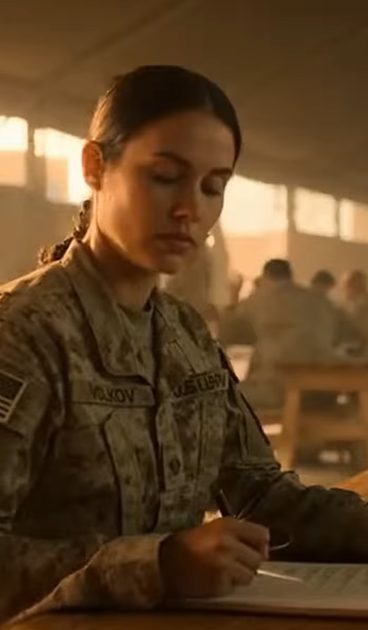
Specialist Ava Markovic had just been transferred in. Logistics, clipboard in hand, accent nobody could place, always quiet, always focused. To most of the grunts at Camp Granite, she barely registered. Until one moment changed everything.
Sergeant Jack “Bulldog” Carter, a stocky, steel-nerved infantryman with scars older than some recruits, had noticed her from day one. Not because she did anything wrong – but because she didn’t react. No flinching at shouting. No giggling at crude banter. No sign of intimidation. And that rubbed him the wrong way.
One sweltering afternoon in the mess tent, Carter dropped down beside her with a smirk and a voice loud enough to stop forks mid-air.
“Hey, logistics princess. That a permanent scowl, or just part of your uniform?”
Ava didn’t even glance up. Just kept marking her supply sheet with clinical precision.
Carter sneered, cracked open a sports drink, and in one casual flick, dumped it over her head.
The table fell silent. The entire tent froze.
She blinked once. Then stood.
What happened next lasted less than two seconds but rewrote the entire pecking order of the base.
She stepped into his space like a shadow and drove her elbow straight up into his chin – no hesitation, no rage, just perfect form.
Then came a second strike, brutal and silent. Carter’s eyes rolled back. His body hit the ground like a sack of gear.
Chaos exploded. Shouts. Footsteps. Medics. Someone calling for the MPs.
And Ava? She just stood there. Breathing steady. Not a trace of fear.
She didn’t resist when she was escorted to HQ. Didn’t explain. Didn’t flinch when the commanding officer read the report with a frown deeper than the Rio Grande.
“She crossed a line,” the CO said. “But he pushed her off the edge first.”
No brig time. No court martial. Just reassignment. Warehouse Delta, far perimeter. Hot. Isolated. Forgotten.
As she slung her duffel over her shoulder and disappeared toward the wire, no one noticed the small black falcon inked on her wrist, barely visible beneath her sleeve.
No one asked why a supply clerk moved like a predator.
No one thought to wonder… what would happen if the base ever faced a real threat?
That night, the sirens blared.
And Ava was already in position….
Warehouse Delta
Warehouse Delta was three corrugated metal walls and a concrete floor that radiated heat until around midnight, then turned cold enough to make you remember every decision that brought you here. One industrial fan. One bare bulb on a pull chain. Shelving units full of MRE crates and motor oil and replacement parts for equipment nobody had requisitioned in eight months.
Ava set her duffel on the cot, sat down, and looked at the ceiling for about thirty seconds.
Then she got to work.
She organized the warehouse the way she organized everything: by logic, by access priority, by what you’d need first if things went wrong. The previous clerk had filed replacement brake pads under “Miscellaneous.” She fixed that. She found three cases of water purification tablets buried behind a broken pallet jack and moved them to the front. She located a crate of night-vision battery packs that nobody had logged since March.
She didn’t do it because she was told to. She did it because disorder bothered her the way a crooked picture bothers some people, except Ava’s version of a crooked picture was a base that couldn’t account for its own supplies.
By 2200 she had the whole place mapped in her head.
By 2300 she was lying on the cot, boots still on, staring at the ceiling again.
The base outside was quiet in that particular desert way – not peaceful, just empty. Wind off the flats. A generator humming somewhere east. The occasional bark from the K9 unit kennels near the main gate.
She’d been in louder places. Worse places. Places where you learned not to sleep with both eyes closed because the cost of that was something you didn’t get to pay twice.
Nobody at Camp Granite knew that, of course.
That was fine.
What Carter’s Boys Said After
Word travels fast in a place with nothing else to do.
By the time Ava was halfway to Warehouse Delta, Carter was in the medical tent getting his jaw checked and the mess tent had already split into two camps: the guys who thought she should’ve been sent to the brig, and the guys who were very carefully not saying anything at all.
Private First Class Danny Okafor, who’d been sitting four seats down when it happened, told the story seventeen times in six hours. Each time the elbow strike got a little cleaner. Each time Carter’s fall got a little more vertical.
“She didn’t even look angry,” he kept saying. “That’s the part. She didn’t look angry. She just looked like she was filing paperwork.”
Carter himself said nothing. Not to the medics, not to the MPs, not to the CO. He sat on the edge of the examination table with an ice pack against his jaw and stared at the floor.
Sergeant First Class Donna Pruitt, who ran motor pool and had seen thirty years of this kind of thing, came to check on him out of professional obligation. She looked at him for a long moment.
“You gonna be all right?” she said.
“Yeah.”
“Good.” She turned to leave. Stopped. “Don’t do that again, Jack.”
She didn’t specify what “that” was. She didn’t have to.
Carter didn’t say anything. Just pressed the ice pack harder against his face.
The Falcon
Nobody would’ve noticed the tattoo if Corporal Renee Sloan hadn’t been standing close enough in the HQ corridor to see it when Ava’s sleeve rode up.
Sloan had done two years in signals intelligence before lateral transferring to Camp Granite for reasons she didn’t discuss. She knew what certain symbols meant. Not all of them. But enough.
The falcon was small – three inches, maybe four. Black ink, no fill, clean lines. The kind of work that cost real money or was done by someone who owed you a very significant favor. It sat on the inside of Ava’s left wrist, slightly below the heel of the hand.
Sloan recognized the unit designation.
She didn’t say anything in the corridor. She waited until that evening, found Okafor near the vehicle bay, and said, “You know that clerk they reassigned?”
“Markovic? Yeah.”
“Do you know where she was before this posting?”
Okafor shrugged. “Transfer paperwork said Fort Bliss. Before that, some training rotation in – “
“No,” Sloan said. “Where she was.”
Okafor looked at her.
“I’m not saying anything official,” Sloan said. “I’m just saying. That tattoo on her wrist isn’t decorative.”
She walked off. Okafor stood there for a while, working through it.
Then the sirens went off.
Contact
2347 hours.
The alarm wasn’t the fire alarm and it wasn’t the medical alarm. It was the perimeter breach tone – three short bursts, pause, three short bursts – and every person on base who’d been through a real contact situation felt their stomach drop about two inches.
Camp Granite wasn’t a combat outpost in the traditional sense. It was logistics support, training coordination, supply chain management for three forward elements operating in the region. But “not a combat outpost” didn’t mean unarmed, and it didn’t mean safe, and the people who planned these things knew that a supply hub was a target.
Tonight, someone had decided to test that.
Four vehicles came in from the northwest, running dark. They cut the outer fence line between two camera positions, which meant either luck or reconnaissance. The two-man patrol on that section had already been neutralized – zip-tied, non-lethal, which suggested a grab operation rather than a destruction run. Someone wanted something specific.
The QRF scrambled from the main building.
They found Ava at the breach point before they got there themselves.
She’d come in from the east, moving along the inside of the perimeter fence in the dark without a flashlight. She had her sidearm out. She also had, somehow, the battery-pack crate she’d found earlier, one unit open and running, powering a set of night-vision monoculars she’d located in a box labeled “Obsolete Equipment / Pending Disposal.”
She’d logged those monoculars her first hour in the warehouse.
The QRF team leader, Staff Sergeant Greg Hatch, came around the corner of the fence line and nearly walked into her back. He pulled up short. She didn’t move.
“Markovic,” he said.
“Four vehicles, northwest. They came in between posts seven and nine. Two men from each vehicle, so eight total, but one vehicle stayed running – driver plus possible second. Call it ten.” She kept her eyes on the dark. “They’re moving toward the comms building. They know the layout.”
Hatch stared at the back of her head.
“How long have you been out here?”
“Since the alarm.”
“The alarm was forty seconds ago.”
She didn’t answer that.
What Happened in the Dark
The next eleven minutes were not the kind of thing that got written up in full in the after-action report.
What the report said was: perimeter breach neutralized, all hostile personnel detained, no friendly casualties, two friendlies with minor injuries sustained during the close-contact phase of the engagement.
What actually happened was that Ava moved through the dark between the fence line and the comms building like she’d rehearsed it, which she hadn’t, but she’d spent two hours that afternoon walking the perimeter with her clipboard pretending to check cable routing. She’d counted steps between structures. She’d noted the dead angles.
Hatch’s team took the south approach. She went north.
She found two of them between the generator housing and the back wall of the comms building, and she dealt with that situation in a way that Hatch, watching from fifteen feet away, processed slowly and in pieces.
Later he’d tell Pruitt: “She moved like she knew where they were going to be before they were there.”
Pruitt said, “Did she?”
Hatch thought about it. “Yeah,” he said. “I think she did.”
The detainees were flex-cuffed and handed off to the MPs. The two patrol soldiers who’d been zip-tied were found unhurt, embarrassed, and very cold. The vehicles were impounded.
By 0115, it was over.
Ava walked back toward Warehouse Delta with her sidearm holstered and her clipboard under her arm – she’d picked it up off the ground near the generator housing on her way out, because she’d had it with her when the alarm sounded and she wasn’t the kind of person who left things lying around.
Hatch watched her go.
He thought about calling after her. Couldn’t figure out what he’d say.
The Morning After
The CO’s name was Lieutenant Colonel Frank Diaz, and he’d been running Camp Granite for fourteen months without a single incident worth writing home about. He was not a man who liked surprises.
He read the after-action report twice. Then he called Hatch in.
“Tell me about Markovic.”
Hatch told him. All of it – the perimeter, the monoculars, the way she’d moved, the thing with the two detainees that Hatch still wasn’t entirely sure how to describe in language that sounded like a military document.
Diaz listened with his hands flat on the desk.
“And before last night,” he said, “she was in Warehouse Delta.”
“Yes, sir.”
“Because of Carter.”
“Yes, sir.”
Diaz was quiet for a moment. Outside, the desert was already baking. A truck engine turned over somewhere near the motor pool.
“Pull her transfer file,” he said. “The full file. Not the summary.”
Hatch had already tried that. “It’s flagged, sir. I got a two-page redaction and a contact number for a liaison office I’ve never heard of.”
Diaz looked at him.
“The falcon tattoo,” Hatch said. “Sloan thinks she knows what it means.”
“What does Sloan think it means?”
Hatch told him.
Diaz sat back in his chair and looked at the ceiling for a moment. Then he looked at the report again. Then he said, very carefully, “Where is she right now?”
“Warehouse Delta, sir. She’s been there since 0200. Sloan went by an hour ago to check.” Hatch paused. “She’s reorganizing the east shelving section.”
Diaz almost said something. Stopped himself.
“Send her in,” he said. “Quietly.”
Ava Markovic, 0900
She came in without knocking, because Hatch had told her to come straight through, and she stood in front of Diaz’s desk with her hands at her sides and her expression doing nothing in particular.
Diaz looked at her for a long moment.
She looked back.
“You’ve been busy,” he said.
“I had time.”
“The monoculars from the disposal crate.”
“They work fine. The casing is cracked on one unit but the optics are clean. I logged them back in this morning.”
Diaz put the after-action report to one side. He picked up a different piece of paper – a handwritten note on plain white paper. He looked at it, then at her.
“I made a call this morning,” he said. “Someone called back.”
Ava said nothing.
“They told me to use you well and ask you nothing.” He set the paper down. “That’s a first for me.”
“I can go back to the warehouse,” she said. “The east shelving is half done.”
“No.” Diaz leaned forward. “Carter wants a formal complaint filed. I’ve been sitting on it since yesterday.”
“Okay.”
“You assaulted a superior.”
“He poured a drink on me.”
“I know what he did.” Diaz’s jaw moved slightly. “The complaint’s going in the drawer. Carter’s going to agree with that decision, or Carter is going to have a different kind of morning.” He looked at her steadily. “You understand?”
“Yes, sir.”
“Good.” He stood. Extended his hand. “Welcome to Camp Granite, Specialist.”
She shook it. Firm, brief, done.
She was back at the warehouse by 0920.
The east shelving was finished by noon.
—
If this one got you, send it to someone who’d appreciate it.
If you enjoyed this tale of an underdog proving everyone wrong, you might also like the story of the old man who asked if he could take just one shot or how my father laughed until he heard my call sign.