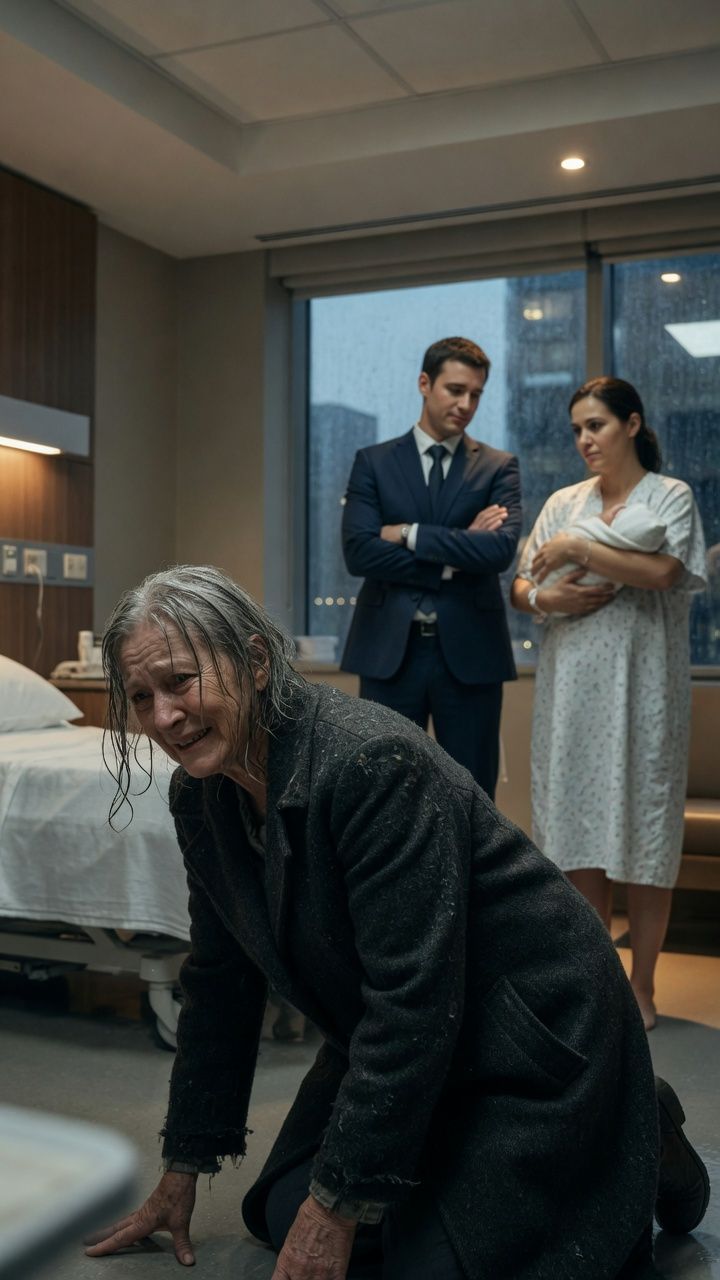

I entered the hospital room eager to meet my newborn grandson, but my daughter-in-law pulled him away.
“Stay back, you filthy old woman! You’ll infect my son!”
A moment later she pushed past me, and I lost my balance. My own son stood nearby with folded arms, saying nothing. I got slowly to my feet, smiled, and said, “Then don’t take anything that belongs to this filthy old woman.”
By morning, they would discover exactly what I meant.
—
I had arrived carrying a hand-knitted blue blanket and the silver rattle that had belonged to Daniel when he was a baby. My coat was old but clean, my hair damp from the rain, and my hands were shaking with happiness as I stepped into the private maternity suite.
“Let me see him,” I whispered.
Vanessa tightened her arms around the baby and recoiled as though I carried disease.
“Stay back, you filthy old woman! You’ll infect my son!”
As she pushed past me I stumbled, catching myself against the wall. The silver rattle rolled beneath the bed.
Daniel stood beside the window in an expensive navy suit, arms folded, expression blank. Then he gave Vanessa a slow, approving nod.
Something inside me broke. It didn’t make a sound.
A nurse rushed forward. “Ma’am, are you all right?”
“I’m fine,” I said, straightening up.
Vanessa laughed. “She always makes scenes. Daniel, tell her she can’t keep showing up looking like this.”
Daniel finally spoke. “Mom, Vanessa needs her rest. Maybe it’s better if you go.”
I brushed the dust from my sleeve and looked at the man I had raised alone after his father died. The man whose tuition I had paid, whose first company I had quietly rescued from collapse, whose penthouse, car, and private hospital suite existed because my signature sat beneath every loan that had made them possible.
I had sold my wedding ring to keep him in college. I had worked nights through pneumonia. I had mortgaged our small house to fund the prototype that made him rich. He remembered none of it now, or had simply decided not to.
I smiled.
“Then don’t take anything that belongs to this filthy old woman.”
Daniel’s brow creased. “What is that supposed to mean?”
“You’ll understand by morning.”
Vanessa rolled her eyes. “Please. She’s threatening us with her pension.”
I left without the blanket.
—
In the elevator, I called my attorney, Miriam Cole.
“Activate the protection clauses,” I said.
A brief pause. “All of them?”
“All of them. And send the hospital security footage to my office.”
Her voice sharpened. “Did something happen?”
“They showed me who they are.”
By the time I reached the lobby, my phone was displaying three assets Daniel believed were his: the company headquarters, the family home, and the trust controlling his shares. Legally, every one of them still belonged to me.
Outside, rain glittered under the streetlights. I opened the holding-company app, entered my authorization code, and froze the first transfer.
Upstairs, Daniel was probably still nodding.
What Miriam Already Knew
I had met Miriam Cole twenty-two years ago, in the same week Daniel started his first semester at university. She was a junior associate then, working out of a cramped office on the fourth floor of a building that smelled like old carpet and cigarettes. I’d gone to her firm for help with a simple property matter. She’d stayed late to explain every clause to me twice, because I kept asking.
We’d worked together ever since.
She knew about the mortgage on the house. She knew about the ring. She knew about the three hundred thousand I had personally guaranteed when Daniel’s first company hit a wall in its second year and the bank was ready to call the loan. He had never known about that last one. I’d kept it from him deliberately, because I didn’t want him to feel the weight of it. I thought protecting him from that weight was the kind of thing a mother did.
Miriam had warned me. Not in those words, exactly. But she’d said, once, over coffee in her office about four years ago: “Margaret. You should formalize this. All of it. Not because you don’t trust him. Because circumstances change.”
I had smiled and said Daniel was a good boy.
She hadn’t pushed. But she had quietly drafted the protection clauses anyway, and filed them away, and never billed me for the hours.
I sat in my car outside the hospital and called her back.
“The footage,” I said. “I need it preserved carefully.”
“Already requested. The hospital has a thirty-day retention policy. I’ve flagged it with their legal team.”
“Good.”
“Margaret.” A pause. “Are you all right?”
I thought about that. The rattle was still under the bed in room 412. Blue wool blanket folded on the visitor’s chair. Twenty-three years of choices, stacked up like furniture in a house I’d just been told I wasn’t welcome in.
“I’m fine,” I said. “Start with the headquarters lease.”
The Architecture of It
Most people assumed Daniel had built everything himself. That was the story he told, and he told it well. Self-made. Driven. The son of a widow who’d scraped by, who’d risen above his circumstances through intelligence and hard work.
All of that was true, as far as it went.
What the story left out was the scaffolding.
The house I had mortgaged was still in my name because the bank had insisted on it. I was the one with the credit history, the stable income, the collateral. Daniel had been twenty-six and brilliant and broke. The prototype had worked. The company had grown. But the original loan, the one secured against the house, had never been fully restructured. I had meant to deal with it. There was always something else.
The company headquarters sat on a long-term lease that ran through a holding entity. My holding entity. When Daniel had needed the address for early investor meetings, he’d used it, and we’d both agreed to sort out the transfer later. Later kept not arriving.
The trust was the cleanest piece. I had set it up when he was twelve, after his father died, to protect whatever small assets we had. As he’d grown successful, he’d added to it, restructured it, used it for tax efficiency. But the original trust instrument had my name on it as controlling trustee, and that had never changed.
I had not done this deliberately. I want to be clear about that.
I had done it carelessly, in the way that people who love their children are careless: assuming it would never matter, assuming the person you’re protecting would never need protecting from.
Miriam had seen the architecture clearly for years. I had looked at it and seen my son.
The Phone Calls Started at 6 A.M.
I was home, in the kitchen, drinking tea I didn’t taste, when my phone lit up.
Daniel.
I let it ring.
It rang again. Then a third time. Then Vanessa’s number appeared, which surprised me. She had not called me voluntarily in four years.
I let that one ring too.
At 6:47 a.m., a text from Daniel: Mom call me now.
At 6:51: This isn’t funny.
At 7:03: Our card was declined at the hospital pharmacy. What did you do.
Not a question. He’d written it without a question mark, which told me something about the state he was in.
I put the phone face-down on the table and finished my tea.
The thing about the pharmacy charge was that I hadn’t touched it. That was just the credit card, which ran through the household account, which was linked to the trust, which Miriam had quietly flagged for review pending the structural audit she was now conducting. A flag that generated an automatic hold. Nothing dramatic. Just paperwork doing what paperwork does when someone finally asks it to.
At 7:15 I called Daniel back.
He picked up before the first ring finished. “What did you do.”
“Good morning, Daniel.”
“The pharmacy won’t fill Vanessa’s prescription. My card is showing a hold. I called the leasing office for the building and they said there’s a query on the account. What is happening.”
I said nothing for a moment. Outside my window, a blackbird was working at something in the wet grass.
“You should speak to your own attorney,” I said. “Get someone to explain the structure of your assets to you. I think you’ll find it’s been a long time since anyone sat down and really walked through it.”
Silence.
Then: “Are you doing this because of last night.”
Not a question again.
“I’m doing this,” I said, “because your wife put her hands on me in front of hospital staff, called me filthy, and you stood at the window with your arms folded. And I realized I had spent thirty years building something, and I had never once thought about what happened to it if you forgot where it came from.”
“She was emotional. She just gave birth.”
“Yes. And I was emotional when I worked nights through pneumonia so you could finish your degree. We’re all emotional sometimes, Daniel.”
Another silence. Longer this time.
“I want to fix this,” he said. His voice had changed. Something in it I hadn’t heard in years. He sounded young. He sounded like the boy who used to fall asleep at the kitchen table doing homework while I graded papers at the other end.
“I know you do,” I said.
“So tell me what you need.”
I looked at the blackbird. It had found whatever it was looking for. It flew off.
“I need you to understand that what happened last night was not acceptable. Not the shove. Not the words. And not the silence.” I kept my voice level. “I need Vanessa to understand that too. Not because I require an apology, though one would be appropriate. But because that child upstairs is going to grow up watching how his parents treat people. And I will not watch him learn that his grandmother is someone to be pushed aside.”
Daniel said nothing.
“Take a few days,” I said. “Be with your family. When you’re ready to have a real conversation, call me. Miriam will hold everything in place until then. Nothing is lost. Nothing is permanent. But nothing moves forward either.”
I hung up before he could answer.
What I Did With the Morning
I drove to the craft shop on Clement Street and bought more blue wool. The blanket I’d left in room 412 had taken me eleven evenings to finish. I figured I had time for another.
At the checkout, the young woman behind the counter said, “Oh, this is a lovely color. Baby?”
“Grandson,” I said.
She smiled. “How old?”
“One day.”
I paid and walked back to my car and sat for a minute with the wool in my lap. He was one day old. He had my son’s nose, I’d seen that much before Vanessa pulled him back. He had no idea any of this was happening. He was just a person who had arrived in the world and was trying to figure out how to breathe.
I started the car.
I had not done this to punish Daniel. I want to be clear about that too. I had done it because I had spent thirty years making myself easy to forget, and I was seventy-one years old, and I was done with that.
The blanket would be finished before they called.
They called four days later.
The Part That Surprised Me
It wasn’t Daniel who called. It was Vanessa.
I almost didn’t answer. But something made me pick up.
She sounded terrible. Exhausted in the specific way of new mothers, that hollow, scoured-out voice. She said she hadn’t slept more than ninety minutes at a stretch since the birth. She said the baby had colic and screamed from two to five every morning. She said she’d cried in the shower three times.
Then she said: “I was horrible to you.”
I didn’t say anything.
“I’ve been horrible to you for years,” she said. “And I don’t have a good reason. I was scared of how much Daniel loves you, and I made that your problem. And then that night I was in pain and terrified and I took it out on you, and you were just standing there with that blanket, and I – “
She stopped.
“I’m sorry,” she said. “I’m genuinely sorry.”
I sat with it for a second.
“Thank you,” I said. “That took courage.”
“Daniel doesn’t know I’m calling.”
“All right.”
“Can you come?” she said. “Can you just come and meet him? His name is Thomas. He has your chin, Daniel says. I didn’t see it at first but I think he’s right.”
Thomas.
I looked at the blue wool on the chair beside me. Six evenings in. Almost done.
“I’ll be there tomorrow,” I said.
—
I brought the blanket. And I brought the silver rattle, which Miriam had arranged to have retrieved from under the bed in room 412 by a very patient hospital administrator.
Thomas was asleep when I arrived, curled small and serious in his bassinet. I stood over him for a long time without saying anything.
He had Daniel’s nose. And yes, something around the jaw that I recognized from very old photographs.
I put the rattle down beside him, gently, so it didn’t wake him.
Vanessa watched me from the bed. Daniel stood near the window again, but his arms weren’t folded this time. He looked like a man who had been thinking hard for four days and wasn’t finished yet.
I didn’t rush him.
Thomas made a small sound in his sleep, a sigh so tiny it was almost nothing, and all three of us looked at him at the same time.
—
If this one stayed with you, pass it along to someone who needs to hear it.
If you’re looking for more stories about family drama, you might find some interesting reads in My Father Left a Key With a Stranger for the Day I Came Home From Prison, My Dad Suspended Me Until I Apologized to My Sister. I Went to My Attorney Instead., or even My Stepfather Sold My Dead Father’s Cabin While I Was Deployed.