
I came home from deployment barely able to walk.
The doctors at Walter Reed called it “a complicated recovery.” That phrase covered a great deal – the slow shuffle down hospital corridors, the cane I hadn’t yet made peace with, the simple tasks that now cost me more than they once had.
Daniel looked at me that first morning and said, “You’re not a wife anymore, Rachel. You’re a burden.”
Our daughter Lily stood behind the kitchen island in her pink pajamas, eight years old and gripping her cereal spoon so tightly her knuckles turned white. She didn’t say a word. She just watched.
By sunset, Daniel’s mother Patricia had packed our things into two trash bags and carried them to the front porch like she was taking out the garbage.
“This is my son’s house,” she said. Her silver hair was pinned perfectly above a face carved from cold stone. “He needs peace. Not a cripple crying in the hallway.”
Daniel stood in the doorway with his arms crossed and watched me struggle down the porch steps with my cane while Lily followed behind, carrying her school backpack and crying without making a sound.
Rain hammered the driveway. Thunder rolled across rural Virginia. I lifted Lily into my old Ford Escape and sat for a moment with both hands on the wheel, trying to think. I had nowhere to go except the farmhouse where I grew up – three hours away, a place I hadn’t set foot in since my father’s funeral.
The storm worsened as we drove. Lily fell asleep against the window, her cheeks still wet. I gripped the wheel through waves of pain and whispered the same words to myself, over and over: Just make it home. Just make it home.
When we finally turned onto the gravel road in Briar County, my childhood home stood dark at the end of it – roof sagging, porch boards warped, weeds climbing high around the steps. I had expected emptiness. I had expected a cold house and a long night.
Instead, a porch light glowed next door.
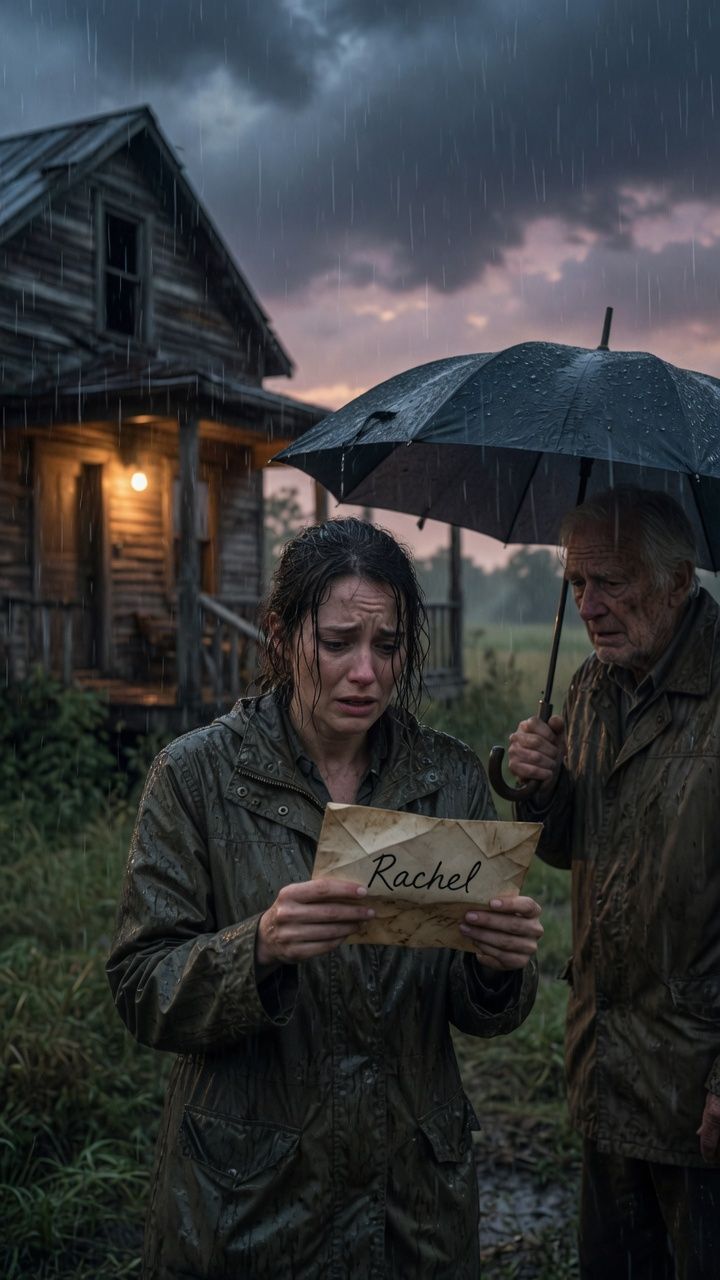
Before I could get out of the car, an elderly man stepped into the rain wearing a brown coat and holding an umbrella. I recognized him slowly, the way you recognize someone you haven’t needed to think about in years.
“Mr. Callahan?”
Arthur Callahan had been our neighbor since before I was born. He was eighty now, thinner than I remembered, but his eyes were as sharp as ever. When he saw my face, something in his expression broke open.
“Rachel,” he said, his voice catching. “Your father made me promise.”
He reached inside his coat and placed a dust-covered envelope in my hands. My name was written across the front in my father’s handwriting – careful, deliberate, unmistakably his.
My fingers trembled as I tore it open.
The first line made me drop it.
Rachel, if you are reading this, then Daniel finally showed you who he really is – and I am sorry I did not live long enough to stop him.
What My Father Knew
I stood in the rain and stared at the envelope on the wet gravel.
Arthur bent down slowly, with the careful movement of a man whose knees have opinions about everything, and picked it up. He handed it back without a word. Just pressed it into my hands again and waited.
I read the whole thing standing there in the driveway. Rain soaking my jacket. Cane sinking a half-inch into the mud. Arthur holding his umbrella over me at an angle that kept most of the water off the letter and none of it off himself.
My father, Gerald Pruitt, had written the letter fourteen months before he died. He’d had a bad feeling about Daniel since the engagement, he said. Not a specific thing he could name at first. Just the way Daniel talked about me to other people – always slightly wrong. A correction here. A small undermining there. The way he’d say “Rachel thinks she wants to go back in, but we’ll see” at the backyard barbecue when I reenlisted. Smiling when he said it.
Dad wrote that he’d asked Arthur to hold the letter. That if I ever came back to the house under bad circumstances, Arthur would know. Arthur had been watching out for this place, and for me by extension, for three years.
I know you will say I should have told you, the letter read. But you would not have believed me. You never did when it came to that man. So I am telling you now, when there is no arguing with a dead man.
I laughed at that. Wet-faced and shaking, standing in the mud, and I laughed.
Lily had woken up. She was watching me through the car window with her forehead against the glass.
The House My Father Left Me
Arthur had a key.
He’d been maintaining the place – not renovating, just maintaining. Keeping the pipes from freezing. Running the heat a few hours a week through winter. Pulling the worst of the weeds back from the steps so the wood didn’t rot through.
“Your father paid me six months in advance before he passed,” Arthur said. He was embarrassed about it. Wouldn’t look at me when he said it. “I told him it wasn’t necessary. He said he knew that.”
The inside smelled like old wood and something faintly like my father’s aftershave, which was probably just my brain manufacturing it. The furniture was covered in sheets. The kitchen was bare except for a box of crackers Arthur had left on the counter along with a note that said milk and eggs in the cooler on the back porch, figured you might need a night before you could get to a store.
Lily walked through the living room slowly, touching things. The arm of the couch. The frame of the door to the back hallway. She’d been here twice in her life and remembered neither visit.
“Is this ours?” she asked.
“Yes,” I said.
She looked at me. “For real?”
I had no idea what the legal situation was. I hadn’t looked at the will in two years. I didn’t know if Daniel had any claim to it, if there were debts attached, if the roof was going to hold through another winter. I didn’t know anything except that my daughter was standing in a warm room asking me if she was safe.
“For real,” I said.
The Week That Followed
I slept fourteen hours the first night.
Lily made herself breakfast from the eggs Arthur left. I woke up to find her sitting at the kitchen table eating scrambled eggs off a paper plate she’d found under the sink, reading a book she’d pulled out of her backpack. She’d let me sleep.
Eight years old.
I sat with her while she finished and didn’t say much. Outside, the storm had gone. The morning was gray and still and the fields behind the house looked the way October fields in Virginia look – brown and wide and quietly done with everything.
I called a lawyer that afternoon. A woman named Connie Marsh, out of Lynchburg, who a nurse at Walter Reed had mentioned once in a context I hadn’t thought I’d need. Connie picked up on the second ring and listened to the whole thing without interrupting. When I finished she was quiet for three seconds.
“Are you in a safe place right now?”
“Yes.”
“Is your daughter?”
“Yes.”
“Okay,” she said. “Then let’s start there.”
The house was mine outright. Dad had made sure of it – the deed was in my name only, had been since two years before he died. He’d done it quietly, through a lawyer in Charlottesville, without telling me. Without telling Daniel.
Connie said that was either very lucky or very deliberate.
I knew which one it was.
What Daniel Did Next
He called twice the first week.
The first call was cold. Businesslike. He wanted to know where I’d taken Lily and said something about a custody arrangement that needed to be “sorted out quickly.” His voice had the same tone he used when he was talking to contractors – clipped, certain, slightly bored.
I didn’t answer. I let it go to voicemail and listened to it once and deleted it.
The second call came four days later, at eleven at night. Different tone entirely. He’d been drinking, I think, or just tired enough that whatever he usually kept tamped down had loosened some. He said he hadn’t meant it the way it sounded. He said I had to understand the pressure he’d been under. He said Lily needed her father and I was being selfish, keeping her from him, and didn’t I think about what this was doing to her.
I sat on the edge of my father’s bed in the dark and listened to the whole message.
Then I forwarded it to Connie.
She called back the next morning. “That’s useful,” she said, which was the most satisfaction I heard in her voice in the months I worked with her.
Patricia called once. I didn’t listen to that one at all.
Arthur
He came by every other day or so. Not intrusively – he’d knock, leave something on the porch if I didn’t answer. A jar of tomatoes he’d put up in September. A bag of birdseed, which I thought was odd until I noticed the feeder hanging outside the kitchen window that I hadn’t seen before. He’d hung it sometime in the past year, apparently. Just in case.
One afternoon I found him on the porch fixing the third step, which had gone soft. He had a piece of lumber cut to size and a coffee can of nails and he was working slowly and carefully with the focused expression of someone who has done this kind of thing ten thousand times.
I sat in the porch chair and watched him work.
“You didn’t have to do this,” I said.
“I know it.”
“How long have you been keeping an eye on this place?”
He thought about it. “Since your mother left. So.” He counted on his fingers. “Thirty-one years.”
I didn’t say anything to that.
“Your father was a good man,” Arthur said. He drove a nail with three clean strokes. “He just worried. That’s all he did wrong, really. Worried too much and said too little, and by the time he started saying things it was already complicated.”
“He wrote it all down at the end.”
“He did.” Arthur moved to the next board. “He felt better after that. Said at least the record existed somewhere.”
I looked out at the field. A few crows were working the far edge of it.
“He should’ve told me himself,” I said.
“Yes,” Arthur said. “He should have.”
Neither of us said anything after that for a while, and that was fine.
What We’re Doing Now
It’s been seven months.
The divorce isn’t final yet but it’s close. Connie says the custody arrangement will likely be structured in a way that reflects “the circumstances of separation” – her careful words for what Daniel said to me in front of Lily, which Lily told a family court evaluator about in a small office in Lynchburg in January. Lily told it straight, the way she does everything. Cereal spoon. White knuckles. Watching.
The roof needed work. I hired two brothers from town, Carl and Dennis Hatch, who did it in three days for less than I expected and didn’t make a single comment about the cane. Carl brought his dog, a fat beagle named something I could never quite catch, and Lily fed it crackers through the fence every morning.
My hip is better than it was. Not good. Better. The physical therapist I’m seeing in Charlottesville says I may always walk with some irregularity but that “significant functional improvement” is still possible. I’ve stopped needing the cane indoors. I still use it outside on uneven ground. I’ve mostly made peace with it.
The porch step Arthur fixed doesn’t creak anymore.
Some mornings I sit in my father’s chair at the kitchen table with coffee and watch Lily eat breakfast and think about the letter sitting in my father’s handwriting, the line that made me drop it in the rain. The way he’d thought ahead into a future he hoped would never happen and decided that wasn’t good enough, that hoping wasn’t sufficient, that he needed to do something real.
He left me the house. He left me Arthur. He left me the letter.
He left me enough.
—
If this one stayed with you, pass it on to someone who needs it.
From difficult homecomings to family drama, you’ll find more to read in these stories about My Son Stood There With Folded Arms While His Wife Called Me Filthy, My Father Left a Key With a Stranger for the Day I Came Home From Prison, and My Dad Suspended Me Until I Apologized to My Sister. I Went to My Attorney Instead..