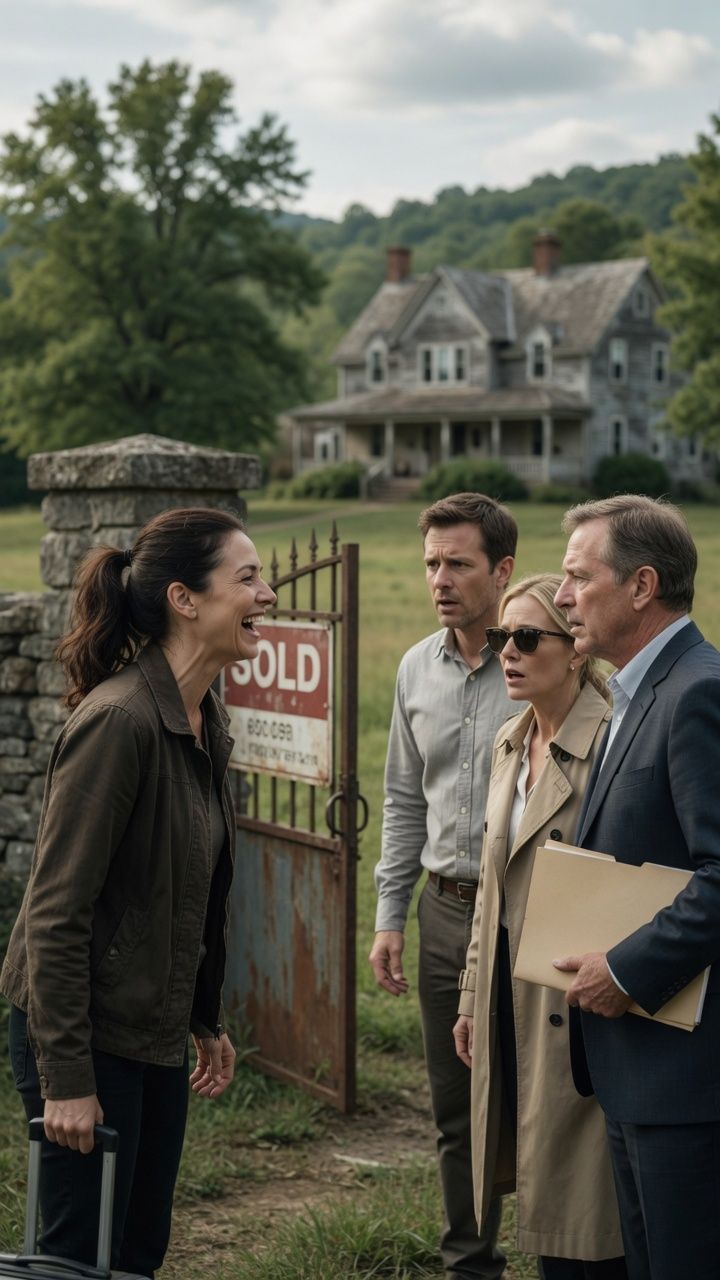

My brother called me while I was standing in the airport security line and told me he had sold my farmhouse.
Not asked. Not warned. Sold.
“I got three million for it,” Brandon said, with the easy confidence of someone expecting a thank-you. “Honestly, you should be grateful. That old place was just sitting there.”
My suitcase was already on the conveyor belt. My passport was in my hand. I was twenty minutes from the first vacation I’d taken in four years.
I stepped out of line.
“You sold my farmhouse,” I said. It wasn’t really a question.
He laughed. “Don’t be dramatic. You live in the city. You barely use it.”
The farmhouse was worth $6.3 million.
It sat on eighty acres of restored apple orchards, wildflower meadows, and lakefront land my grandmother had left me before she died. After a fire nearly took the east wing, I rebuilt it beam by beam. I paid the taxes, hired the caretakers, and converted the old barn into a retreat for foster kids aging out of the system – teenagers who needed somewhere quiet and whole to land.
Brandon called it my “country hobby.”
I called it the only place that had ever felt like home.
“Where is the money?” I asked.
A pause.
“I spent it.”
My chest went cold.
“On what?”
“My girlfriend’s business. She needed it more than you did.” He let that settle for exactly one second before adding, “Don’t be selfish, Clara. You have other properties.”
I canceled my flight before he finished the sentence.
By noon I was in a rental car, six hours of highway ahead of me, working through my attorney, my property manager, and the county recorder’s office while Brandon’s texts stacked up on my phone.
Don’t make this ugly.
It’s already done.
Family should support family.
I didn’t respond to any of them. By the time I reached the farmhouse gates, the rage had burned through itself and left something quieter behind. Colder. More useful.
Then I saw the Sold sign propped against the driveway post.
Brandon stood beside it, flanked by his girlfriend Tessa and a man in a cheap navy suit clutching a manila folder. Tessa had her sunglasses on and wore the relaxed smile of someone who had already started picking out curtains.
Brandon spread his arms wide. “See? No disaster. The buyer’s happy, Tessa’s business is saved, everyone wins.” He said it the way people do when they’ve rehearsed it enough times to almost believe it.
I looked at the man in the suit.
Then at the farmhouse.
Then at the locked gate between us and it.
And I started laughing. Not a polite laugh – a real one, the kind that comes from somewhere deep and catches you off guard.
Brandon’s smile flickered. “What’s funny?”
I took a breath and wiped my eyes.
“What’s funny,” I said, “is that you sold a farmhouse you don’t own, to a buyer who doesn’t legally exist, using a deed that became invalid six months ago.”
Tessa’s sunglasses came down slowly.
The man in the suit stopped moving entirely.
And Brandon, for the first time in this whole miserable afternoon, looked genuinely afraid.
What Brandon Didn’t Know
Six months before that phone call, I’d transferred the farmhouse into a land trust.
It wasn’t complicated. My attorney, a woman named Donna Hatch who has been doing property law in this state for thirty-one years and has the energy of someone who actively enjoys watching people realize they’ve made mistakes, had suggested it after I finished the barn renovation. Tax advantages, she said. Easier succession planning. And, though she didn’t say this part out loud, protection against exactly the kind of thing that was currently happening.
The trust had one trustee. Me. The beneficial interest was split between me and the youth retreat nonprofit I’d set up the previous spring.
Brandon’s name appeared nowhere in it.
It never had.
What Brandon had apparently done – and I was piecing this together in real time from three simultaneous phone calls while driving – was locate a copy of the original deed from our grandmother’s estate. The one that had my name on it, yes, but that had been superseded when I recorded the trust instrument at the county clerk’s office the previous October. He’d taken that old deed, found a notary somewhere willing to stamp a quit-claim document with my signature on it, and presented the whole package to a buyer named through an LLC that, when Donna pulled the state registry, had been dissolved for non-payment of fees four months ago.
So. Dissolved LLC. Forged signature. Superseded deed.
Brandon had committed fraud. Badly. Sloppily. With witnesses.
The Man in the Suit
His name was Gary Pruitt. He told me this himself, about forty seconds after I finished explaining the trust situation, when he walked away from Brandon and Tessa and came to stand on my side of the gate.
He was a real estate broker from three counties over. He’d been hired by the LLC to facilitate the closing. He had not, he was very clear on this point, known the LLC was dissolved. He had not known the deed was forged. He had paperwork showing he’d done his due diligence, or what he’d thought was due diligence, and he was now holding that manila folder against his chest like it might protect him from something.
“I have a wife,” he said. It wasn’t relevant. I think he just needed to say it.
I told him to call his own attorney and stood back while he did exactly that, pacing the gravel driveway with his phone pressed to his ear.
Brandon watched him go and then looked at me with an expression I’d seen on his face exactly twice before. Once when he was nine and had broken our grandmother’s kitchen window and couldn’t figure out how to blame it on me. Once when he was thirty-four and his first business had collapsed and he’d needed to explain to our mother why.
The expression of a man who has run out of angles.
“You could have just given me the money,” he said. “If I’d asked, you would have said no.”
“You’re right,” I said. “I would have.”
He nodded like this justified something.
What Tessa Did Next
Tessa had not, until this moment, spoken a single word. She’d stood beside Brandon with those sunglasses and that composed expression, and I’d gotten the impression she was someone who’d learned early that looking unbothered was its own kind of armor.
But when Brandon said you would have said no and I confirmed it without apology, she took her sunglasses off entirely and looked at me with something that wasn’t anger exactly. More like a person recalculating.
“He told me it was his inheritance,” she said. “That your grandmother left it to both of you and you’d been keeping his half tied up.”
I looked at her.
“His half,” I said.
“That’s what he told me.”
I pulled out my phone and showed her the trust document. Then the original will. I’d photographed them both in the car, three hours outside the city, because Donna had told me to have everything ready.
Tessa read them for a long time. Longer than necessary, really. I think she was just buying herself a minute.
Then she put her sunglasses back on, picked up her bag from the driveway, and walked to her own car – a white Audi parked behind Gary Pruitt’s sedan – without saying another word to Brandon.
He called after her twice.
She didn’t turn around.
The Part That Took Months
I want to be clear that what happened next was not fast or clean or satisfying in the way a story about justice is supposed to feel.
Brandon was charged with deed fraud and forgery. That process took eight months. There were continuances, there were attorneys, there was a period in the spring where his lawyer tried to argue that the quit-claim document had been signed by me verbally over the phone in some implied agreement, which was so creative I almost respected it. Almost.
Gary Pruitt cooperated fully and was not charged. He lost his broker’s license for six months on a separate technicality involving his due diligence procedures, which Donna said was probably fair.
The dissolved LLC turned out to be connected to a larger pattern of fraudulent real estate transactions in two other states. That investigation was ongoing as of the last time I checked, which was a while ago, because at a certain point following it stopped helping me and started just keeping me angry.
Brandon’s girlfriend – Tessa – filed a civil suit against him for the money she’d put into her business, which had by then collapsed anyway. I have no idea how that resolved. We don’t have mutual friends anymore.
My mother called me four times during the criminal proceedings to ask if I could ask the DA to go easier on him. I let those calls go to voicemail. I called her back once, after the sentencing, and we talked about other things.
What the Farmhouse Looks Like Right Now
October, which is when I’m writing this, is the best month there.
The orchards go orange and gold and the light in the afternoon comes in sideways through the old kitchen windows and lands on the floor in long rectangles. The barn has new insulation and a wood stove that the kids fight over sitting next to. This year we had eleven teenagers come through the retreat program, the oldest just turned twenty, the youngest had been in seven placements since she was four.
She spent three days not talking to anyone and then asked if she could help with the apple harvest.
She could.
The east wing still has a scar along one beam where the fire got in. I’ve never had it replaced. My grandmother would have left it too. She was a person who believed the marks things survived were worth keeping visible.
The Sold sign is gone. I burned it in the fire pit the evening of the day Brandon was arrested, which felt theatrical but also completely correct.
I did eventually take that vacation. Portugal, four months late. I sat on a terrace above the Atlantic for six days and ate good food and didn’t check my phone much and thought about my grandmother, who bought that land in 1974 for what was then an enormous amount of money for a woman in her position, who planted the first apple trees herself, who sat on the porch every August evening until she was eighty-three years old.
She left it to me because she knew what I’d do with it.
I think about that.
I think about it a lot.
If this one hit somewhere close to home, pass it along to someone who’d understand why.
For more tales of family drama and unexpected betrayals, dive into stories like My Parents Told Everyone I Dropped Out. They Were Wrong to Show Up at My Graduation., My Husband Stood Silent While His Sister Threatened My Unborn Children’s Future, or discover what happened when The Lawyer Stood Up at My Father’s Funeral and My Brother’s Face Went White.