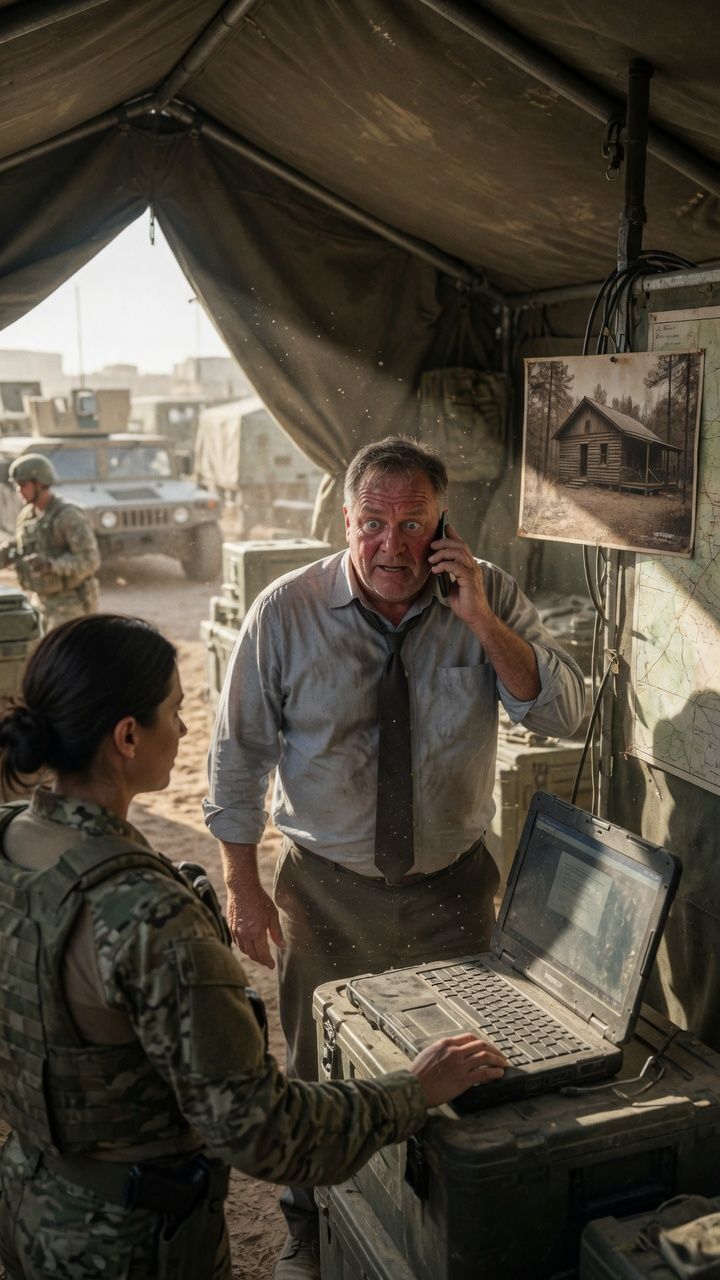

Victor Pike called me at 5:42 in the morning.
I was outside a maintenance tent at Fort Bliss, dust on my boots, sweat drying under my collar, a paper cup of black coffee cooling in my hand. The Texas sky was just beginning to bleach from black to gray. The air smelled of diesel, hot rubber, and desert wind. I remember every ordinary detail because I needed something solid to hold onto when his voice came through the phone.
“I sold your father’s cabin,” he said.
For a moment I thought I’d misheard him.
The base was already awake around me. A generator coughed behind the tents. Humvees rolled past, throwing yellow dust across my sleeves. Someone shouted about a missing wrench. Someone else laughed near the motor pool. The world kept moving, indifferent and loud, while my stepfather’s words settled into me like a stone dropped into still water.
Then he kept talking.
“Your old man’s shack in the woods is gone. Signed the papers yesterday. My debts were getting ugly, and Brianna deserves one decent vacation before college. We’re going to Maui.”
My fingers tightened around the cup until the lid popped loose.
Then he chuckled.
“And those dusty medals he left in the display case? Tossed them. Nobody wants that junk.”
My father’s medals.
My father’s cabin.
My father had built every wall of that place with his own hands.
The desert went quiet inside my head. I saw cedar boards stacked in the bed of his old truck. I saw his flannel shirt white with sawdust. I saw him kneeling beside me when I was twelve, guiding my hands across a pine plank, his voice patient and low: Slow work lasts, Elena. Rushed work falls apart.
My name is Elena Calder. I was thirty-two years old, an Army intelligence officer, trained to hold steady when bad news arrived. I had briefed commanders under pressure, read satellite imagery while sirens wailed, learned to breathe through the kind of fear that makes other people freeze. I was good at all of it.
But nothing had prepared me for hearing my stepfather laugh while selling the last piece of my dead father.
Before I could speak, there was a rustle on the line.
Then my mother’s voice.
“Elena,” she said, already sounding tired of me. “Don’t make this dramatic.”
That was when the real wound opened.
“Mom.” I kept my voice careful, the way you speak near something fragile. “Tell me he’s lying.”
She sighed.
Not cried. Not apologized. Sighed.
“You’re in the Army. You live wherever they send you. What do you even need a mountain cabin for? Victor has been under terrible pressure. Brianna has had such a hard year. Sometimes family means sacrifice.”
Sacrifice.
That word landed harder than anything Victor had said.
She never asked what I had already sacrificed. Not the birthdays I’d missed, not the holidays I’d spent eating cafeteria food under fluorescent lights, not the years I’d spent far from home while she built a new life around a man who called my father’s legacy junk. She only ever counted what I could still give them.
“I have to go,” she said. “Please don’t call and upset everyone.”
The line went dead.
A younger version of me would have called back. She would have begged for an explanation, turned the question over for weeks, wondered what she’d done wrong. She would have cried in a bathroom stall and still found a way to apologize.
That girl was gone.
I set the coffee down on a nearby crate. My hand was steady now. Too steady – the kind of stillness that comes not from calm but from something colder, something that has finally stopped waiting.
I walked toward the operations building.
For ten years, Victor had called that cabin a shack. For ten years, my mother had asked me to keep the peace. For ten years, I had stayed quiet, because my father taught me that the strongest walls are the ones nobody notices until the storm arrives.
But Victor didn’t know what my father had left behind.
When he died, I hadn’t inherited only grief.
I’d inherited instructions.
My father was a careful man. He trusted people only after paperwork proved they deserved it, and he had spent the last years of his life building more than a cabin in those Colorado woods. He had built a legal fortress – quietly, methodically, the same way he built everything. Slow work lasts.
I opened my encrypted laptop and pulled up a contact I hadn’t needed in ten years.
Sloane Mercer. Denver attorney. A voice like a blade and a record of winning the cases other lawyers declined.
I opened a new message.
Subject: Citadel Trigger.
One sentence in the body:
They tried to sell the cabin. Begin enforcement.
My thumb rested over the key.
Once I sent it, there would be no family meeting. No tearful conversation around a kitchen table. No graceful misunderstanding to smooth over, no quiet retreat behind the word sacrifice. What came next would be formal, irreversible, and entirely out of Victor’s hands.
I pressed enter.
The message vanished.
Somewhere in Colorado, ten years of silence began turning into something else entirely.
What My Father Knew About Victor Pike
My father died in February, eight years ago. Lung cancer. He was sixty-one.
He’d been sick for fourteen months before it finished him, and in those fourteen months he did two things. He got his affairs in order. And he watched Victor.
Dad had never trusted him. He’d said so once, plainly, the summer before his diagnosis, sitting on the cabin’s back porch with a can of Coors sweating in his hand. Victor had been in the picture for about two years by then. He had a way of touching my mother’s shoulder that looked like affection from across a room but felt like ownership up close.
“That man counts things,” my father said. He didn’t elaborate. He didn’t need to.
What Dad meant was that Victor catalogued. He noticed the truck, the tools, the acreage. He asked casual questions about property values in Routt County. He brought up my father’s military pension in conversation the way you bring up someone’s weight, framed as concern.
So my father called Sloane Mercer.
I only met her once, at the reading of his will. She was maybe fifty-five, gray hair cut short, no jewelry except a plain watch. She spoke the way people speak when they’ve already thought through every objection. She explained the trust structure my father had set up, the conditions, the tripwires.
The cabin was held in a revocable living trust, sole beneficiary: Elena Calder. My mother had no claim to it. Victor had no claim to it. My father had transferred title two years before he died, which meant it had never been part of his estate at all. No probate. No negotiation. No vote.
Sloane had looked at me over her reading glasses and said, “Your father was precise.”
I’d had to look away.
The thing is, my father had known my mother would remarry. He’d known she’d lean into whatever new life felt easier. He didn’t blame her for it. He told me once, near the end, that people move toward warmth, and he couldn’t fault her for that. What he could do was make sure she couldn’t take the cabin with her when she went.
So he’d locked it down.
The trust included a specific provision: the property could not be sold, transferred, leased, or otherwise conveyed without my written consent. If anyone attempted to do so, Sloane was authorized to pursue immediate legal action, including injunctive relief, damages, and recovery of any funds already exchanged.
Victor had signed a purchase agreement on a property he didn’t own.
The buyer had paid a deposit on a property that was never his to sell.
Somewhere in that transaction was a real estate agent who hadn’t done their title search properly, a buyer who was about to have a very bad week, and a stepfather who had just committed fraud.
The Buyer’s Name Was Gary
Sloane called me back within four hours.
I was in a briefing when my phone buzzed. I stepped out, stood in a concrete hallway that smelled of burnt coffee and dry-erase markers, and listened.
“The buyer is a man named Gary Phelps,” she said. “Retired, Durango. He paid Victor forty-two thousand dollars as a deposit against a three-hundred-ten-thousand-dollar purchase price.”
I did the math on that. Victor’s debts must’ve been uglier than he’d let on.
“Victor represented himself as co-owner with rights to sell. He produced a forged document purporting to be a joint title agreement between himself and your mother, and between your mother and the trust.”
“He forged it.”
“Badly. The notary seal is from a county where your father never lived. The signature doesn’t match any sample I have on file.” A pause. “Mr. Pike is not a sophisticated man.”
“No,” I said. “He’s not.”
She told me she’d already filed for an emergency injunction to halt any further transfer. The sale couldn’t close. Gary Phelps, who sounded like a perfectly decent retired guy who just wanted a mountain property, was going to get his deposit back and a letter of apology from someone. Victor was going to get a certified envelope with his name on it and a court date inside.
“What about the medals?” I asked.
Sloane was quiet for a second.
“He claims he threw them away. We can pursue damages for destruction of personal property with sentimental value. Courts are inconsistent on those, but the number we’d cite is high enough to make him uncomfortable.”
I leaned my head back against the concrete wall.
My father’s medals. A Purple Heart. A Bronze Star with valor. Thirty years of service pressed into metal and ribbon, and Victor had dropped them in a trash can because they took up space in a display case he wanted for his golf trophies.
“Make him uncomfortable,” I said.
Maui Never Happened
My mother called on a Thursday evening, three weeks after the injunction landed.
I was in my quarters, eating a sandwich over my laptop, when her name came up on the screen. I looked at it for a long moment. I picked up.
She didn’t say hello.
“Victor is devastated,” she said. “He made a mistake. He thought the property was part of the family assets. He didn’t know about your father’s arrangement.”
“He signed a forged document, Mom.”
“He didn’t know it was forged. Someone advised him poorly.”
I set the sandwich down. “Who forged it, then?”
Silence.
“Sloane is going to ask that question in court,” I said. “Under oath. With records.”
More silence. Then the sound of her breathing, slightly unsteady.
“Brianna is very upset. She’d been looking forward to Maui for months.”
And there it was. We’d traveled from fraud to a nineteen-year-old’s vacation disappointment in under sixty seconds. That was my mother’s particular talent. She could shrink any crisis down to the size of a personal inconvenience and hand it back to you as guilt.
“I’m sorry Brianna’s upset,” I said. “I genuinely am. But that cabin is mine. Dad made sure of it. Whatever Victor told you about the finances, whatever he told you about the property, he was wrong. Or he lied to you. One of those two.”
She didn’t answer that.
“He threw away Dad’s medals,” I said. “I need you to understand what that means to me.”
“They were old, Elena. He didn’t realize – “
“Mom.”
She stopped.
“Dad built that cabin. He built it with his hands. He took me up there every summer until I was seventeen. He taught me to split wood and read topographic maps and tie a bowline knot in the dark. He left it to me because he wanted me to have one thing that was mine, that nobody could take.” I stopped. Started again. “Victor threw his medals in the garbage and sold the deed to a stranger and laughed about it on the phone at five in the morning. And you told me not to be dramatic.”
The line was quiet for a long time.
“I didn’t know about the medals,” she said finally. Her voice had gone flat. “He told me he’d packed them in a box.”
That surprised me. I hadn’t expected that.
I didn’t say anything, and neither did she, and for just a moment something passed between us that wasn’t anger. Something older and sadder and harder to name. Then she cleared her throat.
“I’ll call you next week,” she said.
She didn’t.
What Was Still There
The injunction held. The sale was voided. Gary Phelps got his deposit back, plus interest, plus a formal apology from Victor’s attorney that Gary’s attorney made Victor sign himself.
Victor avoided criminal fraud charges by a margin that his lawyer probably charged him a lot to engineer. He paid Sloane’s fees. He paid damages. He did not go to Maui.
I got emergency leave in April. Fourteen days.
I drove up to the cabin alone, took the county road off Route 40 past the turnoff most people missed, parked in the gravel lot my father had leveled by hand. The place was exactly as I’d left it the last time I’d been there, two years before, which was the last time I’d had leave long enough to make the drive worth it.
The cedar boards had weathered to silver-gray. The porch railing was solid. The firewood I’d stacked under the eave was still there, dry, waiting.
I sat on the back steps for a while with a cup of coffee, looking at the tree line. Aspens, mostly, with a stand of old ponderosa pine along the ridge. My father had named them. Not officially. Just in conversation. The big one on the left is Gerald, he’d say. Gerald’s had a rough winter.
I laughed, alone on the steps, at the memory of Gerald the pine tree.
The medals were gone. I couldn’t get those back. The court had awarded damages, and I’d deposited the check, and the number on it meant nothing at all compared to the weight of a bronze star in your palm.
But the cabin was there. The walls my father built were there. The pine plank floor he’d laid over two weekends in October 1987, before I was born, was there under my boots, solid and level.
Slow work lasts.
I stayed all fourteen days.
—
If this one hit somewhere real, pass it along to someone who needs to read it.
For more tales of family drama and unexpected twists, you won’t want to miss My Son-in-Law Told Me to Finish My Drink. The Waiter Saved My Life., or read about when My Daughter Showed Up Without Her Luggage, Her Ring, or a Real Smile. And for a different kind of family challenge, check out I Let My Daughter and Her Husband Think I Was Broke at My Own Dinner Table.