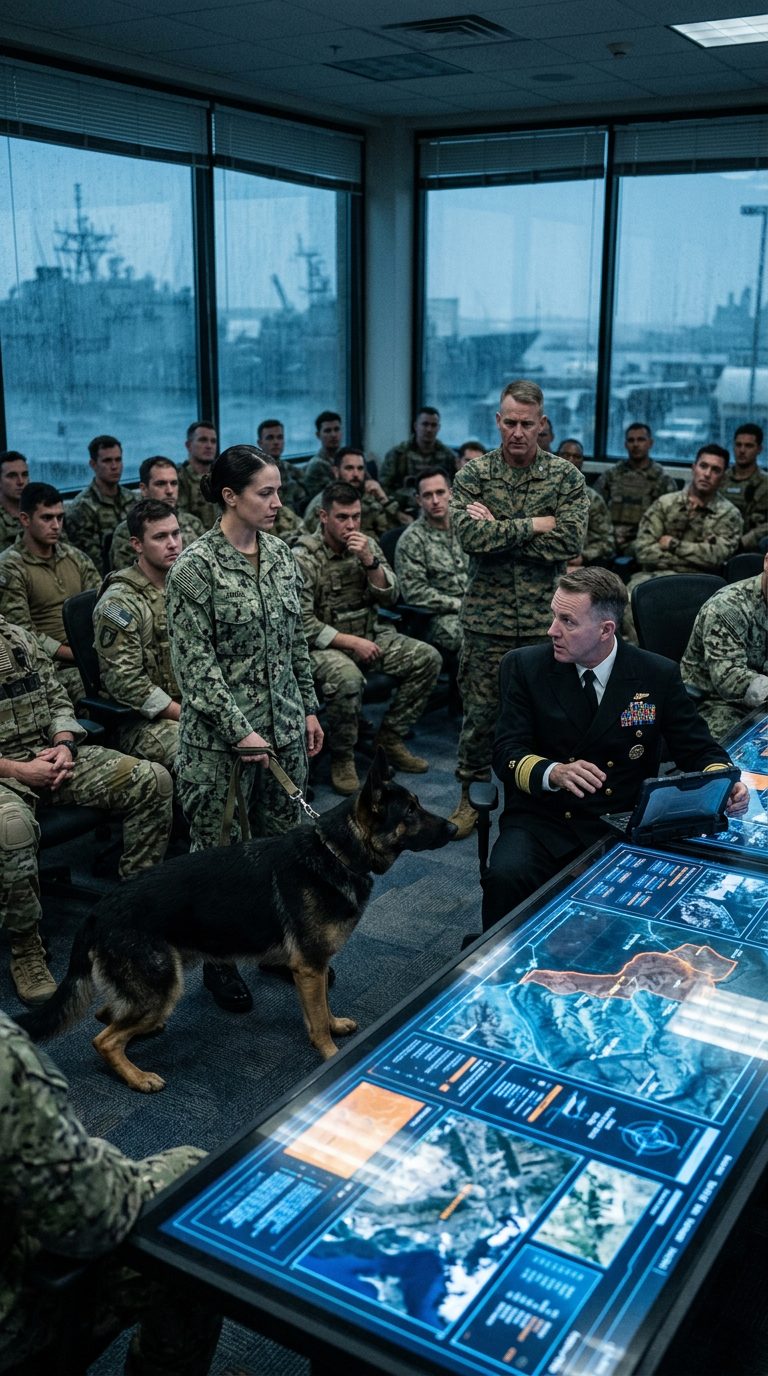

The storm over Naval Base Coronado had been building since dawn.
Thick gray clouds pressed down on the Pacific horizon like something that refused to be reasoned with, and by the time Officer Sophia Carter stepped out of the transport vehicle, the base was already soaked in a cold, restless rain that made the air feel sharper than it had any right to. She moved through the outer security checkpoint with controlled precision, her uniform crisp despite the weather, and she read the room before she even reached the building – not from any briefing document, but from the way people looked at her.
That particular look needed no translation.
Beside her walked Ragnar. A German Shepherd, massive and unhurried, his leash loose in her hand but his attention absolute – scanning every shift of wind, every passing soldier, every flicker of movement with the quiet intensity of something that understood the world in a language humans had never been taught to speak.
What the Room Decided Before She Said a Word
Inside Tactical Operations Building Six, the atmosphere changed the moment she entered.
The room was already full. Navy SEALs, Marine Raiders, intelligence analysts, and senior mission commanders occupied seats around a long digital briefing table that glowed with classified data most people in the country would never be cleared to see. Conversations stopped. Heads turned. And then came the shift – subtle, collective, unspoken – the kind that happens when a room decides, without a single word, that someone doesn’t belong there.
At the front stood Lieutenant Colonel Michael Harlan.
His reputation preceded him the way weather precedes a front – you felt it before you saw it. Built on precision, arrogance, and an absolute conviction that authority was something he alone had the right to define, he looked at Sophia the way a man looks at something left in the wrong place.
“You’re in the wrong facility,” he said, not bothering to check her credentials, his voice pitched just loud enough to ensure the room caught every syllable.
A few operators smirked. Someone exhaled a quiet laugh.
Sophia didn’t respond. She adjusted her grip on Ragnar’s leash and let the silence stretch – let it settle, let it expose the ease with which the room had already decided she was insignificant.
The silence, however, did not extend to Ragnar.
He had stopped moving the moment they crossed the threshold. Not frozen – focused, the distinction being everything – his entire body angled toward the center-right section of the room, where a single man sat quietly reviewing mission files.
Captain Nathan Grayson.
Decorated. Respected. Untouchable.
That was the public version of him, at least.
Ragnar’s stare didn’t waver.
Sophia noticed immediately. Something in her expression tightened – barely perceptible, the kind of tell only visible to someone who knew what to look for. Because dogs like Ragnar didn’t react without cause. They didn’t fixate, didn’t lock on, unless something buried deep in memory or instinct had been disturbed. And whatever Ragnar had found in Captain Grayson wasn’t simple recognition.
It was alertness sharpened into something considerably more dangerous.
—
Harlan stepped forward, breaking the moment with deliberate force.
“This briefing is classified beyond your clearance level.” Louder now. Performing. “K9 support handles perimeter work. You wait outside while professionals operate.”
The line landed exactly as intended. Laughter moved through the room – quiet, unhurried, the kind that doesn’t need volume to carry weight. Collective dismissal, executed with the casual confidence of people who had never once questioned their right to dismiss.
Sophia finally lifted her gaze to meet his.
“I was ordered here directly by Naval Intelligence,” she said.
Harlan smiled like she had just handed him something. “Everyone in this room could say that.”
Ragnar took one step forward.
Not aggressive. Not reactive.
Intentional.
The kind of movement that made several operators straighten in their seats without quite understanding why. The room’s laughter died the way a flame dies when the oxygen shifts – not dramatically, just suddenly gone.
Sophia followed Ragnar’s line of sight again.
Captain Grayson still hadn’t looked at her. But his hand had stopped moving over the mission files. And the air around him had changed in the way air changes before a storm makes landfall – not visible, not measurable, but undeniable to anyone paying attention.
What the Official File Left Out
Three years earlier, a classified operation in Eastern Europe had gone catastrophically wrong.
It had no official name. It had no official record. The kind of mission that exists only in the negative space between documents – defined not by what was written but by what was deliberately omitted. Seven operatives were declared lost. One returned.
Captain Nathan Grayson.
The official file was clean. Enemy contact. Solo extraction. Archived and sealed beneath layers of classification designed not to preserve truth but to bury it. Finalized. Forgotten. Erased by paperwork the way inconvenient things often are when the alternative is accountability.
What the file did not include – what no official document had ever acknowledged – was that the extraction had not been solo.
Ragnar remembered.
Not in the way humans remember, with narrative and language and the comfortable distance of retrospect. He remembered the way the body remembers – in the forest floor beneath frozen ground, in the smell of gunfire and blood and burning wood, in the specific weight of movement through terrain that punishes hesitation. He remembered hours of darkness and the low urgency of commands spoken just above a whisper. He remembered the moment everything should have ended.
And the reason it hadn’t.
Now, in a bright and controlled briefing room filled with decorated operators who believed they understood every layer of what warfare could produce, Ragnar stood staring at the one man who had survived something the official record insisted had never occurred.
—
Harlan snapped his fingers.
“Last warning. Remove yourself from this briefing.”
Sophia didn’t move.
Ragnar did.
One step forward. Then another. Not toward the door.
Toward Captain Grayson.
The shift in the room was immediate and total – not loud, not dramatic, but the kind of change that moves through trained people the way current moves through water. Every operator present arrived at the same understanding at the same moment, because they had all spent enough time around military working dogs to know the difference between random behavior and something else entirely.
That was not random.
That was recognition.
And recognition in a military working dog did not mean memory, not the way civilians understood the word. It meant something unresolved. Something that had never been properly answered. A loose thread in the record that the dog, unlike the paperwork, had never been able to seal away and forget.
Captain Grayson looked up.
His eyes found Ragnar’s.
And for the first time since Sophia had entered the room, his expression came apart – not dramatically, not all at once, but in the way a carefully constructed thing comes apart when the single point holding it together finally gives.
Because what he saw in that dog wasn’t merely familiar.
It was impossible.
And impossible things, in Grayson’s experience, had a way of demanding answers that no official file could provide.
The Thing About Impossible
Ragnar sat.
Clean and final, right at Grayson’s feet. Not a trained alert. Not a command response. Just a dog who had arrived somewhere he had been trying to get back to for three years and had decided, without ceremony, that he was done moving.
The room held.
Harlan opened his mouth and closed it again. Whatever script he’d been running had no line for this.
Sophia let the leash go slack.
She’d been waiting for this. Not this room, not this specific morning, but this moment – the moment Ragnar’s body confirmed what Naval Intelligence had spent eighteen months trying to reconstruct from fragments of signals intercepts and a single partial photograph recovered from a Ukrainian field contact. She pulled a thin folder from inside her jacket and set it on the briefing table without drama. No slide presentation. No preamble. Just a folder, face down, pushed toward the center of the table.
“The dog was part of an eight-member unit designated Specter Four,” she said. “He was reported as killed in action during the Kharkov operation. His handler, Sergeant Dennis Pruitt, was also listed as KIA.”
Pruitt.
The name landed differently than the others. A few people shifted. One of the Marine Raiders near the back wall went very still.
“Ragnar was recovered from a safehouse in Lviv seven months after the operation. Malnourished. Scarring consistent with a long field deployment. His microchip confirmed his identity. His behavioral profile, assessed over the following fourteen months, confirmed something else.”
She didn’t look at Grayson when she said the next part.
“He had been trained by a specific handler to alert on a specific scent profile. That profile was programmed during the Specter Four pre-deployment workup. It wasn’t Pruitt’s.” She paused. “The scent profile belonged to an individual who provided critical intelligence during the operation. An individual whose cooperation allowed one member of Specter Four to extract alive.”
Grayson hadn’t moved.
His hands were flat on the table. His face had gone to something neutral and careful, the expression of a man who had spent years building a wall and was now watching someone remove bricks from the foundation.
“The individual’s identity was redacted from all post-operation documentation,” Sophia continued. “But Ragnar doesn’t read documentation.”
What Grayson Said
Nobody spoke for a long time.
Harlan looked like a man who had arrived at a party wearing the wrong clothes and couldn’t figure out when the dress code had changed. He glanced around the room for support, found none, and settled into a silence that didn’t suit him.
It was Commander Patricia Vance, seated two chairs down from Grayson, who finally said what the room was thinking.
“Are you saying the dog can identify a source?”
“I’m saying the dog already has.”
Vance looked at Grayson.
Everybody looked at Grayson.
He exhaled once, slow and controlled, and then he reached out and pulled the folder toward him. He opened it. Looked at the first page for a long time without reading it, the way you look at something when you already know what it says.
“Her name was Darya,” he said.
The room didn’t react. They’d been trained not to.
“She was a signals analyst. She’d been feeding intercepts to a Western contact for about eight months before the operation. When Specter Four’s extraction route got blown, she was the one who knew the terrain. She got me out through a drainage system that ran under the checkpoint.” He paused. “She didn’t make it back.”
Sophia had known most of this. The folder confirmed the bones of it. But hearing it in Grayson’s voice put weight on the bones that the documents hadn’t managed.
“The official report listed you as a solo extraction,” she said.
“Yes.”
“Who filed that report?”
Grayson looked up at her.
He didn’t answer immediately. And the answer, when it came, was not a name. It was something quieter and more damaging.
“I did,” he said.
What Ragnar Already Knew
The rain outside had picked up. You could hear it now against the building’s roof – a low, continuous sound, not dramatic, just persistent.
Ragnar hadn’t moved from Grayson’s feet.
He wasn’t watching the door. He wasn’t tracking the room. He was just there, the way dogs are when they’ve finished the thing they came to do. Settled. Patient. Waiting for the humans to catch up.
Sophia crouched down beside him. Put one hand on his back. He leaned into it slightly, a small pressure, and she stayed there for a moment without speaking.
The reason Ragnar had been trained to Darya’s scent profile was something she hadn’t included in the briefing. It was in the folder, on the last page, but she hadn’t read it aloud because some things needed to be arrived at slowly.
Darya had been Pruitt’s contact. Before the operation, before the extraction, before any of it. She’d worked with the unit’s K9 handler for four months, and Pruitt had registered her scent as a secondary recognition target because he trusted her in a way that didn’t fit neatly into any official category.
He’d wanted Ragnar to know her.
Pruitt was listed as KIA. Darya was listed as nothing at all, which was worse. And Grayson had filed the solo extraction report not to protect himself but because the alternative – naming Darya – would have exposed her network, her family, and the Western contact she’d been running through for eight months. He’d buried her in the paperwork to keep the people around her alive.
It hadn’t worked. She’d died anyway, three weeks after the extraction, in circumstances the signals intercepts described in two clinical sentences that Sophia had read six times and still couldn’t finish without putting the folder down.
The report had been wrong. And it had also been the only thing Grayson could do.
Both things were true. That was the part that didn’t resolve cleanly.
Harlan cleared his throat. “I need to understand the operational implication here-“
“The operational implication,” Sophia said, standing back up, “is that a classified operation produced a survivor whose account was incomplete, and that the incomplete account has been shaping mission planning in this theater for three years.” She picked up the folder. “Naval Intelligence needs a full debrief. That’s why I’m here.”
She looked at Grayson.
He was still looking at Ragnar.
“He was Pruitt’s dog,” Grayson said. It wasn’t a question.
“Yes.”
“Pruitt talked about him constantly.” Something moved across his face. “I didn’t know they’d recovered him.”
Ragnar lifted his head and looked up at Grayson with the complete, unhurried attention that dogs give to things they’ve already decided about.
Grayson reached down.
His hand was not steady.
Ragnar pushed his nose into it anyway.
—
The debrief lasted four hours. Harlan was present for the first twenty minutes and then was quietly asked to step out by Commander Vance, who had a way of making requests sound like something other than what they were.
The rain stopped around noon.
By the time Sophia walked back out through the security checkpoint, the Pacific had gone flat and gray and still, the kind of still that comes after something has passed through. Ragnar walked beside her, leash loose, unhurried, his attention already moving outward again – wind, movement, the particular weight of open air after a confined space.
She didn’t look back at the building.
She didn’t need to.
Ragnar had already said everything that needed saying.
—
If this one stayed with you, pass it on to someone who needs to read it today.
For more incredible stories about overcoming assumptions, check out what happened when My Commanding Officer Told Me to “Go Back to the Desk” – So I Let the Tournament Answer, or the unexpected outcome when She Aimed at the Wall. What Hit the Target Stopped the Whole Arena. And you definitely won’t want to miss how She Didn’t Say a Word When He Mocked Her. That Was the First Mistake.