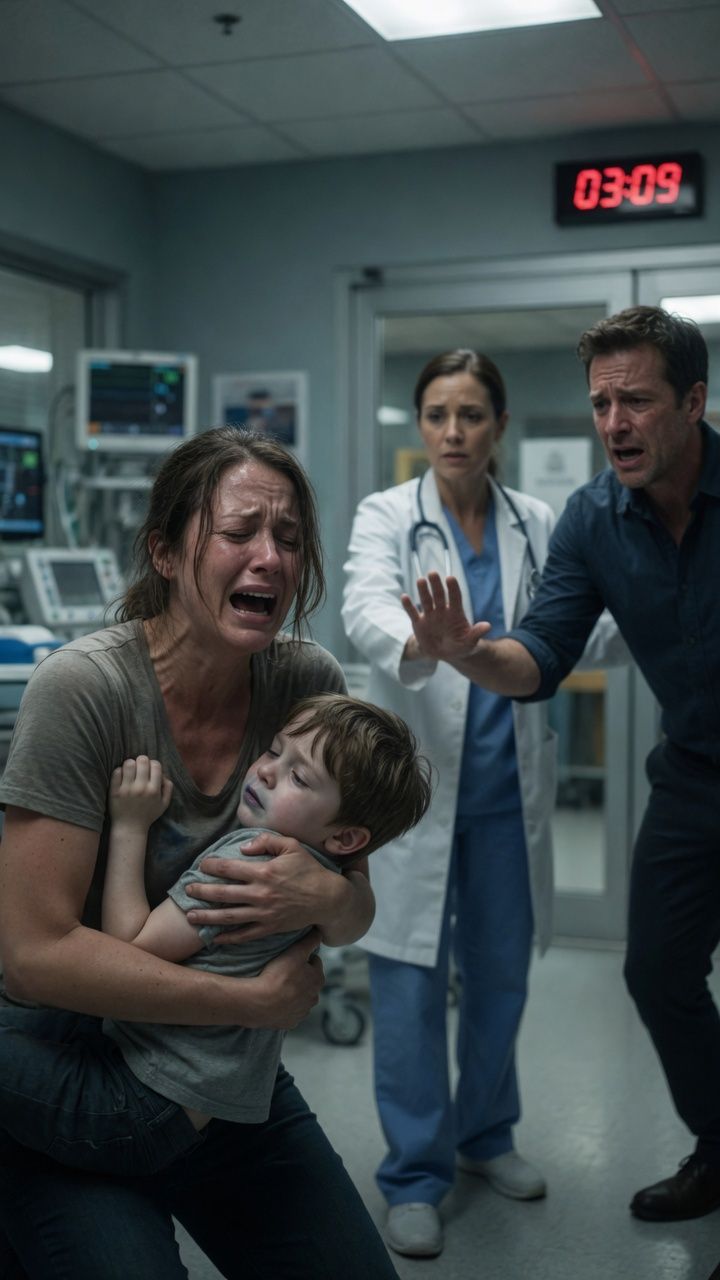

After three years in prison, I came home expecting nothing more than my father’s arms around me. Instead, Reagan opened the door and told me he was dead.
I had to find out at my own front doorstep.
—
“Your father died a year ago, Finnley. And this house doesn’t belong to you anymore.” She finally looked at me directly. “So don’t make a scene. Just leave.”
She said it the way you’d tell someone the kitchen is closed.
I had been released from Oakwood Prison that morning after serving three years for a theft I had never committed. I carried a borrowed backpack, secondhand clothes, and hands that wouldn’t stop shaking as I stood in front of the house where I had learned to walk, to ride a bike, to grieve my mother.
For 1,095 nights, I had kept myself sane with one image: my father opening this door. Camden Dennis, sitting in his worn leather armchair, telling me what he always told me during the hard years. Hang in there, son. The truth always finds a way to come out.
I needed him to still be alive. I had built my entire survival around it.
But Silver Lake didn’t feel like home anymore.
The house had been repainted a cold, elegant gray. My father’s rose bushes had been torn out, replaced by sculpted hedges that looked like they belonged to someone else’s life. A luxury white SUV and an unfamiliar red sedan occupied the driveway. Even the front door was different – sleek and black, fitted with a modern lock that had never known my key.
Same house. Different soul.
I knocked the way a son knocks. Not politely. Not tentatively.
Hard.
Reagan answered in an emerald-green dress, pearl earrings, hair straightened to a shine. She looked at me the way you look at a stain on new carpet – not with hatred, exactly. With inconvenience.
“You got out sooner than I expected,” she said.
“Where’s my father?”
She exhaled slowly, as though the question bored her.
“Buried a year ago. Cancer. Fast, then painful, then over.” She tilted her head. “These things happen.”
The ground shifted beneath me.
“No one told me? No one thought I deserved to say goodbye?”
A thin smile crossed her face. “Finnley, you were in prison for stealing from your own father’s company. Did you honestly think he wanted you at his funeral?”
“I didn’t steal anything.”
“You said that at the trial too.” She paused. “No one believed you then either.”
I tried to look past her into the house. The entrance hall had been gutted and refurnished. My mother’s portrait was gone. My father’s favorite hat – the battered gray one he wore every Saturday morning – had vanished. In their place: expensive furniture, blank walls, and the synthetic sweetness of an air freshener working hard to erase any trace of the people who had once lived there.
“Let me in. I just want to see his room.”
“His room doesn’t exist anymore. I had it remodeled.”
Then Carter appeared at the top of the stairs. My stepbrother, the man who had spent the better part of a decade drowning in gambling debts and bad decisions, descended slowly, smiling as though he had been rehearsing this moment for months.
“Well,” he said. “The ex-con, right on schedule. Come for his inheritance?”
I stepped toward the doorway.
Reagan moved to block it.
“If you set foot on this property again, I’ll call the police.” Her voice was calm, almost pleasant. “With your record, that conversation won’t go well for you.”
The door closed with a soft, final click.
I didn’t shout. I didn’t pound on it. I stood on the porch for a moment, breathing, then turned and walked.
—
Pinecrest Cemetery was a twenty-minute walk through streets that no longer recognized me. My father had always said he wanted to be buried beside my mother, beneath the old cypress row near the eastern wall. I needed to see his name carved in stone. I needed something real.
An elderly groundskeeper intercepted me near the entrance, moving with the unhurried certainty of a man who had spent decades among the quiet dead.
“Who are you looking for, son?”
“Camden Dennis. His wife told me he’s buried here.”
The old man studied me for a long moment, something shifting behind his eyes.
“You’re Finnley, aren’t you.”
It wasn’t a question.
A cold current moved through me. “How do you know my name?”
He glanced toward the cemetery gate, then lowered his voice to barely above a whisper.
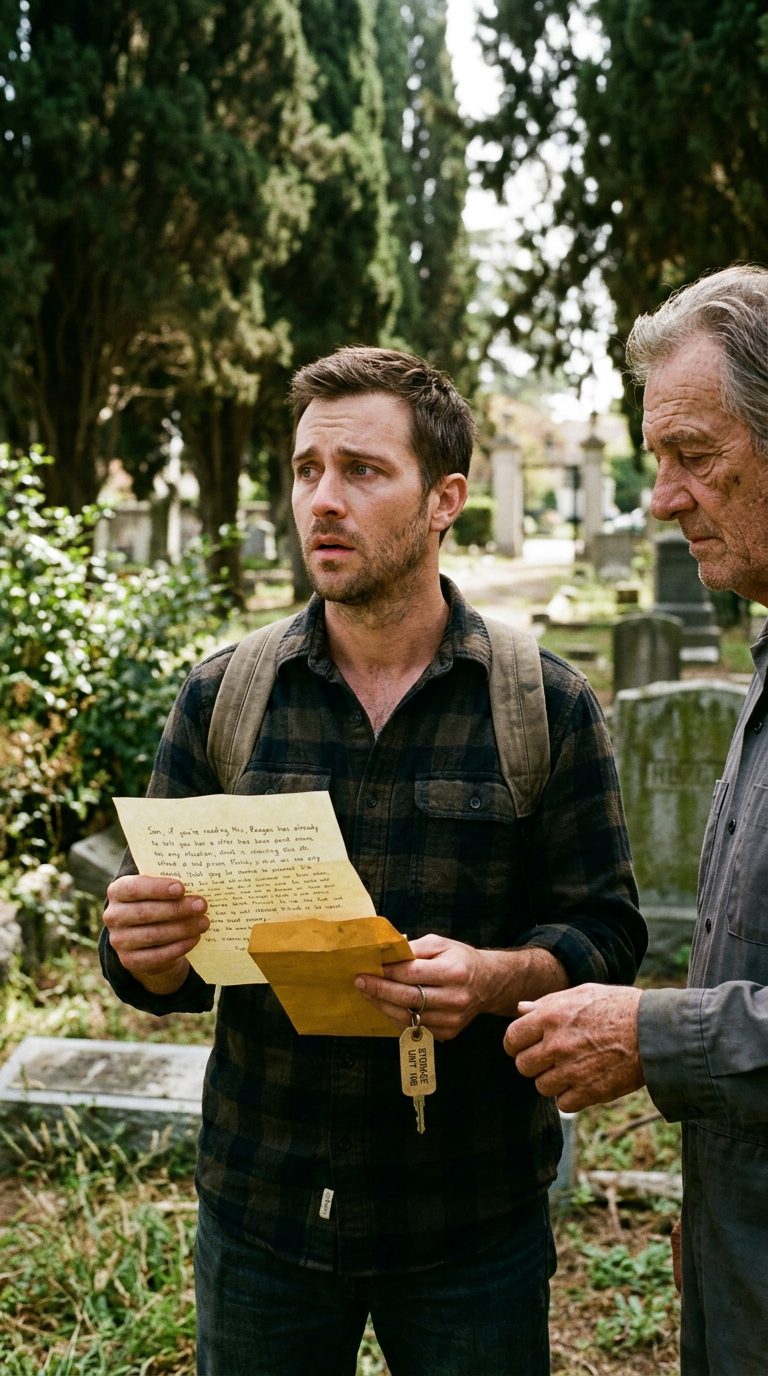
“Because your father asked me to give you something. He said if you ever came looking for him, I’d know you by your eyes.” He reached into his coat and produced a yellowed envelope, soft at the edges from being handled and re-handled. “He said you’d come eventually. He said you always kept your word.”
Inside the envelope was a letter, folded twice, and an old brass key. A small paper tag had been tied to the key with string.
STORAGE UNIT 108.
I looked up from the key. “Where is he buried?”
The groundskeeper swallowed. His jaw tightened slightly, the way a man’s does when he’s carrying a weight he’s been waiting to set down.
“Not here,” he said quietly. “And before you go back to that woman and ask her why, you should read that letter first.”
My hands had started shaking again. I unfolded the paper.
The first line stopped my breath entirely.
Son, if you’re reading this, Reagan has already started lying to you.
I stood there among the cypress trees, the old key warm in my palm, and understood that my father’s death was not the end of the story.
It was a door. And he had left me the key.
What My Father Actually Knew
I read the letter three times standing there between the graves, the groundskeeper – his name was Walt, Walt Pruitt, he’d worked Pinecrest for thirty-one years – waiting with the patience of a man who’d watched a lot of people absorb bad news in this particular patch of earth.
My father had known he was dying eight months before he actually did. Stage four pancreatic, caught late, the way it almost always is. He’d had time to think. Time to plan. And time, apparently, to understand exactly what Reagan and Carter were going to do the moment he couldn’t stop them.
The letter wasn’t long. My father was never a man who used ten words when five would do. But what was there hit like a fist.
He’d found the discrepancy himself. The missing $340,000 from Dennis Fabrication’s accounts that had been pinned on me – he’d traced it. Not all the way, not with proof that would hold in court, but far enough to be certain it wasn’t me. Carter had been bleeding the company for two years before the theft was ever reported. Reagan had known. They’d needed someone to take the fall before an outside audit found the hole, and I was convenient: young, estranged enough from the business to be plausible, and stupid enough to have been in the building that weekend without signing the log.
He’d written that last part himself. Stupid enough. That was my father. Loving you and being honest about you in the same breath.
He hadn’t come forward at the trial. That part of the letter was the hardest to read, and he knew it, because he’d written: I am ashamed of this. I will be ashamed of it until I’m gone.
Reagan had threatened to contest his mental competency if he spoke up. He was already sick, already on medication, already starting to lose weight in the visible way that cancer takes it. She had a doctor ready to testify. She had records she’d apparently manipulated, or paid someone to manipulate. He believed her. He was scared and sick and he believed her.
So he’d done the next best thing he could think of. He’d spent his last months building me a road back.
Storage Unit 108
Walt walked me to the gate when I folded the letter back into the envelope. He shook my hand with both of his, the way old men do when they mean it.
“He talked about you,” Walt said. “More than once. He’d come sit by your mother’s grave some mornings. Just sit.” He paused. “Good man. Scared man. But good.”
The storage facility was called Lakeview Self-Storage, which was misleading because there was no lake visible from it – just a strip of industrial road off Route 9 and a chain-link fence with a keypad entry. The code was in the letter. My mother’s birthday, the year reversed. Of course it was.
Unit 108 was in the back row, a standard ten-by-ten with a roll-up door and a padlock that the brass key fit perfectly.
I stood there for a second before I opened it.
Inside: filing boxes, six of them, labeled in my father’s handwriting. A laptop in a padded case. A sealed envelope marked Attorney – Do Not Open Without Counsel. And sitting on top of the nearest box, like he’d set it there as a greeting, was the battered gray hat.
I sat down on the concrete floor of that storage unit and held the hat for a while.
Then I opened the first box.
What He’d Built
My father had been meticulous in the way that dying men sometimes get – the urgency of it, knowing time is a fixed and shrinking thing. The boxes held copies of financial records going back four years. Bank statements, internal transfer logs, email printouts. He’d had help; there was a note from a man named Gerald Marsh, a forensic accountant in Bridgeport who had apparently done a preliminary review on a private basis. Gerald’s note said the irregularities were “significant and systematic” and that he was prepared to provide a formal affidavit if counsel engaged him.
Carter’s name appeared in those records the way a bad smell appears in a room: everywhere, once you knew to look for it, and impossible to ignore.
The laptop held more. Emails Reagan hadn’t known my father had copied before she’d changed the account passwords. A conversation between her and Carter from two years before my arrest, discussing the “liability exposure” and what to do about it. They never used my name in writing. They didn’t have to. The timeline did that work on its own.
There was also a recorded phone call. Just one. An mp3 file sitting on the desktop, labeled with a date from four months before the trial.
I put in earbuds and played it.
Reagan’s voice. Carter’s voice. Twelve minutes and forty seconds.
I listened to the whole thing without moving.
The Attorney
The sealed envelope led to a lawyer named Patricia Doyle, whose office was in downtown Silver Lake above a dry cleaner on Marsh Street. My father had retained her eighteen months ago and paid a year of fees in advance. She’d been waiting.
She was in her late fifties, gray hair cut short, the kind of woman who looked at you like she was already three moves ahead. She shook my hand and told me to sit down and didn’t waste any time being gentle about it.
“Your father was thorough,” she said. “Thorough enough that we have a real case. The recording alone is significant, but combined with Marsh’s analysis and the email chain, we’re looking at criminal fraud, obstruction, and potentially perjury depending on what testimony was given at your trial.”
“Can I get my conviction overturned?”
“That’s the goal. It won’t be fast. But yes. That’s the goal.”
She’d already filed a preliminary motion. Had done it the week after my release date was confirmed, because my father had written her a letter too, telling her when I’d be out, telling her I’d come.
He’d known I’d go to the cemetery first. Knew I’d find Walt. Knew I’d follow the key. He’d mapped the whole thing out from a hospital bed and a leather armchair and wherever else he’d sat in those last months, building me a road out of the hole they’d put me in.
The Part I Didn’t Expect
Three weeks after I first sat in Patricia’s office, Carter called me.
I don’t know how he got my number. I’d been staying in a room above a bar on Clement Street, a place a guy from Oakwood had told me about, cheap and no questions. Carter called at 7 in the morning, which told me he hadn’t slept.
“I know you went to the storage unit,” he said.
“Good morning, Carter.”
Silence. Then: “What do you want?”
“I want what’s mine.”
“Finnley.” His voice had changed. The rehearsed smugness from the doorstep was gone. What was left underneath it was smaller. “You have to understand, it wasn’t – I didn’t plan for you to go to prison. That wasn’t – “
“But you let me.”
He didn’t say anything.
“Three years, Carter. I watched men break in there. I didn’t break, but I watched it happen and I understood how it worked. And you let me sit in that place for three years.”
The line was quiet for long enough that I thought he’d hung up.
“What do you want?” he said again. Smaller this time.
I told him.
What the Road Back Looks Like
Patricia says the civil case will take another year, maybe two. The criminal referral is with the DA’s office. Reagan has hired a firm out of Hartford that specializes in exactly this kind of thing, which tells you something about how scared she is.
The house is frozen in a dispute. I’m not living in it. I don’t know if I want to. My father’s rose bushes are gone and my mother’s portrait is gone and whatever that place was when I was young, it isn’t that anymore.
But the gray hat is on the shelf above the bed in my room on Clement Street. And the recording is in three separate places, backed up, safe.
My father knew he’d failed me once. So he spent what was left of him making sure he wouldn’t fail me twice.
The truth always finds a way to come out.
He used to say it like a comfort. I used to hear it like a promise.
Now I understand it was both.
—
If this one got to you, pass it on. Someone out there needs to read it.
If you’re looking for more stories about family drama and unexpected twists, you might appreciate reading about My Dad Suspended Me Until I Apologized to My Sister. I Went to My Attorney Instead. or how My Stepfather Sold My Dead Father’s Cabin While I Was Deployed. And for a tale where a stranger makes all the difference, check out My Son-in-Law Told Me to Finish My Drink. The Waiter Saved My Life..