
At three o’clock in the morning, someone knocked on my door like the world was ending.
It was my daughter.
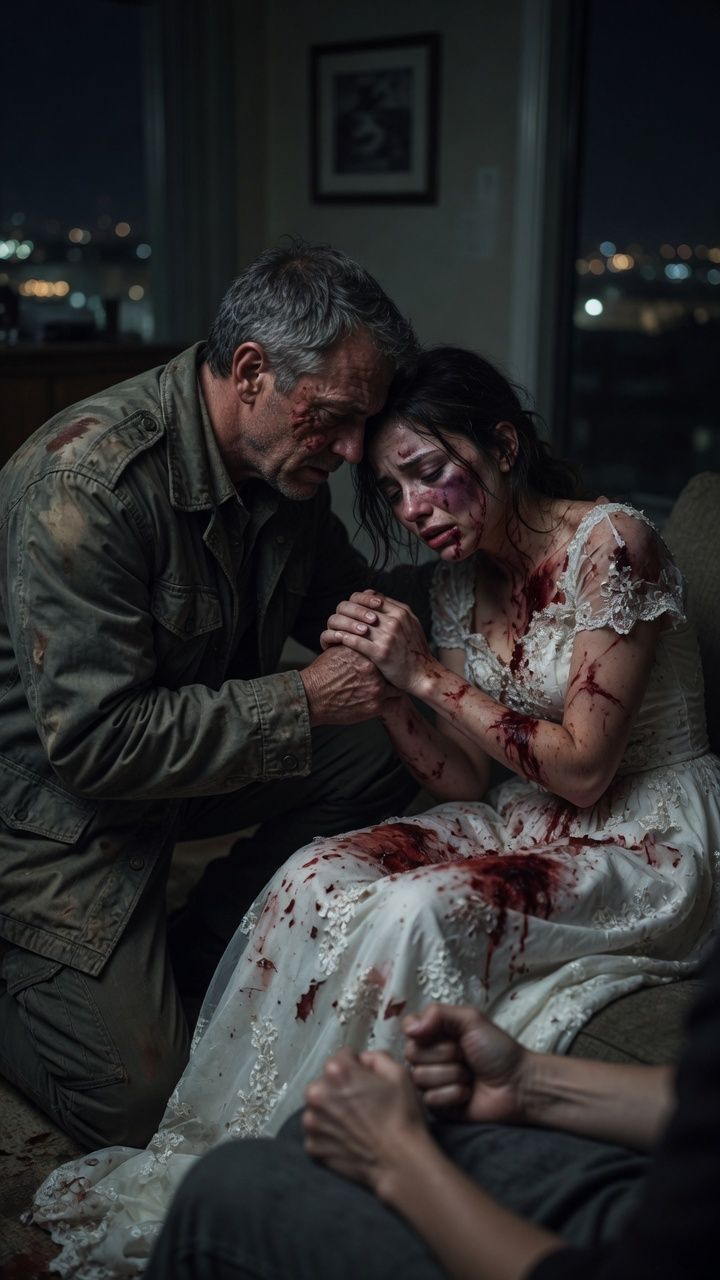
Sofia stood in the hallway still wearing the wedding gown I had zipped up with trembling, happy hands just hours before. The dress was torn now, stained with blood, clinging to a body covered in bruises. She looked at me the way she hadn’t since she was small – like I was the only solid thing left in the world.
Before she collapsed into my arms, she whispered four words.
“Mom. My mother-in-law.”
Then she told me why.
In that moment, something shifted inside me. Not panic. Not grief. Something colder and far more deliberate.
Someone was going to pay for this.
—
When I opened my apartment door in Dallas, I almost didn’t recognize her.
Sofia had a split lip. A swollen cheek. Dark finger-shaped bruises encircling both arms like bracelets. The woman who had laughed through photographs only hours earlier – radiant, certain, beginning her life – was simply gone.
The person standing in her place was terrified.
“Mom.” She gripped my wrist with shaking fingers. “Please don’t call the hospital. They said if I tell anyone, they’ll kill me.”
My heart stopped beating for a full second.
“Who threatened you?”
She closed her eyes and struggled to breathe.
“Carmen. Javier’s mother.”
Even the name made my stomach turn.
I had known from the beginning that Carmen Robles was not a woman welcoming a daughter into her family. She was a woman performing the role while pursuing something else entirely. Everything about her – the designer clothes, the rehearsed warmth, the way her eyes moved around a room calculating value – telegraphed a person who cared deeply about status, money, and appearances, and very little else.
Three months before the wedding, she visited my home and sat across from me with a polished smile. She didn’t ask about Sofia’s happiness, her career, her dreams, or what kind of life she hoped to build. She asked about what Sofia owned.
“I heard she has a luxury condo in Uptown Dallas,” Carmen said, as casually as if she were commenting on the weather.
“She does,” I replied. “And it will always belong to her.”
That condo had been a gift from Sofia’s father, Colonel Alexander Brooks, after our divorce. He had insisted on it. He wanted his daughter to have something permanent, something that couldn’t be taken or negotiated away – something that was entirely, irrevocably hers.
Carmen only smiled.
As the wedding approached, her requests quietly became demands. Money. Jewelry. Financial guarantees. Every conversation felt less like two families joining together and more like a hostage negotiation conducted over canapés. I refused everything except contributing to the wedding itself, because Sofia loved Javier, and I believed in honoring that.
But before the ceremony, I made one thing absolutely clear.
“The condo is not negotiable. Not now. Not ever.”
Everyone smiled and nodded.
I understand now that those smiles meant nothing at all.
—
Sofia sat curled on my couch, still wrapped in her ruined dress, her voice barely above a whisper as she told me what had happened.
After the reception, Javier had taken her to the honeymoon suite. Then he told her he had something to handle and left. She waited. Twenty minutes passed.
Then the door opened.
Carmen walked in with six other women. They locked the door behind them.
I pressed my hand over my mouth.
Carmen demanded that Sofia sign the condo over to Javier’s family immediately. She said it belonged with them now. She said this with the calm confidence of someone who had already decided how the evening would end.
Sofia refused.
And that was when everything changed.
“She grabbed me,” Sofia whispered. “She kept saying a stubborn daughter-in-law needed to learn respect.”
My hands curled slowly into fists.
“And Javier?” I asked.
Fresh tears spilled down Sofia’s face.
“He was outside the door the whole time.”
She looked at me with an expression I will never forget – equal parts disbelief and devastation, the look of someone watching their entire understanding of a person collapse in real time.
“I heard him tell her, ‘Just don’t damage her face too much. People will notice tomorrow.'”
The room went very quiet.
Something broke open inside me then. Not into grief. Not into fear. Into something white-hot and absolutely focused.
I reached for my phone.
Sofia grabbed my arm. “Mom – Dad hasn’t spoken to us in years.”
I looked at my daughter. At her split lip and her swollen face and her bruised arms and her torn dress.
“He is still your father.”
I dialed the number I hadn’t called in nearly a decade.
It rang twice.
“Clara?”
Alexander’s voice. Older than I remembered, but unmistakable.
I kept my own voice steady through sheer force of will.
“Our daughter was attacked on her wedding night.”
Silence. A long, heavy silence.
Then his voice changed – dropped into something quieter and far more dangerous.
“Send me your address. I’m coming.”
—
Thirty minutes later, the doorbell rang.
Alexander stood in the hallway wearing jeans and an old military jacket, looking like a man who had dressed in the dark and driven too fast. He didn’t say anything when I opened the door. He didn’t need to. His eyes moved past me immediately, searching.
Then he saw her.
Sofia on the couch. Bruised. Frightened. Still wearing the dress from what should have been the happiest day of her life.
He crossed the room slowly and knelt beside her. He took her hand in both of his.
“Baby girl.”
His voice broke on the second word.
I watched his face as his eyes moved carefully over her injuries – the marks on her arms, the swelling along her jaw, the dried blood at the corner of her lip. I watched the man I had once known better than anyone process what he was seeing.
Something left him in that moment.
The years of distance. The careful removal. The retired soldier who had learned to stay contained and stay away.
All of it fell away.
What remained was something much simpler and far more absolute.
A father who had just learned that someone had declared war on his family.
And who had already decided what came next.
What He Did Next
He stood up from the couch.
He didn’t look at me. He looked at the wall for a moment, the way men like Alexander look at walls when they’re making calculations they don’t want you to see. Then he pulled out his phone and walked to the kitchen, and I heard him speaking in a low, flat voice to someone I didn’t know.
I caught fragments. I need you to find out everything. A name. Carmen Robles. Then: Tonight.
He came back into the living room and sat down across from Sofia, and his voice had gone entirely gentle again. Like he could switch it. Like there were two of him and he could choose which one to be.
“I need you to tell me everything you remember,” he said. “The suite number. The hotel. The women who were with her. Any names you heard. Anything.”
Sofia looked at him for a long moment. She hadn’t seen him in four years. The last time they’d spoken, it had ended badly – something about holidays, about schedules, about the particular kind of damage that follows a divorce when everyone means well and nobody handles it right.
None of that was in the room now.
She told him everything.
He listened without interrupting, without touching her, without changing his expression once. He just listened and held her gaze like staying still was the most important thing he could do.
When she finished, he nodded once.
“Okay,” he said.
That was all.
The Hours Before Dawn
I made coffee I didn’t drink. I changed Sofia out of the dress and into clothes that didn’t have blood on them. I sat beside her on the couch with her head on my shoulder while Alexander made phone calls I wasn’t supposed to hear and sent messages I wasn’t supposed to see.
Around four-thirty in the morning, she fell asleep.
I stayed awake.
Alexander came and sat at my kitchen table, and we looked at each other across twenty-two years of history – the marriage, the divorce, the long careful distance we’d both maintained because it was easier than whatever the alternative was.
“You should have called me before the wedding,” he said.
“I know.”
“I would have looked into him.”
“I know.”
He rubbed his face with both hands. He looked tired in a way that had nothing to do with sleep.
“She loves him,” I said. “She did love him.”
“Yeah.” He looked toward the couch where she was sleeping. “That’s the part that’s going to take the longest.”
He wasn’t wrong.
We didn’t talk about the past. We didn’t revisit the things that had built the distance between us. It wasn’t the time and we both knew it. Instead we sat in my kitchen in the dark and drank bad coffee and talked through what came next with the focused practicality of two people who had agreed, without saying so out loud, to deal with the wreckage of their feelings later.
He knew a DA. Not a friend, exactly, but someone who owed him a conversation.
He had already contacted a woman named Paulette Fischer at a firm downtown – someone who handled cases like this, he said, and who was very good at making sure the people who needed to be scared became scared quickly.
“What about Carmen?” I asked.
He looked at me.
“Carmen Robles has a prior,” he said. “Domestic incident in San Antonio, 2019. Charges dropped. I’m told she has a habit of making problems go away before they become problems.”
“And this time?”
“This time she walked into a hotel room with six witnesses and put her hands on a colonel’s daughter.” He set down his coffee cup. “She miscalculated.”
The Part Nobody Tells You
The bruises on Sofia’s arms turned purple-yellow over the next three days. She slept a lot. She ate almost nothing. She sat by my window in the afternoons and looked at the street below like she was watching for something she couldn’t name.
She didn’t cry much. That worried me more than the bruises.
On the second day, Javier called.
I answered because she couldn’t.
He said he was sorry. He said his mother had gone too far. He said he hadn’t known it would get physical, that he’d just thought they were going to talk, that he never meant for any of this to happen.
I let him finish.
Then I said, “You stood outside the door and told her not to damage Sofia’s face too much because people would notice.”
Silence.
“I’m going to need you to not call this number again.”
I hung up.
Sofia was standing in the kitchen doorway. She’d heard. She didn’t ask me what he said. She just turned around and went back to the window.
That was the last time anyone in our family spoke to Javier Robles.
What Alexander Built in Seventy-Two Hours
The charges were filed on a Thursday.
Aggravated assault. Unlawful restraint. Terroristic threat – that last one because of what Carmen had said about killing her, which Sofia had repeated to Alexander twice and which he had recorded the second time, on his phone, with her permission, at two in the morning while I watched from across the room.
Carmen was arrested at her home in Highland Park at 7 A.M.
I know this because Alexander texted me one word.
Done.
Paulette Fischer filed the civil suit the same afternoon. Seven defendants. Carmen, Javier, and five of the six women in that room – the sixth they couldn’t yet identify, but Paulette said give it a week.
The condo was never in question. Sofia’s name was on every document. Carmen had apparently believed that a marriage certificate would change that, or that enough fear would. She was wrong on both counts.
What I hadn’t expected was what happened with the wedding venue.
It turned out two of Carmen’s cousins worked there. Had worked there for three years. The manager called Sofia personally to apologize and to let her know that both women had been let go pending the investigation. He also, unprompted, offered to return the entire venue fee.
Sofia told him to keep it and donate it somewhere.
He did.
What She Said on the Fourth Morning
Sofia came into the kitchen on Saturday while I was making eggs I wasn’t sure either of us would eat. She sat down at the table and watched me for a while.
“I keep thinking about the photographs,” she said.
I turned around.
“From the ceremony. The ones where I’m laughing.” She looked at her hands. “I looked so sure of everything.”
I set down the spatula. I sat across from her.
“You were sure,” I said. “That’s not the same as being wrong.”
She looked up.
“He was different,” she said. “Or I thought he was.”
“Maybe he was. People can be different until they’re not.”
She was quiet for a while. The eggs were burning and I didn’t get up.
“Dad called me last night,” she said.
I hadn’t known that.
“He said he was sorry he wasn’t around more.” She picked at the edge of the table. “I didn’t know what to say. So I just said thank you for coming. And he said – ” She stopped. Started again. “He said some things you love turn out to be worth protecting even when you didn’t protect them right the first time.”
I didn’t say anything.
“I think he was talking about more than me,” she said.
She was right. But that was a conversation for another day, between two people who weren’t me.
The eggs were definitely burned now.
Neither of us mentioned it.
She reached across the table and put her hand over mine. Her knuckles were still faintly bruised. Her grip was steady.
Outside, Dallas was doing what Dallas does in October – pretending to be autumn while still being eighty degrees, the light going gold and flat over the rooftops.
We sat there in the kitchen while the smoke alarm beeped once, twice, and then went quiet.
—
If this one hit close, pass it on to someone who needs to read it.
If you’re looking for more stories that will keep you on the edge of your seat, you might enjoy reading about My Daughter Drove 1,400 Miles in the Dark to Find Me or even My Husband Told Me Not to Make a Scene. I Pressed One Button..