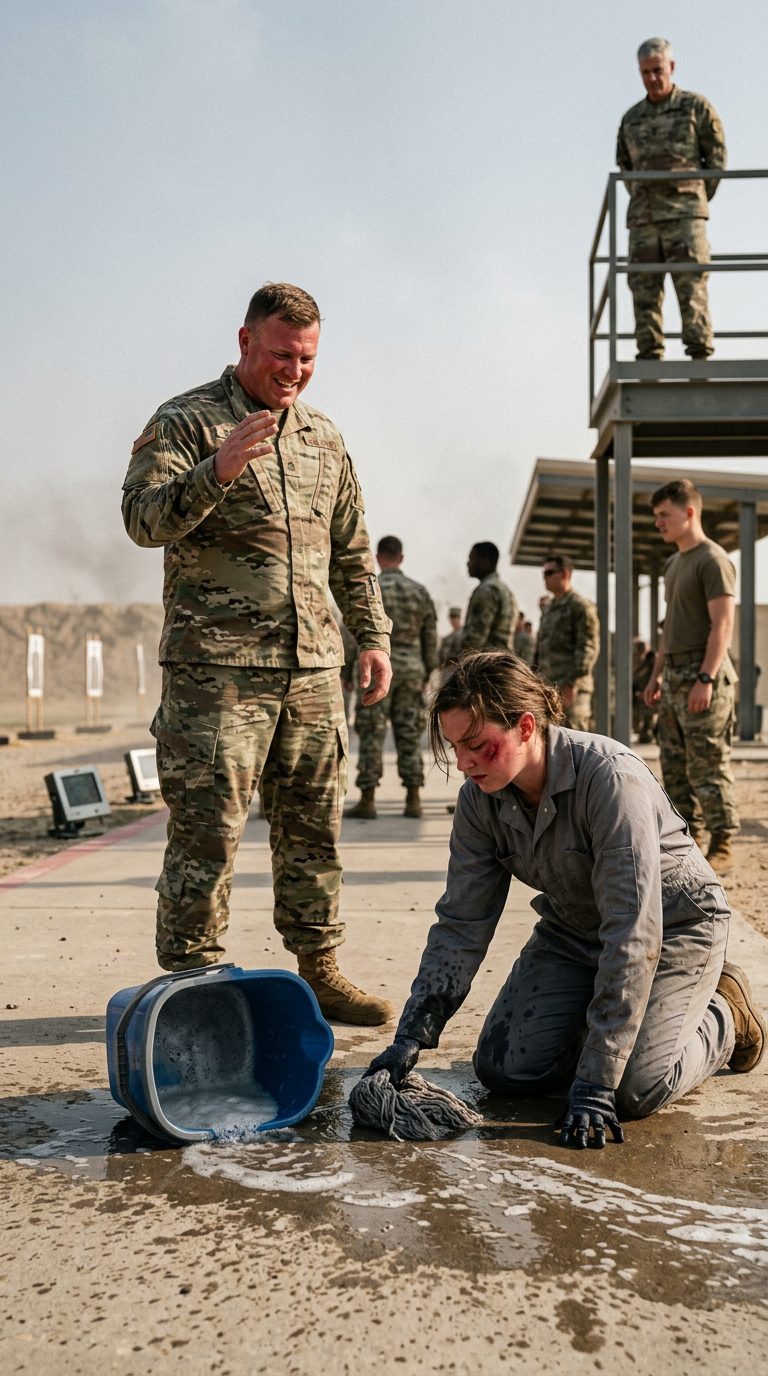

The slap cracked across Rachel Hayes’s face so loudly that the entire firing line went quiet.
“Stick to cleaning,” Sergeant Ryan Cole said, smiling in front of everyone. “Leave shooting to real soldiers.”
Rachel didn’t stumble.
She didn’t cry.
She stood beside the overturned bucket, water spreading slowly around her boots, while twenty soldiers stared from their lanes. The mop handle rested against her shoulder. Gray suds crept across the concrete like spilled nerves. Ryan’s palm was still raised, and his grin widened when Rachel turned her face calmly back toward him.
There was no fear in her eyes.
That seemed to bother him far more than tears would have.
“What?” he asked. “You didn’t hear me?”
A few soldiers laughed too loudly. Another lowered his rifle and nudged the man beside him.
Rachel bent down and picked up the bucket. She moved carefully, like every motion had been measured long before this moment. Ryan kicked it again before she could set it upright. It rolled across the concrete and struck the metal leg of a shooting bench with a hollow clang that echoed downrange.
“Come on, janitor,” Ryan said. “Clean faster.”
Rachel looked at the bucket. Then she looked past the firing line at the row of targets standing under the bright Texas morning sun – white squares against brown berms, electronic scoreboards blinking beside each lane. The air smelled of dust, oil, hot brass, and wet concrete.
No one moved to help her.
A young private shifted uncomfortably, then looked away.
Ryan noticed him. “You got something to say, Miller?”
“No, Sergeant.”
Ryan turned back to Rachel. “That’s what I thought.”
Rachel knelt and gathered the mop head from the puddle. Her gray janitor uniform clung to one sleeve. A thin red mark had risen on her cheek. She touched it once with the back of her gloved hand, then lowered her hand and said nothing.
The soldiers waited for anger. They waited for humiliation. They waited for some small proof that Ryan had broken her.
Rachel gave them nothing.
—
From the observation deck behind the line, Colonel David Brooks watched without speaking. His gray hair moved slightly in the wind. His hands rested behind his back. He had been watching Rachel since she arrived that morning.
Ryan had been watching her too, but for entirely different reasons. To him, she was an interruption – a woman pushing a mop through a place built for noise, moving quietly where men were busy proving themselves.
Ryan stepped closer until his boots splashed in the water. “You understand this is a military range, right?”
Rachel wrung out the mop. “Yes.”
Her voice was calm and low. That single word was enough to thin out the laughter.
Ryan tilted his head. “Yes what?”
“Yes, Sergeant.”
The words were polite. The tone was not weak. Ryan stared, searching for disrespect. He found none, and that seemed to make him angrier.
“This area is for qualified shooters,” he said.
Rachel glanced briefly at the soldiers. “Then I’ll stay out of the way.”
Ryan laughed. “You already failed at that.”
A soldier near lane four snorted. Another covered his mouth.
Rachel turned toward the spill and dragged the mop across the concrete, moving through the laughter as though she couldn’t hear it.
But she heard everything.
She heard Ryan’s boots. She heard the safety clicks. She heard the wind moving the flags above the range tower. She heard Colonel Brooks take one slow, deliberate step closer to the railing.
Ryan followed her. He leaned near her ear. “Bet you’ve never fired anything bigger than a spray bottle.”
The laughter surged back.
Rachel stopped mopping – only for a single second – then continued.
That pause caught Colonel Brooks’s attention. His eyes narrowed.
Ryan caught it too. “There it is,” he said. “Did I hurt your feelings?”
“No.”
Ryan stepped into her path. “You sure?”
Rachel looked past him toward lane one. A rifle rested there, untouched. A long-range precision rifle. Clean. Balanced. Expensive.
Ryan followed her glance and smiled slowly. He turned to the soldiers. “She’s looking at the rifle.”
The laughter came harder this time.
Rachel lowered her eyes – not in shame, but in something quieter and more deliberate. Calculation.
Behind Ryan, Colonel Brooks descended the short metal stairs from the observation platform, his boots meeting each step with patient, unhurried weight. Nobody noticed except Rachel.
Ryan raised his voice to the crowd. “She probably can’t even hold one.”
That line earned the biggest laugh yet. It rolled across the range, ugly and relieved all at once.
Rachel placed the mop inside the bucket and stood upright. Water dripped steadily from the strings.
Ryan leaned back, entertained. “What now?”
Rachel said nothing.
Her silence spread farther than the water had. The soldiers began to quiet on their own, one by one, sensing something shift in the air they couldn’t quite name.
Colonel Brooks’s shadow crossed the wet concrete as he came up behind Ryan.
“Sergeant Cole.”
Ryan snapped to attention. “Sir.”
Brooks looked at the bucket. He looked at the puddle. He looked at the mark on Rachel’s cheek. Then he looked at Ryan with an expression that required no elaboration.
“Did you create this mess?”
Ryan swallowed. “Training area got crowded, sir.”
“That was not my question.”
Ryan’s jaw tightened. “Yes, sir.”
Brooks held his gaze for a long, unhurried moment. Then he turned to Rachel.
“Ma’am.”
The word landed strangely in that place. Several soldiers exchanged glances. Ryan frowned.
Rachel gave Brooks a small, composed nod. “Colonel.”
Brooks studied her face, his expression unreadable. “Are you all right?”
“I’m fine.”
Ryan’s eyes moved between them. Something about the exchange unsettled him in a way he couldn’t yet identify.
Brooks turned toward lane one. “Sergeant Cole believes this range belongs to qualified shooters.”
Ryan forced a smile. “Yes, sir.”
Brooks walked to the bench and lifted the rifle. The movement pulled every eye in the range. Metal clicked softly as he checked it with practiced ease, then turned and carried it back across the wet concrete toward Rachel.
The soldiers shifted. A few smiled, anticipating entertainment. Ryan laughed quietly under his breath, already composing the story he’d tell later.
Brooks stopped in front of Rachel. He held the rifle out with both hands – an offering, not a joke.
“Let’s see what happens.”
The laughter died completely.
Because every man on that range suddenly noticed what Ryan, in his certainty, had missed entirely: Colonel Brooks wasn’t smiling the way someone smiles before a punchline.
He was smiling the way someone smiles before a lesson.
What She Picked Up
Rachel looked at the rifle for two full seconds before she took it.
Not hesitation. Something else. The way a person looks at a familiar thing they haven’t touched in a long time.
She checked the chamber. Her fingers moved without theater, without performance. Magazine seated, action smooth, safety confirmed. The motions were compact and automatic, the kind that don’t come from reading a manual.
Ryan’s smile had not disappeared yet, but it had changed shape.
Rachel walked to lane one. She set the bucket down beside the bench without being told. She did not ask for ear protection. She already had her own – small foam plugs she pulled from the breast pocket of her gray uniform and seated with two practiced taps.
Ryan watched this. His mouth opened slightly. He closed it.
The target downrange was set at five hundred meters. A standard silhouette. The electronic board beside it read zero.
Rachel settled into a prone position on the mat, adjusted her grip, and went still.
Not performance-still. Not trying-to-look-professional still.
Actually still. The way certain people go still when everything around them finally makes sense.
The range had gone so quiet that Miller, the young private from lane three, said he heard the wind change direction before the shot.
The crack hit the berm.
The scoreboard blinked.
Center mass. Dead center. The kind of shot that scores a circle so tight it looks like the target was waiting for it.
Nobody laughed.
What Ryan Did Next
Ryan said, “Lucky.”
Nobody agreed with him out loud, but a few soldiers looked at the ground in that particular way men do when they’re deciding whether to stand behind someone.
Brooks said nothing. He watched Rachel cycle the bolt.
She fired again.
Same hole. Or close enough that the scoreboard didn’t bother distinguishing.
Ryan crossed his arms. He was still smiling, but his jaw had tightened and the smile had started looking like something he was holding onto rather than feeling. “Two shots doesn’t mean anything.”
Rachel fired a third time.
Then a fourth.
Then she stood up, cleared the weapon, and handed it back to Brooks with the muzzle pointed down and the action open. Every step of the sequence was textbook, but faster than textbook, and without the self-consciousness of someone trying to demonstrate they know what they’re doing.
Brooks took the rifle. He looked at the scoreboard for a moment, then at Ryan.
Ryan uncrossed his arms.
“Where did you – ” he started.
“Fort Benning,” Rachel said. “Then Bragg. Then two rotations overseas.” She picked up her bucket. “Then my husband died, and I came back, and this was the work that was available.”
The range was so quiet after that, you could hear the flags snapping above the tower.
Ryan’s face did something complicated. It went through three or four versions of itself before settling on something that wasn’t quite an expression at all.
The Part Nobody Expected
Miller spoke first.
He was twenty-two years old, seven months in, from a small town outside Lubbock where he’d grown up shooting coyotes off fence posts. He knew good shooting when he saw it.
“Ma’am,” he said. “What unit?”
Rachel looked at him. “75th.”
Miller blinked. He turned to the man beside him, said something very quietly. The man beside him said it to the man beside him.
The 75th Ranger Regiment. The information moved down the firing line like current through wire.
Ryan heard it. His shoulders dropped two degrees.
Brooks had known. That was the thing nobody said out loud but everyone understood by the time it finished settling. Brooks had known exactly who Rachel Hayes was from the moment she walked onto his range. He’d watched Ryan for forty minutes before he came down those stairs. Forty minutes of deciding whether Ryan was the kind of man who could be corrected, or the kind who needed to be shown.
He’d decided shown.
Rachel pulled the mop back out of the bucket. She looked at the puddle still sitting on the concrete, smaller now, edges drying in the Texas heat.
Ryan stood six feet away. He had not moved.
“Sergeant Cole,” Brooks said.
“Sir.”
“You’ll submit a formal apology by end of day. Written.” Brooks looked at the red mark on Rachel’s cheek, still faint but there. “And you’ll report to my office at 0700 tomorrow. We’ll discuss your understanding of who earns the right to stand on a range.”
Ryan’s voice came out smaller than it had been all morning. “Yes, sir.”
Brooks nodded once. Then he walked back toward the observation stairs without looking at the scoreboard again.
What She Didn’t Say
Rachel finished mopping the floor.
She worked the same way she’d worked before the rifle, before the shot, before any of it. Methodical. Unhurried. She didn’t look at Ryan. She didn’t look at the scoreboard. She didn’t look at the soldiers standing in their lanes trying to figure out what expression to wear.
Miller picked up the bucket when she was done and carried it to the utility closet at the back of the range building without being asked.
She followed him. He held the door.
“Thank you,” she said.
“Yes, ma’am.”
He wanted to say more. She could tell. He had the look of someone with a sentence backed up behind his teeth. She waited.
“My dad was 82nd,” he finally said. “He’d have wanted me to say something earlier.”
Rachel looked at him for a moment. “You were new,” she said. “It takes time to know what you’ll do.”
She took the bucket back. She walked out of the closet, down the side hall, and out the rear door of the range building into the flat bright morning.
She didn’t look back.
The Story Ryan Told
Ryan Cole submitted the written apology at 4:47 that afternoon. Brooks read it, filed it, and kept the meeting at 0700 the next morning anyway.
What happened in that office stayed in that office. But Miller said Ryan came out looking like a man who’d been handed a mirror he didn’t want.
A week later, Ryan transferred to a different post. Administrative reassignment, the paperwork said. Nobody asked questions.
Rachel came back to the range the following Monday. She mopped the same floors, cleaned the same benches, emptied the same brass buckets at the end of the day.
The soldiers on the line were quieter around her. Not uncomfortable. Something different. The kind of quiet that comes from knowing you’re in the presence of something you don’t fully understand yet.
Miller always nodded when she passed.
She always nodded back.
The scoreboard from that morning had been photographed by three different soldiers before the end of the day. The picture moved through the post the way pictures do, without anyone deciding to send it, just passing from phone to phone until it had traveled farther than anyone could track.
It showed four shots.
Four circles, stacked so tight they looked like one.
Five hundred meters.
The caption different soldiers added was always some version of the same thing: You should’ve seen who put those there.
Nobody ever wrote her name. They didn’t need to.
—
If this one stayed with you, pass it along to someone who needs to see it.
For more stories about standing your ground, check out how My Own Lieutenant Dragged Me Through the Dirt in Front of the Whole Unit or what happened when I Dropped a Bullet in Formation and Nobody Moved for Thirty Seconds, and definitely don’t miss when She Didn’t Salute Him. Then She Unzipped Her Jacket..