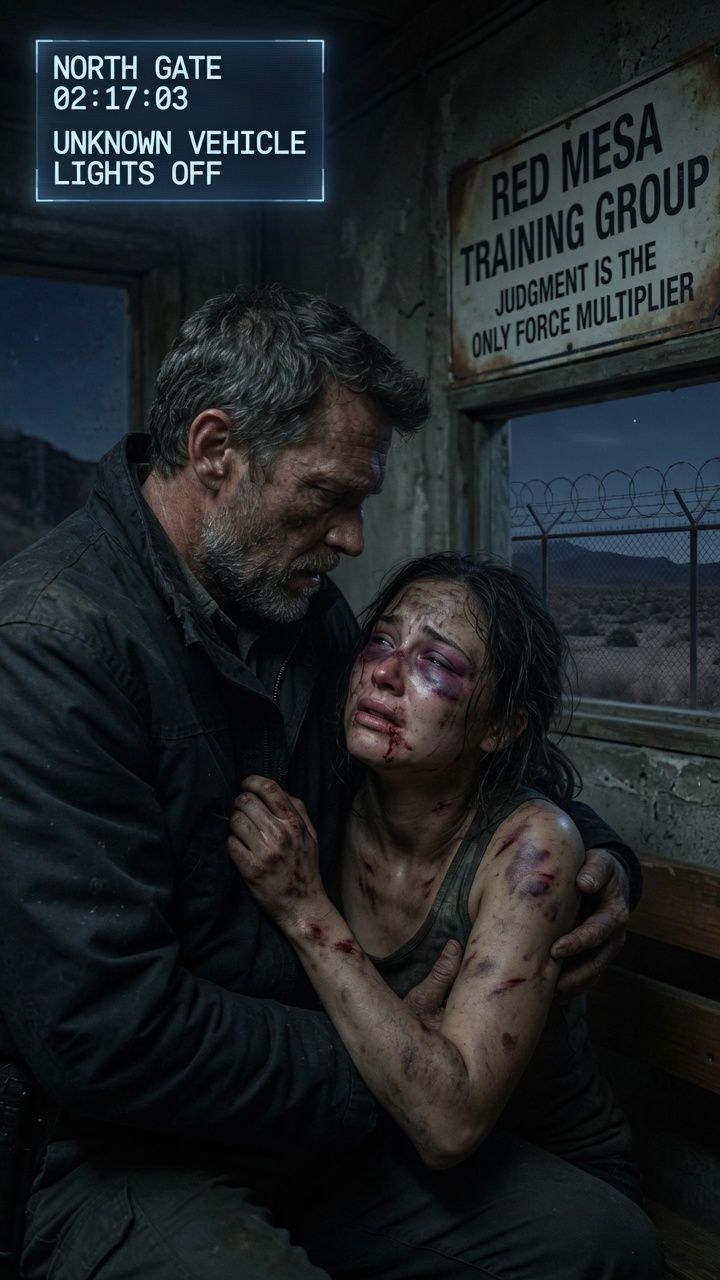

The security camera woke me at 2:17 in the morning.
At my age, I’d learned the difference between real rest and simply closing your eyes while waiting for the next problem to arrive. Men like me don’t sleep deeply. We listen – for unusual sounds, unfamiliar engines, for silence where something should be heard.
The monitor beside my bed glowed blue.
North gate. Unknown vehicle. Lights off.
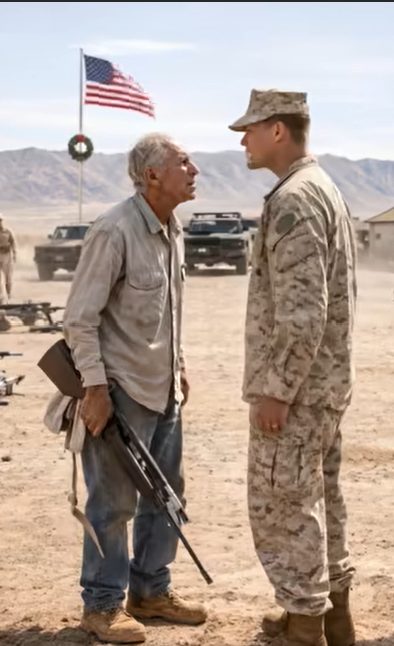
My name is Callan Mercer. I run Red Mesa Training Group on a remote stretch of desert in southern New Mexico. Officially, we train executives and security personnel in crisis response, defensive driving, evacuation procedures, and protective operations.
But the real lesson I teach is judgment.
“Anyone can panic when they have power in their hands,” I tell every new class. “The hard part is staying human when anger tells you to become something else.”
That night, I forgot my own lesson for a few seconds.
The vehicle sat fifty yards outside the fence line, angled awkwardly in the gravel. Kentucky plates. Cracked windshield. One broken taillight. No call ahead, no explanation, no attempt to leave.
Everything about it felt wrong.
I dressed quickly, grabbed my jacket, and slipped out through the side entrance without waking the guard. The desert air carried dust and dry brush. Moonlight cut sharp shadows across the mountains.
I approached the sedan carefully. A man who owns a training facility doesn’t casually walk toward a suspicious vehicle at 2 in the morning – not without his hand near something useful.
The driver’s door opened before I reached it.
Someone fell out.
Not stepped. Fell.
A young woman hit the gravel on one knee, catching herself with both hands. The sound she made was quiet. The pain behind it was not.
At first, I only saw tangled dark hair.
Then she lifted her face toward the moonlight.
“Dad.”
Everything inside me stopped.
“Juniper?”
She tried to stand, but she was barely holding herself together. One arm pressed tight against her ribs. One eye was swollen shut. Her lip was split. Dark bruises covered both arms in the unmistakable pattern of someone else’s hands – fingers, knuckles, grip marks.
She was seventeen years old.
And she had driven nearly fourteen hundred miles to find me.
I reached her just before she went down.
“Please,” she whispered into my shoulder. “Don’t call Mom.”
I had heard fear in many voices throughout my life – in training yards, in debriefs, in the controlled confessions of men who thought they were tough until something stripped that away. I had heard fear from soldiers and contractors and men who had seen genuinely terrible things.
I had never heard it like that.
So I didn’t call her mother.
I lifted Juniper into my arms the way I used to when she was small – when she’d fall asleep on the couch during movies and I’d carry her to bed without waking her, when she’d chase fireflies barefoot down by the lake and come back muddy and laughing. I carried her like I hadn’t spent years losing pieces of her childhood to custody hearings and distance and a woman who had learned, with quiet precision, exactly how to make me feel powerless.
I carried her into the gatehouse.
The bright lights made everything worse.
The darkness had let me hope it wasn’t as bad as it looked.
The light removed that mercy.
Possible broken ribs. Bruising along her jaw. A mark on her wrist that looked like a burn. Scratches across her neck. A cheekbone so swollen her eye had disappeared behind it entirely.
I set her down carefully on the bench, sat across from her, and made myself breathe slowly. Made myself stay in the room with her instead of going somewhere cold and purposeful inside my own head.
Then I asked the only question that mattered.
“Who did this to you?”
Juniper looked at me with her one clear eye. Whatever she was carrying, she’d hauled it fourteen hundred miles through the dark to lay it down here, at my feet, in the middle of the New Mexico desert at 2 in the morning.
She took one careful breath against her broken ribs.
And then she told me.
What She Said
His name was Derek Pruitt. Thirty-one years old. Her mother’s boyfriend of fourteen months.
Juniper told me in a flat, careful voice, the way people talk when they’ve already spent too much energy on the feeling part and have nothing left except the facts. She told me about the first time, which her mother had called an accident. About the second time, which her mother had called Juniper’s fault. About the pattern that followed – controlled, repetitive, escalating in the way those things always do when nobody stops them.
She told me she’d called the police twice.
The first time, her mother talked her out of the report in the parking lot of the station before they even went inside. The second time, a deputy came to the house, looked at Derek Pruitt standing in the doorway with his arms crossed, and asked Juniper if she was sure about what she was saying.
She was sure.
Nothing happened.
She told me about the night four days ago, which was the one that finally made her run. She didn’t describe it in detail. She didn’t need to. I’d seen the result. The burn on her wrist was from a cigarette. She said it like it was a minor clarification, just filling in a gap, and I made myself sit still and keep my face neutral while something I didn’t have a clean name for moved through my chest.
“Mom told me not to contact you,” she said. “She said you’d make it into something it wasn’t.”
I looked at my daughter’s face.
“She said you’d overreact.”
I didn’t say anything to that.
“I didn’t know where else to go,” Juniper said. Then she looked at the floor. “I almost didn’t come. I kept thinking maybe I was making it worse than it was.”
She had a burn on her wrist from a lit cigarette and she was wondering if she was exaggerating.
I asked her if she had eaten.
She hadn’t. Not since somewhere in Texas, which she thought was yesterday.
The Night, Managed
I had a medic on staff, a retired Army combat medic named Don Waite who lived in a trailer at the south end of the property and had seen worse things than this and handled them without drama. I woke him. He came over in five minutes, still pulling on his jacket, took one look at Juniper, and went to work.
Two ribs cracked, not broken through. Cheekbone intact but badly bruised. The burn was real but shallow. He cleaned everything, wrapped her ribs, gave her something for the pain that wouldn’t knock her out entirely.
“You drove like this?” he asked her, gesturing at her ribs.
“I drove like this,” she said.
Don looked at me over her head. I looked back at him.
He didn’t say anything else. He finished his work, told her to breathe shallow for a few days, and left us alone.
I made her eat. Eggs, toast, whatever I could find in the gatehouse kitchen at 3 in the morning. She ate like she was ashamed of being hungry, small bites, watching me.
“You’re not going to yell,” she said.
“At you? No.”
“At Mom.”
I set down my coffee. “Not tonight.”
She seemed to accept that. She ate the rest of her eggs.
Somewhere around 4 AM she fell asleep sitting up against the wall, her head tipped back, still holding a piece of toast. I took it out of her hand and put a blanket over her and sat in the chair across from her until the light outside started going gray.
I thought about Derek Pruitt. I thought about a deputy standing in a doorway deciding a thirty-one-year-old man was more credible than a sixteen-year-old girl. I thought about my ex-wife, Sandra, who I had once believed was a reasonable person, telling our daughter she was making it into something it wasn’t.
I thought about the custody arrangement that had moved Juniper to Louisville four years ago, the one I’d spent eleven months fighting and lost, the one a family court judge had signed off on because Sandra had a stable address and a regular income and I had a facility in the desert that trained men to do things that made people in courtrooms uncomfortable.
I thought about all of it.
Then I let it sit.
What I Did and Didn’t Do
I want to be honest about something.
There was a version of that morning where I drove to Louisville and made choices I couldn’t undo. I knew it was there. I could feel the shape of it. I’ve spent enough years around men who are capable of real damage to know exactly what that road looks like when you start down it.
I didn’t take it.
Not because of Derek Pruitt. He didn’t deserve that consideration.
Because of Juniper. Because she’d driven fourteen hundred miles to the one person she trusted not to make her situation worse, and burning everything down in a way that landed me in a Kentucky jail cell would have been the most efficient way to fail her.
So I called a lawyer instead. A family attorney named Greta Sloan out of Albuquerque who had handled two cases for men I knew and who did not waste words. I called her at 7 AM. She picked up.
I told her my daughter was sitting in my gatehouse with cracked ribs and a cigarette burn and I needed to know what I was legally able to do and what I needed to document before I did anything.
She told me to photograph everything. Write down everything Juniper told me, timestamped, in her own words. Get a formal medical evaluation at a hospital, not just my on-site medic, so there was a record that existed outside my property.
“And don’t call the mother yet,” Greta said.
“I wasn’t going to.”
“Good.”
I woke Juniper at 8. She was stiff and sore and her face looked worse in daylight than it had under the gatehouse bulbs. I told her we were going to the hospital in Las Cruces, that it wasn’t optional, and that I was going to sit with her the whole time.
She nodded. She didn’t argue. She just asked if she could wash her face first.
“Take your time,” I said.
Las Cruces
The ER doctor was a woman named Dr. Chen who examined Juniper with careful hands and a neutral expression and then stepped out into the hallway and asked me directly: “Is she safe right now?”
“She’s with me,” I said.
She nodded once and went back in.
The records they generated that morning became the foundation of everything that followed. Documented injuries. Estimated age of the bruising, which placed several of the older marks at ten to fourteen days prior to examination. The burn, formally noted. All of it timestamped, signed, filed.
Juniper sat on the exam table and answered questions and didn’t cry once. Not in the hospital. Not when the doctor asked her to describe what happened. Not when a social worker came and sat with her for forty minutes while I stood outside the door.
She cried once, later. In the truck, on the way back to Red Mesa. Quietly, facing the window, watching the desert go past.
I didn’t say anything. I just put my hand on the back of her seat.
She didn’t move away.
The Part That Took Longer
The legal process was not fast. I want to say that plainly because I think people expect these things to resolve cleanly, and they don’t.
Sandra called on day three. The conversation was exactly what I expected. She said Juniper had exaggerated, that I was using this to relitigate custody, that she was going to get a lawyer. I told her she should. I told her Juniper had documented injuries and a hospital record and a formal statement and that I had an attorney and that Juniper was not coming back to Louisville while Derek Pruitt was in that house.
Sandra hung up.
Derek Pruitt was arrested six weeks later. The charge that stuck was felony domestic assault. He had a prior, which I hadn’t known about and which made me wonder what that deputy had looked at when he ran the name and decided not to pursue it.
The custody modification took eight months. Greta Sloan was good. The records from Las Cruces were good. Juniper, when the time came, spoke for herself in a room with a guardian ad litem, and what she said was enough.
She lives at Red Mesa now.
She’s finishing her senior year through an online program. She helps with the administrative side of the facility two afternoons a week, answering phones, filing, learning the business. She has opinions about the filing system that are mostly correct.
She sleeps through the night.
I know because the security monitors show me everything, and her cabin stays dark and quiet from lights out until morning, and I’ve started to sleep a little deeper myself.
Not deeply. Men like me still listen.
But a little deeper.
Last month she asked if she could sit in on one of the new trainee orientations. I said yes. She sat in the back and didn’t say anything, just watched.
Afterward she asked me what I meant when I told the class the hard part was staying human when anger told you to become something else.
I thought about the night I sat in the gatehouse chair until gray light came through the window. About what I’d decided not to do and why.
“It means,” I said, “that the people who need you to be steady are worth more than the satisfaction of burning something down.”
She thought about that.
“Did you want to?” she asked. “Burn it down?”
I looked at my daughter.
“Yeah,” I said. “For about four seconds.”
She nodded like that was the right answer.
Maybe it was.
—
If this one stayed with you, pass it to someone who needs to read it.
For another wild story about unexpected moments, check out My Husband Told Me Not to Make a Scene. I Pressed One Button., or if you’re looking for different advice, perhaps What Time Should The Elderly Go to Bed After 70 For Better Health – Here’s What Doctors Advise and These 3 Drinks KILL CANCER & Beat Disease might be of interest.