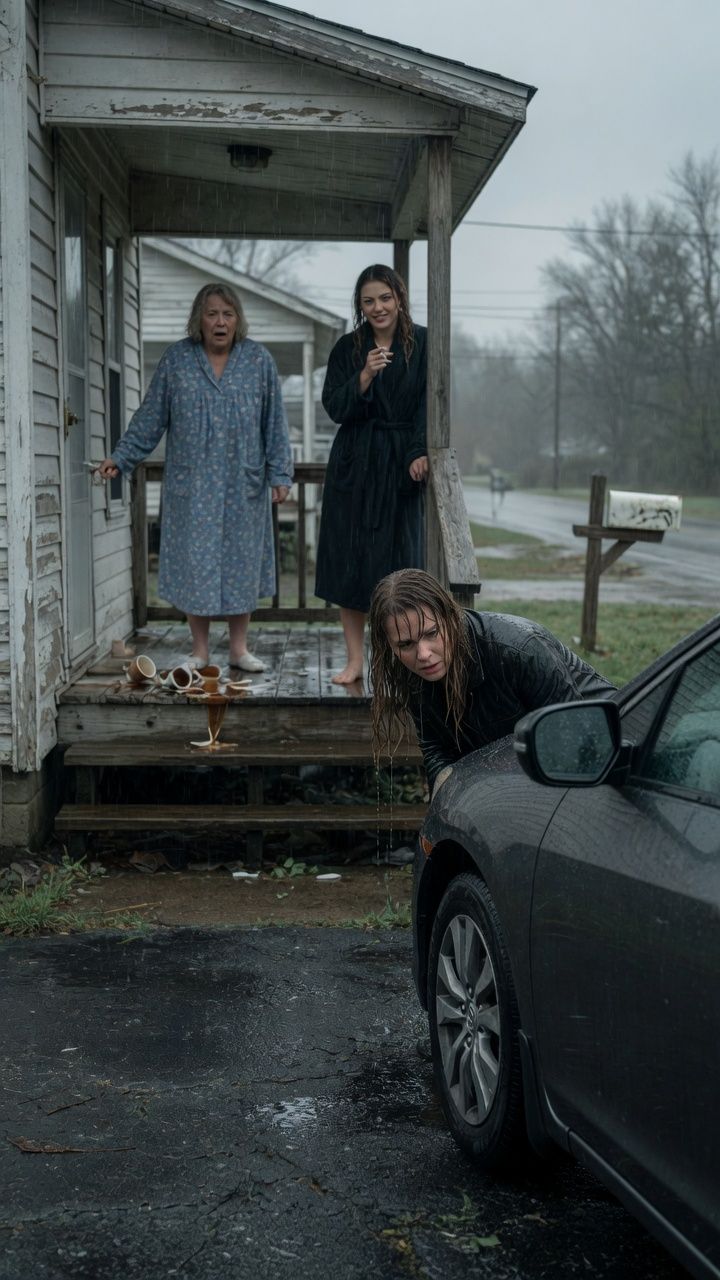

My sister made sure my car wouldn’t get us to court. My mother stood on the porch, smiled, and said, “You’re not going anywhere.” What neither of them knew was that I had been preparing for exactly this moment for three years.
Something was wrong the instant Claire’s foot touched the brake.
For one frozen second, she told herself she’d slipped. Then the old Honda surged forward down the rain-soaked driveway, tires hissing across wet pavement, gathering speed it had no business gathering. Beside her, twelve-year-old Ava pressed her backpack against her chest like a shield.
“Mom?”
Claire pumped the brake. Then again, harder.
Nothing.
At the bottom of the driveway, Pine Hollow Road curved sharply past a drainage ditch. Beyond it, morning traffic crawled beneath a low Ohio sky the color of wet concrete. Claire’s hands tightened on the wheel as the ditch rushed closer.
“Hold on.”
She yanked the emergency brake.
The rear wheels locked and screamed. The Honda fishtailed violently, clipping the mailbox with a hollow crack before lurching to a stop on the grass, its front bumper hanging over the edge of the ditch. Ava let out a sharp cry, then went silent.
For a long moment, neither of them moved. The engine ticked. Rain tapped the roof.
Then Claire looked up at the house.
Her mother, Margaret Vale, stood on the porch in her blue housecoat, coffee mug cradled in both hands, watching with the unhurried calm of someone who already knew how the morning would unfold. Beside her, Claire’s younger sister Paige leaned against the railing with a cigarette burning between her fingers.
Neither of them looked surprised.
Claire switched off the engine. Her hands were trembling, though she hadn’t noticed until now. Ava sat perfectly still, tears sliding silently down her face.
“Stay here,” Claire said. “Lock the door behind me.”
She stepped out into the rain. At the rear of the car, she crouched beside the back wheel. A thin thread of fluid traced a dark line down the driveway, still dripping.
Someone had been out here before they woke up.
Claire stood slowly.
Paige exhaled a long breath of smoke and looked away. Margaret smiled over the rim of her mug.
“You should have stayed where you belonged,” she called out, her voice as easy and certain as a woman commenting on the weather.
Something inside Claire went very quiet.
For three years, she had built her case the way someone builds a shelter against a storm – patiently, deliberately, one piece at a time. She had documented the threats, the stolen paychecks, the smashed phone, the false police reports filed against her, the custody hearings designed to exhaust and humiliate her. She had saved screenshots, recorded conversations, photographed bruises and broken locks. Today’s hearing was the last one. The judge would decide whether she and Ava could finally leave Ohio, leave this house, leave all of it behind for good.
She had not made it this far by panicking.
Claire reached into her coat pocket and pulled out her phone.
The smile dropped from Paige’s face.
“What are you doing?” Her voice had an edge now, the first crack in the morning’s performance.
Claire tapped the screen. The security camera mounted above the garage had been recording since 6:11 a.m. It had captured the driveway in full. It had captured everything.
She forwarded the footage to her attorney, to Detective Owens, and to the court clerk. Then she dialed.
“My name is Claire Donovan,” she said, her voice steady and clear. “I need to report tampering with my vehicle. My daughter and I were nearly driven into a drainage ditch.”
On the porch, Margaret Vale’s coffee mug slipped from her hands and exploded across the floorboards.
Claire didn’t look up. She kept talking.
How You Get to a Morning Like That
People always want to know when it started. There’s no clean answer to that.
It started when Claire was nine and Margaret told her she was too sensitive to survive the real world. It started when she was seventeen and brought home a report card with four A’s and a B and her mother put it in the trash without looking up from the television. It started the night Claire came home with a bruise across her cheekbone and Paige said, “What did you do to make him that mad?”
But if you’re asking when Claire started fighting back, that answer is easier.
October 14th, three years ago. A Tuesday. Ava was nine, and Claire had picked her up from school and driven straight to the county courthouse to file for a protection order against Ava’s father, a man named Dale Pruitt, who had thrown a ceramic mug at Claire’s head the week before and missed her by four inches. She’d had a split lip from the week before that. The week before that, he’d locked Ava out of the house in December while Claire was at her second job, and Ava had sat on the front step for two hours in a coat that was too small.
The clerk at the courthouse was a woman named Deb, mid-fifties, reading glasses on a beaded chain. She slid the paperwork across the counter without comment, but when Claire’s hands shook too hard to hold the pen, Deb reached over and steadied the form.
“Take your time,” she said.
Claire took her time.
That was the day she started keeping records.
The File
It lived on a flash drive she kept in a tampon wrapper in the bottom of her toiletry bag. Not clever, just practical. Paige had a habit of going through Claire’s things when she thought Claire was asleep, and Dale still had a key to the house until the locksmith came in November.
The file had folders. Dates, times, descriptions. Photos of the broken lock on her bedroom door. A voice memo from the night Margaret told Claire that if she “kept making trouble,” she’d call Dale herself and tell him where Claire was working. A screenshot of a text from Paige that read you think you’re better than us but you’re not and I’ll make sure the judge knows that.
There were forty-seven screenshots of that particular conversation thread. Paige had not been brief.
Claire had also kept the ER paperwork from the February night she’d brought Ava in with a wrist that turned out to be fractured. The notes said “fall from bed.” Claire had signed that. She’d been scared then, the grinding, practical kind of scared that makes you write whatever keeps everyone calm. She kept the paperwork anyway, with a separate note clipped to it explaining what had actually happened.
Her attorney, a woman named Karen Briscoe, had looked at the full file for the first time in August and gone very still for about thirty seconds.
“How long did it take you to put this together?” Karen asked.
“About two and a half years,” Claire said.
Karen set the folder down on her desk. “They don’t know you have this.”
It wasn’t a question.
“No,” Claire said.
What They Thought They Knew
Here’s what Margaret and Paige believed, going into the morning of the hearing.
They believed Claire was broke. She was, mostly, but not the way they thought. She’d been setting aside sixty dollars a week in a credit union account Margaret didn’t know existed, opened at a branch in Millbrook, twenty minutes east, where nobody from Pine Hollow Road banked.
They believed Claire was isolated. She had been, for a long time. But Karen Briscoe had put her in contact with a woman named Rhonda who ran a small nonprofit out of a converted house on the east side of Columbus, and through Rhonda she’d met three other women in various stages of the same fight. They texted. They checked in. On the nights Claire sat in the dark in Ava’s room listening to Margaret move around downstairs, she had people to text.
They believed she was too afraid to follow through.
That one had been true once. It stopped being true sometime around month four of building the file, when Claire realized that the fear didn’t go away, it just stopped being the loudest thing in the room.
And they believed that even if she got to the courthouse, even if the judge ruled in her favor, she had nowhere to go.
She had somewhere to go.
Rhonda had helped with that too.
The Call
The 911 dispatcher was calm, professional, and had Claire’s address pulled up before she finished her second sentence. Two cruisers arrived eleven minutes later, which felt both fast and slow at the same time, the way time moves when you’re standing in the rain watching your mother pick pieces of ceramic mug off a porch floor and pretend she doesn’t know why the police are coming.
Paige had gone inside by then. Claire heard the deadbolt turn.
The first officer, a young guy named Trent Hollis who couldn’t have been more than twenty-six, walked the driveway with a flashlight and crouched at the rear wheel well for a long time. The second officer, older, stayed near Claire.
“You said you have camera footage,” he said.
“Already sent to my attorney and the court clerk,” she said. “I can pull it up for you right now.”
He looked at her for a second. Not skeptical, just reading her.
“Okay,” he said.
She showed him. He watched it twice without speaking. In the footage, the timestamp read 4:53 a.m. The figure crouching behind the Honda was wearing Margaret’s blue housecoat, but it was Paige’s build. Paige’s walk. Paige’s way of looking over her shoulder.
The older officer’s jaw moved once, like he was working something over.
“Do you have somewhere you can take your daughter while we sort this out?” he asked.
“Yes,” Claire said. “But I need to make it to a hearing first.”
He checked his watch. He looked at the car, which was not going anywhere under its own power.
“I can have someone drive you,” he said.
The Last Hearing
The Harlan County Family Court building smelled like old carpet and coffee from a machine that had probably been there since 1994. Claire and Ava arrived in the back of a county vehicle at 9:47 a.m., thirteen minutes before their scheduled time. Ava had her backpack. Claire had the flash drive, a printed copy of the file index, and Karen Briscoe, who was already in the hallway with her reading glasses pushed up on her head and a look on her face that meant she’d already talked to Detective Owens.
“They arrested Paige at the house at 9:15,” Karen said. “Margaret is being questioned.”
Ava heard that. She looked up at Claire and then looked away, at the water fountain against the wall, at nothing in particular.
“You okay?” Claire asked her.
Ava thought about it for a second. “I want to go to Aunt Rhonda’s,” she said. She’d started calling Rhonda that sometime in September. Rhonda had not objected.
“Tonight,” Claire said. “We’ll go tonight.”
The judge was a woman in her early sixties named Patricia Morrow. She’d had the case file for six weeks and she’d clearly read every page of it, because she asked almost no clarifying questions. She looked at the footage timestamp. She looked at the ER paperwork with Claire’s handwritten note attached. She looked at the screenshot of Paige’s text thread for what felt like a long time.
Then she looked at Claire over the top of her glasses.
Claire looked back.
Judge Morrow signed the relocation order at 10:34 a.m.
That Night
They left at 7 p.m. with two duffel bags and a laundry basket of Ava’s things and the box Claire had kept packed and hidden in the back of the hall closet for four months. Rhonda met them at the door of the converted house on the east side of Columbus with the porch light on and a pot of something on the stove that smelled like garlic and onion.
Ava walked straight in like she’d been there before.
Claire stood on the porch for a second, her hand on the door frame.
She didn’t feel the way she’d expected to feel. She’d imagined relief, some big exhale, the movies version of it. What she actually felt was tired in a way that went all the way down to her feet, and hungry, and something else she didn’t have a word for, something that was maybe just the absence of dread.
She went inside.
Rhonda handed her a bowl without asking what she wanted.
“Sit down,” Rhonda said. “Eat.”
Claire sat down and ate.
—
If this story stayed with you, share it. Someone out there is three years into building their own file and they need to know it’s worth finishing.
For more tales of family drama and unexpected twists, you might enjoy reading about My Daughter Knocked on My Door at 3 A.M. Still Wearing Her Wedding Gown or when My Daughter Drove 1,400 Miles in the Dark to Find Me, and for a different kind of confrontation, there’s always the time My Husband Told Me Not to Make a Scene. I Pressed One Button..