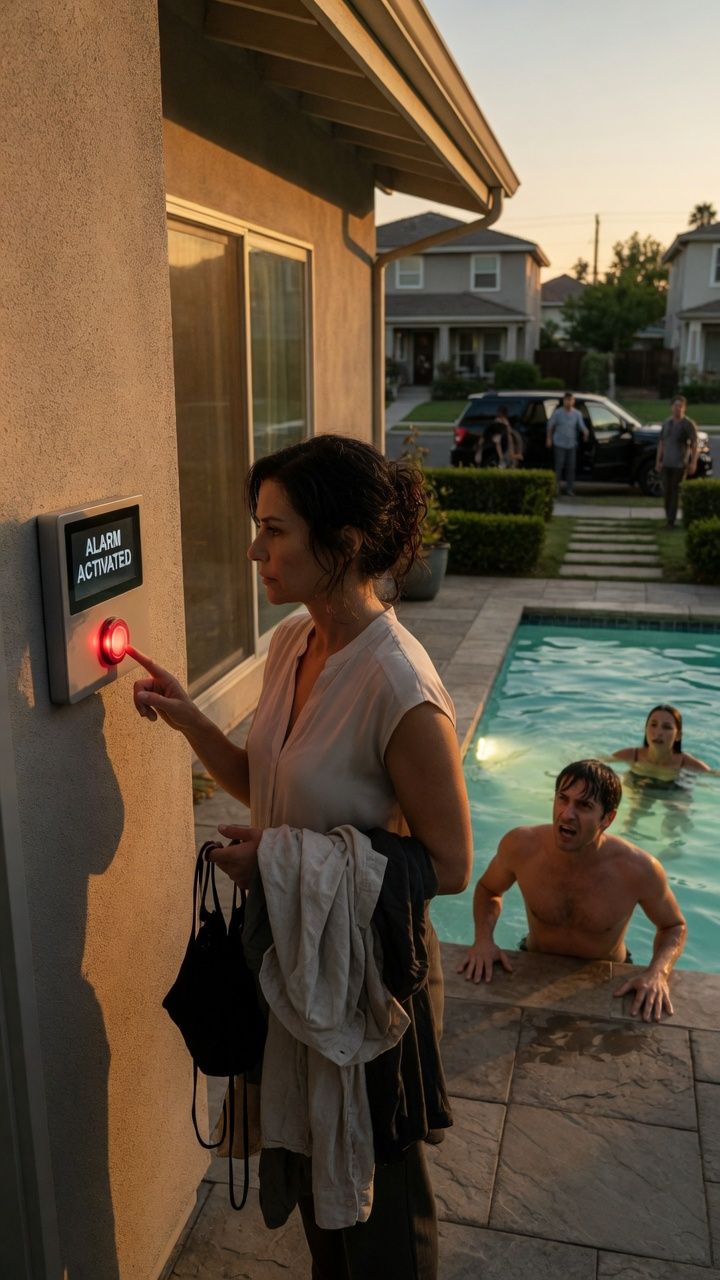

At exactly 5:42 p.m., I stepped into my backyard and saw my husband in our $18,000 pool with the neighbor who showed up every Tuesday pretending she needed sugar. He looked straight at me and said, “Don’t make a scene.” So I picked up their clothes, pressed one button, and made sure the whole neighborhood heard the truth.
The first thing that felt wrong was the water.
Not laughter. Not voices. Just the heavy sound of it striking the pool tiles while evening light bounced off the glass doors. The air smelled like chlorine, warm stone, and the basil I had planted beside the grill because Caleb once said it made the patio feel like home.
Home.
That word becomes a wound when someone else decides what it means.
I had come home from work at 4:56 p.m., a grocery bag cutting into my fingers. I remembered setting it on the counter. I remembered an avocado rolling across the floor. I remembered the neighbor’s dog barking twice and then going suddenly, completely quiet, as if even that animal understood something had shifted.
Caleb saw me first.
His hands left Vanessa’s waist so fast the water erupted around them.
“Marissa,” he said, the way you say the name of something you’re trying to contain.
Vanessa sank lower until only her shoulders and her glossy red lips remained above the surface. The same shade of lipstick that had marked the coffee cup she left in my kitchen the week before, after stopping by to borrow sugar for the third Tuesday in a row.
That was the real betrayal, wasn’t it?
Not the sugar. Not the friendly smiles at the gate. It was that I had opened my yard, my kitchen, and my trust to her. I had let her get close enough to learn the rhythm of my life, and she had used every inch of that access.
Caleb cleared his throat.
“Don’t make a scene.”
I looked at the patio chair beside the pool.
Her black bikini top hung over the back like a confession. Caleb’s linen pants were folded neatly beside it. His belt lay on the stone. His keys. Her sundress. Her sandals. Her phone, screen glowing with three missed calls from her husband.
Proof has its own sound when everything finally locks into place.
A click.
I didn’t throw the groceries. I didn’t scream. I didn’t ask how long it had been going on, because women only ask that when some part of them still believes the answer can change something.
I set the bag on the outdoor counter.
One avocado rolled out and tapped softly against the stainless-steel sink.
Then I walked toward the lounge chairs.
Caleb’s shirt. His belt. His keys. Vanessa’s dress. Her sandals. Her phone. I gathered each item slowly, draping them over my arm the way you collect laundry on an ordinary afternoon.
“Please,” Vanessa whispered. “We can explain.”
I glanced at the wet footprints leading from my kitchen door to the pool’s edge.
“You already did.”
Caleb gripped the tile. His wedding ring caught the light beneath the water, bright and completely meaningless.
“Don’t be dramatic.”
That sentence turned something inside me colder than anger ever could.
Anger would have made me throw his keys over the fence. Anger would have made me tear her bikini top in half. Anger would have made me exactly the version of myself he could later use to make himself look like the reasonable one.
So I stayed still.
My fingers tightened around the damp fabric until it pressed against my arm.
Then my thumb found the red emergency button on the security panel beside the kitchen door. The same system I had paid $2,700 for after Caleb laughed and called me paranoid. The same system connected to the side gate camera, the pool camera, the front doorbell, and the neighborhood patrol alert he had dismissed as way too much.
At 5:42 p.m., way too much became evidence.
His face changed before I even touched it.
“Marissa. Don’t.”
I pressed the button once.
The alarm tore through the backyard. Sharp. Violent. Impossible to ignore or explain away.
Dogs erupted all the way down the street. Curtains shifted. Garage doors rolled open one after another. The older man across the road stepped onto his porch with a coffee mug in his hand, squinting toward my fence. Mrs. Palmer leaned over her hedge in gardening gloves, one still caked with dirt. Two teenagers stopped their bikes at the curb and stared at my house like something had cracked open in the middle of the afternoon.
The whole subdivision held its breath around the noise.
A sprinkler kept ticking across someone’s lawn. A delivery driver stood frozen beside his van, a package tucked under his arm, not moving. Mrs. Palmer opened her mouth and closed it again. The teenagers glanced toward my gate, then looked away fast, as if pretending not to see it might keep them out of whatever this was.
Nobody moved.
Caleb shouted, “Turn it off!”
I stood beside the panel with their clothes over my arm and my wedding ring still on my finger.
“Why?” I said. “You brought this five feet from my kitchen.”
Vanessa covered her face with both hands, but the water couldn’t cover what she had done. Caleb moved to climb out of the pool, then stopped when he remembered he had nothing to put on.
My phone buzzed.
Security Company: Emergency alert confirmed. Patrol notified.
Then the Ridge Hollow community app pushed a notification to every phone on the street.
Backyard alarm at 214 Ridge Hollow Lane.
There it was. The address. The alert. The exact time, automatically recorded and permanently logged. The kind of record Caleb could never talk his way around, deny, or quietly rewrite later.
I reached into his folded pants and pulled out the key fob to his new $64,000 truck.
His mouth fell open.
I held it between two fingers and looked at him across the water.
“This,” I said, “is the last thing of yours going into my pool.”
I dropped it into the deep end.
It vanished beneath the blue.
Caleb went completely still, one hand still gripping the tile. Vanessa turned toward the side gate just as a car door slammed out front.
Her husband’s black SUV sat at the curb.
The alarm kept screaming.
I tightened my grip on their clothes.
And when the driver’s door swung open, Vanessa whispered one name that finally made Caleb look afraid.
“Mark.”
What Followed Mark Through That Gate
Mark Pruitt was not a small man.
Six foot two, maybe. Broad through the shoulders in the way that comes from actual work, not a gym. He wore a gray t-shirt and jeans and he had the look of someone who had driven over here in a hurry but had not, in the car, decided exactly what he was going to do when he arrived.
He stood at the gate and took it in.
His wife, chest-deep in another man’s pool. The alarm still screaming. A woman he’d probably waved at twice in a grocery store parking lot, standing on the patio holding a pile of other people’s clothes.
He didn’t say anything at first.
That was somehow worse than if he had.
Vanessa said his name again, softer this time. “Mark.”
He looked at Caleb. Caleb looked at the water. The alarm kept going.
I crossed to the panel and turned it off.
The silence it left behind was different from before. Heavier. The kind that fills up fast with everything nobody wants to say out loud.
Mark walked to the edge of the pool. He crouched down, forearms on his knees, and looked at his wife the way you look at a car wreck when you’re still trying to figure out the sequence of events.
“How long,” he said.
Not to me. Not to Caleb. To her.
Vanessa shook her head. “It’s not what it looks like.”
That sentence. I had been bracing for it since 5:42.
Mark stood back up. He turned and looked at me, and there was something in his face that I recognized. Not anger. Not shock. Just the very specific exhaustion of someone who has just had a suspicion confirmed that they had been hoping, badly, was wrong.
“I’m sorry,” he said.
To me.
I didn’t know what to do with that, so I just nodded.
He picked up Vanessa’s sandals from the patio chair. Her sundress. He set them at the pool’s edge without a word and walked back toward the gate.
“Mark.” Her voice cracked. “Please.”
He stopped with his hand on the latch.
“Come home when you’re decent,” he said. “We’ll talk there.”
Then he left. The gate clicked shut behind him. His SUV started, sat for a moment, and drove away.
The Part Nobody Tells You About Being Right
Caleb hauled himself out of the pool while I was still standing there.
He grabbed a towel from the rack beside the outdoor shower, the good Turkish cotton ones I had ordered from a catalog in March, and he wrapped it around his waist and stood dripping on my patio stone.
“Marissa.” His voice had shifted. Gone careful. “We need to talk about this like adults.”
I looked at him.
Six years. We had been married six years. I knew the exact cadence of every sentence he used when he was managing a situation instead of living in it. I had sat across from him at dinners, at his mother’s kitchen table, at our own kitchen table, and I had believed, for most of those six years, that the distance I sometimes felt between us was just the ordinary friction of two people building a life.
It wasn’t friction.
It was him. Deciding, over and over, that I was someone to be managed.
“The cameras recorded everything,” I said. “The community alert logged the time. The patrol company has it on file.”
He blinked.
“I’m not saying that to threaten you,” I said. “I’m saying it so you know the shape of what happened today. So you don’t spend the next week convincing yourself it can be minimized.”
Vanessa had climbed out by then. She pulled her dress on over wet skin, not looking at either of us, and found her sandals by the chair. Her phone had twelve notifications now. She picked it up and walked to the gate without speaking, and I heard the latch go, and then her footsteps on the side path, and then nothing.
Caleb and I were alone in the backyard.
The basil beside the grill moved in a small wind.
“Where are you going to go tonight?” I asked.
His jaw tightened. “This is my house.”
“It’s in my name.”
That had been a practical decision, three years ago, because my credit score was better and the rate was lower. Caleb had signed the paperwork without reading it carefully, which was also, I now understood, a pattern.
He stood there in the Turkish cotton towel and said nothing.
The Calls That Came After
My sister Donna called at 6:15.
She had seen the Ridge Hollow community app. She lived four streets over and had been in the middle of cooking dinner when her phone lit up with the alert.
“214 Ridge Hollow,” she said. “That’s you.”
“Yes.”
A pause. Then: “Do you need me to come over?”
“Not yet.”
“Are you okay?”
I thought about it honestly. My hands weren’t shaking. My voice was level. The avocado was still on the counter where it had rolled and I hadn’t put the groceries away yet.
“I don’t know,” I said. “But I’m not falling apart.”
“That’s either healthy or concerning.”
“Probably both.”
Donna showed up anyway, forty minutes later, with a bottle of wine and the leftover pasta from her dinner. She didn’t make me talk through it in sequence. She just sat at my kitchen counter and ate pasta and let me move around the kitchen at whatever pace I needed.
At some point she said, “The truck key.”
“Yeah.”
“In the pool.”
“Yeah.”
She was quiet for a second. Then: “That’s going to cost you.”
“I know.”
“Was it worth it?”
I thought about the look on his face when it hit the water. The way his hand had gone still on the tile. The way he had, for one unguarded second, looked genuinely afraid of me.
“Yes,” I said.
What the Pool Camera Showed
The security company sent the footage to my email at 8:47 that night.
Standard procedure after an emergency alert, the rep told me on the phone. Thirty-minute clip. Pool camera, gate camera, front doorbell. All timestamped.
I watched it once.
They had been in the pool for forty-one minutes before I got home.
Forty-one minutes. On a Tuesday. In my backyard. In the pool I had picked out of a catalog, that I had argued with the contractor about for three weeks over the tile color, that I had paid $18,000 for because Caleb said we deserved something nice.
I forwarded the footage to my email and then to a folder on my cloud storage. Then I texted my friend Cheryl, who had been a paralegal for eleven years, and I said: I need to know who you’d recommend for divorce.
She responded in four minutes with a name and a direct number.
Call tomorrow morning, she wrote. Before he does.
I set my phone face-down on the counter.
The house was quiet. Donna had gone home an hour before, and Caleb had not come back, which meant he was either at a hotel or at his brother’s place in Garfield, which was where he went when he wanted someone to agree with him.
I walked to the back door and looked out at the pool.
The underwater lights had come on automatically at dusk. The water sat still and blue and completely ordinary, like nothing had happened in it at all.
Caleb’s truck key was down there somewhere in the deep end. Eight feet of water and a $64,000 fob and six years of a marriage I had believed in more than he ever did.
I turned off the patio light.
I went inside.
I put the groceries away.
—
If this one hit somewhere real, pass it on to someone who needed to read it today.
For more useful tips, consider learning about what time the elderly should go to bed after 70 for better health or how these 3 drinks kill cancer & beat disease. You might also be interested in how one person hasn’t been sick for 35 years with clear vision and normal blood pressure.