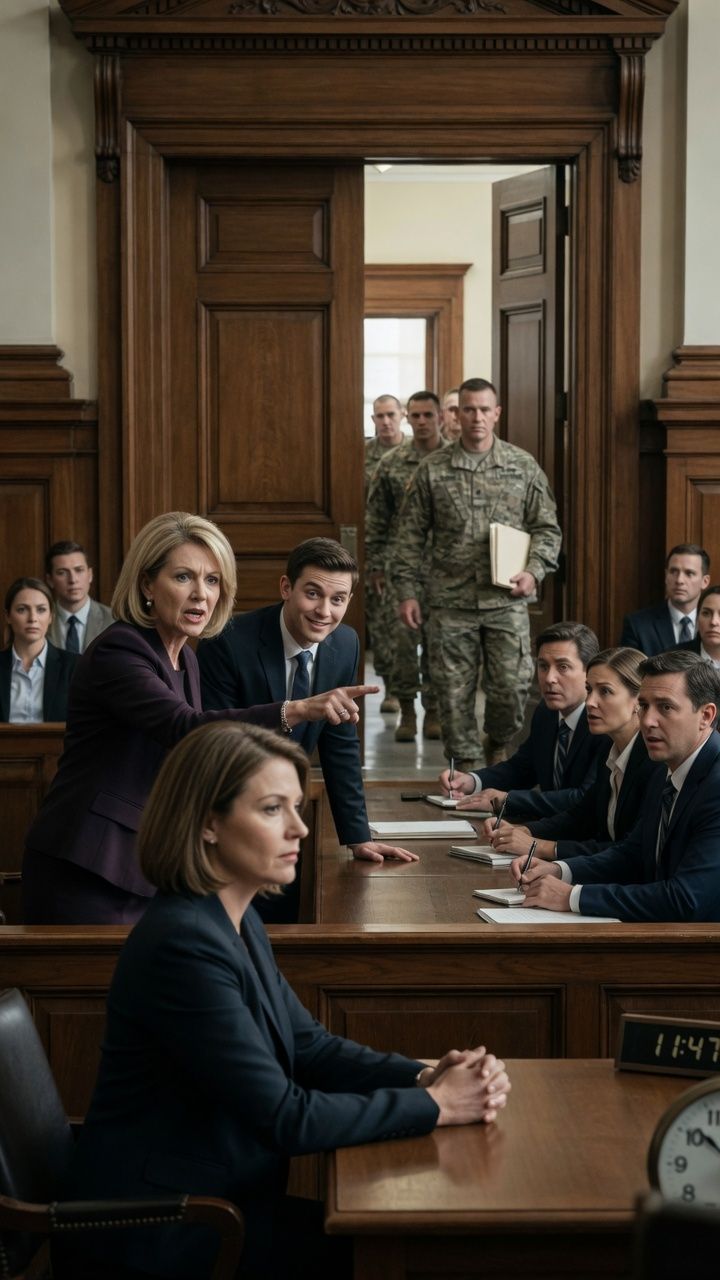

I stood frozen as I watched my own mother swear under oath that I had never served my country.
She looked the judge dead in the eye, pointed at the scars hidden beneath my clothes, and called them fake. Before a packed courtroom, she declared with perfect composure that I had fabricated twelve years of military service, bought my medals online, and built my entire life on a foundation of lies.
The jury believed her. Reporters furiously scribbled notes, catching every word. Even my younger brother was smirking, already certain he had won.
None of them knew what I knew.
I was counting down the minutes. Because right outside those courtroom doors, the only people who could prove my truth were already on their way. And when those doors finally swung open, everything my family had built on lies would come crashing down.
—
My name is Mara Bennett, and betrayal hits hardest when it arrives in a familiar voice.
The first lie my mother told stole twelve years of my life. The second was designed to put me behind bars.
“She was never in the Army,” my mother, Victoria Bennett, said from the witness stand, her voice carrying the kind of quiet certainty that only comes from years of practice. “The scars, the medals, the entire story – she made it all up.”
Whispers rippled through the courtroom.
I did not move.
My attorney leaned close. “Mara. Don’t react.”
“I won’t,” I said quietly.
He studied my face for a moment. “That worries me more.”
Across the aisle, my younger brother Caleb dipped his head to hide a satisfied smile.
—
The case had begun as a dispute over my father’s defense technology company, Bennett Meridian Systems. Before he died, Dad had left me the controlling shares and named me executor of his estate. Three days after the funeral, Caleb produced a new will that left everything to him.
When I challenged it, he escalated.
He accused me of forging military records, fabricating combat service, and manipulating our father with stolen valor. Then the prosecutors got involved.
Fraud. Forgery. Falsified federal documents.
The prosecutor lifted a wooden shadow box and turned it slowly toward the jury. Inside sat my Silver Star, my Purple Heart, and the burned unit patch I had carried home from a mission that nearly ended my life.
My mother’s lip curled.
“She bought those online.”
Several jurors turned to look at me. I knew what was behind their eyes.
Fraud. Liar. Imposter.
Beneath my blouse, the scar along my ribs throbbed as if it remembered the blast before I did. For one unguarded moment, I was back overseas – rotor blades cutting smoke, blood soaking through my uniform, Major Daniel Hayes dragging me through wreckage while gunfire split the air around us.
Those memories were real. Every single one of them.
But I couldn’t explain them. Not in this courtroom. Not yet.
The operation was still classified. My military file had been sealed on grounds of national security, and Caleb knew it. That was the entire architecture of his case – he had built it around the one truth I was forbidden to tell.
—
My father had known everything.
In the last weeks before cancer took him, he gripped my hand with what little strength he had left.
“They’re moving money through shell companies,” he whispered. “Protect the company, Mara. But don’t expose your unit.”
“I promise,” I told him.
I meant it then. I still meant it now, even sitting at a defense table while my mother dismantled my life one sworn sentence at a time.
The prosecutor approached her again.
“Mrs. Bennett, did your daughter ever deploy overseas?”
“No.”
“Did she ever serve in the United States Army?”
“Never.”
Then she turned and looked directly at me. A small, unhurried smile crossed her face – the kind that said she had already won and wanted me to know it.
I calmly folded my hands on the table and looked at the clock above the judge’s bench.
11:47 a.m.
My pulse stayed even.
My attorney leaned in. “What are you waiting for?”
I didn’t look away from the clock.
“Authorization.”
He frowned. “For what?”
For the first time all morning, I smiled.
“In thirteen minutes,” I said, “classified becomes declassified.”
At that exact moment, the courtroom doors rattled as someone on the other side reached for the handle.
The Doors Open
The bailiff moved to block them.
He didn’t get there in time.
The doors swung wide, and the sound that came through them was the sound of hard-soled shoes on marble, moving in formation. Not running. Not hurrying. The deliberate, unhurried pace of people who already know they own the room.
There were four of them.
Major Daniel Hayes came through first, still built like a door frame, still carrying that particular stillness that combat leaves in certain people. Behind him, Captain Renata Okafor, who had pulled shrapnel from my side with her bare hands on a mountainside I’m still not allowed to name. Then Sergeant First Class Greg Pruitt, who I hadn’t seen since Walter Reed, walking with the same slight hitch in his left knee that he’d walked out of the same blast with. And behind them all, a man in a civilian suit I didn’t recognize, carrying a leather briefcase and a government seal on his lapel.
The judge leaned forward. “Who are these people?”
My attorney was already on his feet. He’d known. I’d told him to be ready, but I hadn’t told him what ready would look like, and from the way his hand shook slightly as he reached for his notes, I think the reality of it hit him different than the theory had.
“Your Honor,” he said, “the United States Department of Defense requests permission to address the court.”
The man with the briefcase stepped forward. “Deputy General Counsel, DoD. We have a declassification order signed this morning at oh-eight-hundred hours authorizing the release of Sergeant First Class Mara Bennett’s complete service record, including all previously sealed operational files.”
The prosecutor stood up so fast her chair scraped back. “Objection. This is highly irregular – “
“Sit down,” the judge said.
She sat.
What My Mother’s Face Did
I watched Victoria Bennett across the courtroom.
She hadn’t moved. Her posture was still perfect, hands still folded in her lap, chin still level. But something behind her eyes had shifted, some small interior machinery grinding against a gear it hadn’t expected to find there.
Caleb was less composed. His attorney was already leaning into his ear, and Caleb kept shaking his head, short tight shakes, like he was trying to dislodge something.
He’d known the files were sealed. He’d built the whole case on that. What he hadn’t known, what neither of them had known, was that six weeks before my father died, he had reached out to a contact at the Pentagon. A man he’d worked with on three defense contracts over twenty years. A man who owed him a favor and had the clearance to call in another favor above him.
Dad had started the declassification request from his hospital bed.
He just hadn’t told me. Hadn’t wanted to get my hopes up, maybe. Or hadn’t wanted me to feel like I needed rescuing. Either way, he’d set the clock running before he died, and this morning it had hit zero.
The Deputy General Counsel handed a document to the bailiff, who carried it to the judge.
The judge read it. Took his time. Nobody breathed particularly well.
Then he looked up.
“The court will recess for thirty minutes. When we reconvene, we will review the declassified record in full.” He looked at the jury. “You are instructed to disregard the testimony given in the last hour until the evidentiary record has been updated.”
Several jurors were already staring at my mother.
She was staring at the table in front of her.
What the File Contained
I already knew what was in it. But hearing it read aloud in a federal courtroom, in front of my mother, in front of Caleb, in front of the reporters who were now very still in the gallery – that was something I hadn’t prepared for.
Twelve years of service. Four deployments. Two commendations for valor. One Silver Star awarded for actions on a date and at a location now entered into the public record for the first time. One Purple Heart for wounds sustained during the same operation, documented by field surgeons and countersigned by a colonel whose name I won’t put here because he’s still active.
Major Hayes took the stand.
He is not a man who performs emotion. He answered every question in the flat, factual cadence of someone filing a report. Yes, Sergeant Bennett served under his command. Yes, she deployed. Yes, he was present when she was wounded. Yes, he personally submitted the recommendation for the Silver Star. Yes, the burned unit patch in the shadow box was genuine; he had an identical one in a box at home in Fayetteville.
The prosecutor tried to cross-examine him.
She asked two questions. He answered both in one sentence each. She sat back down.
Renata took the stand after him. Renata is different from Hayes – warmer, quicker – and she looked at me once before she started talking, just a glance, the kind that meant I’ve got you. She described the blast. She described the wreckage. She described the specific dimensions of the wound she’d packed with her hands for eleven minutes until the medevac came down.
I looked at the jury during her testimony.
One woman in the second row had her hand pressed flat against her sternum.
What Caleb Didn’t Know About the Shell Companies
Here’s the part nobody in the courtroom had connected yet.
Caleb had accused me of fraud to discredit me before I could investigate the finances. That was the play. Get me convicted, get me out of the picture, walk away with Bennett Meridian and the shell company money Dad had told me about from his hospital bed.
What Caleb didn’t know was that I’d spent the eight months between Dad’s death and this trial doing exactly what Dad had asked. Quietly. Without telling Caleb, without telling my mother, without filing anything that would tip them off.
The DoD’s Deputy General Counsel hadn’t just brought my service record.
He’d brought a second envelope.
My attorney opened it at the defense table while Hayes was still on the stand. I watched his face as he read the first page. He went very still in a way that reminded me of Hayes, actually – that same quality of a man absorbing information and not letting it out until he knows what to do with it.
Then he looked at me.
“Mara,” he said quietly. “This is a federal wire fraud investigation. They’ve been building it for four months.”
“I know,” I said.
“You know.”
“I gave them the documentation. The shell company records. The transfers.” I paused. “Dad found the first thread. I just pulled it.”
He looked back at the envelope. Then at Caleb across the aisle. Then back at me.
“Your brother is going to be arrested today.”
“I know that too.”
The Moment Caleb Understood
The judge called a second recess to review the new materials.
During that recess, two men in suits entered from a side door and walked directly to the plaintiff’s table. They didn’t hurry. One of them said something to Caleb’s attorney. The attorney went the color of old chalk.
Caleb looked at his attorney. His attorney looked at the table.
Then Caleb looked at me.
I don’t know what he expected to find on my face. Satisfaction, maybe. Triumph. Something that would let him frame this as a personal attack, a sister’s vendetta, something small and emotional he could reduce it to in his own head.
I just looked back at him.
He was the first to look away.
My mother had not moved. She was still at the witness stand, technically, though nobody was asking her anything. She sat with her hands in her lap and her chin level and her eyes fixed on some middle distance, and I thought about all the years I had spent trying to understand her. All the phone calls she hadn’t returned. All the holidays I’d come home from deployment to find she’d told people I was traveling for work. The way she’d introduced me at my father’s funeral to his colleagues as his daughter who worked in logistics.
Logistics.
Twelve years. Four deployments. Two wars.
Logistics.
I don’t know what she told herself. I don’t know if she believed Caleb, or if she built the belief because it was useful, or if somewhere in the architecture of who she is, having a daughter who did what I did was a thing she simply couldn’t hold. I stopped trying to figure it out a long time ago. Somewhere over the Atlantic on a flight back from a place I can’t name, I put that question down and left it there.
She turned and looked at me, finally. Just for a second.
I looked back.
Then I turned toward the doors as Hayes and Okafor and Pruitt came back through from the hallway, and Renata caught my eye and gave me the small nod she’d been giving me since the day she pulled shrapnel out of my side, the one that means still here, still standing, and I nodded back.
The bailiff called the court to order.
Outside, I could hear the sound of someone being read their rights.
—
If this one hit you somewhere real, pass it on to someone who needs to read it.
For more truly unbelievable family stories, you might want to read about My Brother Sold My House While I Was Overseas. He Did It at a Family Dinner. or even My Parents Skipped My Graduation and Told Everyone I Failed.