
“Security!”
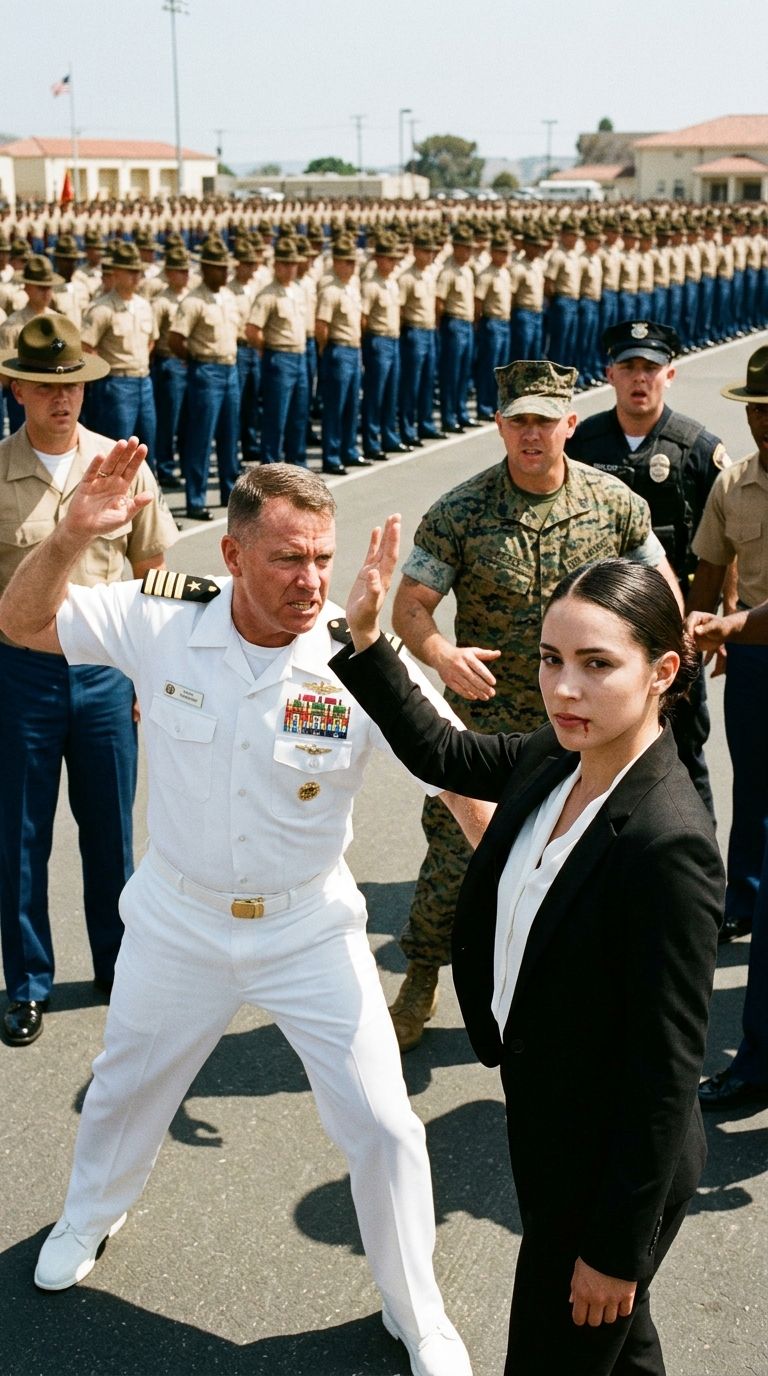
The word cracked across the parade deck a heartbeat after the slap – sharp, furious, unhinged.
The impact still hung in the air.
It split the noon heat like a rifle shot, severing the moment clean. Even the gulls wheeling high above Camp Pendleton seemed to veer away, as if instinct alone warned them from what had just happened below.
Two thousand Marines stood in perfect formation – rows locked, boots aligned, dress whites and blues blazing beneath the merciless California sun. Discipline held.
Almost.
For a fraction of a second, it faltered.
Eyes shifted – barely.
Breaths caught – quietly.
A ripple of disbelief moved through bodies trained never to react.
Then it vanished, buried under years of conditioning.
At the center of the parade ground, the woman didn’t move.
She didn’t stumble. Didn’t recoil. Didn’t even blink.
A thin line of blood formed at the corner of her mouth – slow and deliberate, as if the world itself had paused to watch it appear.
Rear Admiral Warren Blackwood lowered his hand as though expecting applause.
His chest rose sharply. His jaw was set with authority, with rage – but beneath it, something uglier flickered. The look of a man who had lived too long believing rank could excuse anything.
“Get her off my deck,” he snapped. “Now.”
The nearest military police hesitated – just long enough to notice.
Staff Sergeant Nolan Pierce stepped forward, every movement controlled, reluctant.
“Sir – she has Department of Defense authorization.”
Blackwood turned on him instantly.
It wasn’t anger alone. It was offense. As though the existence of resistance – however small, however measured – was a personal affront.
“I said remove her.” His voice dropped, quieter now, and more dangerous for it. “I don’t care if she has authorization from God Himself.”
Silence pressed in from all sides.
The woman lifted her chin.
She was young – late twenties, perhaps – but there was nothing uncertain about her. Dark hair pulled back cleanly. A fitted black blazer over a white blouse. Civilian. Unremarkable.
Until you looked closer.
Until you saw the stillness.
It wasn’t fear. It was something rarer than that – the particular calm of someone who had already decided how this would end.
It unsettled everyone who noticed it.
When she spoke, her voice didn’t rise.
It didn’t need to.
“Admiral Blackwood.” Even. Unhurried. “I’m here under direct orders from the Secretary of Defense.”
A pause.
Then, softer – but sharper:
“And you just assaulted a federal official in front of two thousand witnesses.”
The words moved through the formation like cold water – not loud, not chaotic. Simply undeniable.
Blackwood stepped closer, invading her space with the ease of a man who had never been told no in any way that mattered.
“You think anyone here is going to side with you?”
She looked at him. Really looked at him.
Not with anger. Not even with judgment.
With certainty.
“I think,” she said quietly, “you should be very careful about what you do next, Admiral.”
Something shifted in his face.
Panic surfaced – brief, raw, unmistakable.
Then pride crushed it back down.
His hand came up again.
Faster this time. More force behind it.
And then – Her arm moved.
What Two Thousand People Saw
It wasn’t a big movement.
That was the thing nobody could quite explain afterward, when the statements were being taken and the JAG officers were still trying to reconstruct the sequence. It wasn’t dramatic. It wasn’t a spin or a throw or anything that looked like training.
Her left forearm came up. Caught his wrist. Redirected it past her face with maybe four inches of clearance.
Then her right hand closed around his thumb.
One controlled rotation. His elbow bent the wrong direction. His knees followed because there was nothing else for them to do.
Rear Admiral Warren Blackwood – two stars, thirty-one years of service, the kind of man who got a parking spot with his name on it – went down onto the parade deck on one knee like he was proposing to the concrete.
He made a sound. Not words. Just a sound.
The formation did not react.
Two thousand Marines, and not one of them moved a muscle.
But the silence changed. It went from held breath to something else – something that took up more space, pressed against the edges of the afternoon like weather coming in.
Staff Sergeant Pierce stood exactly where he’d been standing. His face was a wall. But his eyes did something they weren’t supposed to do.
They went to the woman.
She wasn’t looking at Blackwood anymore. She was looking at Pierce. Calm. Still holding the Admiral’s thumb at an angle that made his whole arm useless.
“Sergeant,” she said. “You’re going to want to make a call.”
Pierce didn’t hesitate this time.
Her Name Was Diane Mercer
Nobody on that parade deck knew who she was. That was by design.
Diane Mercer had worked for the Department of Defense for six years, the last three of them as a special investigator attached directly to the Inspector General’s office. She’d been in rooms with three-star generals. She’d walked out of those rooms with careers in her briefcase.
She wasn’t a spy. She wasn’t special forces. She’d gone to Georgetown on a partial scholarship and spent two years at a law firm in Alexandria before deciding she was bored in a way that felt permanent. The IG’s office had called her. She’d said yes before they finished the sentence.
The thumb control was from a three-day defensive tactics course she’d taken in 2019. She’d practiced it exactly twice since then. Both times in her kitchen, on herself.
It had worked fine.
She’d been sent to Camp Pendleton on a matter that had nothing to do with Blackwood directly. A procurement irregularity. Numbers that didn’t line up between three contractors and a base supply account going back eighteen months. Routine, in the way that a gas leak is routine – contained, until it isn’t.
Blackwood had found out she was coming.
That had been his first mistake.
His second was meeting her on the parade deck instead of letting her come to his office like a normal person. She’d been told later – by Pierce, actually, over bad coffee in the base legal office – that Blackwood had wanted an audience. He’d wanted her to feel small in front of two thousand people. Wanted her to understand, before she said a single word to him, what kind of ground she was standing on.
It was the move of a man who confused intimidation with power.
He’d had thirty-one years to learn the difference. He hadn’t.
What Happened After Pierce Made the Call
It took eleven minutes.
She knew because she counted them. She was sitting in the shade of the reviewing stand with a paper cup of water someone had found for her, her blazer folded across her knees, the dried blood at the corner of her mouth going stiff. Blackwood had been separated to the other side of the deck. She could see him from where she sat – standing very straight, talking to two of his aides, performing composure.
His right hand was wrapped in a cold pack.
She hadn’t broken anything. She’d checked the angle before she applied pressure. She wasn’t there to break things.
At eleven minutes, two vehicles came through the main gate. Black, government plates, no markings. Four people got out of the first one. Two got out of the second.
She recognized one of the four. A man named Gerald Hatch from the Navy’s Judge Advocate General Corps – mid-fifties, rumpled, perpetually tired in the way of someone who had been cleaning up other people’s disasters for twenty years. He’d testified before her once, or she’d testified alongside him, she could never remember which.
He saw her face. His expression didn’t change, but something behind it did.
“Ms. Mercer.”
“Gerald.”
He looked across the deck at Blackwood. Back at her. “Walk me through it.”
She did. Twice. The second time with a recorder running. She kept her voice flat, factual, sequential – the first contact, the words exchanged, the second approach, the arm. She didn’t editorialize. She didn’t need to.
Pierce gave his own account separately. She could see him talking to one of the other JAG people, hands clasped behind his back, face still a wall. He was a good soldier. He’d hesitated once, at the beginning, and she didn’t hold it against him. After that he’d been exactly what the situation required.
What Blackwood Said
He said she’d made contact with him first.
He said she’d been aggressive, that he’d been attempting to escort her from the area, that whatever happened with his arm was the result of her attacking him.
He said this in front of Gerald Hatch, two JAG officers, his own aide, and a court reporter who typed without looking up.
Nobody in the room said anything for a long moment after he finished.
Then Hatch asked, very quietly, whether the Admiral was aware that the base security camera system had full coverage of the parade deck, including the reviewing stand approach, with audio capture within forty feet of the reviewing stand’s center.
Blackwood said he was aware of the system.
Hatch said that was good.
He said it in a way that meant something.
Two Thousand Witnesses
The statements took four days.
Not all of them – you couldn’t take two thousand statements, the logistics alone would’ve been insane. But JAG pulled a representative sample. Forty Marines, selected from different positions across the formation. Different ranks, different vantage points, different distances from the center of the deck.
Thirty-eight of the forty gave accounts that were, in their essential details, identical.
The thirty-ninth had been looking the wrong direction at the moment of first contact and said so plainly.
The fortieth was a lance corporal named Deb Pruitt, nineteen years old, seven months into her first posting, who had been standing in the third row and had a completely unobstructed view of both moments. She gave her statement in twenty-two minutes, in the kind of precise, unembellished language that made the JAG officer conducting the interview stop twice and ask her to slow down so the transcript could keep up.
When it was done he asked if she had anything to add.
She thought about it.
“He looked surprised,” she said. “The second time. Like he’d never had somebody just – not let him.”
She paused.
“That was the part that got me.”
What the Investigation Found
The procurement irregularity was real. Worse than the initial numbers suggested.
Three contractors, one supply officer who had since retired to Scottsdale, and a set of invoices that had been moving through Blackwood’s command for two years without triggering a single audit flag. Not because the system had missed them. Because someone had made sure they wouldn’t be flagged.
That someone reported directly to Blackwood.
Whether Blackwood had known, or had simply created an environment where that kind of thing could happen and nobody felt safe enough to say so – that was the question the IG’s office spent the next four months trying to answer.
Diane Mercer wasn’t the one who answered it. That part of the work went to a different team. She handed off her files, wrote her summary, and went back to her office in Arlington.
She was back at her desk on a Tuesday morning, third coffee, when Gerald Hatch called.
“Charges filed,” he said.
She said, “Which ones?”
He listed them. Assault on a federal official. Conduct unbecoming. Three counts related to the procurement matter.
She wrote them down, though she didn’t need to.
“The thumb thing,” Hatch said, after a pause. “Where’d you learn that?”
“A course.”
“One course.”
“It’s a good technique.”
He laughed. It was short and a little exhausted and completely genuine.
“Mercer,” he said. “You should’ve been a lawyer.”
She looked at the stack of files on her desk. The next case was already open. Numbers that didn’t line up, a base in Georgia, a contractor in Delaware with a very clean paper trail.
“I’m fine where I am,” she said.
And hung up.
—
If this one got under your skin, pass it along to someone who’d understand why.
If you’re looking for more incredible stories of unexpected moments, you’ll love reading about the dog that remembered and how one person let a tournament answer a tough question, or even the time she aimed at the wall and stopped the whole arena.