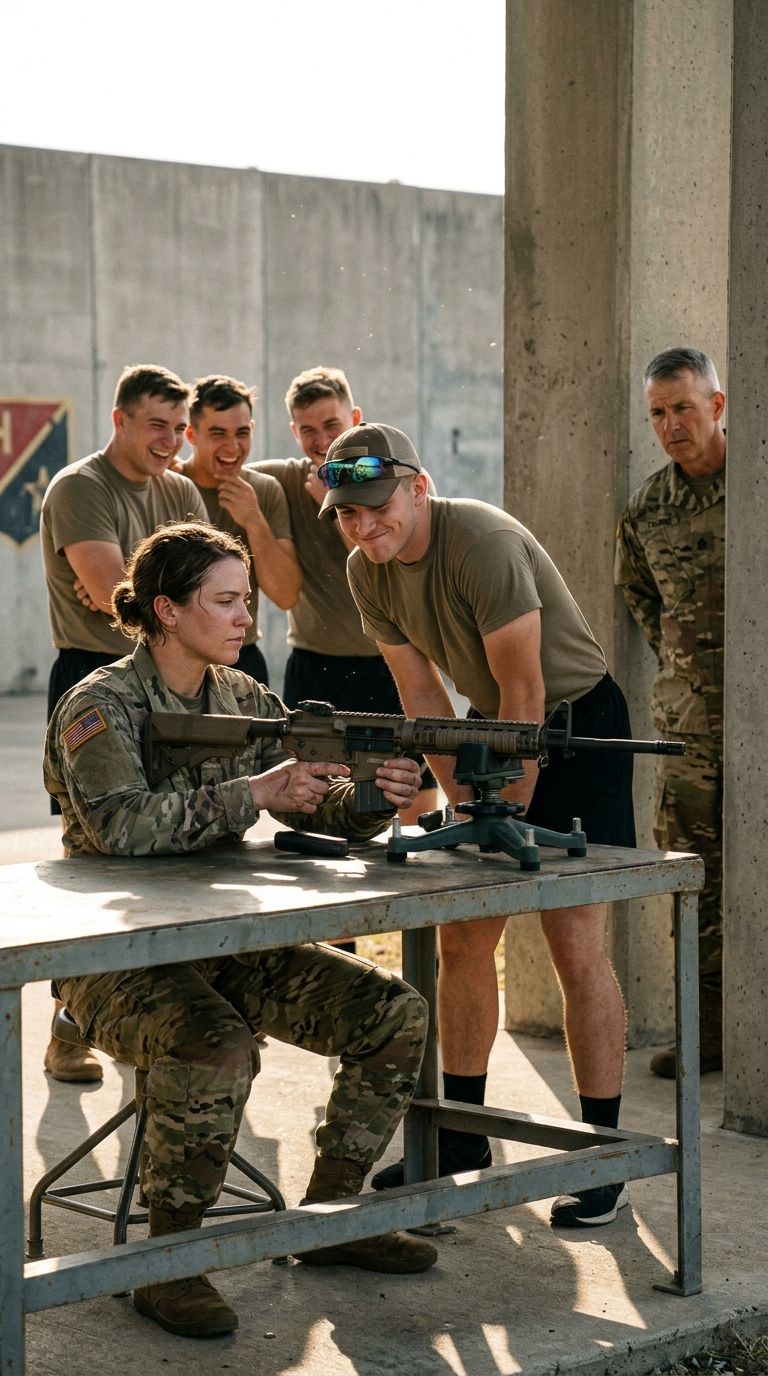

The first two days at Fort Liberty passed without incident – until the cadets pushed the wrong woman.
They mistook her silence for weakness. They had no idea what they were standing next to.
—
The afternoon sun was merciless, cutting through the thick, humid air that smothered North Carolina every late summer. At the weapons benches, a group of cadets moved through advanced leadership prep with the loose, careless energy of men who had never truly been tested. Their laughter bounced hard off the concrete training yard, filling the space with noise that meant nothing.
Cadet James Miller was at the center of it, as he always was. He wasn’t the kind of man who earned respect – he was the kind who simply assumed it, propped up by swagger and a voice that never seemed to lower. He moved through rooms like he owned them, and so far, no one had bothered to correct him.
At the far end of the bench, Specialist Anna Cole sat apart from all of it.
She wasn’t ignoring them. She was simply somewhere else entirely – hands moving in a calm, unhurried rhythm as she field-stripped an M110A1 SDMR rifle. Each component came free with practiced ease. She wiped every piece with an oiled cloth, inspected it without ceremony, and reassembled the whole mechanism in a sequence so fluid it looked like reflex rather than training.
Miller drifted toward her, drawn by the silence the way certain men always are – unable to leave it alone.
“You even know what you’re holding?” he asked, his tone carrying that particular brand of mockery that expects an audience. Behind him, a few cadets obliged with laughter.
Anna didn’t look up.
Her hands continued their work – steady, deliberate, unbothered. As she guided the bolt carrier back into place, the afternoon light shifted and caught her knuckles for just a moment. The scars there were faint but deep, the kind that don’t come from accidents. The kind that come from close work, repeated, over a long time.
From the far edge of the yard, Master Sergeant Thomas Thorne watched from the shade. He had been watching for several minutes already. His arms were crossed, his expression unreadable, but his eyes had gone still and careful in the way they did when something demanded his full attention.
He recognized what he was seeing.
Not the rifle work – though that alone was telling. It was the focus. That particular quality of stillness that no amount of training could manufacture in someone who hadn’t earned it the hard way. It was the kind of calm that didn’t come from confidence.
It came from experience.
She’s going to let him keep going, Thorne thought, watching Miller lean closer, emboldened by her silence. Right up until she doesn’t.
He didn’t move to intervene. Not yet.
He simply watched, and waited, and recognized in Anna Cole something that the cadets laughing behind Miller were nowhere near qualified to see – a person who had already been to the place they were only pretending to train for.
And she had come back.
The Second Question
Miller didn’t take the silence as a warning. He took it as an opening.
He picked up the rifle’s detached suppressor from the bench beside her, turned it over once, and set it back down with a small clatter that was just deliberate enough to be disrespectful.
“Where’d you even serve?” he asked. “Admin? Supply?”
One of the cadets behind him, a guy named Garrett with a sun-peeled nose and a tendency to laugh at anything Miller said, let out a short sound somewhere between a snort and a laugh.
Anna set the reassembled rifle down. Not hard. Not with any drama. She just placed it on the bench and looked at Miller for the first time.
She didn’t say anything for a moment. She just looked at him the way you look at something you’re trying to decide if it’s worth your time.
“Kunar Province,” she said. “Two rotations.”
Miller blinked. The laughter behind him thinned.
Kunar. Eastern Afghanistan. The kind of terrain that ate units whole, where the altitude alone made everything harder and the ridgelines gave every engagement a particular kind of ugliness. Not a place people mentioned casually. Not a place you got sent for admin work.
Miller recovered fast. That was his skill, really – the recovery. He couldn’t read a room, but he could paper over the silence with more noise.
“Still,” he said, and shrugged. “Different time. Different mission set.”
Anna picked the rifle back up.
“Sure,” she said.
That was it. Just the one word. She went back to her work and Miller stood there for a second with nothing to push against, which was the one thing he genuinely didn’t know how to handle.
Thorne, from the shade, uncrossed his arms.
What Thorne Knew
Thomas Thorne had twenty-two years in. He’d been at Fort Liberty for the last four, running leadership development rotations for advanced cadets, which mostly meant watching young men discover the distance between what they thought they were and what they actually were. It was not always a gentle process.
He knew Anna Cole’s file. He’d read it twice before this rotation started, which wasn’t something he did for everyone.
She’d come up through 75th Ranger Regiment support, worked three deployments, and on the second one had been attached to a small unit operating in Kunar during a stretch that produced more after-action reports than Thorne cared to think about. She’d been recommended for the Army Commendation Medal with V device after an engagement in the Pech River Valley that the official report described in language so clipped and careful it told you everything by what it didn’t say.
She was twenty-nine. She looked older in the eyes.
She was here because someone up the chain had decided her experience had value in a training environment. Thorne agreed. What he hadn’t anticipated was Miller.
Miller was twenty-three, third-generation Army, and had coasted through every evaluation on a combination of genuine physical ability and a gift for performing competence without actually building it. He’d never been anywhere that cost him anything. And he had the particular problem of men like that: he couldn’t tell the difference between a person who was quiet because they had nothing to say and a person who was quiet because they’d already seen the thing he was performing about.
Thorne had seen it go wrong before. The ones who pushed too hard at the wrong person.
He walked out of the shade.
The Bench
He came up on the group from the side, not fast, not slow. Miller saw him coming and straightened slightly. The other cadets went quiet in the way cadets go quiet when they know they’ve been observed doing something they can’t quite defend.
“Miller,” Thorne said.
“Sergeant.”
Thorne looked at the bench. At the rifle Anna had reassembled. Then at the suppressor Miller had moved.
“You touch her equipment?”
Miller’s jaw shifted. “Just picked it up for a second, Sergeant. Wasn’t a big deal.”
Thorne looked at him for a long moment. Not angry. Just quiet.
“You know what that rifle is?”
“M110, Sergeant.”
“M110A1. SDMR variant. You know the difference?”
Miller didn’t answer, which was its own answer.
Thorne turned to Anna. “Specialist. You want to tell him?”
Anna didn’t look up from the bench. “Semi-auto precision rifle. Suppressed. Designed for engagement out to 600 meters in environments where noise discipline is critical.” She paused. “The suppressor he moved is calibrated. You knock it around, you affect zero. Zero is the difference between a hit and a miss. Miss at the wrong moment and someone doesn’t come home.”
She said it the same way she’d said everything else. Flat. Even. Like she was reading from a technical manual. But the last sentence sat differently than the rest of it, and everyone at the bench felt that.
Miller said nothing.
“Right,” Thorne said. He looked at the group. “Back to your stations.”
They moved. Miller moved with them, and Thorne watched him go, and then he looked at Anna, who had already gone back to her work like none of it had happened.
“You alright?” he asked.
“Yes, Sergeant.”
He nodded once and left her to it.
What Happened After Dinner
The mess hall at 1830 hours was loud in the specific way Army mess halls get loud – a lot of people in a compressed space, trays clattering, conversations overlapping. Anna sat alone at the end of a table near the far wall with a cup of coffee and a battered paperback she wasn’t really reading.
Miller came in with Garrett and two others. They took a table across the room. For a while, nothing happened.
Then Garrett said something to Miller, too low to hear, and Miller laughed. He glanced over at Anna. Looked away. Said something else.
Anna turned a page.
A woman sat down across from her. Specialist Diane Pruitt, short hair, freckles across the bridge of her nose, the kind of steady presence that doesn’t announce itself. She’d been in the rotation since day one and had said maybe forty words total.
“You know what they’re saying, right?” Pruitt said.
“Probably,” Anna said.
“Does it bother you?”
Anna looked up from the book. She thought about it for a real second, which Pruitt seemed to appreciate.
“Not the way it used to,” she said.
Pruitt nodded. She picked up her coffee. “Kunar. I heard what you told him.”
“Yeah.”
“My brother did a rotation in Korengal. 2009.”
Anna looked at her. “He make it back okay?”
“Mostly,” Pruitt said. Which was its own kind of answer.
They sat with that for a while. The mess hall kept going around them, loud and indifferent.
Day Four
The land navigation exercise on day four sent the cadets out in pairs across a wooded course southeast of the main training area. The terrain was uneven, the tree cover dense enough to drop GPS reliability, and the time standard was tight. It was designed to produce stress.
Miller got paired with Anna.
He didn’t say anything when the assignments went up. Neither did she.
They moved out at 0700 with a map, a compass, and four grid coordinates to hit in sequence. The first two went without conversation. Anna navigated. Miller followed. He didn’t argue the route, which surprised her, and he kept pace without complaint, which surprised her more.
It was on the third leg, climbing a slope thick with pine and loose shale, that he slipped. Not badly – his boot caught a loose rock, he went down on one knee, caught himself on a low branch. But his compass hit the ground and skittered down the slope a few feet.
Anna was below him. She picked it up before he could get to it, checked the bezel, handed it back.
He took it. Didn’t say anything for a second.
“Thanks,” he said.
“Bezel’s fine,” she said. “You’re good.”
They kept moving.
At the fourth coordinate, a narrow creek crossing where the bank was soft and treacherous, Miller stopped at the edge and looked at the water. Maybe eight feet across. Not deep, but the footing on the far side was bad.
“You go first,” he said. Not a challenge. Just a statement.
Anna crossed, found the solid ground, turned back. “Come at an angle. Hit the flat rock, then the root.”
He crossed without falling.
They finished with four minutes to spare.
On the walk back to the staging area, Miller was quiet for a long stretch. Then he said, “The Pech River Valley. That was bad, right?”
Anna kept walking. “Yeah.”
“I read about it. Some of it.”
She didn’t respond.
“I don’t know why I was being a dick,” he said. “At the bench.”
It was so blunt and graceless that it almost landed as honest. Almost.
“I know why,” Anna said.
He looked at her.
“Same reason most people are,” she said. “Doesn’t matter.”
She walked ahead and he let her, and that was the end of it.
What Thorne Wrote
That evening, Thorne sat in the small office adjacent to the training bay and wrote his end-of-day notes. He did this every night, longhand, in a green notebook that he’d been keeping since his second deployment.
He wrote about the land nav results. The time splits. A few observations about specific cadets.
When he got to Miller, he paused.
Showed adaptability in the field. Deferred to a more experienced partner without prompting. Something shifted today – unclear if it holds.
He thought about Anna for a while before he wrote anything.
Cole continues to be exactly what the file said she was. The cadets will learn more from watching her work than from anything I put in front of them. Whether they know that yet is a different question.
He closed the notebook.
Outside, the training yard was quiet. The lights over the weapons benches threw long yellow rectangles across the concrete. Somewhere on the far side of the compound, someone was running the track, footsteps steady and even in the dark.
Thorne didn’t need to look to know who it was.
—
If this one stayed with you, pass it on to someone who’d get it.
For more tales of unexpected strength, check out how she put the biggest man on base on the mat, or read about a father called a traitor and a mysterious folded paper one woman begged to destroy before they found it.