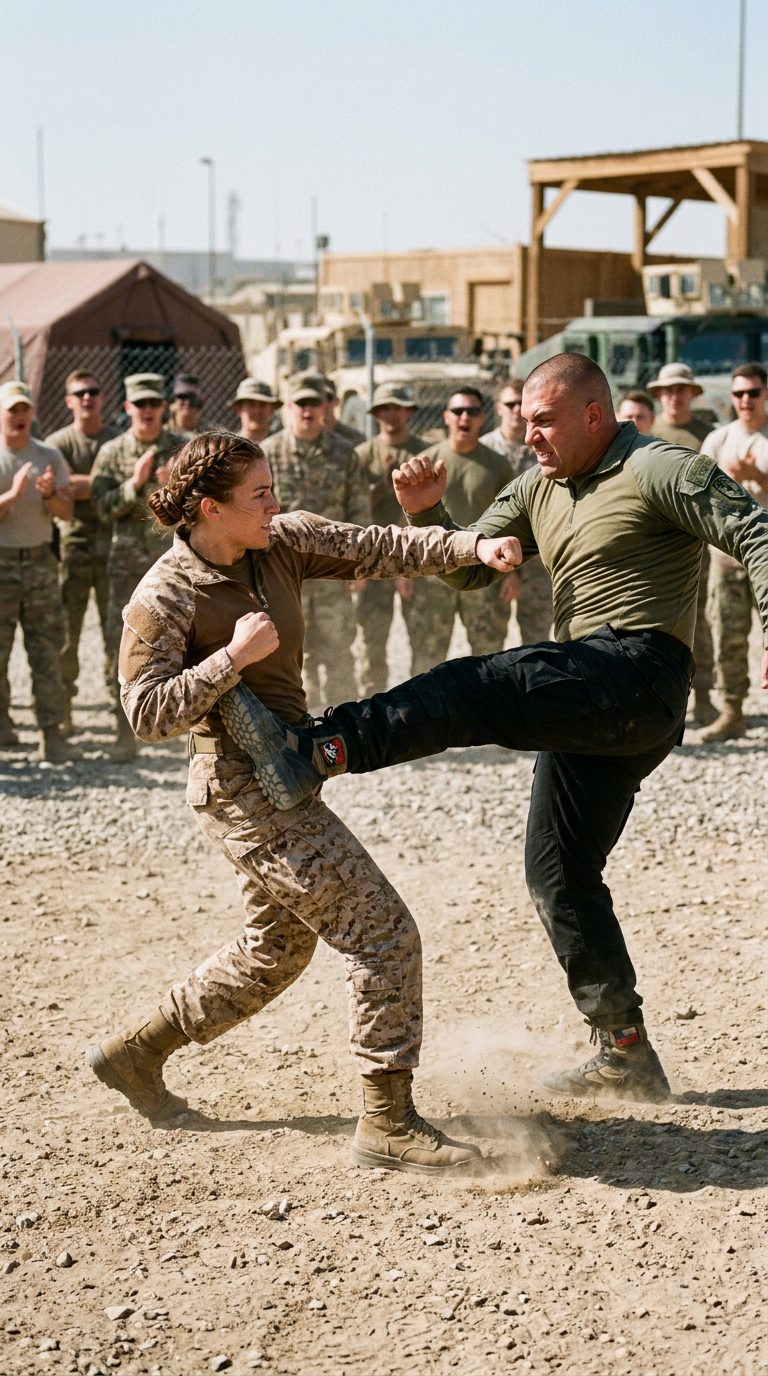

I didn’t even have time to blink before Thorne’s boot came for my ribs.
Fort Harden’s tactical arena was packed shoulder to shoulder, soldiers pressed against the chain-link fence, dust rising in the Texas heat. This was supposed to be a sanctioned combat tournament. Rules. Referee. Skill.
But Sergeant Darius Thorne had decided the final bout was going to be a public lesson.
The day before, he had cornered me near the equipment racks and snarled, “Little girls playing dress-up don’t belong in the pit. Go back to the desk where you belong.”
I didn’t answer him.
I let the matches answer.
By the championship round, I had already taken down three opponents who’d made the same mistake he was about to make. When Thorne finally stepped into the dirt and heard me say, “I’m a Navy SEAL,” he laughed – loud enough for the front row to hear, easy enough to make clear he wanted the whole arena to hear it too.
“Fraud,” he said.
The crowd shifted. Something uncertain moved through it, the way a field of grass moves when the wind changes direction.
The bell rang.
He didn’t circle. He charged.
I slipped the first two punches and felt the air cut past my face, then landed clean on his jaw. For half a second, his eyes went somewhere else. Then rage came back and filled them completely.
The referee shouted a warning. Thorne drove forward anyway – knee rising toward my throat, boot swinging hard at my ribs. He wasn’t fighting to win anymore. He was fighting to make a point, to end my career right here in the dirt in front of five hundred witnesses.
That was his mistake.
Anger is loud. Anger telegraphs. Anger leaves doors wide open for anyone patient enough to walk through them.
And as his boot came in, I saw exactly the opening his fury had handed me.
The Six Months Before the Dirt
I should back up.
My name is Carla Reyes. I’d been assigned to Fort Harden on a joint-training rotation – Navy attached to Army, which is already the kind of arrangement that makes everyone vaguely territorial and slightly suspicious. I’d done two deployments. BUD/S. The whole thing. I had the paperwork and the scars to prove it, though I’d learned early that showing either one just made certain men angrier.
Thorne ran the physical training programs for three battalions. Big guy. Not tall exactly, but built like something structural, like a load-bearing wall that learned to walk. He’d been at Fort Harden for eleven years and had the kind of institutional confidence that calcifies into something uglier after long enough.
He’d never said anything directly to me the first two weeks. Just the looks. The way he’d pause a conversation when I walked into a briefing room, let it sit a beat too long, then keep going like the interruption had been mine. Small stuff. The kind of stuff that’s very hard to name out loud without sounding like you’re complaining about weather.
The tournament had been scheduled six weeks out. Annual thing, open to all ranks and branches attached to the post. Mostly it was Army guys competing against Army guys, but the rules didn’t exclude anyone.
I signed up on a Tuesday. By Wednesday afternoon, Thorne knew.
He found me at the equipment racks on Thursday morning, early, before anyone else was around. That’s when he said the thing about the desk.
I looked at him for a moment. He was waiting for something – an argument, maybe, or an apology, something he could respond to and escalate. I didn’t give him either one.
I went back to checking my gear.
What the First Three Rounds Looked Like
The tournament ran over two days. Sixteen competitors in the bracket, single elimination, full contact with pads and a referee.
My first opponent was a Staff Sergeant named Greg Pullman. Good guy, actually. We’d talked twice before, no problems. But the moment we stepped into the ring and the crowd started doing the math – him at six-one and two-ten, me at five-six and a buck fifty – I could see him recalibrate. Decide to go easy. Pat me on the head and move on.
I put him on the ground in forty seconds.
He came up laughing, which I respected. “Okay,” he said, holding up both hands. “Okay.”
Second round was harder. A guy named Marcus Webb who’d done some amateur MMA and actually knew what he was doing. He didn’t underestimate me, which made it a real fight. I took a hit to the cheekbone that rang my ears. Spent most of the second minute just surviving, reading him, waiting. Found the pattern in his footwork, the slight drop of his left shoulder before he committed to a right cross.
Third time he did it, I wasn’t there.
He went down. Referee counted it.
Third round was a blur. I was tired and my face hurt and I remember very little except that it ended and I was still standing.
Then the bracket posted the final matchup.
Reyes vs. Thorne.
The Arena at 0900
Five hundred people is a lot of people to be wrong in front of.
That’s what I was thinking when I walked into the arena the next morning. Not fear exactly. More like arithmetic. Five hundred people, most of whom had heard Thorne call me a fraud the night before – because he had, again, at dinner, loud enough for two tables to hear. Five hundred people who were about to watch one of two things happen: either he was right, or he wasn’t.
Thorne came in from the opposite side of the arena and the crowd did the thing crowds do, that low surge of noise, and he played to it a little. Not ostentatiously. Just a nod here, a handshake there. He knew this place. He owned this place.
He looked at me across the dirt and said it again.
“I’m a Navy SEAL,” I said. Not loudly. It was just the truth.
The laugh was immediate and big and designed to carry. He turned to make sure the front rows caught it. “Fraud,” he said.
And then the referee was between us and the bell rang and Thorne charged.
What Anger Hands You
His first two punches were fast. He was good – I won’t take that away from him. He was genuinely good and he was strong and if either of those punches had landed clean, the fight might have gone differently.
But they didn’t land.
I slipped left on the first, ducked under the second, came up and caught him on the jaw with a short right. Not a knockout shot. Just enough to let him know the geometry of this was going to be different than he’d planned.
That’s when the rage took over completely.
Some fighters, when they get hit, get colder. Tighter. They stop gambling and start thinking. Thorne went the other way. The jaw shot didn’t hurt him much – it just made him furious. And fury, in a fighter, is a very specific kind of gift to the person across from you.
He stopped feinting. He stopped reading. He just came forward.
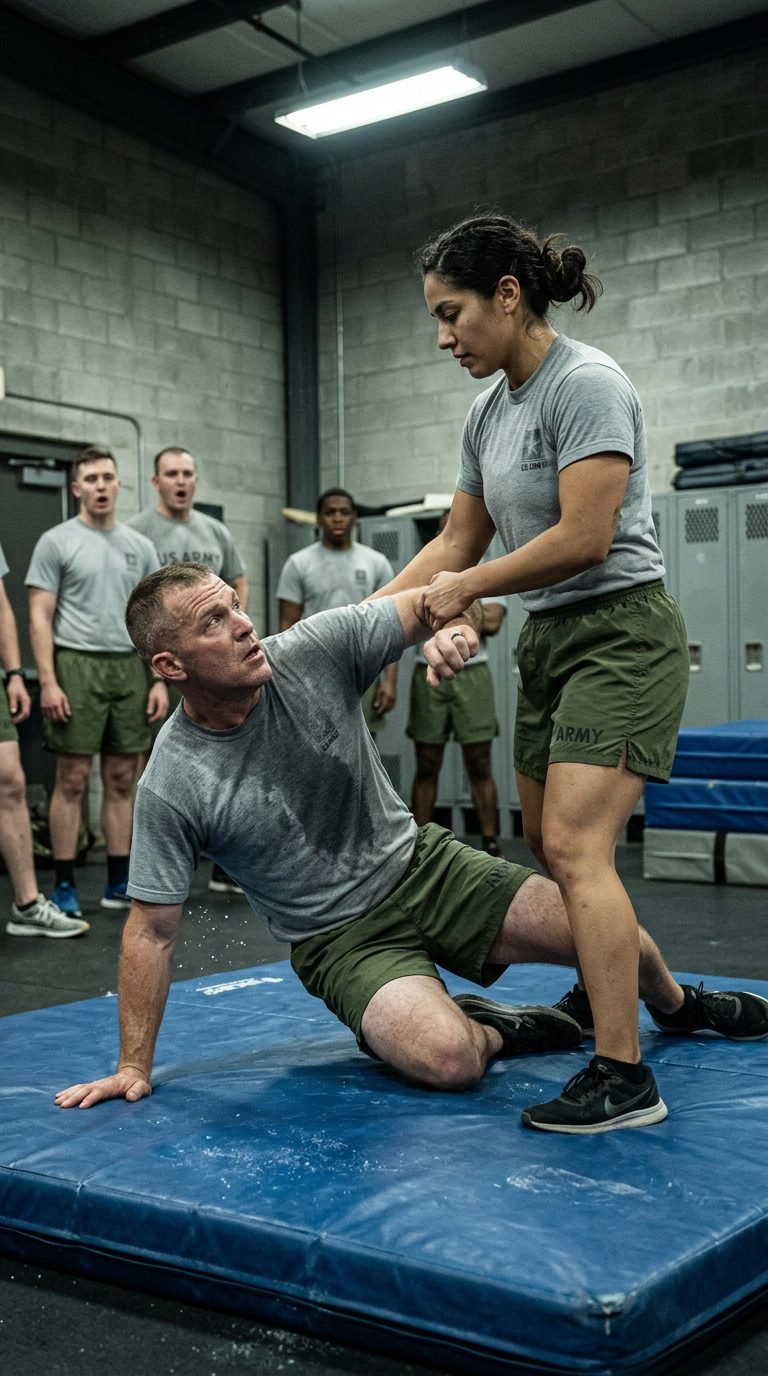
The knee toward my throat I redirected with my forearm, turned my body, let his momentum carry him half a step past me. The boot at my ribs I caught – actually caught, both hands, his ankle between my palms – and I didn’t do anything dramatic with it. I just held it for one second, long enough for him to understand what had happened, and then I took him to the ground.
He landed hard.
The referee didn’t even start a count. Thorne was already scrambling back to his feet, which was fine. I let him.
We went another ninety seconds. He landed two shots to my body that I’m still annoyed about. I put him down twice more. The second time, he was slower getting up.
The third time, he didn’t.
What Five Hundred People Sound Like When They Stop
Silence isn’t actually silent.
There’s still the wind. There’s still the chain-link fence flexing. There’s still somebody’s radio somewhere in the distance playing something country. But the human noise – the crowd noise, the shuffle and murmur and low-grade constant commentary of five hundred soldiers watching a fight – that stopped.
Completely.
For maybe four seconds.
Then it came back, different. Louder than before but shaped differently. Not the noise of a crowd watching something expected. The noise of a crowd that had just seen something recalibrate their understanding of what was possible.
The referee raised my hand.
I looked at Thorne. He was sitting up, one of his guys crouched next to him. He didn’t look at me. I don’t know what I wanted from that moment – some acknowledgment, maybe, some crack in the wall – but I didn’t get it and I wasn’t surprised.
I walked back to my side of the arena.
Pullman, the Staff Sergeant I’d beaten in the first round, was standing near the fence. He started clapping. Slow, deliberate, not performative. Just a guy deciding to clap.
A few others joined.
Then more.
I didn’t stop walking. I didn’t turn around to take it in. Not because I was being stoic or whatever – I was just tired and my ribs hurt and I wanted water.
What Came After
Thorne filed a formal complaint the following week. Claimed I’d used an illegal hold. The referee’s footage showed otherwise. The complaint went nowhere.
He never spoke to me directly again during the rest of my rotation. Which was, honestly, a relief. The looks continued. The pauses in conversation. The weather.
But something had shifted in the rooms I walked into. Not dramatically. Not like a movie. Just – slightly differently. A few more people who made eye contact. A few more who didn’t move their gear when I sat down at a table.
Small stuff. The kind of small stuff that actually matters.
My rotation at Fort Harden ended three months later. I went back to my unit. I didn’t think about Thorne much after that.
But sometimes, when I’m in a room and someone does the calculation – looks at me and decides the math doesn’t work out in my favor – I think about that boot coming at my ribs.
And I think about what you can do with someone’s anger, if you’re patient enough to wait for them to hand it to you.
You just have to let it arrive.
—
If this one hit you somewhere, pass it along to someone who needs it.
For more stories about proving them wrong, check out She Aimed at the Wall. What Hit the Target Stopped the Whole Arena or read about how She Didn’t Say a Word When He Mocked Her. That Was the First Mistake, and don’t miss the tale of I Watched Her Put the Biggest Man on Base on the Mat. Twice.