
“Ma’am, installation policy doesn’t permit utility uniforms for anyone not on active duty.”
The sentence cut through the lobby’s quiet rhythm, sharp enough to turn heads before he had even finished speaking.
Captain Laura West had just entered Fort Blackhawk’s administrative building, the glass doors whispering shut behind her, when the lieutenant’s voice carried across the lobby and stopped her mid-step.
The building held that particular official smell – scorched coffee and floor wax clinging stubbornly to the air, regardless of how sleek and updated the place tried to appear. Boots tapped over tile. Phones buzzed in low tones. Somewhere near the reception counter, someone gave a small, careless laugh.
Everything seemed ordinary.
Until it wasn’t.
“You’ll have to change before you go any farther.” The lieutenant moved just far enough into her path to make the boundary obvious – not hostile, but solid.
Laura didn’t respond the way most people did when corrected.
No annoyance. No defensive look. No argument.
Only one slow, controlled breath.
Then a nod.
“That’s fine.”
Her tone stayed calm – too calm.
The lieutenant blinked, briefly caught off guard. He had expected pushback. Most contractors at least exhaled sharply, sometimes protested, sometimes launched into complaints about delays and wasted time.
But she simply accepted it.
That should have been the end of it.
It wasn’t.
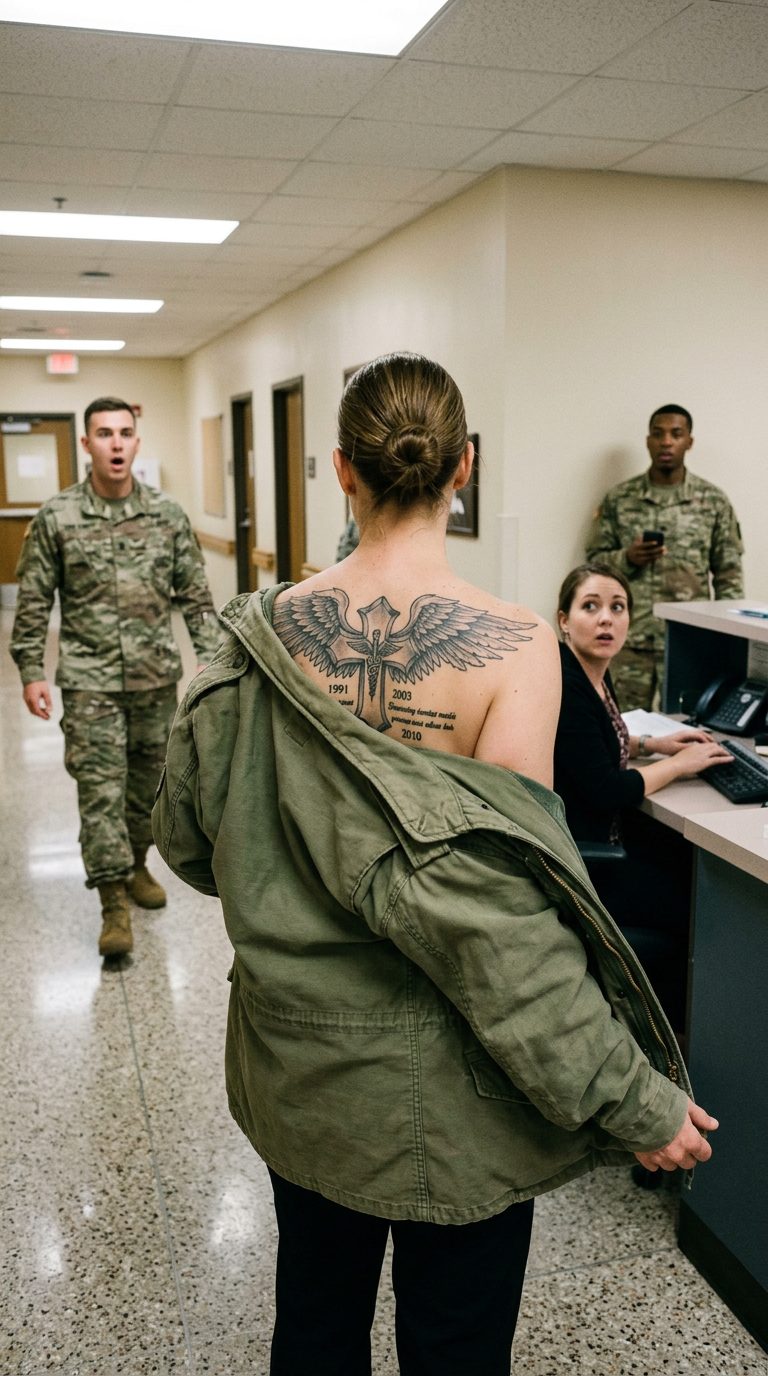
Instead of turning toward the restroom down the corridor, Laura shifted her stance, her boots making the faintest sound against the polished floor. Her hand lifted – steady, deliberate – to the zipper of her jacket.
A few people noticed.
Not all of them.
But enough.
The receptionist’s fingers froze above her keyboard. A soldier resting against the far wall lowered his phone. Even the lieutenant’s expression tightened, confusion flickering across his face.
They were expecting a quick adjustment. A simple correction.
What they received instead belonged to no category they knew how to process.
Zip.
The sound wasn’t loud.
But in that moment, it carried.
The jacket opened slowly – unhurried, unapologetic – just enough for the fabric to fall away from her shoulder.
And reveal what lay beneath.
Ink.
Not decorative. Not casual.
A combat medic cross covered her back – dark and precise, its lines softened only slightly by the passage of years. Around it, two angel wings extended outward – uneven, imperfect, each feather rendered with such painstaking care that it seemed less like artwork and more like memory pressed permanently into skin.
Below it: dates.
Several of them.
Small. Deliberate. Impossible to look away from.
The shift in the room was immediate.
Conversations died mid-sentence. A chair scraped somewhere behind the reception desk. The soldier near the wall straightened without seeming to realize he had done it, his spine pulling upright as though something older than conscious thought had taken command of him.
The lieutenant’s lips parted slightly – then pressed shut again.
Something in the air had changed, and no one could quite name what it was.
Laura did not turn around.
She did not explain.
She did not hurry.
She simply let the moment settle. Let it breathe.
Then – Footsteps.
From the hallway.
Measured. Steady. Weighted with authority. They echoed just enough off the walls to draw every remaining pair of eyes toward the corridor.
A woman’s voice followed, clear and unmistakable.
“Laura West?”
The name landed in the room like something heavy dropped onto stone.
Everyone turned.
The Woman in the Corridor
She was maybe sixty. Gray at her temples, cropped short in the way career women cut their hair when they stopped caring what anyone thought about it. Her uniform was pressed to a standard that suggested habit, not effort. Two stars on her shoulders.
Major General Patricia Howe.
The lieutenant’s face went a particular color that had no good name.
Laura turned then, finally, and whatever expression she wore was the kind you couldn’t read from across a room. Not warm, not cold. Something older than either.
“General Howe.” She zipped her jacket back up in one clean motion. “Wasn’t expecting you to come down personally.”
“I wasn’t expecting to have to.” Howe stopped a few feet away and looked her over the way people look at someone they haven’t seen in a long time and are checking whether the years have been fair. “You look the same.”
“I look older.”
“You look the same,” Howe repeated, and left no room for argument.
The lieutenant had not moved. He was standing exactly where he’d planted himself two minutes ago, and the geometry of the room had shifted so completely around him that he appeared to be standing in the wrong place entirely, a piece from one puzzle dropped into another.
Howe glanced at him the way you glance at furniture.
“Lieutenant.”
“Ma’am.”
“Walk with me,” she said to Laura, already turning back toward the corridor.
Laura followed without looking at the lieutenant again. Not because she was making a point. Because he’d already stopped being relevant.
What the Dates Were
Fort Blackhawk had a conference room on the third floor that nobody used for conferences anymore. Long table, eight chairs, a whiteboard still ghosted with marker from some briefing years back. The kind of room that smelled like stale air and old decisions.
Howe closed the door.
“You know why you’re here,” she said. It wasn’t a question.
“I have a general idea.”
“The program’s being reviewed. Congress wants answers we don’t have yet. They need someone who was actually in the field to walk them through what happened in Kandahar, specifically the October rotation.” Howe pulled out a chair but didn’t sit. Just rested her hand on the back of it. “That’s you.”
“That’s me,” Laura agreed.
Outside, the building hummed along at its ordinary pace. Phones. Boots. Distant photocopier cycling through a job. In here, the air sat different.
“The dates,” Howe said. She didn’t look away. “On your back. I’ve heard about them but I’ve never – ” She stopped. Started again. “How many?”
Laura was quiet for a second.
“Seven.”
Howe’s hand tightened on the chair back. Just slightly.
“All from the October rotation?”
“Three from October. Two from the Kunar deployment before that. One from a training accident stateside – my fault, my call, my ink.” A pause. “And one from before I was deployed. Before any of it.”
Howe waited.
“My brother,” Laura said. “Fallujah. 2006.”
The whiteboard ghost-marks blurred a little if you looked at them too long. Someone had written LOGISTICS in red and only half-erased it. The word sat there like a bad joke.
“He’s why you enlisted,” Howe said.
“He’s why I stayed.”
What the Lieutenant Found Out
His name was Gary Pruitt. Twenty-six years old, eighteen months into his posting at Fort Blackhawk, and before today the biggest thing he’d navigated was a scheduling conflict over the motor pool.
He found out about Laura West the way most people find things out on a military installation: someone told someone who told him. In this case it was Denise, the receptionist, who had looked up from her keyboard and spent the next forty minutes doing quiet research between incoming calls.
Pruitt was in the break room at half past two when Denise came in and poured herself coffee and said, without particular ceremony, “She was a combat medic. Two tours in Afghanistan, one in Iraq. Meritorious Service Medal. Bronze Star.”
He looked at his cup.
“The Bronze Star was with valor,” Denise added. “You know what that means.”
He did.
It meant she’d been under fire when she earned it.
He thought about the way she’d unzipped that jacket. Slow and deliberate, no performance in it. Not showing off. Just – showing. Making a record. The way you’d show a scar you’d stopped being ashamed of.
“She’s a contractor now?” he asked.
“Medical program advisor. She trains field medics. Travels between installations.” Denise sipped her coffee. “She’s been doing it for four years.”
Pruitt thought about the lobby. The way she’d said that’s fine with exactly nothing in her voice.
“She wasn’t angry,” he said. Mostly to himself.
“No,” Denise agreed. “She wasn’t.”
He sat with that.
The Thing About the Wings
What nobody in that lobby had known – what most people never knew unless they’d served with her or read past the first paragraph of her file – was that the wings weren’t symmetrical on purpose.
The left wing was slightly larger. Fuller. The right had a gap in the feathers near the top, a section where the lines just stopped, unfinished.
She’d had it done in two sessions, three years apart. The artist in Fayetteville who’d done the first session had offered to complete the right wing at the second appointment, fill in the gap, make it whole.
She’d told him to leave it.
He hadn’t asked why. He was good enough at his job to know when a question would land wrong.
The dates below the wings were inked in a plain block font. No flourish. No decoration. Just numbers. Month, day, year, seven times over, arranged in two loose columns the way you’d arrange items on a list.
Because that’s what they were.
A list.
The names lived in her head. Had since the beginning. The ink was for the days she couldn’t trust her head – the bad-sleep mornings, the two a.m. stretches when everything blurred and she needed something fixed and permanent to hold onto.
She didn’t talk about this.
Not to Howe. Not to anyone.
But the lieutenant had seen the dates, and the dates were enough.
The Briefing
She spent three hours in that conference room with Howe and two men from the Inspector General’s office whose names she forgot almost immediately. They had laptops and printed summaries and the particular energy of people who understand documents better than they understand what documents describe.
She answered their questions straight.
Yes, the supply chain failures in October were known before the rotation began.
Yes, she had filed reports.
No, she could not confirm whether those reports reached anyone with authority to act on them.
Yes, there were moments in the field where the gap between what they had and what they needed was the difference between someone going home and someone not going home.
She said this without heat. Without anything, really. Just the words in the right order.
One of the IG men kept writing while she talked, his pen moving in fast small strokes. The other one watched her with the look of someone recalibrating something.
Howe didn’t write anything down. She already knew.
When it was done, when the laptops were closed and the printed summaries were stacked and the IG men had filed out with their briefcases and their careful faces, Howe stayed behind.
“You doing okay,” she said. Again, not a question.
“I’m fine.”
“Laura.”
“I’m fine,” she said again, and this time there was just enough in her voice that Howe let it go.
The Lobby Again
It was close to five when Laura came back down.
The afternoon shift had mostly thinned out. The receptionist – Denise – was logging off her station, coat already on. The soldier who’d been at the wall was gone. New faces, different energy, the building cycling through its ordinary hours.
Pruitt was still there.
He was standing near the door, not quite waiting, or maybe exactly waiting, in the way of someone who has thought about something for several hours and decided they need to say it even if they’re not sure they should.
Laura saw him.
She didn’t slow down.
He stepped forward anyway.
“Captain West.” He stopped. His jaw worked once. “I didn’t know.”
She looked at him for a moment. Not cold. Not warm. Just looking.
“You were doing your job,” she said.
“I should have – “
“You were doing your job,” she said again, and that was the whole thing, start to finish. No softening, no sting. Just the fact of it.
She pushed through the glass doors and they whispered shut behind her.
Pruitt stood there.
Outside, through the glass, he watched her cross the parking lot in the early evening light, jacket zipped, walking the way she walked, like someone who had decided a long time ago what pace she was going to move through the world at and had not revised that decision since.
The doors reflected the lobby back at him. His own face, the empty reception desk, the lights.
He stood there a little longer than he needed to.
—
If this one stayed with you, pass it on to someone who’d get it.