
“Somebody get her a desk chair before she drops that rifle,” a young soldier called out.
Laughter tore across Blackridge Range.
Lieutenant Sarah Vance didn’t move.
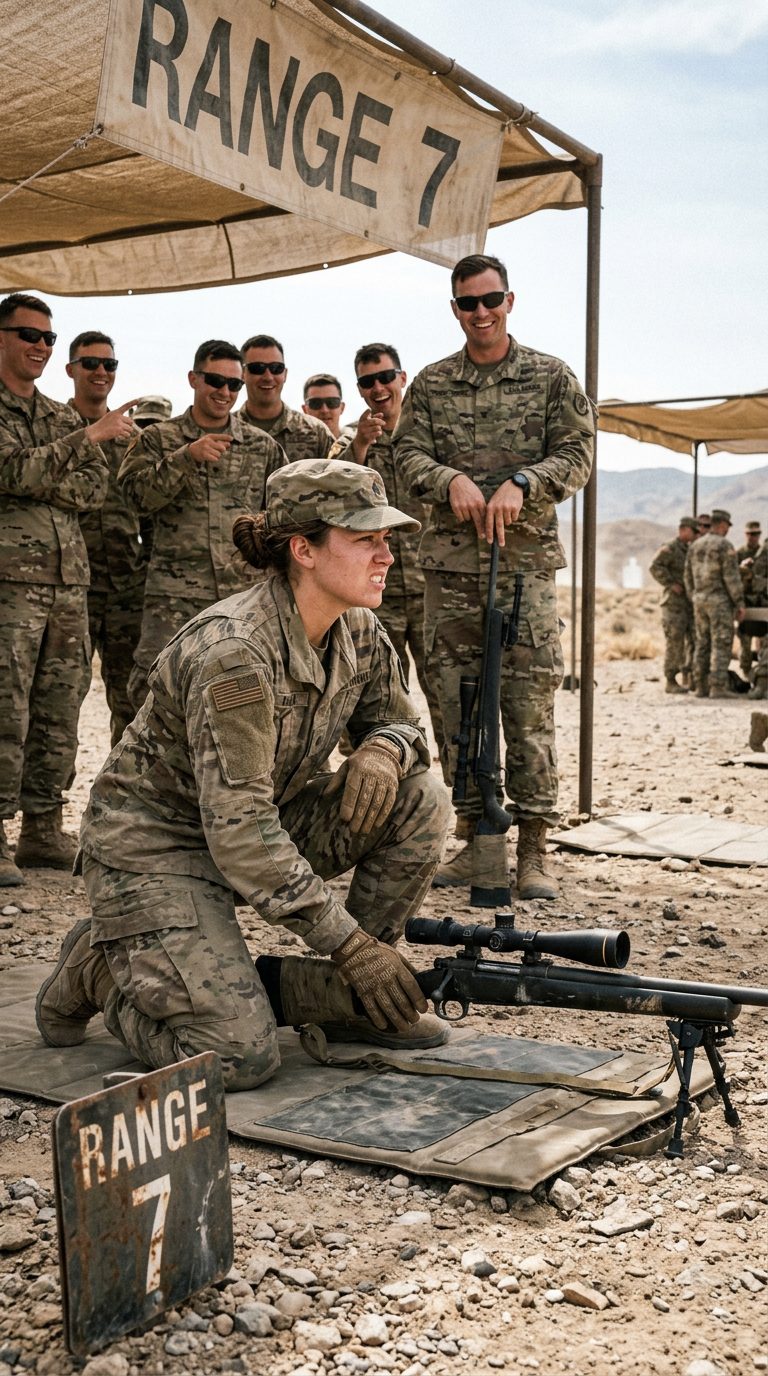
She stood at Lane Seven, hands resting near the long rifle on the mat, close enough for everyone to see the faint tremor in her fingers. Not enough to stop her. Just enough to feed the crowd.
The rifle waited like a challenge made of steel.
Captain Nolan Thorne stood beside it, smiling like he’d already won.
“Go ahead, Lieutenant,” he said. “Show them what you requested.”
Sarah said nothing.
A soldier near the back whistled softly. Another said, “She’s shaking before she even touches it.” A few men laughed harder.
Sarah kept her eyes forward.
The Nevada sun had barely cleared the low hills, but heat already shimmered beyond the firing line. Dust moved in thin sheets over the gravel. Canvas shade covers snapped in the dry wind. Far downrange, a white target waited at fifteen hundred meters – smaller than a quarter held at arm’s length.
Thorne tapped the rifle with two fingers. “This is not standard qualification.”
Everyone already knew that. The rifle was too heavy for quick comfort, its stock scarred from years of hard use. The bipod was stiff. The trigger had no forgiveness. The scope looked older than most of the soldiers watching.
Sarah studied the rifle. Then the target.
“Problem?” Thorne asked.
“No, sir.”
“Louder.”
“No, sir.”
“That sounded confident,” a soldier muttered. Another snorted.
Thorne let the laughter breathe. He seemed to enjoy how it circled her. He stepped closer and lowered his voice, though everyone still heard him.
“Blackridge does not reward fragile people.”
Sarah’s jaw tightened.
Thorne gestured toward the valley. “You asked for field evaluation. I decided to make it meaningful.”
Sarah lowered herself to one knee. The motion was controlled but slow. Her left hand twitched once near the rifle stock, and the soldiers caught it instantly.
“Look at that.”
“She’s going to miss the berm.”
She didn’t turn toward them. Her brown hair was tucked beneath her cap, loose strands shifting across her cheek in the wind. She looked tired. She looked too slight for the weapon in front of her. She looked, to every man watching, like someone who had wandered onto the wrong range entirely.
That was what made them laugh.
That was what made Thorne smile wider.
“Maybe she thought this was office qualification,” a soldier said.
The line behind the firing lanes broke apart with laughter again.
What Nobody on That Range Knew
Three months before Blackridge, Sarah Vance had been at a forward operating base in a country most of these soldiers hadn’t been assigned to yet. A position the size of a parking lot. Six personnel. One working radio.
The shot that mattered there had been at eleven hundred meters, and she’d made it prone in forty-knot wind off a ridgeline that tilted left. The rifle she’d used that day was worse than this one. The scope had a crack in the housing that she’d taped with electrical tape from a medical kit.
Nobody on that range knew any of that.
Her file was clean. Not the kind of clean that meant nothing had happened. The other kind. The kind that meant someone had decided what stayed in and what didn’t.
She’d requested Blackridge’s field evaluation program because she wanted a formal record. Something with a date and a score and a signature. Something that couldn’t be quietly filed away.
Thorne had processed the request himself.
He’d picked the rifle from the armory’s back shelf, the one the younger soldiers called The Coffin because it shot heavy and mean and its stock had been cracked and re-welded twice. He’d set the range at fifteen hundred meters without telling her in advance. He’d made sure there were witnesses.
He’d done everything right, technically.
That was the thing about Thorne. He was very good at technically.
The Rifle
Sarah settled fully onto the mat.
The laughter behind her had softened into something more attentive. Not respectful. Just watching. The way people watch something they expect to go wrong.
She got her elbows under her and pulled the rifle in. The bipod legs were uneven, the left one slightly shorter than the right, and she felt it immediately. She made the adjustment with two fingers without looking down. Her cheek found the stock.
The scope was old but clean. Someone had taken care of the glass, at least.
Fifteen hundred meters. The target was a white circle on a dark backing. In the scope, with the heat rising off the valley floor, it moved. Not really. The air moved around it and the image bent and breathed. Experienced shooters learned to read that movement. To find the pattern in it and wait for the still moment between pulses.
Sarah breathed out slowly.
Thorne crossed his arms. He was doing the thing where he looked patient. He was not patient.
“Whenever you’re ready,” he said.
She didn’t answer.
A soldier near the shade canopy said something quiet to the man next to him. The man next to him laughed once, short.
Sarah’s right hand settled around the grip. Her finger rested outside the trigger guard. Her whole body went still in a way that wasn’t forced, the kind of still that comes from somewhere deeper than effort. Like a machine reaching operating temperature.
The tremor in her fingers was gone.
It had been gone for two minutes. Nobody had noticed.
The First Shot
The report cracked out flat and hard across the range.
Downrange, the spotter – a Sergeant named Greg Paulk who had been doing this for eleven years and had seen plenty – put his binoculars up and held them there for a long beat.
He lowered them.
He looked at the target.
He picked the binoculars back up.
“Center,” he said. The word came out quiet enough that the men near the firing line had to ask him to repeat it.
“Center mass,” Paulk said, louder.
Silence.
Not the comfortable kind. The kind where people recalibrate.
Thorne’s arms stayed crossed. His expression didn’t change. But his jaw moved once, the way a jaw moves when someone is deciding what to say next.
Sarah worked the bolt. The spent casing bounced off the mat and rolled two inches.
She reacquired.
The Second and Third
The second shot went in eleven seconds after the first.
Paulk called it without hesitation this time. “Same group.”
The third went in nine seconds.
“Same group.”
The men behind the firing line had gone quiet in a way that felt different from before. Before, the quiet was anticipatory. People waiting for a punchline. Now it was something else. The particular quiet of people who have been wrong about something and are in the process of understanding that.
One soldier, the one who’d made the desk chair joke, had his arms at his sides now. He wasn’t laughing. He was watching Paulk.
Thorne walked slowly to the end of the lane.
He stood there looking downrange for a moment. Then he looked at Sarah. She was already on the fourth round, her body completely settled into the mat, her breathing so controlled it barely moved her shoulders.
He said nothing.
She fired.
“Same group,” Paulk said. And then, because Paulk was nothing if not honest about numbers: “Tight group. Forty-millimeter spread across four rounds at fifteen hundred.”
Thorne turned away from the range.
What He Said Afterward
The debrief happened in a room with a whiteboard and three folding chairs and a window that looked out onto the parking area. Thorne, Sarah, and a Major named Dennis Carr who had been brought in as the evaluation supervisor and who had spent most of the morning at the range with his coffee going cold in his hand.
Carr asked Thorne to walk through the evaluation parameters.
Thorne did. His voice was even. He described the rifle selection, the range distance, the wind conditions. He used the word rigorous twice. He said the evaluation had been designed to test performance under non-ideal conditions.
Carr looked at his notes.
“Non-ideal conditions,” he said.
“Yes, sir.”
“The rifle she used. That’s the one with the re-welded stock?”
Thorne said it was.
“And the range distance was set at fifteen hundred meters.”
“Yes, sir.”
“Standard long-range qualification is eight hundred.”
Thorne said that he’d wanted to give Lieutenant Vance the opportunity to demonstrate her claimed proficiency.
Carr looked at him for a moment. Then he looked at Sarah.
“Lieutenant.”
“Sir.”
“Do you have anything to add?”
Sarah thought about it. She had things she could add. She had the forward operating base and the electrical tape and the eleven-hundred-meter shot in forty-knot wind and the file that had been quietly cleaned up. She had three months of requests that had been lost or delayed or processed too slowly to matter.
“No, sir,” she said.
Carr nodded slowly. He wrote something down. He drew a line under it.
“Captain Thorne,” he said. “You’re going to want to review your evaluation procedures before the next cycle.”
Thorne said he understood.
He said it to the whiteboard.
After
The range had cleared out by the time Sarah walked back through it.
Paulk was still there, breaking down his spotter kit. He was a compact guy, mid-forties, with a face that had been in the sun too long. He didn’t look up when she approached.
She stopped a few feet away.
“Eleven years,” she said. “You’ve seen that before.”
It wasn’t really a question.
Paulk set down the binoculars case. He looked at her for the first time.
“Forty-millimeter spread at fifteen hundred,” he said. “With that rifle.” He shook his head once. “No. I haven’t seen that before.”
He picked up the case again.
“The guys who made the jokes,” he said. “They’re going to remember today.”
“I know.”
“Some of them are going to be fine about it. Some of them aren’t.”
“I know that too.”
Paulk zipped the case closed. He looked out at the target, still hanging downrange in the afternoon heat, four holes clustered near its center like a signature.
“You should’ve had a record two years ago,” he said.
Sarah didn’t answer.
She looked at the target for another moment. Then she picked up her gear and walked back toward the vehicles.
The Nevada sun was high now. No shade on the gravel. Her shadow was small and direct beneath her feet, and she walked through the heat without hurrying, past the empty firing lanes, past Lane Seven, past the mat where the rifle was already being returned to whatever shelf Thorne had pulled it from.
The laughter was gone.
The range was quiet.
Paulk watched her go.
—
If this one got to you, pass it along to someone who needs to see it.
If you enjoyed Sarah’s grit, you might appreciate the quiet strength in these tales, like when the colonel cut off a subordinate’s braid, not knowing who she was, or when a woman at a table didn’t budge for six SEALs. And don’t miss the story of how she made him think he’d won, having no idea who he was dealing with.