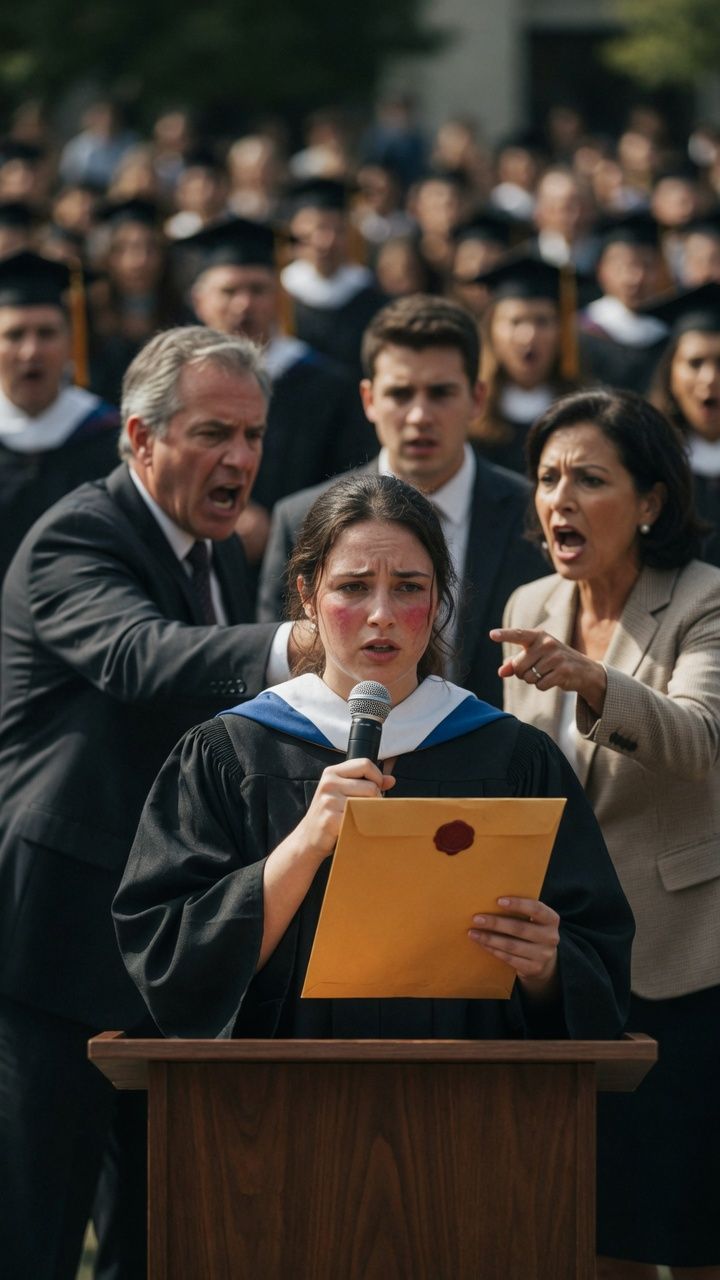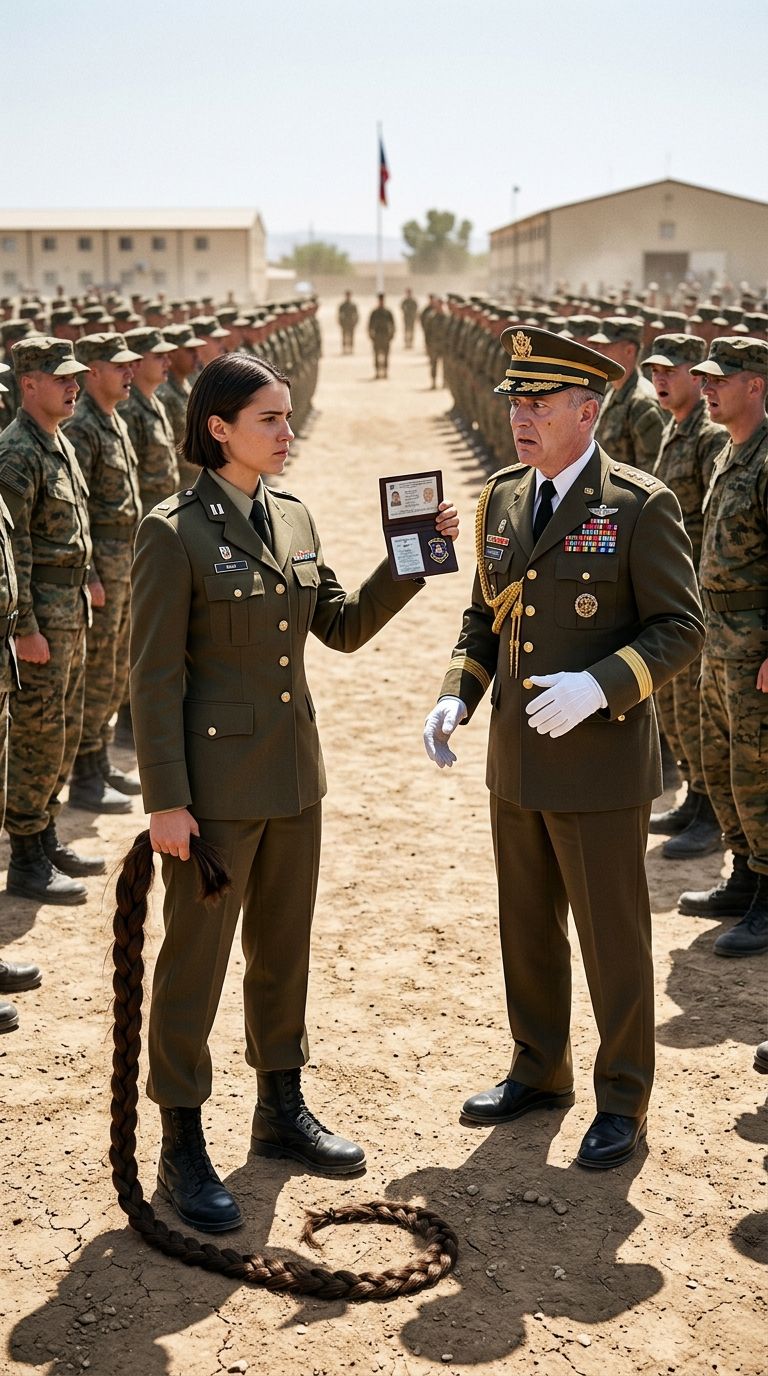

The whole unit assembled before dawn.
Soldiers stood in rigid formation beneath a sun that was already punishing, the kind of heat that made the air shimmer above the parade ground. No one spoke. No one needed to. Every soldier there could feel it – the particular stillness that precedes something irreversible.
At the center of the field stood only two figures.
Colonel Walsh. And a young recruit named Donna.
She had arrived just days earlier. One of the top graduates of her academy class – an exceptional marksman, fast on every task, and constitutionally incapable of complaint. The kind of soldier commanders put in brochures.
But she had clashed with the colonel on her second day. Badly.
It happened during a training drill. One of the soldiers went down hard – a nineteen-year-old kid who mistimed a jump and struck his lower back against a concrete barrier. The sound of the impact carried. He didn’t get up.
The colonel ordered the exercise to continue.
“He’ll get up on his own,” he said, his voice flat and indifferent. “He’s not going to fall apart.”
Donna stepped out of formation without hesitation and crossed the field to the injured soldier.
“He needs a doctor. Now.”
“Return to formation, recruit.”
She didn’t move. “He needs help first, sir.”
Dozens of soldiers heard her. Dozens of soldiers watched her hold her ground. To most of them, it was the bravest thing they’d seen in months. To Colonel Walsh, it was something else entirely – a direct challenge, issued openly, in front of his men. In twenty years of command, no one had done that. Not once.
He didn’t forget it.
A few days later, he decided to make an example of her.
He ordered the entire unit to the parade ground and called Donna forward once everyone was assembled. She stepped out of formation without hurry, her expression unreadable, her long dark braid hanging nearly to her waist. Every soldier in that unit knew what that braid meant to her. She had mentioned it only once, quietly, to a small group of them – that it was the last thing her mother had braided before she passed.
The colonel produced a large pair of shears.
A murmur moved through the ranks like a current. Some of them already understood what was coming. Others still couldn’t believe it.
Donna did not flinch.
The colonel seized her braid with one hand and raised his voice so there would be no mistaking his words.
“This will teach you not to argue with people who outrank you.”
The blades snapped shut.
Her thick braid fell to the dirt. The silence that followed was total – the kind that presses against your ears. Colonel Walsh studied her face carefully, searching for what he had come here to see.
He expected tears. He expected her to break. He expected her to crumble in front of every soldier on that field and beg his forgiveness, and he intended to let her.
None of that happened.
Donna looked down at the braid lying in the dust. She crouched slowly, picked it up, and held it in her left hand. Then, with her right, she reached into the breast pocket of her uniform.
The colonel’s smirk faltered.
What she withdrew was not a tissue. It was not a letter of resignation. It was a small leather identification wallet. She opened it in a single practiced motion and held it up – first directly in front of the colonel’s face, then turning deliberately, making certain every soldier standing on that parade ground could read what was printed inside.
The color drained from Colonel Walsh’s face.
His hands began to shake.
Because the name on that badge did not say Recruit. And the woman standing before him with her hair in the dirt was not remotely who he had believed her to be. Every assumption he had made, every calculation, every move in this little performance – all of it had been wrong from the beginning. She hadn’t stumbled into his unit. She had walked in.
She met his eyes and held them. When she spoke, her voice was steady and clear and loud enough to reach every corner of that field.
“Colonel Walsh. As of this moment, you are under…”
What Was on That Badge
Inspector General’s office. Department of the Army. Criminal Investigation Division.
Special Agent Donna Pruitt.
She’d been embedded in the unit for eleven days. Not because of Walsh specifically – not at first. The original complaint had come from three soldiers who’d quietly filed reports through back channels after a training accident six months prior. Different unit, different location, same pattern. A soldier hurt badly enough to need surgery, an officer who’d ordered the drill to continue, paperwork that had been filed in a way that buried the injury under a maintenance incident.
Donna had been sent to see if the pattern held.
It held.
She’d documented four separate incidents in eleven days. Training logs altered. A corporal who’d been quietly transferred after he tried to file a formal complaint. Medical records for two soldiers that showed injuries inconsistent with the stated causes. And now this – a commanding officer who had used physical intimidation against a subordinate in front of sixty-three witnesses, all of whom were currently standing at attention on a parade ground in the August heat, watching him realize exactly how badly he’d miscalculated.
The shears were still in his right hand.
He looked down at them like he’d forgotten they were there.
The Sixty-Three Witnesses
Here’s the thing about a crowd that’s been holding its breath: when it finally lets go, you feel it.
Not one soldier broke formation. Not one of them moved or spoke or did anything that could be called a reaction. But something shifted across that field, some collective exhale, and Walsh felt it. Donna felt it too. She’d been in enough rooms to know when the temperature changes.
She kept the badge up for a full five seconds. Then she lowered it, closed the wallet, and put it back in her pocket.
Walsh’s mouth opened. Nothing came out.
There’s a particular kind of man who has operated without consequences for so long that he has genuinely forgotten consequences exist. Walsh was that man. Twenty-two years of command. A handful of commendations. A reputation for toughness that had curdled somewhere along the way into something uglier, but nobody senior enough had looked closely, and nobody junior enough had dared to push back. Until a nineteen-year-old named Marcus Webb hit a concrete barrier and couldn’t stand up, and a woman he’d written off as a difficult recruit crossed the field and stood between him and the thing he was about to let happen.
Marcus was fine, as it turned out. Bruised vertebrae, not fractured. He’d been back on light duty for three days.
He was standing in the third row right now, watching.
The Part No One Expected
Walsh did something then that nobody in that formation anticipated. Not Donna, not the two MPs who had been waiting at the edge of the parade ground since before dawn, not the senior sergeant standing to Walsh’s left who had served under him for six years and thought he knew the man.
Walsh laughed.
Not a nervous laugh. Not a performance. A short, genuine, almost confused sound, like something had just struck him as funny in a way he couldn’t quite articulate. He looked at the shears in his hand, then at the braid in Donna’s left hand, then back at her face.
“How long?” he said. His voice was different now. Quieter.
“Since the fourteenth.”
He did the math. That was three days before she’d stepped out of formation to help Marcus Webb. Three days before the incident that he’d spent a week planning his response to.
She hadn’t broken protocol when she crossed that field. She’d been doing her job.
He set the shears down on the ground. Very carefully, like they were something fragile. Then he straightened up and put his hands behind his back and looked at a fixed point above the formation, the way soldiers do when they’re waiting for whatever comes next.
“Alright,” he said.
That was all.
What Happened After
The MPs moved in from the east side of the field. Two of them, both in clean pressed uniforms, neither of them hurrying. The kind of approach that makes clear there’s no question about how this ends.
Walsh walked with them without a word. No resistance, no speech, no last look at his soldiers. He just walked. The three of them crossed the parade ground and went through the gate and that was the last time any of the soldiers in that formation ever saw him in uniform.
Donna stood where she was until they were gone.
Then she turned to face the formation. Sixty-three soldiers, standing at attention, waiting. She looked down the rows for a moment. She wasn’t looking for anyone in particular. Or maybe she was.
“Sergeant Holt,” she said.
A woman in the second row stepped forward. Thirties, compact, a face that had been outdoors for years. She’d been Walsh’s senior NCO for eighteen months, and she’d spent most of that time quietly doing damage control on his worst impulses. Donna had read her file too.
“You have the unit,” Donna said.
Holt blinked once. “Ma’am.”
“Carry on.”
Donna walked off the parade ground with the braid still in her left hand. She didn’t look back.
The Braid
She kept it.
She’d thought about that, later, sitting in the temporary office she’d been assigned to write up her final report. She could have left it in the dirt. Leaving it would have been the clean move, the professional move, the move that kept the whole thing from being personal.
But it was personal. It had been personal since the moment he grabbed it.
Her mother’s name was Carol. She’d died fourteen months before Donna shipped out for her first posting, long enough ago that the grief had settled into something manageable, something Donna could carry without it showing. She hadn’t talked about it much. The one time she’d mentioned the braid to a couple of soldiers in the barracks, she’d kept it brief. Just said what it was. Then changed the subject.
She sat at the desk and turned the braid over in her hands. It was thick and heavy and still held its shape, the elastic still tight at the bottom end.
She put it in the inside pocket of her jacket, next to the badge.
Then she opened her laptop and started writing.
What the Report Said
The full findings ran to forty-one pages.
Donna wasn’t the kind of writer who padded things. Forty-one pages meant forty-one pages of substance: incident logs, witness statements, cross-referenced medical records, the paper trail on the transferred corporal, the training accident from six months prior, and a detailed account of the parade ground incident including the names of all sixty-three witnesses present.
The assault charge was the cleanest part. Sixty-three witnesses, one perpetrator, a set of shears with his fingerprints on them. That one wrote itself.
The rest of it took longer. The pattern of coercion, the suppressed complaints, the culture Walsh had built over two years of command where soldiers had learned that the cost of speaking up was too high. That part required care. Required getting it right. Because Walsh was going to have lawyers, and those lawyers were going to look for anything loose, anything that could be characterized as interpretation rather than fact.
She got it right.
Walsh was relieved of command pending investigation. The formal court-martial proceedings began four months later. The corporal who’d been quietly transferred testified. So did Marcus Webb. So did six other soldiers who’d never filed official complaints but agreed to go on record once they knew the process was actually moving.
Sergeant Holt was given acting command of the unit while the Army sorted out a permanent replacement. She was good at it. That wasn’t a surprise to anyone who’d been paying attention.
After
Donna’s next posting was in Germany. Different climate, different unit, different set of problems that needed looking at carefully.
She kept the braid in the inside pocket of whatever jacket she happened to be wearing. Not always. But often enough.
She never talked about the parade ground incident if she could avoid it. It wasn’t a story she told. Other people told it – it had moved through the ranks the way things do, getting slightly larger and slightly more dramatic with each retelling, until the version circulating bore only a loose resemblance to what had actually happened.
In some versions, she’d known Walsh was going to cut her hair and had deliberately provoked him into it.
She hadn’t. She’d known he was going to do something, eventually. She’d been watching him for eleven days and she understood how he worked. But she hadn’t known it would be the braid. If she’d known it would be the braid, she might have done something differently.
She wasn’t sure what. But something.
She thought about her mother sometimes, in the mornings before the work started. Not in a heavy way. Just a thought, the way a familiar song will surface without any particular reason.
Carol had been a practical woman. Steady. Not easily rattled. She’d have had something dry to say about the whole situation, probably. Something that would have made Donna laugh at exactly the wrong moment.
She’d have approved of how it ended, though.
Donna was fairly sure of that.
—
If this one stayed with you, pass it on to someone who’d get it.
If you’re looking for more stories about women who defied expectations, you might enjoy reading about the woman at our table who didn’t move when six SEALs tried to remove her or how she made him think he’d won, having no idea who he was dealing with.