
SHE WIPED HIS BOOTS WITHOUT A WORD. THREE DAYS LATER, THE ENTIRE BASE LEARNED WHO SHE REALLY WAS.
The room laughed.
That was the part Commander Victor Harlan would remember later.
Not the order. Not the humiliation. Not even the look in Lieutenant Clara Bennett’s eyes when he gave it.
The laughter.
Because laughter sounds different – hollow, almost desperate – when people finally realize they were cheering for the wrong side.
The Incident Nobody Talked About (But Everyone Remembered)
It had started with mud.
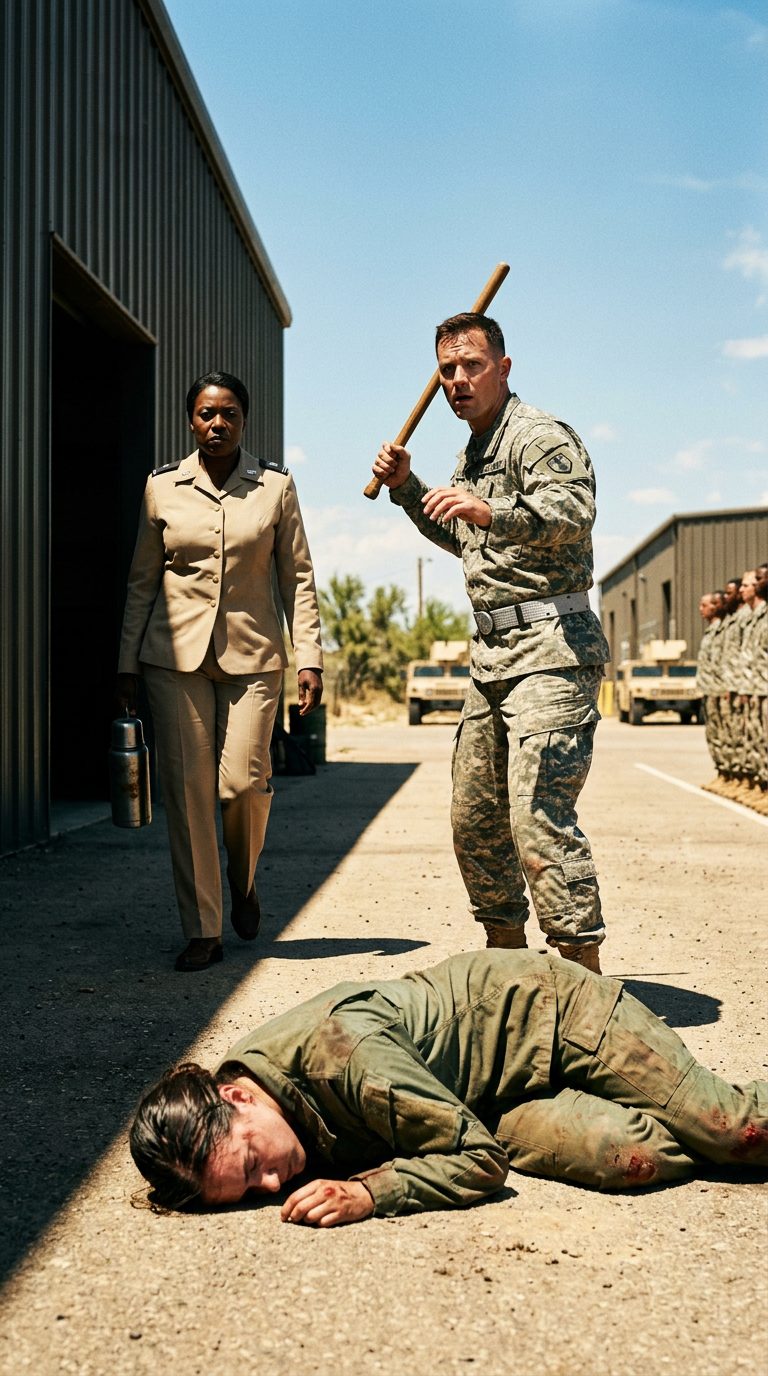
Harlan had come in from the morning inspection with boots caked in red clay from the eastern perimeter. The kind of mud that dries into a crust and flakes across whatever floor you walk on. He’d tracked it through the entrance, through the corridor, straight into the dining facility without a second thought, the way men who’ve never been told to clean up after themselves never think about the floors they ruin.
Clara had been the nearest person.
That was the only reason, and everyone knew it. She wasn’t his aide. She wasn’t assigned to him. She was a junior lieutenant eating a meal she’d earned after a sixteen-hour shift, and she happened to be closest when Harlan decided someone needed to solve his problem.
“Bennett.”
She looked up.
He nodded at his boots.
The table nearest him – six men, mid-rank, the kind who laughed at everything Harlan did because it was easier than not laughing – went quiet for exactly one second before someone snorted. Then someone else. Then the whole table, the particular sound of men who are relieved it isn’t them.
Owen Clarke, sitting four tables back with his coffee going cold, watched Clara set down her fork. Watched her stand. Watched her cross the room without any visible reaction on her face – no flush of embarrassment, no tight jaw, nothing – and kneel next to Harlan’s boots with a cloth from the maintenance station near the door.
She wiped them clean.
Harlan didn’t say thank you. He walked to the serving line.
The table of six laughed harder.
Owen put down his coffee and didn’t pick it up again.
He’d been in the military long enough to know what humiliation looked like on people. The way it moved through a body – the held breath, the blink that takes a half-second too long, the careful way someone carries themselves afterward like they’re afraid of spilling something. He’d seen it on privates, on NCOs, on officers who should’ve known better than to let Harlan get close enough to use them.
Clara had none of it.
She returned to her table. She picked up her fork. She finished her meal in the same unhurried way she’d started it, while the room reassembled itself around her like she wasn’t there.
Owen left the dining facility with one thought he couldn’t shake loose.
She wasn’t embarrassed. She wasn’t angry.
She was waiting.
The File That Didn’t Exist
He told himself it was just curiosity.
That first pull of a personnel record is always easy to justify. He had a reason, technically – he was Senior Chief, he had access, and something about the whole thing had put a splinter in his brain he couldn’t get at. Clara Bennett. Four years on the installation. No friction, no drama, no real presence to speak of. Just a quiet lieutenant who showed up, did her work, and didn’t make noise.
The file loaded in thirty seconds.
He spent the next two hours staring at it.
Four years of service. That much was there. But before that: nothing. No academy record. No prior postings. The commendations section was blank. The deployment history was a series of classification markers stacked on top of each other like someone had taken a black marker to every line. The photograph from her entry processing was there – standard, neutral expression, hair back – but every photograph that should have followed it wasn’t.
No unit photos. No training records. No fitness evaluations from her first three years.
Whole sections of the file were just gone.
Owen had processed enough personnel records to know what a real gap looked like versus a scrubbed one. Gaps happened – lost paperwork, administrative errors, transfers that didn’t sync across systems. They had a particular texture. Random missing pieces, inconsistent dates, the fingerprints of bureaucratic accident.
This wasn’t that.
This was clean. Deliberate. The kind of clean that required someone with serious authority to authorize it.
He called in a favor with an intelligence officer named Garrett – a man he’d worked with twice on separate postings, a man he trusted as much as he trusted anyone in this building, which wasn’t much but was something.
He said the name. Clara Bennett. Asked if Garrett knew anything.
Garrett’s face did the thing.
Not the blank-wall face of someone who doesn’t know. The other thing. The slight contraction around the eyes, the micro-pause before a neutral expression settles in over whatever just moved across it. Owen had seen that face exactly twice before in his career, both times involving things he was later told he’d never seen.
“Forget you asked,” Garrett said.
Then he left. Didn’t look back. Didn’t slow down.
Owen sat with that for a long time.
Then he started digging harder.
The Kind of Man Harlan Was
The thing about men like Victor Harlan was that they were never as powerful as they thought they were and always more dangerous than people gave them credit for.
He’d been at the installation for six years. Long enough to build something. Not a career, exactly – more like a system. A web of small obligations and smaller fears. People who owed him favors. People who were afraid of what he knew. Contractors who moved money through channels that didn’t bear close examination. Officers who’d looked the other way once and couldn’t stop looking away because stopping meant admitting they’d started.
He wasn’t subtle about it. That was the thing that had always struck Owen. Harlan operated in the open, almost. Like a man who’d learned early that most people would rather pretend not to notice than deal with the cost of noticing.
The boot incident was just the most recent version of a thing he’d done a hundred times. Find someone. Make them small in front of people. Remind the room who held the power. Walk away.
It worked. It always worked.
Or it had, until a lieutenant with no real file and no visible reaction had knelt down and cleaned his boots and then sat back down and finished her breakfast like nothing had happened.
Owen kept thinking about what she’d said to him afterward, when he’d caught her in the corridor outside. He’d almost not stopped her. But something made him.
“What was that back there?” he’d asked. Not accusing. Just – needing to know.
She’d looked at him with those level eyes. “What do you mean?”
“You didn’t have to do that.”
“No,” she agreed.
“So why did you?”
She’d considered the question the way you consider something you already know the answer to. “It depends,” she said finally, “on whether someone’s making a mistake or whether someone is the mistake.”
He’d asked her which one Harlan was.
She’d smiled. Just barely. “I haven’t decided yet.”
Then she walked away.
He’d stood in that corridor for a full minute before he moved.
The Morning Everything Cracked Open
The briefing had been on the calendar for two weeks. Major operational review, visiting officials, full command staff. The kind of mandatory assembly that pulled everyone into the same room regardless of rank or schedule, which meant the auditorium was packed by 0800 with the particular restless energy of people who had other things to do.
Owen got there early. He didn’t know why. Some instinct he couldn’t name.
He watched Harlan come in, the same rolling confidence, nodding at people, taking his seat near the front like a man who owned the real estate. Watched Clara slip in through a side door and find a chair near the rear wall, quiet as furniture.
Then the general came in.
And behind him came six people nobody recognized.
Civilian clothes. No rank. No name tags. No explanation. They moved like people who were used to not explaining themselves, and they took seats on the stage with the kind of unhurried certainty that made every uniformed officer in the room sit slightly straighter without knowing why.
Every senior officer stood when they entered.
Owen felt the air change.
The general reached the podium and didn’t shuffle his notes or clear his throat. He just started talking, and what he said landed in the room like something dropped from a height.
Five-year investigation. Corruption. Procurement fraud. Security breaches. Abuse of authority. Multiple installations. A task force deployed under deep-cover federal authorization.
Owen’s mind ran the numbers before the general finished the sentence.
Five years. Hidden records. No visible history. An intelligence officer who went pale at the sound of her name.
He was already turning toward the rear wall when the general said it.
“Lieutenant Bennett.”
Clara stood.
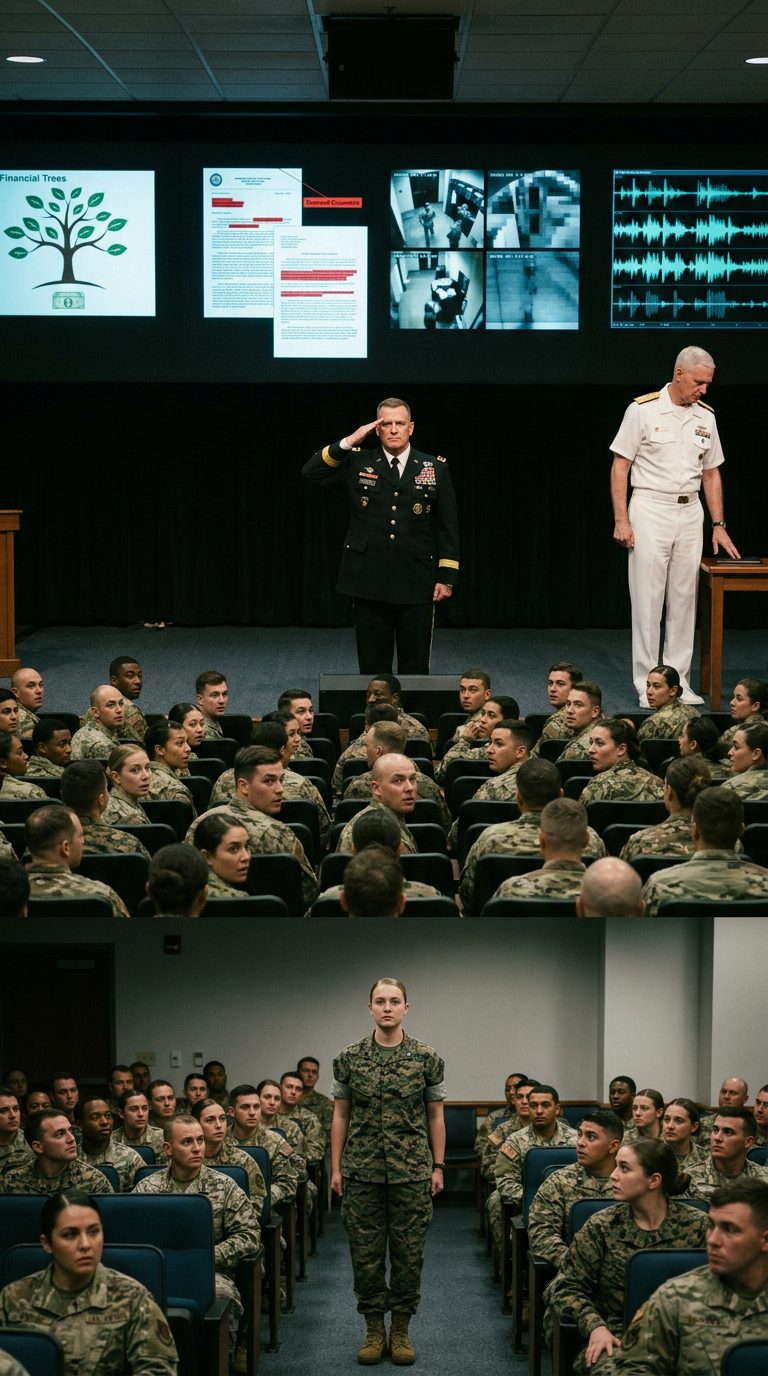
The general raised his hand to his brow in a full formal salute and held it. The six civilians on the stage rose and followed. The chief of staff. The Washington officials. Every person on that stage, on their feet, facing a woman who’d been sitting alone near the back wall of a dining facility three days ago while a table of six laughed at her.
Harlan made a sound. Not a word. Just a sound.
What Five Years Looks Like
The general’s voice filled in the rest.
Five years undercover. Direct authorization from the Department of Defense and three federal agencies Owen had heard of and two he hadn’t. Her actual rank was four grades above what her cover file showed. The operation had generated over two thousand hours of documented evidence, cross-referenced across fourteen separate cases.
Twenty-three arrests. Seventeen federal indictments. Six investigations still active.
The screens lit up around the room.
Owen recognized some of the footage immediately – corners of this building, this installation, moments he’d walked past without registering. Financial records scrolled past, organized and annotated. Audio recordings played for thirty-second clips, voices he knew saying things he wished he didn’t now know they’d said.
Harlan’s name appeared on the fourth slide.
By the sixth slide, he’d stopped looking at the screens.
Clara walked to the front of the room when the general called her up, and she walked the same way she’d walked toward Harlan’s table three days ago. Same pace. Same posture. Like she had all the time there was and wasn’t in a hurry to use it.
She turned and looked at Harlan.
He looked like a man who’d just realized the building had no floor.
“You set me up,” he said. His voice came out wrong. Thin.
She looked at him for a moment. Her expression was the same expression it had been every day for four years – calm, level, giving nothing away.
“No,” she said.
One word. She let it sit.
“You set yourself up. I just made sure someone was paying attention.”
The room didn’t make a sound.
Not a laugh. Not a murmur. Not a chair scraping against the floor.
Owen thought about the mud on those boots. About the table of six and the sound they’d made. About the word patient and how it had frightened him in a way he still couldn’t fully explain.
He understood it now.
Patience that long, that steady, that completely without performance – that’s not a personality trait.
That’s a mission.
—
If this one got under your skin, send it to someone who needs to read it.
If you’re looking for more surprising revelations, you might enjoy discovering A Simple Homemade Moisturizing Face Cream You Can Make With Rice and Baby Oil, or perhaps a new Japanese secret that promises to open your eyes – maybe even a 97-year-old grandma’s secret to saying goodbye to joint pain.