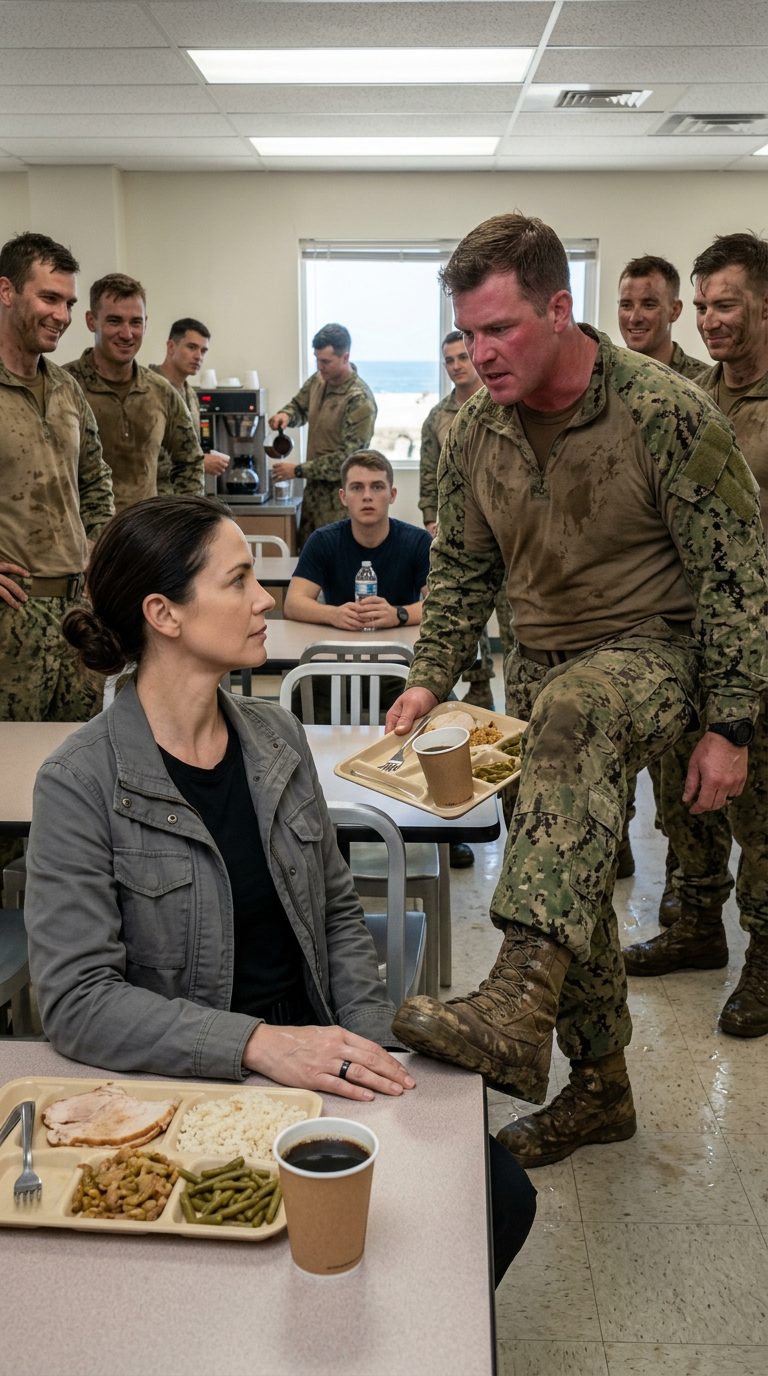

“Get up,” Sergeant Mason Reed said, sliding her lunch tray toward the edge of the table.
The woman didn’t reach for it.
The tray scraped across the plastic surface with a dry, ugly sound. A fork rolled once, struck the rim of a paper cup, and stopped.
Around them, the SEAL cafeteria at Naval Amphibious Base Coronado seemed to hold its breath.
Mason leaned one fist on the table. “This section is for operators.”
The woman looked at his hand, then at his face.
She appeared about forty, maybe a little older. Her dark hair was tied low at the back of her neck. She wore a plain gray field jacket over a black T-shirt. No rank on her chest. No unit patch on her sleeve. Only a long pale scar ran across the back of her right hand, starting near the wrist and disappearing beneath her thumb.
Her lunch sat untouched in front of her. Turkey, rice, green beans, black coffee. She’d been eating slowly before Mason arrived. Now she sat perfectly still while six mud-splattered men closed around her table. Boot water dripped onto the floor beneath them. Brown streaks dried across their uniforms. Their faces were flushed from training, their laughter carrying the sharp edge of men still burning with adrenaline.
“Maybe she didn’t hear you,” Corporal Tyler Boone said. He was younger than Mason and eager to be cruel. His grin looked practiced.
Mason smiled without looking at him. “She heard me.”
The woman lifted her napkin and wiped one fingertip. Her movements were careful. Almost quiet enough to be an insult.
“You sure you want to start here?” she asked.
A few heads turned at nearby tables.
Mason’s smile widened. “Start what?”
She glanced at the cafeteria clock. 11:42 a.m. Then she looked back at him. “That depends on what you think you’re doing.”
Mason gave a short laugh. The men around him laughed with him. The sound bounced off white walls, metal chairs, and vending machines humming near the door. Someone near the coffee station lowered his cup. A young sailor stopped reaching for ketchup.
The woman remained seated. She didn’t raise her voice. She didn’t pull rank. She didn’t explain herself.
That seemed to irritate Mason most of all.
“You walk into a SEAL team cafeteria in a civilian jacket,” he said. “You take a corner table like you own it. You sit there staring at people who earned this room.”
The woman looked around. The cafeteria wasn’t much to look at – long tables, plastic trays, framed unit photos, a bulletin board buried under schedules. Outside the windows, California sunlight burned across the training yard. Beyond that, the Pacific glittered hard and bright.
“You believe the room was earned by volume?” she asked.
Mason’s eyes narrowed. “What did you say?”
“You’re loud,” she said. “That seems important to you.”
Tyler whistled under his breath. Another operator muttered, “Damn.”
Mason’s jaw shifted. He stepped closer and placed one boot against the leg of her chair – a small move, deliberate, a way to crowd her without touching her.
She noticed. Her eyes dropped to his boot, then came back up.
“Careful,” she said.
Mason bent closer. “Cafeteria’s not for visitors.” He nodded at her tray. “Especially ones taking up space after Hell Week practice.”
Someone snorted.
Tyler pointed at her hand. “What happened there?” He leaned in with exaggerated concern. “Rough day opening canned soup?”
The table behind him erupted. Laughter spread fast, rolling across the row of men in damp uniforms, hitting the wall and coming back uglier.
The woman’s fingers closed around her napkin. Only that. Her face stayed calm. The scar seemed brighter under the overhead lights.
Mason glanced at it and gave a thin smile. “Looks painful.”
“It was,” she said.
“Kitchen accident?”
“No.”
The single word landed harder than it should have. For a moment, nobody laughed.
Mason noticed the silence and decided to crush it. He picked up her tray with both hands. Coffee rippled in the paper cup. Rice slid toward the edge. He moved the tray to the far side of the table, then pushed it another inch. It tilted against the raised lip. One more touch would send it over.
Mason looked satisfied. “Stand up.”
Her eyes stayed on the tray. “That meal belongs to me.”
“This seat belongs to people who bled for this country.” He paused for effect. “Real blood.”
The words reached the far end of the cafeteria. A chair squeaked. Someone whispered, “Mason, chill.”
He ignored it.
The woman turned her gaze back to him. “Are you certain those are the words you want remembered?”
He laughed. “Lady, I’m not repeating myself for someone who doesn’t understand combat.”
She studied him – not with anger, not with fear, but with something colder. Something like measurement. Mason had seen that look on instructors before selection. He had hated it then. He hated it now.
“Combat?” she asked.
“Yeah,” Mason said. “The thing you read about.”
Tyler laughed. Mason fed on it. “This isn’t a public-school cafeteria.” He pointed toward the exit. “Visitor center’s down the road.”
The woman leaned back slightly. The metal chair gave a faint creak.
At the nearest table, a twenty-two-year-old sailor named Ethan Cole sat frozen with a water bottle in his hand. He’d been quiet since entering the cafeteria. He had noticed the woman before the others – not because of her face, not because of the scar, but because of the ring on her left hand.
It was black steel, plain and worn at the edges. No jewel. No shine. Just a single thin line engraved around the band.
Ethan knew that line.
He’d seen it once, in a sealed training file pulled from a restricted archive during an advanced briefing. The instructor had killed the projector after five seconds. When someone asked what the ring meant, the instructor had gone quiet for a moment before answering.
“Pray you never need to know.”
Ethan set down his water bottle very carefully and did not move again.
What Ethan Knew
The ring was called a Meridian band.
Not official terminology. Not in any manual. It was the kind of name that spread through certain communities the way all true things spread – quietly, person to person, in the back half of a briefing or over a beer nobody talked about afterward.
The story Ethan had pieced together went like this: there was a tier of service that didn’t appear on any organizational chart. Not JSOC. Not SAD. Not any of the acronyms that showed up in Congressional testimony or leaked documents. Something smaller. Something that got called in when the official options had already failed or couldn’t be seen to try.
The people who operated in that space didn’t wear rank. They didn’t carry credentials that meant anything to a gate guard. They moved through military installations on the strength of a single authorization code and the understanding that asking follow-up questions was a career-ending move.
The Meridian band was how they identified each other. Black steel, single engraved line, worn on the left hand. No other markings. No unit insignia. Just the ring.
Ethan had been told one other thing about those people.
They didn’t carry weapons on base because they didn’t need to.
He looked at Mason, still standing over the woman with his chest out and his jaw set, and felt something cold work its way up from his stomach.
Mason didn’t know. Tyler didn’t know. None of them knew.
And she hadn’t told them.
That was the part that made the back of Ethan’s neck go cold. She’d sat there through all of it – the tray, the boot against her chair, the crack about canned soup – and she hadn’t said a word about who she was. Hadn’t reached for a phone. Hadn’t asked for a supervisor.
She was waiting for something.
Ethan didn’t know what. But he knew enough to stay very still.
The Name Nobody Said Out Loud
Mason was talking again. Something about the training rotation, something about civilians who thought proximity to a base made them interesting. Tyler was grinning at the floor. One of the other operators had his arms crossed, no longer laughing but not stopping it either.
The woman let Mason finish.
Then she said, “Do you know who authorized this facility’s current training cycle?”
Mason blinked. “What?”
“The October rotation. The expanded Hell Week schedule. The variance that let you run water ops two days earlier than the standard calendar.” She picked up her coffee. “Do you know who signed off on that?”
Mason’s mouth opened. Closed. “Command.”
“Closer,” she said.
She drank. Set the cup down. Looked at the tray Mason had moved to the edge of the table, rice still threatening to spill over the lip.
“My name is Carla Voss,” she said. “I’ve been attached to this installation in an advisory capacity since August. The base commander knows I’m here. The training director knows I’m here. The two men currently watching this from the doorway know I’m here.”
Mason turned. There were, in fact, two men standing near the cafeteria entrance. Both in civilian clothes. Both watching without expression. Neither moved.
“They’re not going to help you,” she said. “That’s not why they’re here.”
Mason turned back. His face had gone careful in a way it hadn’t been thirty seconds ago. “Advisory capacity for what?”
Carla Voss looked at her tray. Then at Mason.
“Put my lunch back,” she said.
It wasn’t loud. It wasn’t a threat. It was the same tone you’d use to tell someone the door was open, or the light was on. Completely flat. Completely certain.
Mason stood there for three seconds. Ethan counted them.
Then Mason picked up the tray and put it back in front of her.
Tyler Makes It Worse
Tyler laughed. Short, uncomfortable, covering something.
“Come on, Sergeant. She’s just – “
“Corporal.” Carla Voss said the word without looking at him. “Sit down.”
Tyler’s laugh stopped.
“I’m not your – “
“Sit down,” she said again. Same tone. Same flat certainty.
Tyler sat. He didn’t seem to understand that he’d done it until he was already in the chair.
The cafeteria had gone fully quiet now. Not the held-breath quiet from before. Something more complete. The vending machines still hummed. A tray clattered somewhere near the back kitchen. But nobody at any of the surrounding tables was pretending to eat anymore.
Mason stood at the edge of the table. His hands were at his sides. His face was doing something complicated.
“You should have said something,” he said. His voice had changed. Still controlled. But thinner.
“I did,” Carla said. “Several times.” She picked up her fork. “You weren’t listening.”
She started eating.
Mason didn’t move for a moment. Then he pulled out the chair across from her and sat down. Not aggressively. Not to continue the argument. He sat the way a man sits when he doesn’t know what else to do with his body.
“What kind of advisory capacity?” he asked.
She chewed. Swallowed. “The kind where I read files on men like you and decide whether the right people know what you’re actually capable of.”
The table went very still.
“That’s not a threat,” she said. “It’s a description of my job.”
She ate another bite. Green beans this time.
“Your file is good, Sergeant Reed. Three deployments. Two commendations. Qualified instructor rating in close-quarters. Your psych evals are clean, which is rarer than you’d think at your level.” She looked up. “This morning is the first thing I’ve seen that gave me any pause.”
Mason said nothing.
“Not because you were aggressive,” she said. “Aggressive is fine. Aggressive is the job.” She set her fork down. “Because you were sloppy. You made assumptions based on what someone looked like, and you committed to those assumptions in front of your men even after three separate moments where a careful person would have stopped.”
She looked at Tyler. “That goes double for you.”
Tyler stared at his hands.
What the Scar Was
Nobody asked. But the answer came anyway, the way answers sometimes do when the room is quiet enough.
Carla Voss pushed the sleeve of her field jacket up two inches. The scar on the back of her right hand connected to a second scar, thinner, running up toward the inside of her forearm before disappearing under the fabric.
“Kandahar,” she said. “2009. Not a kitchen.”
She pulled the sleeve back down.
“I’m not telling you that for sympathy,” she said. “I’m telling you because Tyler asked, and I don’t leave questions unanswered when the answer is useful.”
She looked at Tyler directly. He was twenty-four years old and had stopped looking practiced about twenty minutes ago. He looked his actual age now.
“The question you should have asked,” she said, “is why someone with this ring is eating lunch alone in your cafeteria instead of in a command facility.”
Tyler looked at the ring. “Why?”
“Because I wanted to see how this team behaved when they thought nobody was watching.” She picked up her coffee again. “I have my answer.”
The two men near the door had not moved. One of them had his hands in his jacket pockets. The other was checking his phone, or pretending to.
Mason looked at them, then back at Carla. “Is this a test?”
“Everything is a test,” she said. “Most of them don’t announce themselves.”
She finished her coffee. Set the cup down. Looked at the window, the training yard outside, the long flat stretch of California coast beyond it.
“You have good instincts about space,” she said to Mason. “You moved your men efficiently when you came in. You covered the exit without being told to. That’s not nothing.” She paused. “Work on what happens after the instinct fires. The part where you decide what to do with it.”
Mason looked like he was trying to figure out whether he’d been complimented or dismantled. The answer was probably both.
After
Ethan Cole left the cafeteria at 11:58. He didn’t look at Carla Voss on his way out. He didn’t look at Mason or Tyler. He walked to the water fountain in the hall, drank for longer than he needed to, and stood there with his hand on the wall for a moment.
He’d been right about the ring. He wished he hadn’t been.
Behind him, through the cafeteria door, he could hear Mason saying something in a low voice. He couldn’t make out the words. Then he heard Carla Voss answer, shorter, and then nothing.
When he walked back past the door twenty minutes later, the corner table was empty.
Her tray had been cleared. The chair was pushed in.
The two men near the entrance were gone.
The only thing left was a paper coffee cup, sitting precisely in the center of the table where her tray had been.
Ethan looked at it for a second.
Then he kept walking.
—
If this one got under your skin, pass it on to someone who’d understand why Ethan kept walking.
For another tale of unexpected power, read about how She Made Him Think He’d Won. He Had No Idea Who He Was Dealing With..