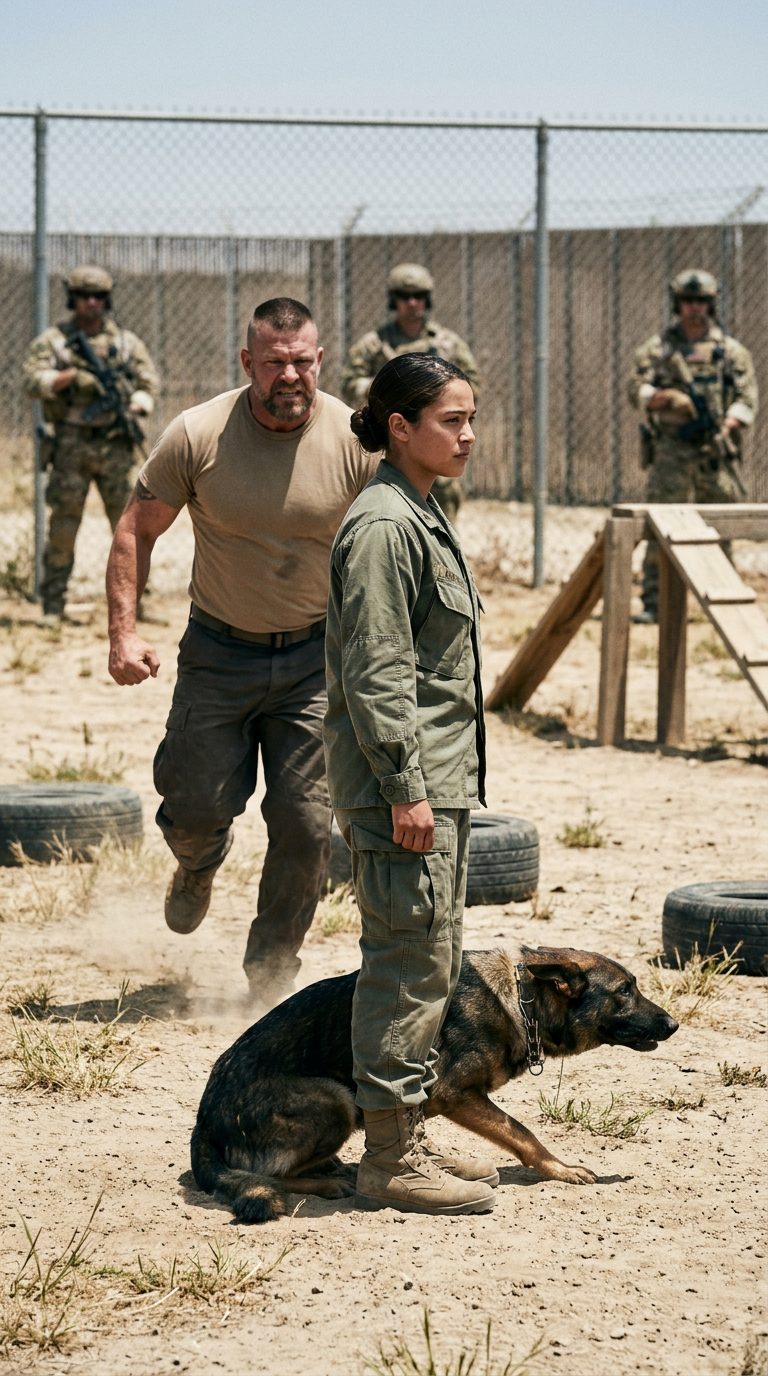
Master Sergeant Briggs wanted me on my knees in front of the whole squad.
To them, I was Corporal Carmen Hayes – a paper pusher with psychology degrees and soft hands that had never belonged in a K9 yard, let alone this one. They’d decided that before I ever set foot through the gate.
So Briggs opened the kennel.
“Release him.”
Cota came out like a cannon shot. One hundred and ten pounds of muscle and fury, paws churning the sand, teeth aimed at my throat. Behind the fence, the SEALs were already laughing – that loose, anticipatory laughter of men who know exactly how something ends.
I didn’t move.
When Cota launched, I leaned forward and spoke two words. Quiet. Steady. Like I was talking to someone I already knew.
“Halt. Ruhe.”
The dog dropped out of the air.
He hit the sand at my boots and stayed there, trembling – not from aggression, but from something older and worse. His whole body was braced, like he was waiting for what came next.
The laughter stopped.
Briggs crossed the yard in long strides, jaw tight, fury radiating off him in waves. Before I could process what he was doing, his steel-toed boot swung back toward the shaking animal.
I stepped over Cota.
“Touch that dog again,” I said, “and I’ll break your leg.”
I meant it. He could see that I meant it.
In the silence that followed, I looked down. That’s when I noticed the collar – the prongs, filed to points, pressed into the skin beneath his fur. I crouched and parted the fur carefully. The wounds weren’t fresh. They weren’t accidental either.
I understood then. Cota wasn’t vicious.
He was terrified. Had been for a long time.
Briggs let the moment breathe before he delivered his real move – measured, almost bored.
“Cota, Athena, and Reaper are scheduled for euthanasia tomorrow. All three are combat-compromised and unfit for deployment.” He paused. “Unless you can make them operational before tonight’s live-fire breach.”
He didn’t say good luck. He didn’t need to.
I stayed crouched in the sand, one hand resting lightly on Cota’s side, feeling the rapid rise and fall of his breathing begin – slowly, barely – to slow. I looked up at the yard full of men who had gone very quiet.
Three dogs. One night. And every one of these men waiting to see me fail.
I scratched gently behind Cota’s ear. He flinched, then didn’t.
“Okay,” I said. “Let’s get to work.”
What They Don’t Teach You in the Classroom
I’d spent four years at University of Maryland studying animal behavior and cognition, then another two at the Naval School of Health Sciences learning how trauma presents in working dogs. I could diagram the neurological cascade of a fear response on a whiteboard. I could cite the literature.
None of that is what saved me in that yard.
What saved me was a summer I spent at fourteen, at my uncle Darnell’s farm outside Fredericksburg, Virginia. He had a cattle dog named Biscuit who’d been beaten so badly by her previous owner that she’d go rigid if you moved too fast, even reaching for her water bowl. Darnell never forced her. He just sat near her, every day, until she decided he was safe. Six weeks. He had the patience of stone.
I thought about Biscuit a lot in the next forty minutes.
The kennel master, a quiet specialist named Doyle, walked me to the other two runs without being asked. He was maybe twenty-two, narrow-shouldered, with the careful movements of someone who’d learned to stay small around loud people. He hadn’t laughed with the others.
Athena was a Belgian Malinois, four years old, with a file that read like a war crimes report. Three handlers in eighteen months. Two biting incidents. One handler hospitalized. She was sitting at the back of her run when I approached, perfectly still, watching me with yellow-brown eyes that had already made their decision about me.
Reaper was the one that scared me.
He was a German Shepherd, six years old, and he wasn’t doing anything. Just lying on his side, facing the wall. His food bowl from that morning was untouched. Doyle said he’d been like that for eleven days, since they’d brought him back from a deployment in Djibouti where his handler, a staff sergeant named Marcus Webb, had been killed in a vehicle ambush.
Reaper wasn’t broken. He was grieving.
Those are two completely different problems.
The Clock
I had roughly nine hours before the live-fire breach exercise kicked off at 2200.
I didn’t go back to Cota first. I went to Reaper.
Doyle hovered near the run door, uncertain. I told him to go get me three things: the handler’s old gear bag if it was still on base, a bowl of warm water, and whatever food Reaper had refused to eat, scraped into something clean. He looked at me for a second like I’d asked him to go find a unicorn, then turned and went.
I sat down on the concrete floor outside Reaper’s run and did nothing.
Not nothing like waiting. Nothing like being there. There’s a difference and dogs know it immediately.
He didn’t move for a long time. Maybe twenty minutes. Then one ear rotated back toward me, just slightly, the way they do when they’re tracking sound but not ready to admit it. I kept my breathing even. I didn’t talk. The afternoon sun was coming in hard at an angle through the kennel’s high windows, laying strips of light across the floor. Somewhere outside, I could hear the SEALs running drills, boots on packed earth, someone calling cadence.
Doyle came back with the gear bag. I could smell it before he handed it through the door – old sweat, gun oil, something that had been in the field a long time. Webb’s bag.
I slid it under the run door without looking at Reaper.
He was on his feet in four seconds. Nose working. Then he had the bag between his paws and he was pressing his whole face into it, and I had to look away for a second because that’s not the kind of thing you watch without it doing something to you.
Athena
Athena was a different equation entirely.
She wasn’t grieving and she wasn’t traumatized in the way Cota was. She was smart, bored, and she’d figured out that aggression was the most efficient way to control her environment. Every handler who’d yanked her leash or raised their voice had confirmed what she already believed: that she was the most dangerous thing in any room, and the only reliable way to stay safe was to prove it first.
She needed to be wrong about that. But she couldn’t be forced to be wrong. She had to discover it.
I asked Doyle if there was a secondary yard, something away from the main kennel. He took me to a small fenced area behind the supply building, mostly used for storage. Broken pallets stacked against one fence. A rusted oil drum. Some lengths of PVC pipe.
I had him bring Athena on a long lead and then leave.
She spent the first ten minutes trying to get to me. Hard lunges, full commitment, the kind that would take your arm off at the elbow if she connected. I let the lead play out to its full length and kept moving, not away from her, just sideways, keeping her working, keeping her from planting. When she stopped lunging and started watching, I stopped moving.
She watched me for a long time.
Then I picked up one of the PVC pipes and rolled it across the ground.
Her ears went forward.
I rolled it again.
This is what they don’t understand about dogs like Athena – she wasn’t a monster. She was a high-drive working animal who’d been given nothing to do except defend herself. The aggression was the symptom. Boredom was the disease.
I worked her for ninety minutes on find-and-indicate drills using my own gear as the hide. By the end she was bringing me the pipe and dropping it at my feet, then staring at me with an expression that I can only describe as finally.
Cota, Again
Cota was the one I’d started with but he needed to be last.
I went back to him at around 1800, four hours before the exercise. Doyle had removed the collar – quietly, without being asked, while I was working Athena. The wounds underneath were shallow but there were a lot of them, and they were in a ring around his neck like something deliberate. Because they were.
I sat with him for an hour. Just sat. He moved closer to me in increments so small you’d miss them if you blinked, until his head was resting against my thigh and his breathing had slowed to something almost normal.
He was still flinching at sudden sounds. That wasn’t going to fully resolve in one afternoon. But flinching is not the same as breaking. Flinching means you’re still in the game.
At 1930 I found Doyle and told him what I needed for the breach exercise: Cota on search, Athena on perimeter, Reaper on handler-presence detail, which basically meant he’d work beside whoever was running the breach, not as primary asset but as a stabilizing force. Dogs steady each other. Most people don’t know that.
Doyle wrote it down without comment.
Then he said, “Briggs is going to be watching the whole thing.”
“I know.”
“He wants you to fail.”
“I know that too.”
Doyle looked at his notepad. “What he did to Cota – the collar thing. That’s not the first time.”
I didn’t say anything.
“I filed a report eight months ago,” he said. “Nothing happened.”
I looked at him for a second. Twenty-two years old, careful movements, stayed small. He’d been carrying that for eight months in a unit where Briggs was God.
“Write it again,” I said. “Tonight, after the exercise. I’ll co-sign it.”
2200
The live-fire breach was a three-building scenario – simulated hostage site, two opposing-force actors in building two, one in building three. The K9 teams would go in ahead of the assault element to clear and indicate. Standard stuff, except that Briggs had added a wrinkle I found out about at the briefing: one of the opposing-force actors was carrying a scent decoy specifically designed to confuse detection dogs. A counter-training tool. It was designed to make the dogs false-indicate, blow the breach, cost the team the scenario.
Briggs watched me during the briefing from across the room with the patient expression of a man who’d already won.
Cota false-indicated once, on the decoy. He sat, then immediately broke the sit and moved off – which is a dog self-correcting, which is something you only see in an animal that’s been trained well and then had that training buried under a lot of noise. The underlying work was still in there. He just needed to trust it.
He found the real target in building three. Clean indicate. Sat and held.
Athena cleared the perimeter in four minutes and didn’t bite anyone she wasn’t supposed to.
Reaper walked the breach with Staff Sergeant Kowalski, who was six-foot-three and had apparently never worked with a dog before in his life. Reaper stayed at his left knee for the entire exercise, calm, steady, like he’d been doing it for years. Kowalski kept looking down at him with an expression that was hard to read. Something between confused and grateful.
The exercise ran clean.
I was walking Cota back to the kennel when Briggs fell into step beside me. He didn’t say anything for a while. The base was quiet, just generator hum and distant water, the particular 2300 silence of a place that never really sleeps.
“Those dogs are still on the euthanasia list,” he said.
“I know.”
“My call to take them off.”
“I know that too.”
He stopped walking. I stopped because Cota stopped, and Cota stopped because he’d felt me tense up, which is the thing about dogs – they read you before you read yourself.
Briggs looked at me for a long moment. Not fury this time. Something else. Closer to recalculation.
“I’ll review the list in the morning,” he said.
He turned and walked back toward the command building.
I stood there in the dark with Cota leaning against my leg, his warm weight steady against my knee. Doyle was waiting at the kennel door with the lights on, Athena already back in her run, Reaper’s run quiet.
I looked down at Cota. He looked up at me.
His tail moved. Once. Slow.
That was enough.
—
If this one got to you, pass it on. Someone out there needs to read it.
For more stories about women who aren’t afraid to stand their ground, check out She Said “Center Hit” Before She Even Pulled the Trigger, She Stepped Onto His Mat. He Didn’t Know Who She Was., and The Range Went Quiet the Moment She Put the Card on the Bench.