
My name is Nora Whitaker, and for most of my life, my mother treated me like something that spoiled a photograph.
When I was eight, she packed a suitcase I hadn’t touched and sent me to my aunt’s house for seven weeks. The reason was simple: wealthy family friends were coming to take Christmas portraits, and I had a birthmark on my face. My sister Vivian got curled hair, a white dress, and a place beside our parents in front of the fireplace. I got a ride in the back of my aunt’s Buick and instructions not to call unless it was urgent.
When I came home, the portrait already hung above the mantle. Celeste, Grant, and Vivian smiled inside a gilded frame – three people, perfectly arranged, perfectly complete. No empty chair. No gap where a second child might have stood. No evidence I had ever existed in that house at all.
That same winter, I was standing in the kitchen holding a bowl of cereal when I heard my mother tell my aunt she sometimes wished she only had one child. She said it the way you might mention the weather. Plainly. Without lowering her voice.
I was eight years old, and I learned something then that took me twenty-two years to fully understand: some people will erase you quietly, and call it nothing.
—
I returned to my grandmother Eleanor’s house in Virginia on a Tuesday morning in October. The dogwoods along the front drive had gone red at the edges, and the air carried that particular stillness that comes just before something shifts.
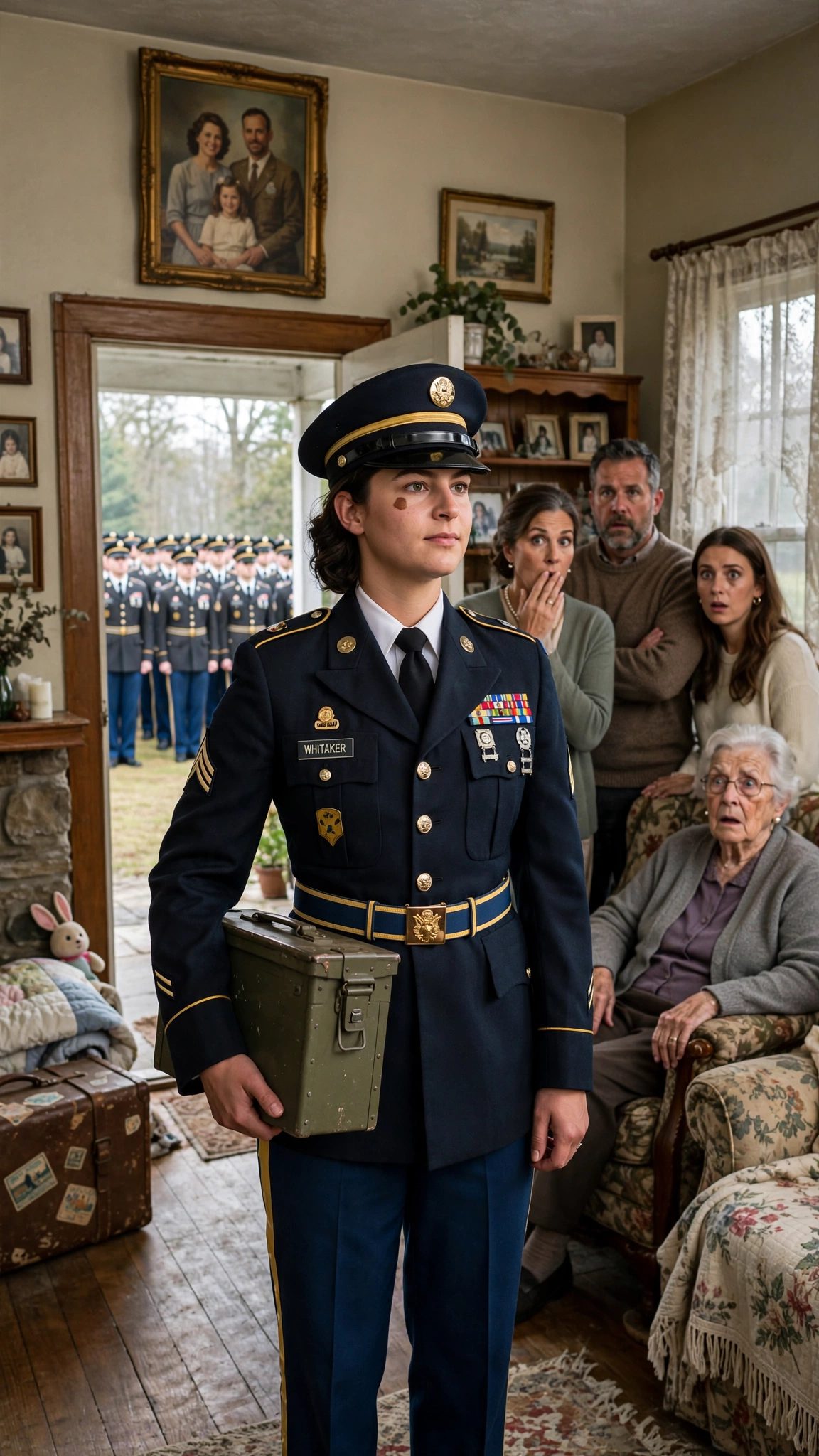
I was wearing my Army dress uniform, sharply pressed, every crease deliberate. I carried an olive metal box in both hands. Behind me, in a formation that stretched from the porch steps back to the gravel drive, stood thirty-four soldiers. They had driven through the night from two different states. Not one of them had complained.
Celeste was inside. She had no idea I was coming, no idea what I did for a living, and no idea what was inside the box.
Thirty-four soldiers called me ma’am.
Thirty-four soldiers had trusted me with their lives.
And the woman who once wished I didn’t exist was about to meet every single one of them.
What the Years Between Looked Like
I should explain what happened in the gap, because none of what came next makes sense without it.
After the portrait, after the cereal bowl, after the kitchen conversation I was never supposed to hear, I spent the next decade learning how to be invisible in a different way. Not the way Celeste wanted, where I disappeared and left her picture cleaner. My way. I made myself small in rooms, quiet at tables, easy to overlook. I figured if I could control the erasure, it would hurt less.
It didn’t.
I left for college at seventeen on a partial scholarship and a work-study arrangement that had me cleaning lab equipment at five in the morning three days a week. Celeste sent a card. Inside, she’d written Best of luck and signed her name. Not Mom. Her name. Celeste Whitaker, like I might not otherwise know who she was.
I enlisted the summer after my sophomore year. That’s a longer story. The short version is that I needed structure I could trust, and I’d already figured out that the kind of structure families were supposed to provide wasn’t something I was going to get from mine. The Army was blunt about what it expected. It told you exactly where you stood. I found that easier to live inside than the silence at my mother’s dinner table.
I did two deployments. Made sergeant. Then staff sergeant. Did a third deployment and came back with a commendation and a box of letters from soldiers I’d served with, most of them thanking me for things I barely remembered doing because that’s what the job was. You did it. You didn’t keep score.
By the time I was thirty, I commanded a unit. Thirty-four people whose names I knew, whose family situations I knew, whose breaking points I’d watched and tried to get ahead of. They were, in the plainest sense, mine to look after. Not in the way a mother looks after children. In the way two people look after each other when the stakes are real.
That’s the gap.
Eleanor
My grandmother Eleanor was eighty-one and still drove herself to church every Sunday, which the whole family pretended not to know about because the alternative was having that argument with her, and nobody wanted that argument.
She called me in August. Said she wasn’t feeling well, which from Eleanor meant she was feeling considerably worse than that. She’d been diagnosed with something in her chest the previous spring and had told exactly three people: her doctor, her neighbor Dot, and me. Not Celeste. Not Vivian. Me.
I don’t know why she chose me. I’ve thought about it. My best guess is that Eleanor was the only person in my family who had actually looked at me directly, my whole life, and seen what was there instead of what inconvenienced her. She came to my commissioning ceremony. She sent actual letters, not cards, letters, two or three pages in her cramped handwriting, about her garden and the town and whatever she was reading. She never once mentioned the portrait.
When she called in August she said, “I want you to come home before the end of the year. Bring whoever matters to you.”
I told her I’d be there in October.
She said, “Bring them in uniform. I want Celeste to see.”
I sat with that for a long time.
What Was in the Box
The olive metal box was a document case, Army issue, the kind that latches with two clasps and has a handle worn smooth from use. Inside it were the letters. Not all of them, the ones I’d kept. Forty-something letters from soldiers, a few from their parents, one from a chaplain I’d worked with in my second deployment, a man named Father Dennis Kowalski who had the kind of face that looked like it had been through something and come out still believing anyway.
There were also photographs. Unit photos, mostly, the formal kind and the informal kind. Some were from places I can’t name. A few were from ordinary moments: a card game, a meal, somebody’s birthday celebrated with a grocery store cake that had survived the journey in a care package from Ohio.
I brought the box because Eleanor had asked me to. She said she wanted to hold the evidence of my life. Her word: evidence.
I understood what she meant.
The Driveway
I called ahead for the soldiers. Sent an email three weeks out, then a follow-up, then confirmed the week before. I told them what I was doing and why, and I told them nobody was obligated. This was personal, not duty. Showing up would cost them a weekend and several tanks of gas.
Thirty-four people showed up.
Sergeant First Class Mike Pruitt drove eleven hours from Tennessee with his wife, Deanna, in the passenger seat and their two kids asleep in the back. He pulled in at six in the morning and slept in his truck for two hours before getting into uniform. He didn’t mention this until later. I only found out because Deanna told me.
Corporal Yolanda Burke, who had been with me through my third deployment and had the kind of quiet steadiness that made everyone around her calmer without her doing anything visible, drove up from Georgia. She brought coffee for the whole formation in a massive thermos and a folding table from her garage because she figured people would need somewhere to set things.
They stood in two columns, dress uniforms, at ease, on my grandmother’s gravel driveway, and they were the most real thing I had ever brought home.
Celeste
She came to the door when she heard the cars.
I was already on the porch, box in both hands, when she opened it. She was wearing a cream cardigan and the particular expression she used when something had surprised her and she hadn’t decided yet whether to be pleased or annoyed. She looked at me. Then past me.
Her mouth opened.
I said, “Hi, Mom.”
She looked at the uniform. Then at the formation behind me. Then back at my face, and I watched her eyes do something I hadn’t seen before, working to make sense of what she was looking at, rearranging something.
“Nora.” That was all.
“Eleanor asked me to come. I brought some people.”
Behind me, Mike Pruitt said, “Ma’am,” and the word moved down the formation like a current, thirty-four voices, not loud, not performative, just the word, said plainly.
Celeste put her hand on the door frame.
Eleanor appeared behind her, smaller than she’d been in August, but her eyes were the same. She looked past Celeste and looked straight at me and she smiled, and it was the smile of someone who had arranged something they’d wanted to see for a long time.
“There she is,” Eleanor said. Not to me. To Celeste. “There’s your daughter.”
The Hours After
We stayed most of the day.
Eleanor sat in her chair in the front room and held the letters and looked at the photographs for a long time, and she asked questions, real ones, and the soldiers answered her the way people answer someone who is actually listening. Yolanda Burke sat on the footstool next to Eleanor’s chair for almost an hour and they talked about something I couldn’t hear from across the room. Yolanda was crying a little when she stood up. Eleanor patted her hand twice.
Celeste stayed mostly in the kitchen. She made coffee, then more coffee, then sandwiches nobody had asked for. Vivian had driven up from Richmond and stood near the window with a look I’d seen before on people who had just realized a story they’d been telling themselves was not the correct story.
I sat with Eleanor after most people had drifted to the backyard or the porch. Just the two of us, the document case open on the coffee table between us.
She said, “You turned out so well.”
I said, “You helped.”
She shook her head. Not disagreeing exactly. Just putting the credit somewhere more accurate.
“You did this,” she said. “I just watched.”
Near the end of the afternoon, Celeste came and stood in the doorway of the front room. Eleanor had fallen asleep in her chair by then, the way she did, suddenly, mid-afternoon, like a switch. I was sitting on the couch with a cup of cold coffee.
Celeste looked at the case. At the photographs spread across the table.
She said, “I didn’t know.”
I didn’t say anything.
“I didn’t know what you were doing. What you’d done.”
I looked at her for a moment. She was seventy-three years old. Her hair had gone fully white sometime in the last few years and she wore it short now, practical, nothing like the woman in the gilded portrait above the mantle.
“I know you didn’t,” I said.
That was all. Not forgiveness, not a door slammed, just the plain fact of it, sitting between us like the coffee table.
She nodded once and went back to the kitchen.
The Drive Out
Around four o’clock the formation reassembled in the driveway, informal this time, people hugging, Deanna Pruitt exchanging numbers with Yolanda Burke, Mike loading his kids back into the truck. The October light had gone low and orange and the dogwoods threw long shadows across the gravel.
Eleanor stood on the porch to watch them go. She’d woken from her nap and come outside without telling anyone, wrapped in a wool blanket Dot had made her, and she stood there watching until the last car turned off the drive.
I carried the metal box back to my rental car and set it on the passenger seat.
Before I got in, I looked back at the house. Eleanor was still on the porch. She raised one hand.
I raised mine back.
The portrait above the mantle had come down sometime in the last few years. I’d noticed when I came in that morning. The nail was still there, and a faint rectangle on the wall where the frame had kept the paint from fading. But the portrait itself was gone, and nobody mentioned it, and I didn’t ask.
Some absences you just let sit.
—
If this one stayed with you, pass it along to someone who needs to hear it.
If you’re looking for more heartwarming (and heartbreaking) stories, read about the two little girls waiting on the porch when one woman drove four hours to grieve, or discover this cheap $0.90 cream that promises to make you look in the mirror tomorrow and see a new you.