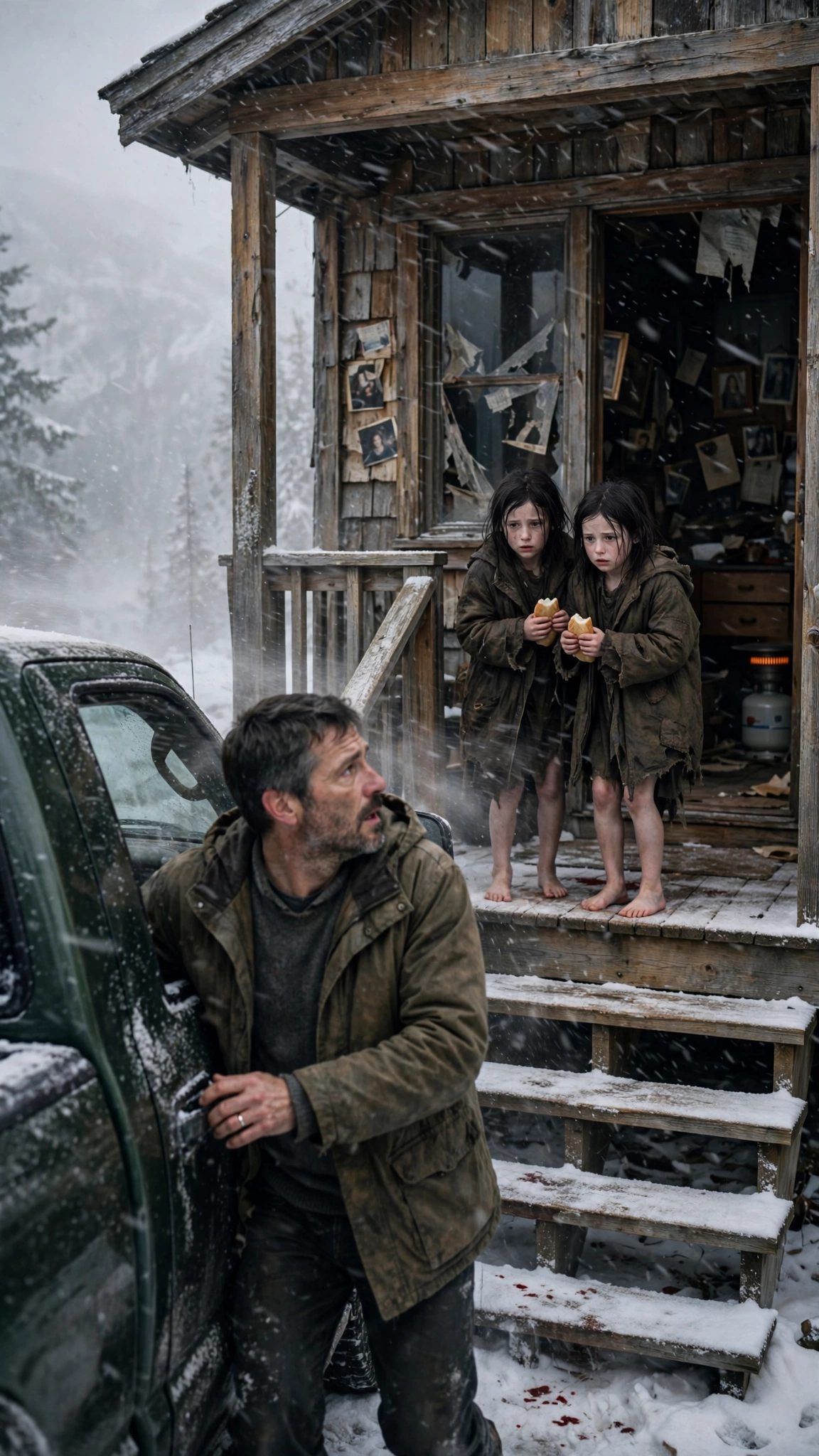

The first thing I saw was blood on the snow.
The second was two little girls staring at me as though I had come to decide whether they deserved to live.
They stood barefoot on the porch of my dead wife’s mountain house, clutching stale bread in blue, shaking hands. The storm was rising behind me, pushing cold through my coat, but neither of them moved. They just watched.
I killed the engine and stepped into the wind.
“Where are your shoes?”
They looked seven, maybe eight. Same black hair. Same hollow cheeks. One pulled the other behind her like a shield.
“Mom said not to talk to strangers,” she whispered.
“This is my house.”
The braver one studied my face with eyes far too old for her age. “Are you Daniel?”
My chest tightened. Only one person had ever called me that up here – my wife, Mara, in the years before cancer took her eleven months ago. She had loved the way the name sounded in mountain air. She said it felt like it belonged there.
“Yes,” I said. “I’m Daniel.”
The smaller twin’s face crumpled. “Aunt Mara said you would come.”
What Three Nights Alone Does to a Child
I carried them inside.
The power had been cut. The pantry held nothing but mouse droppings and cold air. Every family photograph had been torn from the walls, and someone had moved through the rooms with focused, methodical violence – drawers overturned, cushions slashed open, floorboards pried up and left at angles like broken teeth.
Someone had been looking for something specific.
Their names were Lily and Rose Mercer. Their mother, Mara’s younger sister Vanessa, had dropped them at the house three nights ago and driven away.
“She said it was a game,” Lily told me through chattering teeth, once I had found the propane heater and wrapped them both in blankets from the cedar chest. “She said we had to find Aunt Mara’s treasure before she came back.”
“And if you didn’t find it?”
Rose looked down at the bread still clutched in her fist, as if she hadn’t yet decided whether to let go of it. “No food.”
The grief I had driven four hours to sit with turned into something colder and harder.
Three nights. The temperature had dropped below fifteen the last two of them. I had checked the weather on the drive up, the way you do when you’re going somewhere lonely and want to know what you’re walking into. The girls had burned through most of the firewood stacked by the door. The rest they’d dragged in themselves, piece by piece, from the woodpile under the side porch. Rose’s palms had bark cuts across them, dried to thin brown lines.
Seven years old.
I got the propane going and found two cans of soup in the back of a cabinet, behind a box of Mara’s tea. I didn’t let myself look at the tea. I heated the soup on the camp stove and watched them eat with the focus of animals, both hands on the cups, not a word between them.
Lily finished first. She wiped her mouth with the back of her wrist and looked at me.
“Are you going to call the police?”
“Yes.”
She nodded slowly, like she’d already decided that was the right answer and was just waiting to see if I’d gotten it.
“Mom’s going to be really mad,” she said.
“I know.”
She looked at the fire. “Good.”
The Funeral I Keep Replaying
I remembered Vanessa clearly from Mara’s funeral. She had cornered me near the reception table with a glass of wine and a smile that didn’t reach her eyes, and told me the mountain property belonged to blood family, not a widower who had been too weak to save his wife. She called me a washed-up paper pusher. Said I had coasted on Mara’s goodness for years and had nothing to show for it.
I had said nothing. Near the end, Mara had taken my hand and asked me not to fight over money. She had been apologizing for her family even as she was dying, and I had promised her I wouldn’t.
I had kept that promise.
Now I understood what it had cost.
Vanessa had been at the funeral for maybe forty minutes. She’d done the rounds, accepted the condolences, let people tell her how much Mara had meant to them. She’d cried at the right moments. I’d watched her do it and felt nothing, because grief does that – flattens your ability to read anything beyond your own loss.
She’d left before the sandwiches were gone.
I’d thought she was just someone who grieved badly. Privately. I’d given her that.
Eleven months later, standing in a trashed house with two half-starved children asleep in the next room, I understood the calculation she’d been running since before Mara’s body was cold. The property was in both our names. Mara had been meticulous about that, about making sure I was protected. Vanessa had known it. She’d spent nearly a year trying to find another angle, and when she couldn’t, she’d used her own daughters to search a house she couldn’t legally enter.
This was never about grief or inheritance or family loyalty. This was a hunt. Vanessa had simply needed someone to do the searching she couldn’t do herself, and she had used two children to do it.
The Call
I called the sheriff first. Then I called someone Vanessa had no reason to know still answered my calls: Elena Ruiz, chief investigator for the state attorney general’s financial crimes unit. We had worked three cases together before I left the prosecutor’s office. She was precise, relentless, and completely without sentimentality – which was exactly what I needed.
“Daniel Cole,” she said. “It’s been a few years.”
“I need a child abandonment response, a forensic team, and complete silence until you arrive.”
A pause. Her voice sharpened the way it always did when something real was happening. “What did you find up there?”
“Not what,” I said, watching Rose sleep against my shoulder, her breathing finally slow and even. “Who.”
Another pause. Shorter.
“Send me the address,” Elena said.
I did. Then I sat in the firelight with Rose’s weight against my arm and listened to the storm work itself up outside. The windows were old, single-pane, and they flexed slightly in the gusts. Mara had always meant to replace them. We’d talked about it every fall and never gotten to it, the way couples don’t get to things, because there’s always next year.
There wasn’t always next year.
I looked at the ring on my left hand. Plain gold band, slightly scratched. I’d worn it every day since she died. Most people stopped asking about it after the first few months. I’d stopped explaining.
Rose shifted in her sleep and made a small sound, not quite a word. Her hand found my sleeve and held it.
I didn’t move.
What Lily Had Been Carrying
Lily had stayed awake. She sat across from me in the firelight with her knees pulled to her chest, watching my face the way children watch adults when they’re deciding whether to trust them.
After a long moment, she reached inside her torn coat.
Stitched beneath the lining, hidden in a seam so small I would never have found it myself, was a brass key.
She held it out to me in her open palm.
“Aunt Mara told us,” she said quietly. “She said if the bad people came – and she said they would come – we should give this only to the man who still wears her ring.”
I looked down at my left hand. Then I looked up toward the top of the stairs, and the locked cedar room at the end of the hall. The room Mara had always kept to herself. The room I had never pressed her about, because I had trusted her completely and she had known it.
She had been planning for this. Not for her death, exactly – she had accepted that with more grace than I ever could – but for what might come after. She had known her sister. She had known what Vanessa would do when she was gone.
And so she had left a key, and two little girls, and a message carried in a coat lining through three nights of cold and fear.
Give this only to the man who still wears her ring.
I thought about when she must have done it. Sometime in the last months, probably. Sitting with Lily and Rose while Vanessa was out of the room. Sewing the key into the lining with hands that were already giving out on her. Telling two little girls a story about treasure and bad people and a man who would come.
Making sure they understood which part was important.
The ring.
She’d known I’d keep wearing it. She’d known that about me more clearly than I knew it about myself.
“Did your mom know she gave you this?” I asked.
Lily shook her head. One short, certain motion.
“Did she look for it? When she was searching the house?”
“She looked everywhere,” Lily said. “She didn’t look at us.”
What Was in the Room
The key fit.
The cedar room smelled like Mara – that specific combination of cedar and the hand lotion she used and something underneath that I still couldn’t name, that was just her. I stood in the doorway for a moment with my hand on the frame.
Then I went in.
The room held a desk, a filing cabinet, and two cardboard boxes. Everything was labeled in her handwriting, that small, slanted print she’d always used. The filing cabinet was locked, but the same key opened it. Inside: financial records going back eight years, organized by year and category. Bank statements. Investment accounts. Property records.
And a sealed envelope with my name on it, sitting on top of everything else.
I didn’t open it right away. I stood there in the dark with the envelope in my hand and the storm pressing against the window and the sound of two children breathing downstairs.
Then I sat down at her desk and opened it.
It was four pages, handwritten. She started with an apology for keeping the room locked, and then explained why: Vanessa had been siphoning money from their mother’s estate for years before their mother died. Mara had documentation. She’d been building a case quietly, carefully, without telling me because she hadn’t wanted me dragged into it, hadn’t wanted it to be the thing we spent her last months on.
She wrote: I know you. You would have made it your whole life. I needed it to be mine.
The last page was instructions. Who to call. What to hand over. How to protect the girls, because she’d known – she’d known – that Vanessa would eventually use them.
The last line read: I’m sorry I made you promise not to fight. I’ve left you everything you need to finish it. You were always better at this than you knew.
I sat there for a while.
Then I heard tires on the gravel below and saw the blue and red light start moving across the ceiling, and I folded the letter, put it in my coat pocket, and went downstairs to let Elena in.
Vanessa had spent eleven months calculating how to outmaneuver a grieving widower.
She had forgotten that I had spent a decade prosecuting people exactly like her.
And she had never once considered that Mara was smarter than both of us.
—
If this one got to you, pass it along to someone who needs it tonight.
For more fascinating reads, discover how to Put THIS Cheap $0.90 Cream Around Your Eyes Tonight – TOMORROW Look In The Mirror or explore 20 Biblical Superfoods That Will Heal You Instantly and the Top 6 Best Morning Teas to Flush Toxins & Restore Kidney Function Fast.