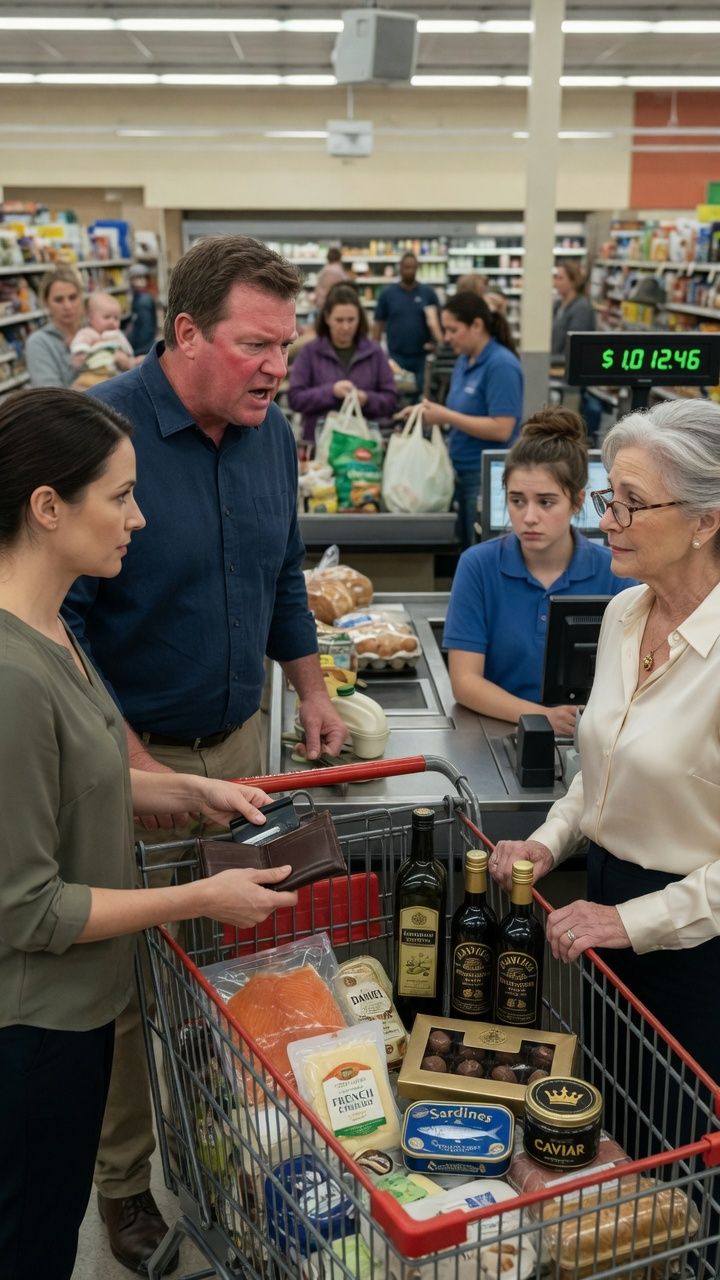

“You honestly expect my mother to pay for groceries?”
He snapped it loud enough for the woman in the next lane to stop unloading dog food and stare.
By the time we’d reached the checkout, Daniel’s face had gone bright red. His voice bounced off the harsh fluorescent lights, and the teenage cashier was making a heroic effort to look anywhere but at us.
I kept both hands on the cart and smiled with the strange calm that comes when something inside you has already shifted beyond repair.
The cart was filled with things I had never chosen.
Vacuum-sealed smoked salmon. Imported French cheese wrapped in wax paper. A bottle of olive oil that cost more than the shoes I wore to mow the lawn. Two bottles of aged balsamic vinegar that looked expensive enough to belong behind glass. A gold box of handmade chocolate truffles. A tin of what Patricia called proper sardines, delivered with the gravity other people reserved for jewelry.
And sitting between the bread, milk, and eggs like a tiny black crown: a jar of real caviar.
My mother-in-law stood at the far end of the conveyor belt, reading glasses perched halfway down her nose, silk blouse perfectly pressed. Her face wore its favorite expression – gentle, wounded innocence. Her best performance. Patricia had a rare gift for making entitlement look like good manners, and after six years, I had stopped underestimating her.
The cashier cleared her throat and glanced at the screen.
$1,012.46.
My own groceries – chicken, sweet potatoes, yogurt, coffee, cooking oil, onions, dishwasher pods, and a birthday card for a coworker – came to roughly $120.
My card was already in my hand. I had been holding it for nearly a minute.
Then I placed it quietly back inside my wallet.
“I’ll pay for mine,” I said. “Patricia can pay for hers.”
Two full seconds passed. Nobody moved.
Then Daniel turned on me as though I had struck him in public.
“What?”
Patricia’s hand had been drifting lazily toward her purse – the unhurried confidence of a woman who expected someone else to handle the bill. It stopped halfway.
I repeated myself.
“My groceries are mine. Patricia’s are Patricia’s.”
“You cannot be serious,” Daniel said, his voice climbing. “She’s family.”
“She is,” I agreed. “She’s also retired, receives a pension, owns her condo outright, and clearly has expensive taste.”
His jaw tightened. “This is humiliating.”
I looked at him.
Daniel had been handsome when I met him, and he still was. That had never been the problem. Soft brown hair. Warm eyes, when he remembered to use them. Broad shoulders that made strangers assume he was more dependable than he actually was. At thirty-seven, he had become the kind of man people trusted on sight – unless they knew precisely where his loyalty went when it mattered.
I had loved that face for eight years. Been married to it for six. I had built a quiet, ordinary life around him because I had once, foolishly, mistaken love for reliability.
Now he stood in checkout lane seven, glaring at me while his mother waited for him to fix it.
“You want her to reimburse you?” he demanded.
“I’m not asking her to reimburse me. I’m asking her to pay for what she put in the cart.”
That was when Patricia finally spoke.
Her voice was soft. Sad. Perfectly rehearsed.
“Oh, Claire.” She tilted her head with practiced sorrow. “I never imagined you’d turn this into a problem.”
There it was – her favorite move. She had a talent for transforming her own selfishness into someone else’s moral failure, and she had been performing it for so long she no longer seemed to notice she was doing it.
Around us, everyone suddenly found something urgent to look at. The teenage bagger focused intently on the reusable totes. The woman behind us stared at her phone. A baby cried somewhere in the next aisle. Over the intercom, an employee was summoned to produce.
And in the middle of all that bright, public noise, something inside me went completely still.
Not numb.
Clear.
It was the calm that arrives after you’ve already cried alone in the dark – after the shock has burned itself out and fear has finally, quietly, hardened into certainty.
“All right, sweetheart,” I said, looking directly at Daniel. “Go ahead. Be angry.”
He stared at me.
For three days, I had known what was in the bottom drawer of the filing cabinet in our home office. For three days, I had been making copies, meeting with my attorney, calling my father, and sleeping almost nothing.
I let the silence hold for one more moment. Then, in the same even voice, I added:
“The real surprise is still coming.”
Daniel had no idea what I meant.
Neither did Patricia.
But I did.
And that changed everything.
What Was in the Drawer
I should back up.
Seventy-two hours earlier, it had been a Tuesday. Ordinary. I’d come home from work around six, kicked off my shoes at the door, and gone looking for the stapler because I needed to mail something for my father’s insurance.
The filing cabinet was Daniel’s domain. He’d always been particular about it, which I’d taken, for years, as a sign of organization. Competence. I liked that about him, I thought. Or I liked the idea of it.
The bottom drawer stuck. It always stuck. I yanked it twice and it finally gave, and underneath the hanging folders was a manila envelope with no label.
I’m not sure why I opened it.
Maybe I already knew. The body sometimes knows before the brain catches up.
Inside: bank statements for an account I had never heard of. Three years of them. A lease agreement for an apartment in a building twenty minutes from our house, signed in Daniel’s name, renewed twice. A name I didn’t recognize on several of the statements, cross-referenced with transfers that averaged around $3,400 a month.
I sat on the floor of our home office for a long time.
At some point I noticed my hands were shaking. Not dramatically. Just a fine, steady tremor, like the kind you get after too much coffee.
I put everything back exactly as I’d found it. Went to the kitchen. Made dinner. Ate across the table from Daniel and listened to him talk about a colleague at work he found irritating.
I nodded in the right places.
That night, after he was asleep, I photographed every page.
The Name on the Lease
Her name was Gwen Pruitt.
I know because I looked her up the next morning, sitting in my car in the parking garage of my office building, twenty minutes before I was supposed to be at my desk.
She was thirty-one. A fitness instructor. She had a public Instagram account with 4,200 followers and a habit of posting Sunday morning coffee photos and gym selfies and, occasionally, pictures of what appeared to be a very nice apartment. Clean lines. Lots of natural light. A kitchen with the kind of marble countertops I’d asked Daniel about twice and been told were not in the budget.
I sat with that for a while.
Then I called my attorney. Her name is Donna Sloan, and she is sixty-two years old and has the bedside manner of a woman who has heard every version of every story and is no longer surprised by any of them. She told me to stop looking at the Instagram account, make copies of everything, and not say a word to Daniel until we had spoken in person.
“Don’t confront him,” she said. “Don’t tip him off. Don’t change your behavior.”
“He’s taking his mother grocery shopping on Saturday,” I said, for no particular reason.
“Then go,” Donna said. “Buy your groceries.”
The Arrangement
Here is something I had understood for years but never said out loud:
Patricia had always treated our household finances like a renewable resource. Not her money, obviously. Mine and Daniel’s. But she had a way of attaching herself to purchases, to dinners, to weekend trips, that made it feel rude to separate her out. Daniel encouraged it. He’d grown up watching her operate that way and had long since stopped seeing it as anything unusual.
She’d moved her condo fully paid-off, no mortgage, a pension from thirty years in hospital administration, and a modest investment account her late husband had left her. She was not broke. She was not struggling. She simply preferred not to spend her own money when someone else’s was available.
The groceries weren’t even the worst of it.
There had been a vacation to Portugal two years ago, $4,200 for her flights and hotel, which Daniel had put on our joint card and never mentioned until I saw the statement. A new living room set for her condo, “just a small contribution” that came to $1,800. Birthday dinners where she ordered the most expensive thing on the menu and then looked at Daniel when the check arrived.
Every time I’d said something, Daniel had a version of the same answer.
She’s my mother, Claire. She’s family. What do you want me to do?
I had tried, for six years, to want less. To adjust my expectations down to whatever size fit inside that sentence.
I was done adjusting.
Lane Seven
So back to the checkout.
Patricia paid for her groceries. She did not do it graciously. She opened her wallet with the precise energy of someone being robbed in broad daylight, and she handed over her credit card without looking at the cashier, and she made a sound under her breath that I chose not to acknowledge.
The total was $1,012.46.
She paid it.
Daniel did not speak to me in the parking lot. He loaded her bags into the trunk of his car with the focused silence of a man rehearsing what he planned to say later. Patricia got into the passenger seat. I got into mine, started the engine, and drove home separately because I had driven separately, which I had done on purpose.
That night, Daniel sat down across from me at the kitchen table and told me I had embarrassed his mother.
“I know,” I said.
“You embarrassed me.”
“I know that too.”
He waited for the apology. It didn’t come.
“What is going on with you?” he said.
I looked at him for a moment. Thought about the manila envelope. Thought about Donna Sloan’s voice on the phone. Thought about an apartment with marble countertops and three years of monthly transfers and a woman named Gwen Pruitt posting Sunday morning coffee on her public Instagram.
“Nothing,” I said. “I’m fine.”
He didn’t believe me. I could see it. But he also couldn’t push further without risking a conversation he wasn’t prepared to have, and we both knew it, even if only one of us knew why.
He went to bed.
I sat at the table for a while longer.
The Real Surprise
Donna filed the paperwork on Monday.
I had moved the money I needed into a separate account the previous Thursday. I had called my father, who is seventy years old and not easily rattled, and he had said, “Okay. What do you need?” I had said, “Nothing yet. I just needed to tell someone.” He’d been quiet for a second and then said, “Come for dinner Sunday.” So I did.
I didn’t cry until I was back in my car, sitting in his driveway.
Then I cried for about four minutes, which felt like the right amount.
Daniel was served on a Wednesday. He called me eleven times between 9 a.m. and noon. I let them go to voicemail. At 12:15 I texted him: Talk to your attorney first. Then we can talk.
He called four more times.
Patricia left a voicemail that I will not quote here, except to say that it confirmed everything I had ever thought about her, and that she used the word “ungrateful” twice.
I saved it. Donna said to save everything.
What I Know Now
I’m not going to tell you it was easy. It wasn’t.
There were nights I lay in the dark replaying eight years of small moments, looking for the exact place where reliability had quietly left the building and I’d just kept setting the table like it was still there.
I didn’t find a single moment. That’s the thing. It wasn’t one moment. It was a hundred small ones, each of them ordinary, each of them survivable on their own.
But I know this: the grocery store was not where it ended. It was just the first place I stopped pretending.
Patricia’s caviar. Daniel’s red face. The cashier pretending not to hear.
Me, putting my card back in my wallet.
That was the beginning of the end, and also the beginning of something else entirely, and I was the only one in lane seven who knew it.
—
If this hit close to home for someone you know, pass it on.
If you found this story wild, you won’t believe what happened when I Stood Up at My Own Engagement Party and Ended the Vows, or the time My Parents Threw Us Out of a Moving Car in the Desert. My Mother Was Smiling. You might also be interested in reading about how My Father Pulled Back the Blanket and My Husband’s Whole Life Fell Apart.