My parents kicked me and my six-year-old son out of a moving car at 2 AM on a freezing desert highway. My mother smiled as the taillights swallowed themselves into the darkness. My father didn’t even look back. They thought they had ended our story that night.
They couldn’t have been more wrong.
—
At 2:13 in the morning, on a lonely stretch of Highway 95 outside Tonopah, Nevada, my father hit the brakes so hard that Eli’s forehead cracked against the back of the passenger seat.
“Get out,” he said.
For one suspended moment, I was certain I had misheard him. The desert beyond the windshield was black and absolute, broken only by the twin cones of the headlights and the thin white dashes of the road bleeding forward into nothing. Twenty minutes earlier, we had passed a temperature sign. Twenty-nine degrees.
“Dad.” My voice came out cracked and small. “Eli is in the car.”
My mother turned around from the front seat. Her lipstick was still perfect, even at two in the morning. She looked at us with the calm, unhurried expression of someone watching a stranger’s problem on the evening news.
My father gave a short, dry laugh.
That was when Eli woke up fully.
“Mom?”
I reached for him, but my father had already stepped out, wrenched my door open, and dragged my backpack from the floorboard. It split when it hit the asphalt. Eli’s inhaler skittered out and disappeared beneath the car.
“His inhaler,” I said.
My mother glanced down at it. Then she turned away.
Something inside me went very still.
I understood then – not as a suspicion, but as a cold and finished fact – that none of this was impulsive. They had taken my apartment keys earlier that evening, claiming they wanted to hold them for safekeeping. My wallet was in my mother’s purse because she had offered to carry it when we stopped for gas. My phone had been dying for an hour because my father had quietly unplugged my charger somewhere outside of Reno and called me dramatic for noticing.
This was not a fight that had gone too far. This was a plan.
My father tossed Eli’s dinosaur blanket out after us. It landed in the dirt at the shoulder’s edge. Then the car eased forward, gathered speed, and shrank away down the highway until there was nothing left of it but two red lights, and then not even that.
Eli cried for his grandparents to come back.
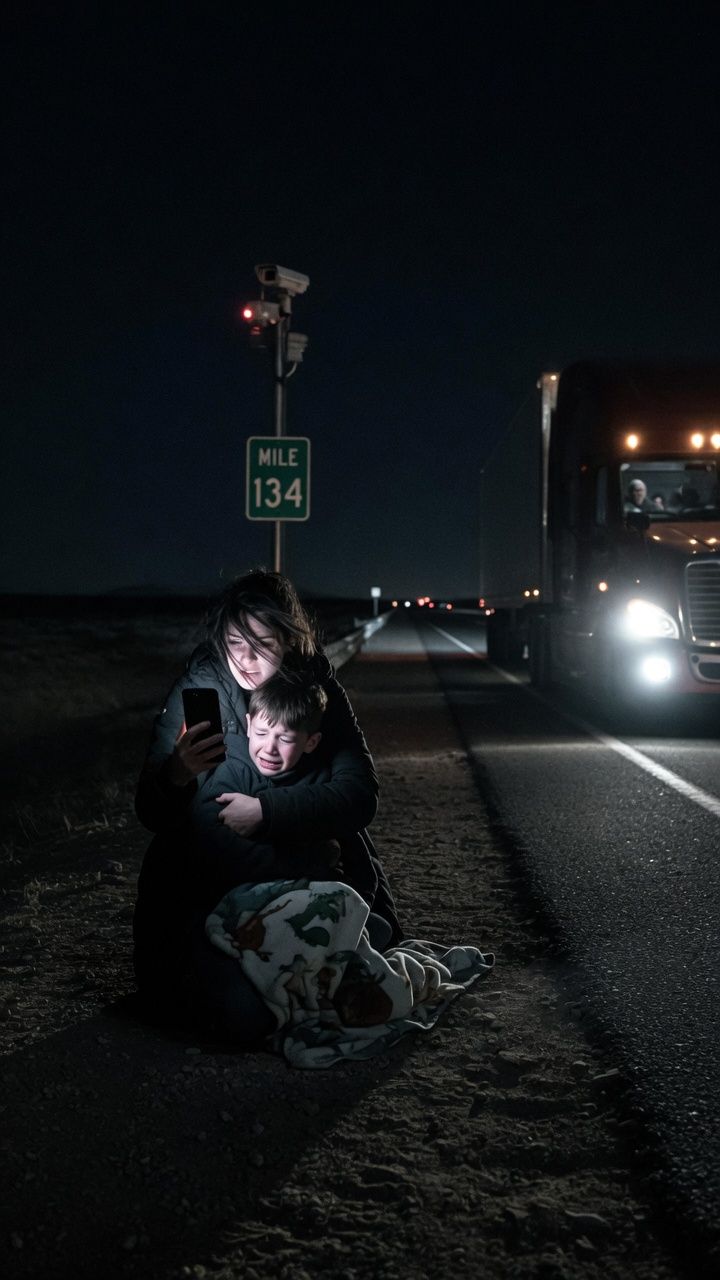
I pulled him inside my coat and held him against my chest and made myself breathe slowly, deliberately. Crying wasted heat. Crying wasted breath. I could not afford either.
I looked around and fixed on the nearest mile marker. 134. I memorized it the way you memorize something you know you’ll need to prove later.
My father had always underestimated me. Most people had. It was the one advantage I had never stopped being grateful for.
Ten minutes after they left, I noticed the light.
A faint amber blink on the shoulder, maybe thirty yards behind us – a highway weather camera mounted on a metal pole, the kind the Nevada DOT uses to monitor road conditions on remote stretches. I had registered it peripherally when my father stopped the car. Now I understood something that made my chest loosen by a single, crucial degree: my parents had abandoned us directly beneath state surveillance equipment. Their license plate had been fully illuminated in the headlights. Whatever happened in the next few minutes had already been recorded.
I carried Eli to the camera pole. Out of reflex, or desperation, or both, I pressed the emergency power button on my dead phone. The screen stayed black.
Then, far down the highway, a pair of headlights appeared. High and wide-set. A semi.
I stepped onto the shoulder and raised both arms and waved them until my shoulders burned, until the truck’s air brakes hissed and the rig shuddered to a stop on the gravel ahead of us.
By sunrise, everything had changed.
What Was Inside That Cab
The driver’s name was Dale Pruitt. Fifty-three years old, out of Elko, running a load of construction materials down to Las Vegas. He had a thermos of coffee wedged between the seats and a CB radio mounted above the dash and he did not ask a single unnecessary question when I climbed up with Eli on my hip and a split backpack over one shoulder.
He just said, “You need heat first or a phone first?”
I said, “Phone.”
He handed me his without hesitating. A Samsung with a cracked corner and a country radio station pulled up on the screen.
I called 911. I gave them mile marker 134, Highway 95, northbound shoulder. I gave them my parents’ names. I gave them the make and color of the car, the Nevada plate number I had memorized on the drive from Reno because something in me had been keeping notes all evening without knowing why. The dispatcher’s voice was flat and professional and she told me to stay where I was.
Then I sat in the passenger seat of Dale Pruitt’s semi with Eli in my lap and a wool blanket he’d pulled from behind the seat wrapped around us both, and I stared at the windshield while he poured coffee into the thermos cap and set it on the dash in front of me without saying anything.
Eli fell asleep again in about four minutes. Kids can do that.
I did not sleep. I watched the road.
What the Deputies Found
Two Nye County Sheriff’s deputies arrived at 3:07 AM. I know the time because I had Dale’s phone in my hand and I checked it when I saw the lights.
They took my statement on the shoulder. One of them – Deputy Karen Vasquez, early forties, short hair, a small scar on her chin – wrote everything down in a spiral notebook while the other went back to the cruiser to run the plates. The temperature had dropped another two degrees since my parents left. Eli’s inhaler was still somewhere under the asphalt where it had skidded.
Deputy Vasquez asked me to walk her through the evening from the beginning.
I did. I was specific. I had dates and times and the name of the gas station outside Reno where my mother had taken my wallet. I told her about the charger. I told her about the apartment keys. I told her about the camera on the pole.
She stopped writing and looked up at that last part.
“You clocked the camera while this was happening?”
“I clocked it after,” I said. “Maybe ten minutes after.”
She looked at me for a second. Then she wrote something down.
The other deputy came back from the cruiser. He spoke quietly to Vasquez. She nodded once.
My parents had been pulled over forty-one miles south on Highway 95 at 2:58 AM. My father had told the officer they hadn’t seen us since dinner. My mother had said she didn’t know what he was talking about.
The camera footage request went in before 4 AM.
The Part Nobody Tells You About
Here is what I did not expect: the paperwork.
Not the criminal side – that moved fast, actually, faster than I’d thought anything official could move. Child endangerment charges were filed within seventy-two hours. The plate, the camera footage, the deputy’s notes, my statement, Dale Pruitt’s statement – it was clean. My parents had done this on a state highway under a state camera with a witness in a truck thirty yards away. They had handed prosecutors a gift.
What I did not expect was everything else.
My wallet was still in my mother’s purse when she was pulled over. Getting it back took eleven days and two phone calls to a victims’ advocate named Sharon who worked out of a county office in Tonopah and had the particular exhausted patience of someone who had been doing this job for twenty years and still showed up. My apartment keys were in my father’s jacket pocket. Getting those back took longer, because he claimed he’d lost them, and I had to get the locks changed, which cost $180 I did not have.
I stayed those first nights in a motel in Tonopah that the county had a contract with for situations like mine. The room smelled like carpet cleaner and the heater rattled but it worked. Eli decided the vending machine down the hall was the greatest thing he had ever encountered in his six years on earth and I let him get a bag of Doritos at seven in the morning because I did not have the energy to argue and because he had been very brave.
He asked me twice why Grandma and Grandpa had left us on the road.
I told him I didn’t know. Which was the truth, in the way that the whole truth is sometimes too large to fit inside an answer.
What My Mother Said in Her Statement
I read it later, through the discovery process. It took me three tries to get through it.
She said I had asked to be dropped off. She said I had gotten out of the car voluntarily after an argument and taken Eli with me. She said she had been concerned but that I had insisted. She said my father had thrown my backpack out to help me, not to strand me.
She said the inhaler had been an accident.
Her handwriting – she had written part of it herself, in the margins, a note to the detective – was neat and looping and completely steady. The same handwriting that had signed my birthday cards for thirty-one years.
I sat with that for a long time.
Not because it surprised me. Because it didn’t.
What Happened to Eli
He started first grade that September in a new school district, forty miles from where we’d been living, in a rental house I found through a woman named Pam Doyle who ran a Facebook group for single parents in the county and who showed up on my second week with a casserole dish and the name of a pediatric pulmonologist who took Medicaid.
Eli lost the two front teeth he’d been wiggling since June. He joined a soccer league where he was, objectively, not very good, and he didn’t care at all. He made a best friend named Marcus who lived two streets over and who came to our house so often that I started buying the specific brand of juice boxes he liked.
He asked about his grandparents one more time, about four months after Tonopah. We were driving home from soccer practice and it was getting dark and he was eating a granola bar in the back seat and he said, out of nowhere, “Do you think they’re sorry?”
I kept my eyes on the road.
“I don’t know, bud.”
He chewed for a second. “I think maybe they’re not,” he said. Just informational. No particular emotion in it.
“Maybe not,” I said.
“Okay,” he said. And went back to his granola bar.
Mile Marker 134
The charges didn’t get dropped. My parents hired a lawyer, a good one, and it still didn’t matter because the camera footage was seventeen minutes of unambiguous evidence and Dale Pruitt was an excellent witness who remembered everything and had no reason to lie.
My father pled out. My mother took it to a hearing and lost.
I wasn’t there for either. I had decided early on that I didn’t need to watch it happen to know that it had. Some people need the courtroom. I needed the moment to be over so I could stop looking backward.
What I kept, and still have, is a photograph that Deputy Vasquez sent me after everything was resolved. She’d requested a still from the DOT camera footage as part of the file and then – I don’t know why, maybe she just thought I should have it – she sent me a copy.
It’s grainy, the way those cameras always are. Timestamp in the corner: 02:14 AM. Two figures on the shoulder of the highway, one large, one small. The large one has both arms wrapped around the small one. The small one’s face is turned in toward the coat.
The road behind them is empty. The desert on both sides is black.
But they’re standing.
—
If this one stayed with you, send it to someone who needs to see it.
For more tales of shocking family dynamics, check out what happened when my father pulled back the blanket and my husband’s whole life fell apart, or the significance of a code word my grandmother sent me. You might also appreciate the story of my family giving me a broken wardrobe while they divided everything else.