
The first laugh came before my future mother-in-law had even finished the insult.
The second came from the man I was supposed to marry.
Five hundred guests glittered beneath crystal chandeliers as Caroline Vale raised her champagne flute and turned toward the head table with a practiced smile.
“To family,” she said. “And to proof that miracles do happen. After all, who could have imagined that a woman from a trailer park would raise a daughter polished enough to marry a Vale?”
The ballroom erupted.
My mother, Elena, sat beside me in the pale blue dress she had sewn herself, every stitch placed with the same quiet precision she brought to everything in her life. Her fingers tightened around her napkin, but her chin stayed high.
Caroline wasn’t finished. “Of course, we did have to teach Sophie which fork to use.”
More laughter. Louder this time.
Preston leaned toward his brother and said, at a volume clearly designed to carry, “At least she stopped asking whether the caviar was jam.”
The room roared.
I turned to him. “You promised they would stop.”
He gave me the smile he reserved for moments when he thought I was being emotional – patient, a little condescending, the smile of a man who believed indulgence passed for kindness. “Relax, Sophie. It’s just a toast.”
Richard Vale rose next, swirling his glass with the ease of a man who had never once questioned whether a room belonged to him. “Elena, don’t worry. We won’t ask you to reimburse us for the wedding. We understand your little alterations business probably couldn’t cover the flowers.”
My mother’s eyes shimmered.
That was the moment something inside me went perfectly, irrevocably quiet.
What the Vales Thought They Knew
They had constructed a story about me and they had believed it completely. I wore simple clothes. I drove a six-year-old car. I never discussed money. To the Vales, that picture could only mean one thing: I was a grateful outsider, someone who had won a lottery she didn’t quite deserve, someone who would swallow anything – any humiliation, any cruelty – for the privilege of their surname.
What they did not know was that I had paid for half this reception myself, drawn from a trust my mother had built quietly over two decades by purchasing neglected properties that no one else thought worth saving. Preston had let his family assume the payment came from him. He had never corrected them. I had told myself that was a small thing, a social convenience, the kind of omission that didn’t really count. Love has a talent for making excuses sound like wisdom.
What they also did not know was that my mother’s little alterations business owned the building that housed three of the Vale family’s most profitable boutiques.
What Preston did not know was that I was the forensic accountant his family’s senior lender had retained six months earlier, quietly, before our engagement became public knowledge.
And what none of them knew – not Caroline with her champagne flute, not Richard with his easy contempt, not Preston with his hand now resting on my knee – was that the Vale dynasty was forty-eight hours from collapse.
The Numbers Don’t Lie
I had spent weeks hoping the numbers were wrong. I had gone back through the records again and again, looking for an innocent explanation, some legitimate structure I had misread. What I found instead, each time, was the same architecture of illusion: hidden loans, inflated valuations, duplicate invoices, money cycled through shell companies and back again to manufacture the appearance of an empire that no longer existed beneath the surface.
That morning, the final confirmation had arrived.
I’d been sitting at my kitchen table at six a.m., still in the clothes I’d slept in, reading the same paragraph of the Meridian Capital summary for the fourth time. The coffee had gone cold. My phone had three unread messages from Preston asking whether the florist had confirmed the centerpiece order. Normal morning. The kind of morning that doesn’t know what it is yet.
The confirmation wasn’t dramatic. It was a single line in a forty-page document. A transfer date that didn’t match. A signature that appeared on two different instruments, in two different cities, on the same afternoon in March 2019. Small. Specific. The kind of detail that only matters if you know what you’re looking for, and I had been looking for exactly that thing for six months.
I closed the laptop.
Then I opened it again, because that’s what you do. You check. You recheck. You give the numbers every possible chance to mean something else.
They didn’t.
I showered. I put on the dress Preston had approved. I drove to the venue in my six-year-old car and I sat in the parking lot for eleven minutes before I went inside, and I smiled at every person who told me I looked radiant, and I took my seat at the head table next to the man I had, for a period of time I was still trying to calculate accurately, genuinely loved.
Or thought I had. The distinction had been getting harder to locate.
The Weight of a Kept Secret
The thing about working in forensic accounting is that you become, over time, extremely good at holding two realities at once. The surface version – the one people present, the one with the clean numbers and the confident narrative. And the actual version, the one underneath, the one that only shows up when you pull the right thread at the right angle.
I had been doing this with the Vales for months before I understood I was doing it with Preston too.
He was charming in the specific way of men who have never needed to be anything else. Genuinely funny sometimes. Generous in the ways that cost nothing – the grand gesture, the conspicuous gift, the public kindness. He’d introduced me to his family as “the smartest woman I’ve ever met,” and then laughed along when his mother made a joke about whether I could find my way to the right table at a restaurant.
I had filed that. The way you file things you’re not ready to look at directly.
There were other things I’d filed. The way he talked about my work – proud of it in the abstract, faintly uncomfortable when it made me unavailable. The way he’d told his family the wedding costs were covered, and hadn’t mentioned my name. The way he’d said, once, that I didn’t need to bring up my professional background at dinner with his colleagues because “it makes people feel evaluated.”
I had told myself those things had context. That the love underneath them was real, even when it didn’t show up.
Preston squeezed my knee. “Smile,” he murmured. “People are watching.”
I looked at my mother. The shimmer in her eyes had steadied into something else – not hurt, exactly, but a kind of sorrow, the look of a woman who has lived long enough to recognize a moment she cannot stop.
She leaned close and whispered, “You don’t have to protect me.”
“I know,” I said.
Five Hundred People Holding Their Breath
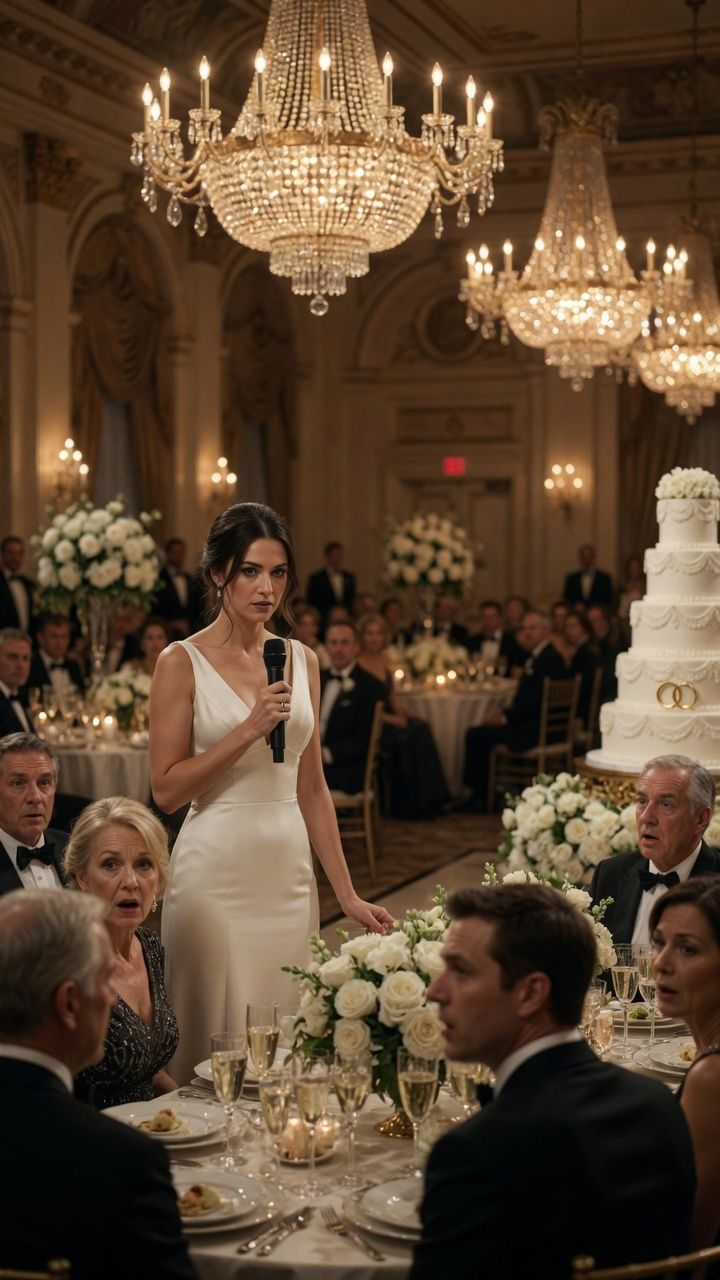
I rose slowly, and the room shifted the way rooms do when someone unexpected reaches for the microphone.
The MC hesitated, then handed it over.
I stood at the head of a table draped in white linen and imported flowers, in a dress I had chosen because Preston said it was what people expected, in a room full of people who had just laughed at my mother, and I felt something I had not expected to feel: calm.
Not performance calm. Not the kind you manufacture when you’re terrified and need to look composed. The real kind. The kind that comes from having already made the decision before the moment arrives.
“Thank you, Caroline,” I said. “And Richard. That was a memorable toast.”
A ripple of appreciative laughter. They thought I was playing along.
“I’d like to add a few things, since we’re sharing family stories.” I paused. “Six months ago, I was retained by Meridian Capital to conduct a forensic audit of Vale Holdings. I want to be clear – I didn’t know Preston when I took the engagement. That came later, and I should have disclosed the conflict immediately. That was my failure, and I own it.”
The laughter had stopped. The room had the particular silence of five hundred people holding their breath at exactly the same moment.
Caroline’s smile remained in place through what appeared to be sheer muscular force.
Preston’s hand left my knee.
“The audit is complete,” I continued. “The findings have been submitted. I won’t discuss the details here – that wouldn’t be appropriate – but I will say that the Vales’ lenders will be in contact very shortly, and I would encourage anyone in this room with significant financial ties to the family to seek independent counsel before the week is out.”
I looked at Preston. He had gone the color of the tablecloth.
Richard Vale had set down his glass. Carefully. The way you set something down when your hands are not entirely reliable.
“I spent a long time,” I said, more quietly now, “believing that what happened in this family was complicated. That the cruelty had context. That the love underneath it was real, even when it didn’t show up.” I set the microphone on the table. “I was wrong about that.”
The Ring
I reached into the small bouquet beside my plate and removed the ring.
The Vale family ring. The one Caroline had presented at our engagement dinner with a speech about legacy and worthiness, about what it meant to be welcomed into a family like theirs, about how Sophie would come to understand, in time, the responsibility that came with the name.
I had worn it for four months. I had never entirely gotten used to the weight of it.
I placed it gently on top of the wedding cake.
It sank slightly into the frosting.
Someone in the back of the room made a sound that might have been a laugh and stopped itself halfway.
Preston said my name. Just once, very quietly. I don’t know what he meant by it. I didn’t turn around.
My mother was already standing.
The Parking Lot
We walked out through five hundred people who did not make a sound, through the gilded doors and into the cool air of the parking lot, where my mother’s sensible sedan sat under a streetlight. She had driven herself. She always drove herself.
She unlocked the doors and we got in and she sat for a moment with her hands on the wheel.
The venue behind us was still lit up. Through the tall windows you could see the chandeliers, the white tables, the shapes of people moving. I watched a cluster of them pull out phones. Watched someone point toward the doors we’d just come through.
The Vales would manage the next few hours with the particular competence of people who have been managing appearances their whole lives. Richard would make a joke. Caroline would redirect. Preston would find something to say that made it sound like a misunderstanding, something fixable, something that could be walked back over brunch on Sunday.
He was good at that. I had admired it once.
“The pale blue dress,” I said finally.
“What about it?”
“It’s the most beautiful thing anyone wore in that room tonight.”
My mother looked at me for a long moment. Then she started the car.
We drove away from the chandeliers and the champagne and the laughter that had already begun to curdle, away from the Vale name and the Vale fortune and the forty-eight hours that remained of it, and I watched the lights of the venue shrink in the side mirror until they disappeared entirely, and I thought about how quiet the world could be when you finally stopped making excuses for it.
The road ahead was dark and completely ordinary. My mother drove with both hands on the wheel, the way she always had, steady and unhurried and entirely sure of where she was going.
I rolled down the window a little.
The air smelled like October and cut grass and nothing in particular.
—
If this one got to you, pass it on to someone who needed to read it tonight.
If you’re looking for more wild family drama, read about how my parents threw us out of a moving car in the desert or how my father pulled back the blanket and my husband’s whole life fell apart, or even when my grandmother sent me a code word I hadn’t heard in twenty years.