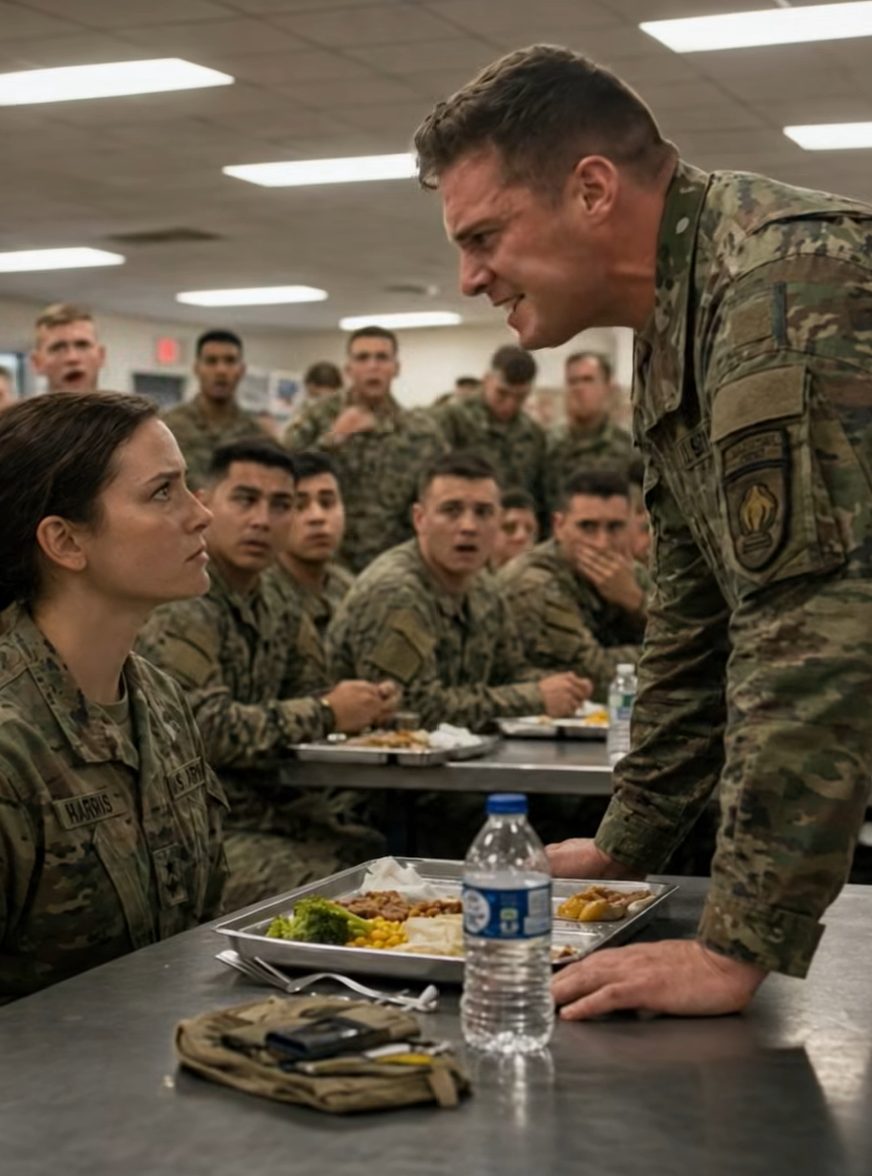

HE DEMANDED I EMPTY MY BAG IN FRONT OF THE ENTIRE MESS HALL. SO I DID.
His hands wouldn’t stop shaking.
I watched him stare at those medals like they were ghosts. Like they might reach up from the velvet and grab him by the throat.
The mess hall was so quiet I could hear the kitchen clock ticking from thirty feet away.
Reed’s mouth opened. Then closed. Then opened again.
“Who…” he started. His voice cracked. He cleared his throat. “Who signed off on the Silver Star?”
I didn’t answer right away.
I reached back into the duffel.
This time I pulled out a folded letter. The paper was yellowed at the creases, soft from being opened and refolded too many times over too many years.
I set it on the table next to the case.
“Read the signature,” I said.
My voice was barely above a whisper.
Reed picked up the letter like it might crumble in his fingers. His eyes scanned the page. I watched the exact moment they reached the bottom.
His entire body went rigid.
The letter slipped from his grip.
A corporal standing two tables away craned his neck, trying to read the name. He caught it. His face went white.
“Holy sh*t,” the corporal breathed.
Reed looked up at me.
For the first time since I’d arrived, his eyes held something other than contempt.
It was fear.
Not fear of me. Fear of what he’d done. Fear of what this meant. Fear of the name on that paper and who it connected me to.
“You’re not just a medic,” he said slowly.
I picked up the letter. Folded it carefully along its familiar creases. Slid it back into the duffel.
“I never said I was just a medic,” I replied.
Behind me, boots scraped. A chair pushed back. Then another.
I didn’t turn around, but I heard it – the sound of soldiers standing.
Not to leave.
To stand at attention.
Reed’s lip trembled. He looked around the room at the men and women now rising from their seats, trays abandoned, faces pale and locked forward.
He turned back to me.
“Sergeant Reed,” I said calmly, zipping the duffel closed. “You wanted to know what kind of game I’m playing.”
I stood up. Lifted the bag onto my shoulder.
Stepped close enough that only he could hear what I said next.
“I’m not playing anything. I’m your new commanding officer. And the reason they transferred me here?”
I glanced toward the door, where two MPs had appeared silently, hands resting at their belts.
“It’s because someone on this base has been selling medical supplies to contractors off-post. Six shipments. Four months. And the investigation traced every single one back to…”
I looked him de*d in the eyes.
Reed stopped breathing.
“…your unit.”
The MPs stepped forward.
The mess hall erupted.
But I was already walking toward the door, my worn duffel pressed against my chest exactly the way I’d carried it off the bus.
Behind me, I heard Reed’s voice break as he shouted after me:
“Wait – I didn’t – you don’t understand, it wasn’t – “
I didn’t turn around.
Because the file in my bag had one more page he hadn’t seen yet. A page with phone records. Timestamps. And a name.
Not his name.
His wife’s….
The Bus
I got to Fort Caswell on a Tuesday.
November. That gray, wet kind of cold that gets into your collar and stays there. The bus from the depot let me off at the main gate at 0640, and I stood there for a minute with my duffel on the ground, watching the MPs run IDs on a line of civilian contractors. Nobody came to meet me. I hadn’t expected anyone to.
My orders said report to the 142nd Medical Support Battalion. They didn’t say anything else.
That’s how these things work. You don’t announce yourself. You arrive. You look around. You let people show you who they are before they know you’re watching.
I shouldered the duffel and walked.
The base was mid-size, the kind of installation that had been built in pieces over forty years and never quite fit together right. Old brick barracks next to prefab admin buildings next to a motor pool that smelled like diesel and rust. I passed a group of soldiers on a morning run, cadence floating back toward me in the cold air, their breath making small clouds. One of them glanced at me. Medic patches, no rank visible on the jacket I was wearing. Civilian duffel. Walking alone.
He looked away.
Good.
Reed
The mess hall was the first place I stopped, because that’s where you learn things.
Not from the food. From the way people sit.
Who eats with who. Who has the table nearest the door. Who talks too loud because they want to be heard, and who talks quiet because they’ve already got the room.
I got a tray, found a seat near the back, and ate powdered eggs and watched.
Reed made himself obvious inside four minutes.
Big guy. Not tall, just wide, the kind of wide that used to be muscle and had softened at the edges but hadn’t forgotten it was supposed to be intimidating. He moved through the mess hall like he owned the square footage, clapping shoulders, talking over people, laughing at his own jokes a half-second before anyone else did.
Sergeant First Class Dennis Reed. I knew his file before I ever saw his face.
Fourteen years in. Two deployments, one to Kandahar, one to a forward operating base outside Mosul that he talked about more than it warranted. Three commendations, all administrative. No combat decorations. A disciplinary note from 2019 that had been quietly buried by a commanding officer who’d since retired to Florida.
He hadn’t noticed me yet.
I kept eating.
He noticed me eight minutes later, when I didn’t stand up fast enough when he walked past my table. He stopped. Looked down at me the way men like Reed always look at people they’ve decided don’t belong.
“You new?”
“Transferred in this morning.”
“From where?”
“Bragg.”
He made a sound that wasn’t quite a laugh. “Bragg. What’d you do to get sent here?”
I looked up at him. “Ate breakfast.”
His jaw tightened. The two guys behind him, both specialists, did the thing where they looked at the floor.
“What’s in the bag?” He nodded at the duffel I’d kept on the bench beside me. Old habit. You don’t leave it.
“Personal effects.”
“Personal effects.” He said it the way people repeat things when they want you to know they think you’re stupid. “That’s a lot of bag for personal effects.”
“I’ve been in a long time,” I said. “You collect things.”
He stared at me for another three seconds. Then: “Empty it.”
The table next to us went quiet.
“Sergeant,” I said, “I don’t think that’s – “
“I said empty it. New blood comes onto my base with a bag that size, I want to see what’s in it.” He crossed his arms. “Unless you’ve got a reason not to.”
The whole mess hall was paying attention now. I could feel it, that particular stillness that happens when people stop pretending to be busy.
I looked at Reed for a long moment.
Then I unzipped the duffel.
What I Carry
The first thing I set on the table was a paperback. The Things They Carried. Spine broken from reading. Reed glanced at it and said nothing.
Then a change of uniform, folded. A phone charger. A photograph in a plastic sleeve, which I placed face-down without explanation and Reed, to his credit, didn’t touch.
Then the case.
It was a standard shadow box, the kind you get made when someone retires or when you want to put something on a wall and mean it. Dark wood, glass front, green velvet inside. I set it on the table and Reed looked at it and something shifted in his face.
Medals have a way of doing that to people.
Not because they’re pretty. Because they mean something happened to earn them, and most people have the sense to understand they don’t know what.
There were seven. I won’t list all of them. But the one in the center, the one Reed’s eyes went to and stayed on, was the Silver Star.
His hands started shaking before he even picked it up.
The Letter
The thing about the letter is that I’d been carrying it for eleven years.
It had been folded and unfolded enough times that the creases were soft, almost fabric-like. I’d had it laminated once and then decided I didn’t like the way that felt, so I’d peeled the laminate off and gone back to the paper itself. Stupid, probably. But some things you want to feel like what they are.
I watched Reed read it.
I watched his eyes move down the page, slower near the bottom. I watched him get to the signature.
General Carl Hutchins. Retired. Formerly commanding general of the XVIII Airborne Corps. The kind of name that, in certain rooms, in certain buildings, still makes people straighten up without meaning to.
The letter was personal, not official. That was the part that got people. Official commendations get filed. Personal letters from four-star generals get noticed.
I have served with few people I would trust with my life, it said, near the end. This is one of them.
Reed put it down.
His hands were shaking worse.
The Room Stands
The corporal two tables over was a kid named Briggs. Twenty-two, maybe twenty-three, from somewhere in Georgia based on the accent I’d caught earlier. He’d craned his neck to read the signature and his face had gone the color of old chalk.
“Holy sh*t,” he breathed.
And then something happened that I hadn’t planned and didn’t expect.
Briggs stood up.
Not dramatically. Not like he was making a statement. He just stood, the way you stand when you’ve been sitting too long and something tells your body it’s time. His tray was still in front of him, food half-eaten.
Then the woman beside him stood. A staff sergeant, mid-thirties, I didn’t know her name yet.
Then two more. Then four.
Reed turned and watched it happen, this slow rising, and I could see him trying to work out the math of it. These were his people. His unit. And they were standing for someone he’d just tried to humiliate over a duffel bag.
He turned back to me.
I was already folding the letter.
What He Didn’t Know
Here’s the thing about an investigation like this.
You don’t build it from the top down. You build it from the outside in. You start with the paper trail because the paper trail is patient, it doesn’t get nervous, it doesn’t change its story, it just sits there in a filing cabinet being true.
Six shipments. Morphine, primarily. Some ketamine. A quantity of trauma dressings and wound packing that would’ve been significant even if the controlled substances weren’t. Pulled from supply, logged as damaged and destroyed, then showing up three weeks later in the inventory of a private medical contractor doing work for three different security firms operating out of a business address in Fayetteville.
Four months.
Whoever was running it was careful. The logs were clean. The signatures were real. The destruction paperwork was filed correctly, which actually made it easier to spot because destruction paperwork that’s filed correctly every single time, with no discrepancies, no lost forms, no coffee stains, is a thing that doesn’t happen naturally. That kind of clean is a thing someone makes.
Someone who knew the system.
Someone who’d been in long enough to know exactly where the gaps were.
Reed’s name wasn’t on any of the paperwork. That was the first thing that told me he probably wasn’t the one running it.
People who run things don’t sign things. They find someone else to sign things.
The Last Page
I didn’t show Reed the last page.
I thought about it, for exactly the two seconds I was standing close enough to smell the coffee on his breath. I thought about pulling it out and putting it on the table and watching his face do whatever it was going to do.
But that’s not how this works.
The MPs were there for Reed because Reed needed to come in for questioning, because Reed’s name was attached to the unit and the unit was attached to the shipments. That part was real. He knew something, or he’d seen something, or someone had made sure he was close enough to the operation that he’d be useful when things went sideways.
But the last page.
The phone records were clean, the way the destruction paperwork was clean. Prepaid numbers, but used in patterns. Same towers. Same times of day. Calls made when Reed was documented as being on-post, which meant the calls weren’t coming from Reed.
The timestamps matched delivery windows.
The number they traced back to belonged to a phone registered to a woman named Sandra Reed, née Kowalski. Forty-one years old. Employed part-time as an office manager for a property management company in Fayetteville.
Married to Dennis Reed for nine years.
I was three steps from the mess hall door when I heard him shouting.
Wait – I didn’t – you don’t understand, it wasn’t –
I kept walking.
Because here’s the thing about Dennis Reed that I’d understood from his file, from his posture, from the way he moved through that mess hall like he was still auditioning for a version of himself he’d never quite become.
He probably didn’t know.
And that was going to make the next part so much worse for him.
Not my job to soften it. Not my job to turn around.
The door swung shut behind me.
Cold air. Gray sky. The sound of the investigation, which had been running for four months and three days and had just moved from paperwork to people, doing what investigations do when they finally break open.
I shifted the duffel on my shoulder and walked toward the admin building.
The photograph I’d placed face-down on the table was still in the bag. I always put it face-down. Not because I’m ashamed of it. Because some things you carry aren’t meant to be explained to strangers over powdered eggs.
The general had written the letter eleven years ago.
He’d been dead for six.
I still carried it.
—
If this one got you, send it to someone who’d get it too.