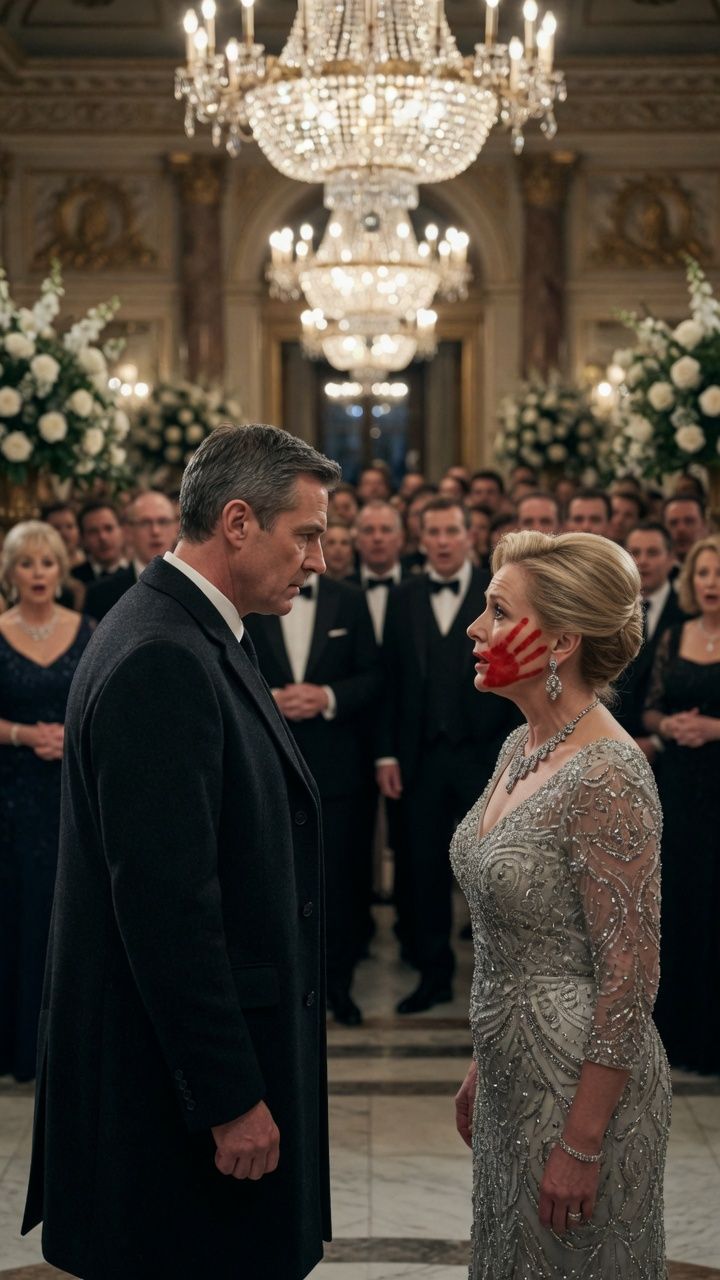

At my own engagement party, my future mother-in-law slapped me twice, called me “a penniless outsider who would never deserve this family,” and ordered me to leave in front of nearly two hundred guests.
So I pulled out my phone and said, “Dad, come get me. And don’t show them mercy.”
The second slap rang harder than the first.
The sound cracked through the ballroom like a gunshot, killing every conversation at once. Even the harpist froze, her fingers suspended above the strings as though the air itself had turned solid.
My cheek burned. Tears gathered at the edges of my eyes.
I refused to let them fall.
Vivian Blackwood stood inches from my face, draped in a shimmering silver gown that probably cost more than my first car. Diamonds caught the chandelier light and scattered it across the ceiling in cold, brilliant fragments. But there was nothing beautiful about the contempt twisting her expression.
“You actually thought you could scheme your way into this family?” she said, her voice low and deliberate, pitched for the room. “A broke little nobody like you? You will never belong here.”
Behind her stood Ethan, the man I had planned to marry.
His face had gone the color of chalk. For one suspended moment, his hand lifted slightly at his side, as though some instinct was urging him to step forward, to say something, to choose me.
He didn’t.
“Vivian,” someone murmured uneasily from the crowd.
She didn’t acknowledge it. Instead, she seized my left hand and wrenched the engagement ring from my finger. The band scraped across my skin hard enough to leave a mark. Then she turned and pointed toward the towering double doors at the far end of the room.
“Get out.”
I looked past her to Ethan.
“Are you going to say anything?”
His mouth opened.
Then closed.
That silence told me everything I still needed to know about him, and settled, quietly and permanently, every question I’d been too afraid to ask myself.
I bent down, retrieved my clutch from the marble floor, and stood up straight.
My cheek throbbed. My dignity did not.
I walked through the crowd without rushing. Whispers rose and fell around me like a tide.
“Poor girl.”
“That was absolutely humiliating.”
“Did she lie about who she was?”
Outside, the January cold hit me immediately. Snow blanketed the circular driveway in white silence, and the valet watched with wide eyes as I stepped onto the salted stone steps and pulled out my phone with trembling fingers.
My father answered on the second ring.
“Lena?”
I swallowed hard against the tightness in my throat.
“Dad, come get me.” I glanced back through the glass doors at the family still gathered inside, already composing themselves, already reclaiming the evening. “And don’t go easy on them.”
A brief pause.
When Richard Vale spoke again, his voice had gone very quiet. The kind of quiet that meant something.
“Where are you?”
“Blackwood Country Club.”
“Don’t move.”
—
Twenty minutes later, three black SUVs turned into the driveway.
My father stepped out of the first one wearing a dark charcoal overcoat, unhurried and precise. His personal attorney, chief financial officer, and two members of his security detail fell into step behind him. The valet fumbled a set of keys.
My father had always been careful to stay invisible. He avoided cameras, declined magazine profiles, and never announced himself in rooms the way wealthy men so often feel compelled to do.
But in American real estate, logistics, and private investment, the Vale name required no announcement.
It opened doors.
It also closed companies.
Vivian Blackwood had decided I was poor because I dressed simply, drove a sensible car, and worked as a counselor at a public school. I had never discussed my family’s money, not out of shame, but because it had never once seemed relevant to who I was or what I wanted my life to be.
What she didn’t know was that the Blackwood family’s construction company had been quietly hemorrhaging capital for two years. It had survived only because my father’s private fund had stepped in with emergency financing, a transaction handled through intermediaries, with no fanfare and no strings attached.
Until now.
Dad reached me on the steps and stopped. He studied the mark across my cheek without speaking. The muscle along his jaw pulled tight.
“Who touched you?”
I nodded toward the glass doors.
Inside, Vivian was still holding court near the center of the room, receiving sympathetic murmurs from her guests, her posture already restored to its usual imperious ease. The crisis, from her perspective, had been handled. The interloper had been removed. The evening could continue.
My father straightened his collar, turned toward the entrance, and walked inside.
His attorney and executives followed.
By the time Richard Vale reached the middle of that ballroom, every smile in the Blackwood family had disappeared.
What Happens When the Room Goes Quiet Again
I watched through the glass.
I don’t know exactly what my father said first. I was still outside, standing in the cold with the valet, who had stopped pretending not to stare. But I could read the room through those doors the way you read weather, the way you know a storm is already here before you feel the rain.
Gerald Blackwood, Ethan’s father, had gone gray. Actual gray, the color draining out of his face in real time, like someone pulling a plug.
Vivian still held the engagement ring. She was gripping it so hard her knuckles had gone white.
My father’s attorney, a man named Paul Drexler who had been doing this particular kind of work for thirty years, set a leather folder on the nearest table and opened it without flourish. He pointed to something on the first page. Gerald leaned in. Read it. Looked up at my father.
My father didn’t look back. He was scanning the room, slow and methodical, the way he surveys a property before deciding what it’s worth.
Then he found Ethan.
Ethan was still standing exactly where I’d left him. Same spot. Same chalk-white face. His bow tie was slightly crooked, which for some reason was the detail I kept coming back to when I thought about that night afterward. The smallest, stupidest detail. His bow tie, just slightly off-center, because nobody had straightened it and he hadn’t noticed or hadn’t cared.
My father walked to him.
I couldn’t hear the words. I didn’t need to.
Ethan nodded twice, slowly, the way people nod when they’re not agreeing with something so much as absorbing it.
What I Knew That Vivian Didn’t
Here’s the thing about my father. He built his first company at twenty-six, working out of a two-room office in Pittsburgh with secondhand furniture and a phone he shared with two other businesses renting space in the same hallway. He lost everything at thirty-one when a partner defrauded him and a bank called in a loan simultaneously. He rebuilt from zero by thirty-eight.
He does not perform wealth. He finds it embarrassing when other people do.
He raised me the same way. I wore jeans to school. I drove a Honda Civic I’d bought used. I worked, because he believed work was the only thing that taught you what you actually valued. The school counseling job wasn’t a cover story or a hobby. It was what I wanted to do with my days, and he’d respected that without question.
What I never told Ethan, not because I was hiding it but because it genuinely hadn’t come up in the way that felt natural, was that the fund my father ran managed just over four billion dollars in assets. That the Vale family trust owned partial stakes in eleven companies across three states. That the house I’d grown up in sat on forty acres outside of Pittsburgh and had a name, the way old houses sometimes do.
I wasn’t keeping secrets. I was just living my own life.
Vivian had looked at me and seen a public school employee in a sensible dress. She’d done the math she knew how to do and gotten an answer that made her feel powerful.
Her math was wrong.
The Part Nobody Expected
I came back inside when my father waved me in through the glass. The crowd parted, not dramatically, just slightly, the way crowds do when they’ve recalibrated who matters in a room.
Vivian was sitting down now. Someone had brought her a chair. She was still holding the ring, though she didn’t seem to realize it.
Gerald was talking to Paul Drexler in a low voice, nodding the way men nod when they’re working out terms.
My father came to me and put his hand briefly on my shoulder.
“You okay?”
“No,” I said. “But I will be.”
He accepted that. He didn’t push.
Then Ethan crossed the room toward me, and I felt the whole space tilt slightly, the way a room does when something is about to happen that can’t be taken back.
He stopped two feet away. His bow tie was still crooked.
“Lena,” he said.
I waited.
“I should have said something.” He looked at the floor, then back up. “I should have stopped her the first time. I knew what she was going to do, I’d seen her do it to people before, and I thought I could manage it, and I didn’t, and I’m sorry.”
It was the most honest thing he’d said to me in months.
And it still wasn’t enough. Not because I wanted him to grovel, not because I needed the spectacle of his remorse in front of two hundred people. But because I’d stood there in front of his entire family and looked at him and asked one direct question, and his answer had been silence. You don’t get to walk that back with an apology forty minutes later when the power in the room has shifted.
“I know you’re sorry,” I said.
“I love you.”
“I know that too.”
I picked up a glass of water from the nearest table, drank half of it, set it down.
“But you didn’t choose me when it cost you something. That’s the answer to every question I needed answered.”
He didn’t argue. I’ll give him that. He just stood there and took it, which was maybe the first genuinely decent thing he’d done all evening.
The Ring on the Table
My father spent another twenty minutes with Gerald and Paul Drexler. I don’t know the full shape of what was agreed to. I know the Blackwood construction company’s financing arrangement was restructured. I know the terms changed. I know Gerald made a phone call in the hallway that left him looking like a man who had just been told the price of a mistake he couldn’t afford.
Vivian set the engagement ring on a table near the floral centerpiece. Just placed it there, among the white roses and the tea lights, and walked away from it.
Nobody picked it up.
When I left, I left without looking back at Ethan. I didn’t need a final image of him to carry around. I had plenty already.
The valet brought my car around. My father stood beside his SUV and watched me get in, making sure I was steady.
“You didn’t cry,” he said.
“I almost did.”
“But you didn’t.”
I pulled out of the circular driveway onto the snow-covered road, my headlights cutting through the dark, and I thought about the ring sitting on that table among the flowers. Whether anyone had picked it up yet. Whether Vivian had gone home and understood, fully, what she’d actually done.
Probably not.
People like Vivian Blackwood don’t usually get there on their own.
But the Blackwood family’s accountants would explain it to her soon enough.
January
I went back to work the following Monday.
Third period, a fourteen-year-old named Marcus came to my office because he’d gotten into a fight over something stupid and was convinced his life was over. I listened to him for forty minutes. I asked him questions. I got him to laugh twice, which he was embarrassed about but couldn’t help.
When he left, he seemed lighter.
That’s the job. That’s the whole job.
I drove home in my Honda Civic. I made pasta. I watched something forgettable on television and fell asleep on the couch with a blanket pulled up to my chin.
My cheek had stopped hurting by Wednesday.
The mark was gone by the end of the week.
—
If this one stayed with you, pass it on to someone who needs to read it.
For more stories about family drama and unexpected betrayals, check out My Husband Called Me a Burden the Night I Came Home from War, My Son Stood There With Folded Arms While His Wife Called Me Filthy, and My Father Left a Key With a Stranger for the Day I Came Home From Prison.