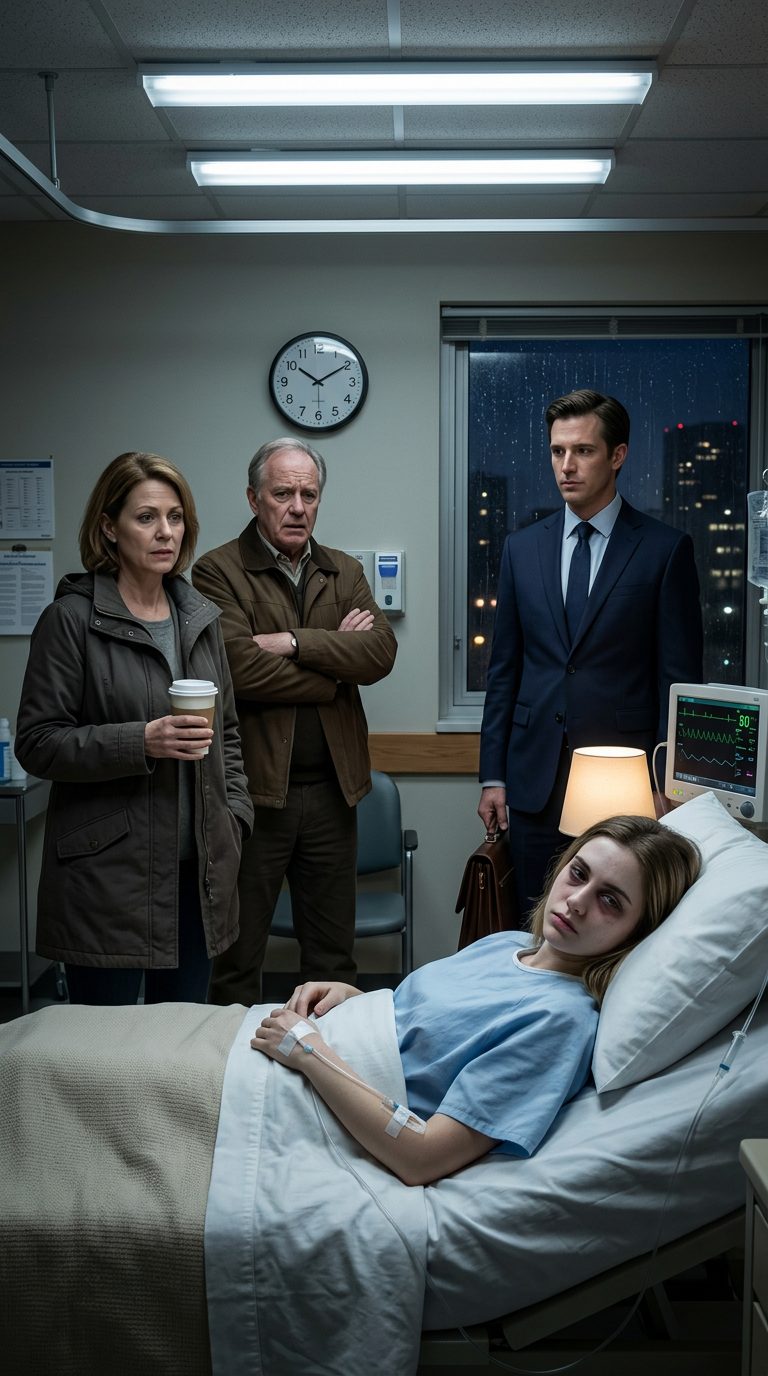

I counted them by the clock on the wall directly across from my bed.
Nine.
Nine times my thumb trembled against the hospital phone while monitors beeped softly beside me. Nine times I called my mother, then my father, then the family group chat. Nine times I received the same answers: voicemail, silence, and one brief text from Mom that read, We’re at Lauren’s. Is this urgent?
I stared at that word while a nurse adjusted the IV in my arm.
Urgent.
The day before, a delivery truck had run a red light and hit my car. My injuries were serious. The doctors had warned me that the next twenty-four hours would be critical.
So yes. It was urgent.
My sister Lauren, however, had just moved into a new home in Ridgefield – white kitchen, unused nursery, and a husband who considered lifting boxes beneath him. My parents had driven there “for just a few hours” the morning after my surgery. They smiled for photos on her front porch while I recovered under bright hospital lights.
At 6:40 p.m., my phone buzzed.
Lauren had posted a video.
“Couldn’t have done today without Mom and Dad!” she sang, sweeping the camera toward them. My father was carrying a lamp. My mother was arranging throw pillows.
I pressed the call button – but not for a nurse.
When Marisol leaned in beside me, I asked her to dial the number saved under Harding & Vance – Estate. My voice was weak. My words were not.
“Are you sure?” she asked.
“Completely.”
The Part They Never Knew About
Here’s what my family understood about my finances: I had done well. I had sold a company. I drove a nice car, took good vacations, lived in a house that made my mother’s eyes go slightly flat whenever she visited.
Here’s what they didn’t understand: the number.
When the acquisition closed two years ago, I sat in Julian’s conference room on the forty-first floor of a building downtown, and I signed papers that changed every practical dimension of my life. The buyer was a hospital network operating in eleven states. My software had been tracking post-surgical infection rates. It worked. It worked very well. And they paid accordingly.
I didn’t tell my parents the figure. I told them it was “life-changing money,” which they interpreted to mean I could probably retire early and maybe help Lauren with a down payment someday.
They were not wrong about the last part.
Lauren’s house in Ridgefield had a down payment that came from a gift I made eighteen months before the accident. Forty thousand dollars. I wrote the check without resentment. She was my sister. Her husband, Craig, had the handshake of a man who’d never done anything hard in his life, but that wasn’t her fault.
My parents knew about that gift. They had been pleased. My mother called it “so generous, Miranda,” in the voice she used when she was actually saying this is the least you could do.
What they didn’t know was what else was in the estate documents. The lake house in Wisconsin they treated as a second home, scheduling their own trips there without asking, leaving it for me to deal with the cleaning service and the dock maintenance. The education trusts I’d structured for future grandchildren, which my mother had mentioned at least four times in the past year as though they were already hers to count on. The two foundation board seats that my parents had started listing in their email signatures.
All of it contingent on one thing: that I kept them in the documents.
I had kept them in the documents because I loved them.
Or because I believed that love meant absorbing this kind of thing quietly.
I was, lying there in that hospital bed with a bruised sternum and two cracked ribs and a monitor clipping to my finger, no longer sure those were different.
Julian at the Foot of the Bed
He arrived at 8:15 p.m. Navy suit, no tie, briefcase that looked like it had been to more difficult places than a hospital room. Julian Vance was sixty-one years old and had the manner of a man who had watched a lot of people make important decisions in bad circumstances. He didn’t rush them. He didn’t perform concern.
He set his briefcase on the chair beside the bed and looked at me for a moment.
“Miranda,” he said. “You don’t have to do this tonight.”
“Yes,” I said. “I do.”
He understood. He didn’t push back again.
What Julian knew, that most people didn’t, was that my family’s access to my estate wasn’t just a question of what would happen after I died. There were emergency financial powers. Medical decision authorities. Account access thresholds I’d set up in case I was ever incapacitated. I had put my parents down for those years ago, when the idea of needing them and having them fail to show up was something I couldn’t have pictured.
I could picture it now. I had nine missed calls’ worth of evidence.
Julian read every change aloud. That was his habit. He believed people should hear the words, not just sign them. I had always appreciated that about him. Tonight I appreciated it more than usual.
My parents: removed as beneficiaries. The specific language was clean and final.
Lauren: removed entirely. Not reduced. Gone.
The lake house: transferred to a charitable trust I already controlled, which meant my parents could no longer schedule their own trips there as though it were a timeshare they’d inherited.
The education trusts: dissolved and redirected to a children’s hospital foundation I’d been quietly funding for three years.
The foundation board seats: my parents’ names removed from the governance documents effective immediately, pending their signatures acknowledging the change.
The emergency financial powers: reassigned. To Marisol, who was still somewhere down the hall and had no idea.
Julian closed the folder.
“Do you want to tell them?” he asked.
I looked at the ceiling. The fluorescent light above my bed had a faint flicker in it, almost imperceptible. I’d been staring at it for two days.
“I’ll let the paperwork do that,” I said.
What My Mother’s Face Did
She walked in at 10:03 p.m. holding a takeout coffee from the place on the corner near Lauren’s house in Ridgefield, which meant she’d driven forty minutes, stopped for coffee, and arrived here having prioritized those things in that order.
She was wearing the cream-colored cardigan she bought last fall. Her hair was done. She looked like a woman who had been helping her daughter arrange throw pillows and then decided to stop by.
Julian was standing at the window with his back to the door. He turned when she came in.
My mother’s eyes went to him first. Then to the briefcase. Then to the folder on the tray table beside my bed.
“Miranda,” she sighed. The specific sigh that meant I had caused a disruption. “You scared us.”
I looked at her.
Not the way I’d looked at her a thousand times before, with the part of my brain already softening, already doing the math on how much easier it would be to let this pass. I looked at her the way you look at something when you’ve finally stopped trying to see it differently.
Something settled in my chest. Not anger. Something quieter. Something that had been forming for a long time and had finally finished.
“No,” I said. “You scared me.”
She opened her mouth. Closed it.
Julian picked up his briefcase.
“Mrs. Calloway,” he said. “I’m Julian Vance. I represent your daughter. I’ll let you two talk.” He looked at me once. “I’ll send the final documents in the morning.”
He left. The door swung shut behind him.
My mother stood there holding the coffee. She looked at the folder on the tray table. She didn’t ask what it was. I think she knew.
“We were only there for a few hours,” she said.
“You were there all day.”
“Lauren needed us.”
I didn’t say anything to that. There wasn’t anything useful to say. What I wanted was not an argument. What I wanted, and this is the part that took me the longest to understand about that night, was to stop pretending that what she’d done was a misunderstanding. It wasn’t a miscommunication. She had gotten the texts. She had seen the missed calls. She had chosen, at every point in the day, to stay.
That was information. And I was done ignoring it.
What Came After
My father came in twenty minutes later. He stood in the doorway for a moment, and I saw him look at my mother’s face before he looked at mine. Whatever he read there made him come in quietly and sit down.
He said, “We should have come sooner.”
Which was true. But it was also the kind of true that comes after the fact, shaped by whatever my mother had said to him in the hallway. I didn’t know if he meant it the way it sounded. I still don’t.
I told them both that I was tired. That was also true.
They left by eleven. My mother hugged me at the door, the careful hug of a person who knows something has changed and is hoping physical warmth will reverse it. I let her. I didn’t hug back the same way. I don’t think she noticed.
The nurse came in at 11:30 to check my vitals. Marisol, again. She had a quiet efficiency I’d been grateful for since the first morning. She noted something on her tablet and glanced at the tray table, where the folder was still sitting.
“Everything okay?” she asked.
“Getting there,” I said.
She nodded like that was a reasonable answer and turned off the overhead light on her way out.
I lay there in the dark and listened to the monitors.
I didn’t feel righteous. I want to be clear about that. There was no satisfaction in it, not the way people sometimes imagine when they picture a moment like this. What I felt was more like the specific exhaustion of carrying something heavy for a long time and finally putting it down. Your arms don’t feel good. They just feel different.
The clock across the room read 11:47.
I counted nothing.
—
If this one stayed with you, pass it along to someone who might need to hear it.
If you’re looking for more incredible true stories, check out My Brother Waited Eight Years to Tell Me What Mom Hid From Me or even My Husband of Seven Days Left Me a Backpack. His Lawyer Said He Wasn’t Who I Thought He Was.. And for a bit of a laugh, don’t miss My Ex Invited Me to Christmas Dinner to Humiliate Me. I Arrived by Helicopter..