
I was twenty-six years old the night my entire life changed.
Lucas had always been my favorite person in the world. From the moment he was born, something in me shifted – a fierce, instinctive protectiveness I’d never felt before. I helped him with his homework, took him to the park on weekends, and read him bedtime stories whenever our parents were too busy or too tired. He was ten years old and still thought I hung the moon, and honestly, I let him believe it.
Then one evening, everything fell apart.
Our parents were in a car accident. A bad one. Mom died at the scene. Dad held on for a few hours at the hospital before he let go too. By some miracle, Lucas survived. We were both shattered – but at least we still had each other, and in those first hollow days, that felt like the only solid thing left in the world.
The relatives descended almost immediately, well-meaning and practical, already talking about who would take Lucas in. They were scattered across different cities. I had a stable job and an apartment. I also knew, with absolute certainty, that if someone else became his guardian, I would lose him – and after everything we’d already lost, I couldn’t survive that.
So at twenty-six, I became my little brother’s legal guardian.
Those first months were brutal in ways I hadn’t anticipated. I was grieving my parents while simultaneously learning how to be a parent. Money was always tight. I worked long hours and came home exhausted, and there were nights – more than I’d like to admit – when I sat in the dark after Lucas had gone to bed and cried, quietly, because I was terrified I wasn’t enough for him. That I was failing him. That he deserved someone who actually knew what they were doing.
But somehow, we made it through.
Eight years passed faster than I ever imagined they could.
Lucas graduated high school. He turned eighteen. Standing there watching him, I felt a pride so overwhelming it almost hurt – the kind that lives somewhere behind your sternum and doesn’t quite have a name. I’d done it. We’d done it.
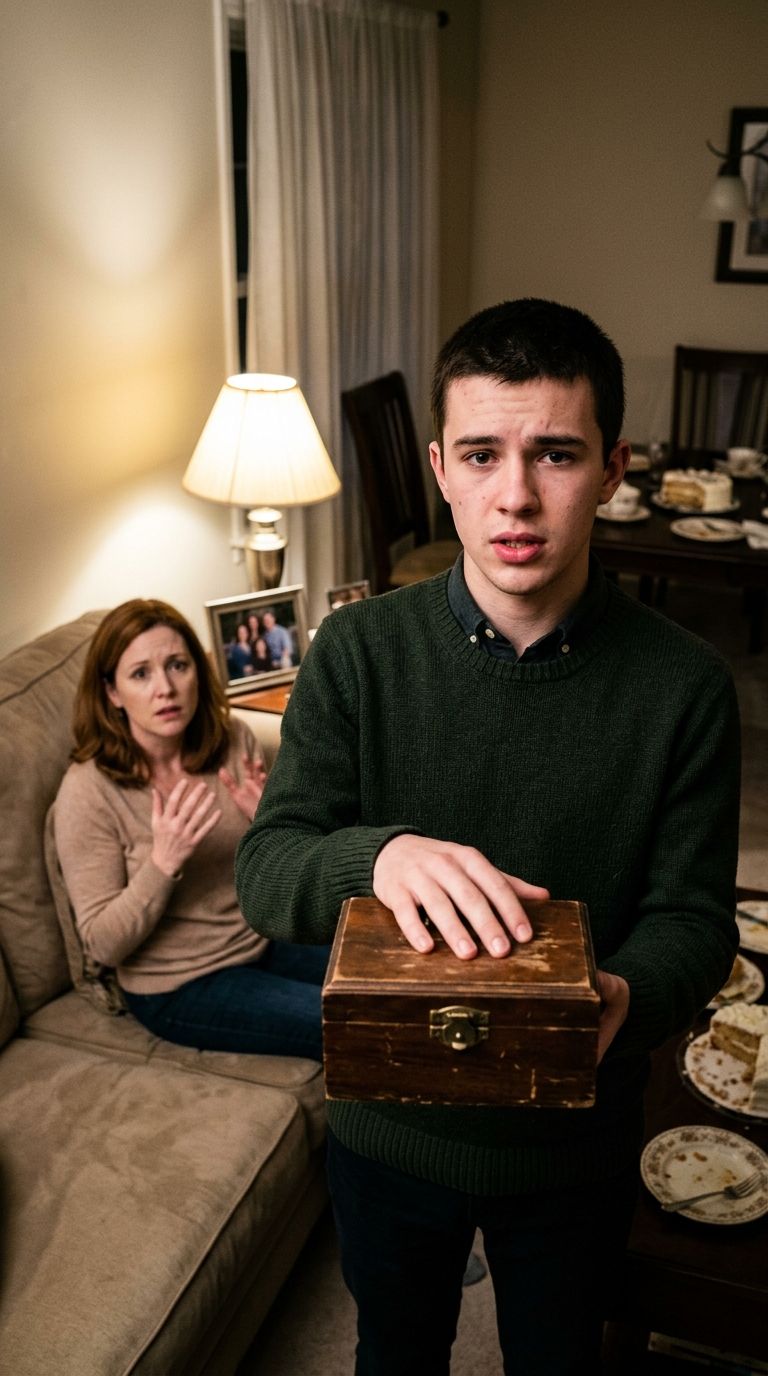
To celebrate, I invited a few relatives over for dinner. It was a good evening – warm and a little loud, the way family dinners are supposed to be. When everyone finally left, Lucas disappeared into his room without a word.
He came back a minute later holding something I hadn’t seen in eight years.
Our mother’s jewelry box.
I went completely still. It was exactly as I remembered – the worn velvet corners, the small brass clasp she always fumbled with. Just seeing it knocked the air out of me.
Lucas placed it carefully in my hands. He looked me directly in the eyes, the way he does when something matters to him, and said quietly:
“There’s one thing Mom never wanted you to find out.”
The Box
My first instinct was to hand it back.
Not because I didn’t want to know. Because some part of me understood, in the three seconds before he said anything else, that whatever was inside had weight. Real weight. The kind that rearranges things.
Lucas didn’t move. He just stood there in the kitchen doorway with his hands loose at his sides, watching me hold it.
The brass clasp was cold. I remembered watching my mother open this box on Sunday mornings – she’d sit at her vanity and pick out earrings for church with the same slow deliberateness other people bring to important decisions. She had maybe forty dollars worth of jewelry in there, total. But she treated every piece like it mattered.
I pressed the clasp. It stuck for a second, the way it always had, then gave.
Inside, on top of the usual tangle of thin gold chains and mismatched earrings, was an envelope. White. Unsealed. My name on the front in my mother’s handwriting.
Not honey or sweetheart the way she usually wrote things. My full name. First and last.
Lucas said, “She gave it to me the week before the accident. Told me to keep it until you needed it most.” He paused. “I figured eighteen counted.”
I didn’t say anything. I was looking at my own name in her handwriting and trying to remember how to breathe normally.
What She Wrote
I sat down at the kitchen table. Lucas sat across from me and didn’t pretend to look away.
The letter was two pages, both sides, in the cramped looping script she used when she was writing fast and didn’t want to lose the thought. There were places where the pen had pressed harder. A few words crossed out and rewritten.
I’m not going to reproduce all of it here. Some of it belongs only to me.
But the part that mattered, the part Lucas had been carrying around for eight years without reading because she’d asked him not to, was this:
When I was four years old, my parents almost gave me up.
Not because they didn’t want me. Because they couldn’t afford me. Dad had lost his job. They were three months behind on rent. My mother’s sister, Aunt Renee, who had money and no children and a house with a yard, had offered to take me. Temporarily, they’d told themselves. Just until things stabilized.
They’d gone as far as packing a bag.
My mother wrote that she’d stood in my bedroom doorway with that bag in her hand and watched me sleep, and she couldn’t do it. She unpacked it herself at two in the morning. Never told my father she’d changed her mind until the next morning over coffee, and by then it was done.
She wrote: I never told you this because I never wanted you to feel like you were almost lost. But I also never told you what it taught me. You were four years old and you had no idea what was happening, and you were the reason I understood what I was capable of. What love actually asks of you.
Then, and this is the part where my hands started doing something I couldn’t control:
If something happens to us, it will be you. I know it will be you. I’m not asking you. I’m just telling you what I already know about you, because you don’t know it yet.
She’d written the letter eighteen months before the accident.
What Lucas Knew
I set the pages down flat on the table.
Lucas was watching me the way he used to watch me when he was small and had done something he wasn’t sure about. Waiting for a verdict.
“You never read it,” I said.
“No.”
“Eight years.”
“She asked me not to.” He shrugged, the way he does when something cost him more than he wants to admit. “She said it was yours.”
I thought about him at ten years old, sitting in the back of some relative’s car on the way to a funeral, holding an envelope he wasn’t allowed to open. Carrying it through every apartment we’d ever shared, through his middle school years and his high school years, through every bad night either of us had ever had.
“Why tonight?” I asked.
He looked at the ceiling for a second. “Because you cried at graduation.”
“I didn’t cry.”
“You cried.”
“I had something in my eye.”
He smiled. Not a big smile. Just the small one, the real one. “You’ve been doing this thing for eight years where you act like you’re barely holding it together. Like you’re one bad week away from having failed me.” He leaned forward with his elbows on the table. “I wanted you to know she already knew you wouldn’t.”
The Thing I’d Never Said
Here’s what I hadn’t told Lucas, not once in eight years:
There was a night, about four months after the accident, when I almost called Aunt Renee.
Not to give him up. Nothing like that. But I’d had a week where everything went wrong at once – a car repair I couldn’t afford, a parent-teacher conference where his teacher told me he’d been crying in class, a fight between us that got loud and then went very quiet and cold, which was worse. I was sitting in my car in the parking lot of a grocery store at nine-thirty at night, and I had Renee’s number pulled up on my phone, and I was thinking: maybe he’d be better off.
I didn’t call. I bought groceries instead. I went home and made grilled cheese because it was the only thing I knew how to make that he’d always eat, and we watched television and didn’t talk about the fight, and eventually things got better.
But I’d thought it. I’d had my own version of standing in a doorway with a bag packed.
I told Lucas this sitting at the kitchen table, holding our mother’s letter.
He was quiet for a long time.
Then he said, “Renee smells like mothballs and she doesn’t have cable.”
I laughed. It came out wrong, too sharp, but it was real.
“I didn’t know that then,” I said.
“I know.” He reached across the table and tapped the letter with one finger. “But she did.”
Eight Years of Not Knowing
The thing about grief is that it doesn’t stay in one place. It moves around. It shows up in weird spots years later – in the middle of a grocery store, or watching someone else’s parents at a graduation, or holding a jewelry box you haven’t touched since you were twenty-six years old and terrified.
I’d spent eight years wondering if my mother would have approved of how I handled things. The question had never been loud. It just sat there, in the background, like a refrigerator hum you stop hearing but never actually stops.
The letter didn’t answer every version of that question. She’d written it before she knew what we’d actually go through. She didn’t know about the car repair or the grilled cheese or the nights I cried in the dark. She didn’t know about Lucas’s junior year, when he got in with a bad crowd for about six months and I had to make some hard calls that he hated me for, briefly.
But she’d known something. She’d known it eighteen months before she had any reason to think it would matter.
I folded the letter back into the envelope. Put it in my pocket. I’d read it again later, alone, probably more than once.
Lucas stood up and started clearing the dinner dishes off the table like it was any other night. Like he hadn’t just handed me something that rearranged eight years of how I understood myself.
“You want tea?” he asked.
“Sure.”
He filled the kettle. I sat there and listened to the water run.
After
He leaves for college in September. University about four hours away – close enough, far enough. He got a partial scholarship and a work-study placement and he did that mostly himself. I helped with the applications but the rest was him.
The jewelry box is on my dresser now. I took out the letter and put it in the drawer of my nightstand, and I put the jewelry box where I can see it when I wake up. The clasp still sticks a little before it gives.
I’ve thought a lot about what Lucas said. About me acting like I was one bad week away from failing him. He wasn’t wrong. I’d been carrying that feeling so long it had become part of how I moved through the world – slightly braced, slightly waiting for the moment I’d finally get it wrong in a way that couldn’t be fixed.
I don’t know that the letter fixed that. I’m not sure one letter can.
But there’s something about being told, in your mother’s handwriting, that she saw you clearly before you’d done a single thing to earn it. That she knew what you’d do before you knew yourself.
My mother packed a bag when she was young and scared and unpacked it alone at two in the morning. She never told me. She carried it for twenty-two years and turned it into something she could give me.
I think about that. The thing you carry quietly, alone, until the right moment.
Lucas did the same thing. Ten years old, riding in a car to a funeral with an envelope in his jacket pocket that wasn’t his to open.
He kept it eight years. He handed it over the night it would land right.
That’s not nothing.
That’s not nothing at all.
—
If this one hit you somewhere quiet, pass it on to someone who needed to hear it.
For more wild family secrets and unexpected twists, dive into the story of a husband who wasn’t who he seemed or read about a sister who landed someone in the ER. And if you’re in the mood for some sweet revenge, you won’t want to miss when an ex arrived at Christmas dinner by helicopter.