
👉 HE GRABBED HER HAIR IN FRONT OF THE WHOLE MESS HALL. THEN HER EYES MADE A SERGEANT FORGET HOW TO BREATHE.
“Move.”
The word cracked across the mess hall like a rifle shot.
For a moment, everything around Table Seven seemed to hold its breath – the scrape of forks, the clatter of trays, the low rumble of soldiers talking over lunch. Then the noise returned, thinner than before, because every person within earshot had just understood the same thing: Sergeant Caleb Reed had chosen a target.
The woman sitting in his seat had not looked up.
She kept peeling her orange.
A narrow strip of rind curled beneath her thumb and dropped onto the steel table with almost insulting precision. Her posture was straight. Her dark ponytail rested against the collar of her olive utility shirt. Her face was calm – pale under the cafeteria’s harsh lights, carrying the stillness of someone who had survived storms far louder than men.
Caleb stood over her with a tray in one hand, jaw tight, shoulders squared. He was the kind of man who didn’t enter rooms so much as occupy them. Tall, broad, blond, and carved by years of discipline, he had earned respect in the field. On base, that respect had long since hardened into something closer to fear.
Behind him, two younger soldiers smirked.
Everyone knew Table Seven was his.
Everyone knew better.
“You didn’t hear me?” Caleb said, louder now.
The room seemed to pull inward – past frozen cups, half-eaten lunches, and soldiers pretending not to stare while staring anyway.
The woman peeled another strip.
Slow.
Clean.
Perfect.
Caleb’s fingers tightened around the tray until the plastic groaned.
He slammed it down.
The sound split the room.
A fork bounced. A cup rattled. Several heads turned fully now, abandoning the pretense. The mess hall had stopped eating. It was watching.
“Wrong seat,” Caleb said, leaning over the table. “Last warning.”
The woman separated one orange segment and set it beside the peel.
Then, finally, she spoke.
“I’m eating, Sergeant.”
Her voice was not loud.
That was what made it worse.
There was no tremor in it, no anger, no apology. Just fact – flat and unhurried, as if his authority were a weather condition she had no interest in discussing.
A murmur moved through the room.
Caleb tilted his head. “You deaf, too?”
“No.”
One word.
Clean enough to cut.
The smirks behind him faded.
Something moved across Caleb’s face – not rage, not yet. Something colder. He was not used to being ignored. He was even less used to being unfeared.
He leaned closer, angling slightly so the room could hear every word.
“I don’t care who you are,” he said. “Clerk. Contractor. Lost tourist.” His eyes narrowed. “You’re in my seat.”
She lifted the orange again.
No flinch.
No excuse.
No surrender.
Caleb’s pride – already bruised in front of half the battalion – cracked.
His hand shot out.
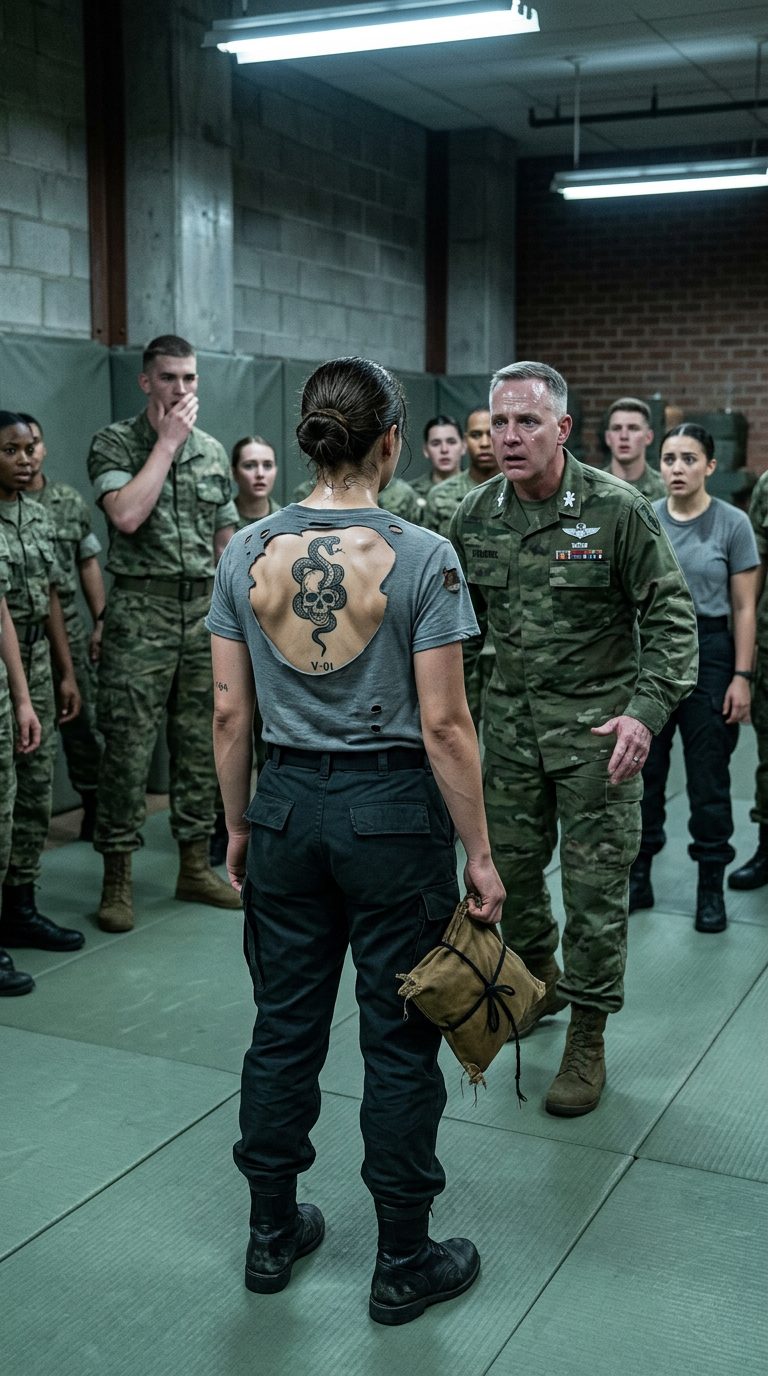
Gasps broke through the mess hall as his fingers closed around her ponytail.
He yanked.
Her head tilted back beneath the white lights.
The room didn’t quiet.
It died.
A spoon hovered halfway to a soldier’s mouth. Someone’s tray froze in both hands. The coffee machine hissed in the corner, suddenly obscenely loud in the silence.
Caleb bent close to her ear.
“I said move.”
She did not reach for his wrist.
She did not cry out.
She did not resist.
Instead, she slowly raised her eyes to his.
And the instant their gazes met, the color drained from Caleb Reed’s face.
Because he knew those eyes.
Not from this base. Not from any file he had ever read.
From a night six years ago in a ruined village outside Kandahar, when smoke had turned the moon red and his squad had been pinned behind a collapsed wall – bleeding, screaming, certain that no one was coming.
A woman had come anyway.
No insignia. No name spoken. Just those blue-gray eyes behind dust and firelight, dragging wounded men through gunfire as though death itself had owed her a debt.
Caleb had been twenty-nine then – arrogant even while dying, shrapnel in his leg and terror raw in his throat.
He remembered asking her name.
He remembered her saying only, “Stay awake.”
He remembered waking three days later in a field hospital and being told the woman who saved him did not exist.
Now she was sitting beneath his hand.
In his mess hall.
Peeling an orange.
His fingers opened as if burned.
The ponytail slipped free.
Her head lowered, but her eyes never left his.
The room waited for an explosion.
Instead, Caleb whispered, “Ghost?”
The word was barely sound. Only the nearest tables caught it.
But it traveled anyway.
Ghost.
The woman placed the orange segment down.
“That name was never yours to use,” she said.
Caleb stepped back.
Every soldier in the room saw it.
The feared sergeant had retreated.
One of the younger men behind him muttered, “Sergeant?”
Caleb didn’t answer.
His gaze had dropped to her left wrist, where the cuff of her sleeve had shifted. A thin scar ran across the skin like a pale thread.
His breath caught.
“It was you,” he said.
Her expression did not change.
“It was a lot of people.”
“No.” His voice broke in a way no one in that room had ever heard from him. “No – you carried me. You came back twice. You – “
“Sat in the wrong seat?” she interrupted.
The words hit harder than shouting would have.
A ripple of shame moved through the room – visible, almost physical.
Caleb looked around as though seeing the mess hall clearly for the first time. The eager young soldiers who had copied his cruelty because they mistook it for strength. The older ones staring at their trays because they had allowed it. The mess staff frozen behind the counter like figures in a photograph.
Then the double doors swung open.
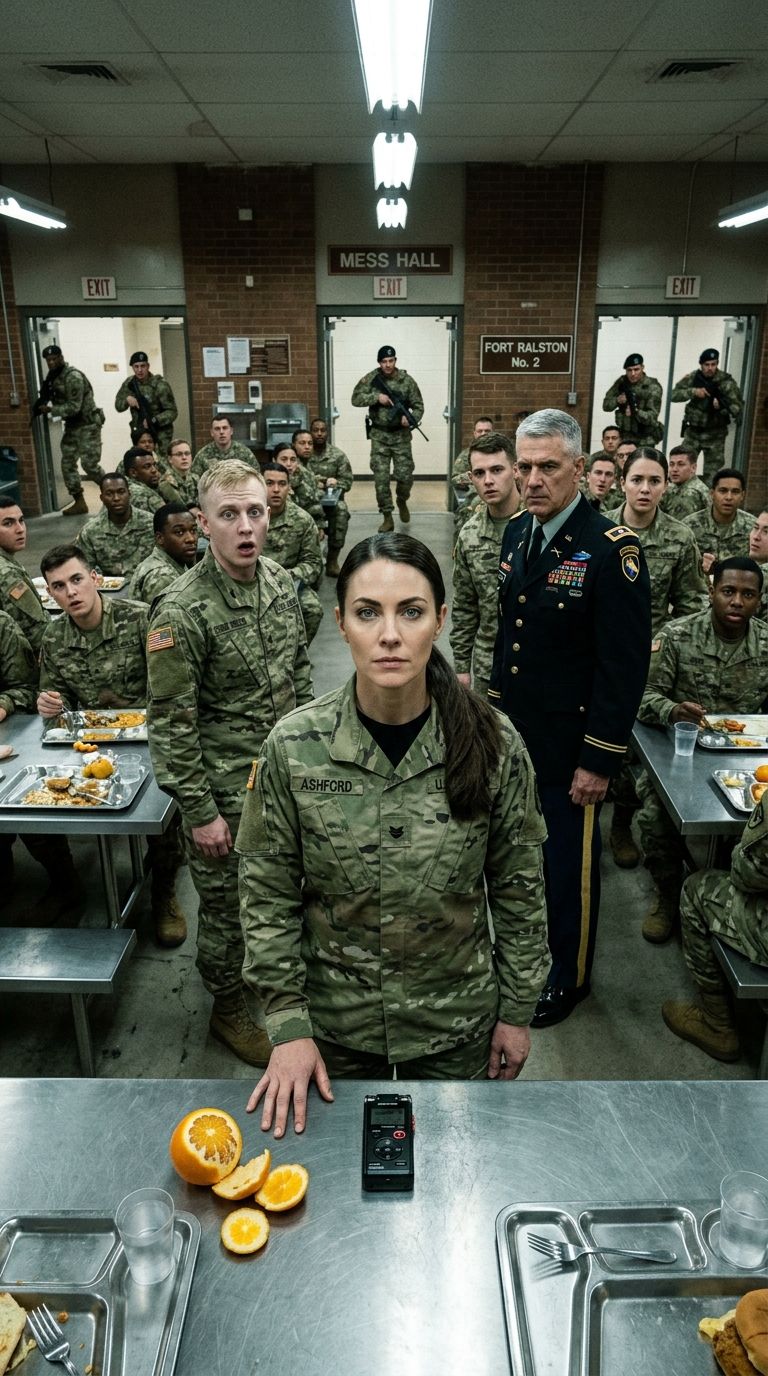
Colonel Richard Vale entered with two officers at his side.
The room straightened by instinct.
But the colonel did not look at Caleb first.
He looked at the woman.
And he saluted.
A full, formal salute.
The entire mess hall seemed to inhale at once.
The woman rose slowly. Caleb watched, still pale, as she returned the salute with quiet precision.
Colonel Vale’s voice carried across the room.
“Major Nora Ashford. Welcome back to Fort Ralston.”
Major.
The word detonated without sound.
Caleb’s men went rigid.
The woman they had laughed at – the woman Caleb had grabbed in front of everyone – was not a clerk. Not a contractor. Not lost.
She outranked him.
But the shock had only just begun.
Colonel Vale turned to the room.
“Major Ashford is here under special review authority from the Inspector General’s office. For the past month, this installation has been under investigation for command abuse, harassment, and retaliatory misconduct.”
Every face changed.
Some confused. Some frightened. Some guilty.
Caleb stared at Nora.
“You came here for me?”
She held his gaze for a long moment.
“No,” she said. “I came here because of what you became.”
That landed in his chest like a blade.
The moment seemed to expand around them – circling the table, drifting past the orange peels, the dropped tray, the tremor in Caleb’s hand.
Nora reached into her pocket and placed a small black recorder on the table.
Its red light blinked.
Once.
Twice.
Caleb swallowed.
The younger soldiers behind him stepped back, as if distance could unmake them from the scene.
Colonel Vale’s expression hardened.
“Sergeant Reed. You are relieved of duty pending formal review.”
For the first time in years, Caleb Reed looked small.
But then came the moment no one saw coming.
Nora did not smile.
She did not celebrate.
She looked tired. Almost sad.
“Before you remove him,” she said quietly, “you need to hear the rest.”
Colonel Vale frowned. “Nora – “
“All of it,” she said.
The room went still again.
She turned to Caleb.
“Six years ago, after Kandahar, you filed a statement saying your squad was abandoned by command. You said air support was delayed. You said the extraction route was changed without warning.”
Caleb’s eyes steadied through the shame.
“Yes.”
“You were right.”
A murmur swept the mess hall like a current.
Vale’s jaw tightened.
Nora’s voice remained level.
“That night wasn’t negligence. Your unit was sent into an exposed corridor because someone needed that village cleared before inspectors arrived. The delay, the route change, the missing support – it was deliberate.”
Caleb looked at the colonel.
The colonel looked away.
In that single, small movement, the whole room understood. The real monster had not been standing beside the table. He had just walked in wearing clean rank and polished authority.
Caleb’s voice dropped to almost nothing.
“You knew?”
Vale said nothing.
Nora picked up the recorder.
“This investigation was never only about Sergeant Reed’s conduct,” she said. “It was about the culture that shaped him – and the men who buried the truth behind medals, promotions, and silence.”
Vale’s officers shifted. One reached toward his radio.
Nora didn’t blink.
“Don’t.”
From every entrance, military police stepped into the mess hall.
The room erupted – not in noise, but in stunned, fractured movement. Chairs scraped. Soldiers rose. The officers beside Vale went rigid.
Caleb stared at Nora as though watching history rewrite itself in real time.
“You used me,” he whispered.
She looked at him steadily.
“No,” she said. “I tested you.”
She let the silence hold for one beat – long enough for the weight of it to settle over every person in the room.
Then she picked up her orange, turned, and walked toward the doors.
She didn’t look back.
She never had.
What Nobody Asked About
The mess hall took about four minutes to process what had happened.
Four minutes where nobody moved much. Where the MPs had Vale and his two officers by the far wall and everyone else just stood there holding their trays like props they’d forgotten they were carrying.
Private First Class Danny Kowalski, nineteen years old and three months out of basic, was the one who finally sat back down. Not because he wasn’t shaken. Because his legs gave out.
He’d been at the table directly behind Caleb when it happened. Close enough to see the knuckles go white around the ponytail. Close enough to hear that whisper.
Ghost.
He hadn’t known what it meant then. He didn’t fully know now. But he’d watched Sergeant Reed – the man who’d made grown soldiers cry in PT, who’d once stared down a lieutenant colonel over a parking spot and won – he’d watched that man go the color of old ash and step back like someone had put a gun to his throat.
Whatever she was, she was something Caleb Reed had never expected to see again.
Danny looked at the orange peels still sitting on the table.
Nobody had touched them.
The Thing About Fort Ralston
Fort Ralston had a reputation, and not a good one.
It wasn’t the kind of reputation that got written up. It was the kind that traveled in the back seats of cars when soldiers rotated out, in texts sent to friends at other postings. Watch yourself at Ralston. Keep your head down. Don’t file anything unless you want it to disappear.
Three JAG complaints in eighteen months. All three resolved without action. One complainant reassigned to Alaska within six weeks of filing.
The IG’s office had opened a preliminary inquiry in February. Quietly. The kind of inquiry that doesn’t announce itself, doesn’t request records right away, doesn’t tip anyone off that the walls are being measured.
What it does instead is send someone in first.
Someone who knows how these places work. Someone who can sit in a mess hall and eat an orange and wait to see exactly what kind of culture she’s dealing with.
Major Nora Ashford had been doing this kind of work for four years. Before that, eleven years in roles that were never fully described in any official document. The Kandahar operation wasn’t on her service record. A lot of things weren’t on her service record.
She’d learned early that the best way to read a unit was to give it something to react to.
She’d sat in that chair at Table Seven on purpose.
She’d known whose chair it was.
What Caleb Reed Had Been Before
The thing people at Fort Ralston didn’t know – the thing that didn’t make it into the whisper network – was that Caleb Reed had once filed a formal complaint himself.
It was 2018. Five months after Kandahar. He was still walking with a slight drag in his right leg, still waking up at 3 a.m. to the sound of a wall coming down.
The complaint named two officers. It described the route change, the delayed air support, the two men who’d bled out waiting for extraction that came ninety minutes late. It used words like deliberate and concealment and criminal negligence.
It went nowhere.
The investigating officer was a friend of one of the named officers. The complaint was reclassified as a performance grievance, which meant it went into a different file, which meant it could be addressed through channels that had no teeth. Caleb was told the matter had been reviewed and found without merit.
He was given a commendation three weeks later. A small one. The kind that says we see you, now stop talking.
He stopped talking.
But something in him had already shifted by then. Had already started the long, slow calcification that turns a man who’s been failed by the system into a man who becomes the system. Who decides that if the rules only protect the people at the top, then the only sane move is to get to the top, and to protect yourself the same way they protected themselves.
Fear. Proximity. Silence.
He’d built a small kingdom on those three things.
And he’d never once connected it back to that reclassified complaint. To those two names. To the friend of a friend who’d made it disappear.
Until a woman sat down at his table and peeled an orange.
After the Doors Closed
The MPs walked Vale and his officers out through the side entrance, the one that opened onto the vehicle lot, away from the main base foot traffic. Standard procedure. Nobody needed a spectacle.
Caleb sat at Table Seven for a long time after.
His tray was still there. Food untouched. The coffee had gone cold.
A staff sergeant named Greg Pruitt, who’d been at Fort Ralston for six years and had seen most of what there was to see, sat down across from him eventually. Not because they were close. Because someone had to.
“You okay?” Pruitt said.
Caleb looked at him.
“She came back,” he said.
Pruitt didn’t know what that meant. He didn’t ask.
“They’re going to want your statement,” he said instead. “IG team’s setting up in the conference room off the admin building. Probably within the hour.”
Caleb nodded slowly. His right hand was flat on the table, fingers spread. He was looking at them like he didn’t quite recognize them.
“I grabbed her hair,” he said.
“Yeah.”
“In front of everyone.”
“Yeah.”
He was quiet for a moment. Outside, a vehicle started up in the lot. The coffee machine kicked on again behind the counter.
“She let me,” Caleb said.
Pruitt frowned. “What?”
“She could have stopped it. I know she could have stopped it.” He looked up. “She let me do it so everyone would see.”
Pruitt didn’t have anything to say to that.
He didn’t think Caleb was wrong.
What the Recorder Caught
The IG team pulled the audio that evening.
Forty-one minutes of mess hall ambient noise, most of it useless. The recorder’s directional mic had been angled toward Table Seven from the moment Nora sat down, which meant it caught everything from the first Move to the last footsteps heading for the door.
It caught Vale’s salute. It caught the words command abuse and retaliatory misconduct in Vale’s own voice, which was useful in ways that would become clear over the following weeks.
It caught Caleb’s whisper.
Ghost.
The transcript listed it as inaudible, possible name or designation. The analyst who typed it up put a question mark in brackets beside it and moved on.
Nobody followed up on that part.
Some things stay classified not because anyone decides to classify them, but because the people who know what they mean are smart enough not to write them down.
The Orange
Danny Kowalski picked up the orange peels.
He didn’t know why. Cleanup instinct, maybe. Or something else he couldn’t name.
He carried them to the trash, dropped them in, and stood there for a second looking at his own hands.
He thought about the woman’s face when Caleb had grabbed her. The total absence of panic in it. The way her eyes had come up slow and steady, like she was surfacing from a depth most people never reached.
He thought about the recorder’s red light.
He’d been at Fort Ralston long enough to have heard things he shouldn’t have heard. Long enough to have kept his mouth shut about two of them. Long enough to know that the complaint he’d been thinking about filing since November had a decent chance of going the same place all the others went.
He pulled out his phone.
He looked up the IG office number.
He stared at it for a while.
Then he walked to the conference room off the admin building and knocked on the door.
When it opened, he said, “I have a statement. It’s about something different. I don’t know if it matters.”
The woman on the other side of the door – not Nora, someone younger, with a notepad and a Fort Ralston visitor badge – said, “Everything matters. Come in.”
He went in.
He sat down.
He started talking.
—
If this one got to you, pass it on. Someone else needs to read it.
If you’re interested in more intense encounters, check out The Sergeant Leaned Over My Table and Said “You People” or see what happened when The Colonel Cut My Braid Off in Front of the Whole Unit. He Didn’t Know Who I Was.. And for a different kind of tension, read about how She Was Shaking Before She Even Touched the Rifle. Then She Fired..