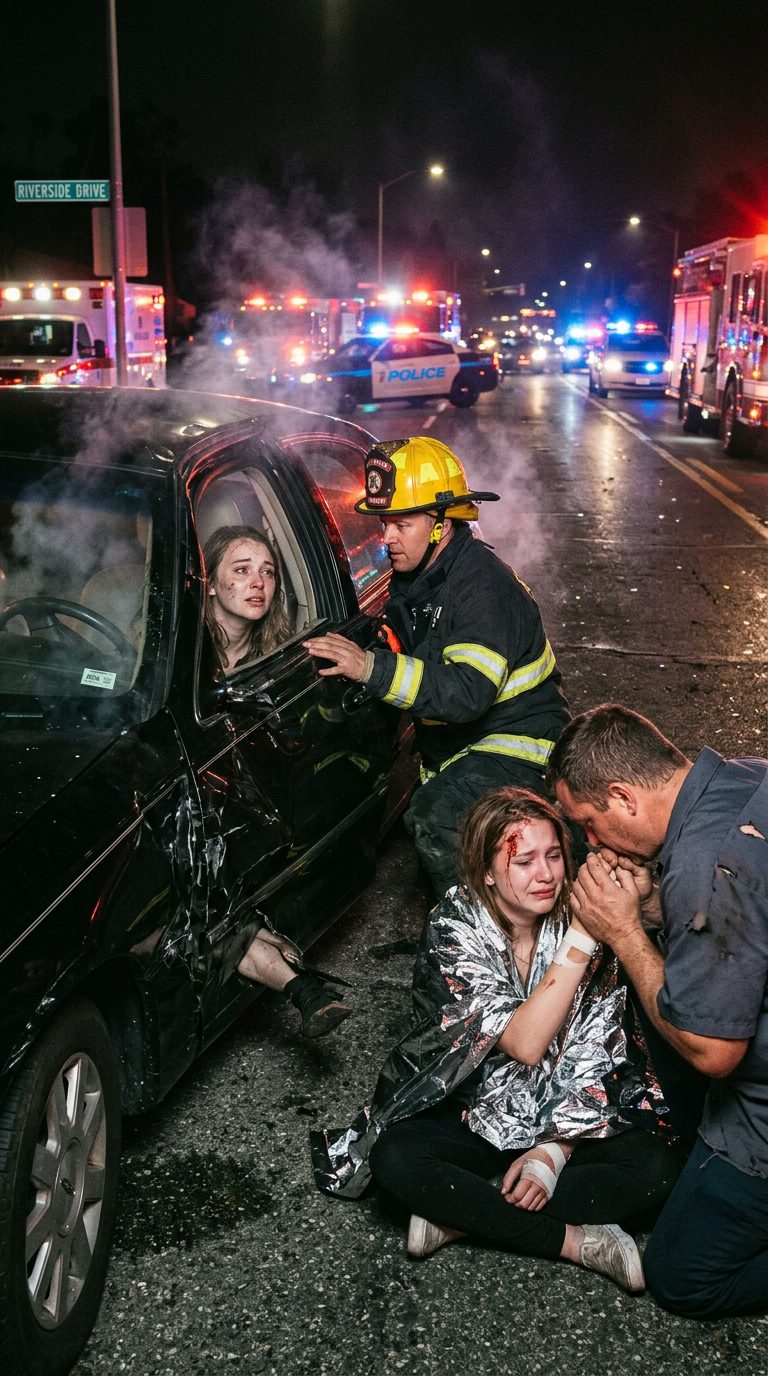

After our car accident, while I was still trapped inside the wreckage, my father pointed at me and told the paramedics, “The other one never meant much anyway. Don’t waste time on her.”
I heard every word.
My left leg was pinned beneath the crumpled door of Dad’s black Lincoln, the metal folded around me like a fist. Firefighters worked the frame with hydraulic tools while smoke threaded through the cold air and emergency lights strobed red and blue across Riverside Drive, turning the night into something feverish and unreal.
Olivia sat a few feet away on the curb, wrapped in a silver emergency blanket. She had a gash across her forehead and a broken wrist. I could see her moving. I could hear her sobbing for Dad.
I could not feel my feet.
“Sir, step back,” a paramedic ordered.
“My Olivia first!” Dad’s voice cracked – not from worry about me. “She’s all I have. Grace is – ” He stopped. Then said it anyway. “Grace is not important.”
The firefighter closest to me paused. Just for a moment. His eyes found mine through the smoke and the chaos.
I wanted to tell him I mattered.
I wanted to tell my father that I had packed Olivia’s lunch every single school morning since Mom died. That I had worked double shifts at the diner to cover the bills he forgot. That I had turned down Boston University for community college because he said the family needed me here.
I couldn’t speak. I could barely breathe.
—
It had started simply enough, less than an hour earlier.
Dad picked us up from Aunt Meredith’s house. Olivia asked to stop for coffee. Dad refused. Somewhere on the drive home, I noticed a strange smell – something chemical, something wrong – and said so.
Dad told me to stop being dramatic.
Then the engine sputtered.
Then the world went dark.
—
A paramedic knelt beside me, her voice steady and close.
“Grace? Can you hear me?”
I blinked once.
“We’re getting you out. Stay with me.”
Behind her, Dad crouched next to Olivia, holding her hand, pressing his lips to her knuckles.
“You’re safe, sweetheart. I’m right here.”
Olivia looked past him toward me. Her expression shifted – not fear, not sadness, but something quieter and harder to look at.
Guilt.
And that was when I remembered what she had whispered just before Dad started the car, her voice low and careful, her eyes not quite meeting mine.
Grace, don’t be mad. I only told him because I thought he already knew.
Told him what?
The answer came back slowly, piece by piece.
The bank envelope in my backpack. The acceptance letter inside it. The apartment deposit receipt folded behind it. My entire plan – carefully built over eighteen months – to leave them both and not look back.
—
The firefighters finally pulled me free.
Dad never looked in my direction.
Lying on that stretcher, staring up at the cold open sky while the sirens wailed and the lights kept turning, I felt something shift inside me – quiet and permanent, like a door closing on its own.
I stopped being his unwanted daughter that night.
I became his witness.
What Eighteen Months Looks Like
I should explain the plan. Not because it excuses anything. Just because you need to understand how long I’d been building a life in secret before Olivia burned it down with a sentence.
It started the winter I turned twenty-two. January, a Tuesday, the diner slow and the coffee burning black in the pot. I’d just worked a double and my feet hurt and I sat in my car in the parking lot for twenty minutes before I could make myself drive home to a house where my father would be asleep in his chair with the TV on and Olivia would want help with her homework and nobody would ask how my shift went.
I’d done the math on a paper napkin. How much I made. How much I spent on the house. How much I had left over if I stopped buying things for everyone else.
The number was small. But it wasn’t zero.
I opened a savings account the next morning at a bank Dad had never heard of, on the east side of town near the hospital. I put in forty dollars. Then eighty. Then whatever I had left after the bills cleared. I didn’t tell anyone. I barely admitted it to myself.
By April I had enough for a deposit on a one-bedroom apartment near the bus line. By September I’d found a place that would hold the unit for me through the end of the year. By November I’d deferred my community college credits and gotten back the letter from Boston – the one from three years ago, the one I’d never officially declined – and found out they had a rolling admissions program for students who’d delayed for family reasons.
I reapplied on a Wednesday night while Dad watched a game in the next room.
The acceptance letter came in a plain envelope. I put it in my backpack and didn’t take it out for two weeks because I was afraid to look at it, like it might disappear.
It didn’t disappear.
The Thing About Olivia
She’s not a villain. I’ve had to keep reminding myself of that, especially in the months since. She was nineteen. She found the envelope while looking for a pen. She’d read the letter and the deposit receipt and she’d done what Olivia always does when she finds something she doesn’t know how to carry alone.
She handed it to someone else.
I don’t think she meant to blow up my life. I think she panicked. I think she’d spent nineteen years watching me be the one who stayed and somewhere in her chest that had hardened into an assumption so solid she’d stopped noticing it. The idea that I might actually leave had probably hit her like a physical thing.
So she told Dad.
What I don’t know, what I’ve never asked her directly, is what she expected him to do. Beg me to stay? Have some kind of conversation? Look at me the way a father looks at a daughter he’s proud of?
Maybe she thought it would force that. Maybe she thought it would shock him into something better.
If so, she didn’t know him as well as she thought.
What He Said in the Car
He didn’t bring it up right away. That was the thing. We drove the first ten minutes in silence, which was normal. The radio was off. Olivia sat in the back and looked at her phone and I watched the streetlights on the highway and felt the specific low-grade dread of a Sunday night before a Monday shift.
Then, somewhere past the Riverside Drive turnoff, he said it.
“I know about Boston.”
My stomach dropped into my shoes.
I didn’t answer.
“After everything I’ve done for you.” His voice was flat. Not angry. Flat is worse. “After everything this family sacrificed.”
Sacrificed. He used that word. As if the diner shifts were his. As if the packed lunches were his. As if the deferred enrollment, the missed orientation weekend, the roommate I’d never met because I’d turned down the housing deposit three years ago – as if any of that had cost him a thing.
I said, “I was going to tell you.”
He said, “When?”
I didn’t answer because the honest answer was never and we both knew it.
That was when I smelled the chemical smell. Something underneath the regular car smell, something sharp and wrong. I said there was something off and he told me to stop being dramatic and then the engine made a sound like something tearing loose and then we were sideways and then we weren’t anywhere at all.
The Firefighter’s Name Was Dennis
I know because he came to the hospital the next morning. Off-duty. Civilian clothes, a gray Carhartt jacket, a paper cup of coffee he didn’t drink.
He found me in the room where they’d put me after the surgery. My left leg was in an external fixator, which is a construction of metal rods and pins that goes through the skin and looks like something from a machine shop. It hurt in a way that wasn’t exactly pain, more like a constant loud noise you can’t locate.
Dennis knocked on the open door and stood there and said, “I just wanted to check on you.”
I looked at him for a second. I said, “You’re the one who paused.”
He didn’t pretend not to know what I meant.
He came in and sat in the chair by the window and we talked for maybe forty minutes. He didn’t say much about my father. He didn’t say the things people usually say, the gracious-under-pressure things, the he was probably in shock things. He just asked me questions. What did I study. Where was Boston. What did I want to do when I got there.
Nobody had asked me that last one in a long time.
Before he left he said, “You should go.”
I said, “I know.”
He nodded and picked up his untouched coffee and walked out.
The Hospital Visit That Didn’t Happen
Dad came to the hospital once.
He stood in the doorway of my room for about thirty seconds. He didn’t come in. He looked at the fixator and looked at the wall and looked at somewhere near my left shoulder and said, “The doctors say you’ll recover fine.”
I said, “That’s what they tell me.”
He said, “Olivia’s home. Her wrist is in a cast.”
I said, “I know. She texted me.”
He stood there a few more seconds.
Then he left.
Olivia came every day. She sat in the chair Dennis had used and she cried on the second day, properly cried, and said she was sorry about the envelope and I told her I knew. I told her I wasn’t angry. I’m not sure that was completely true but it was true enough.
She asked if I was still going.
I said yes.
She nodded like she’d expected it. Like she’d made her peace with it somewhere between the accident and the hospital chair.
“Will you tell me your address?” she asked. “When you have one?”
“Yeah,” I said. “I’ll tell you.”
What I Took With Me
Eight months later I loaded a rented cargo van with everything I owned, which wasn’t much. A bed frame. Four boxes of books. A lamp I’d bought at a thrift store in March. The coffee maker from the kitchen, which had been Mom’s, which I’d decided I was allowed to take.
Dad was at work. I don’t know if he knew I was leaving that day. I’d told Olivia the date. I didn’t tell him.
I left a check on the kitchen counter for two months of utilities, which was more than I owed.
I stood in the kitchen for a minute before I picked up the last box. The house smelled like it always had. Old wood and the faint ghost of whatever Dad had made for dinner the night before. Seventeen years of Sunday mornings and packed lunches and double shifts and turning down the thing you wanted most because someone else needed the space.
I picked up the box.
I drove north on Riverside Drive, past the section of guardrail that was still bent from the accident, past the diner where I’d worked doubles for four years, past the bank where I’d opened an account with forty dollars on a January Tuesday and told nobody.
The acceptance letter was in the glove box. I’d kept it there since the hospital. Folded and refolded until the creases had gone soft.
I didn’t need to read it anymore. I had the address memorized.
I just liked knowing it was there.
—
If this hit somewhere real, pass it on. Someone else might need to read it today.
For more incredible stories, you might want to read about My Family Was Helping My Sister Move While I Was Alone in the Hospital After a Serious Accident or even My Brother Waited Eight Years to Tell Me What Mom Hid From Me. And don’t forget to check out the tale of My Husband of Seven Days Left Me a Backpack. His Lawyer Said He Wasn’t Who I Thought He Was..