
Forty days after my father was laid to rest, my family gathered to divide everything he had left behind.
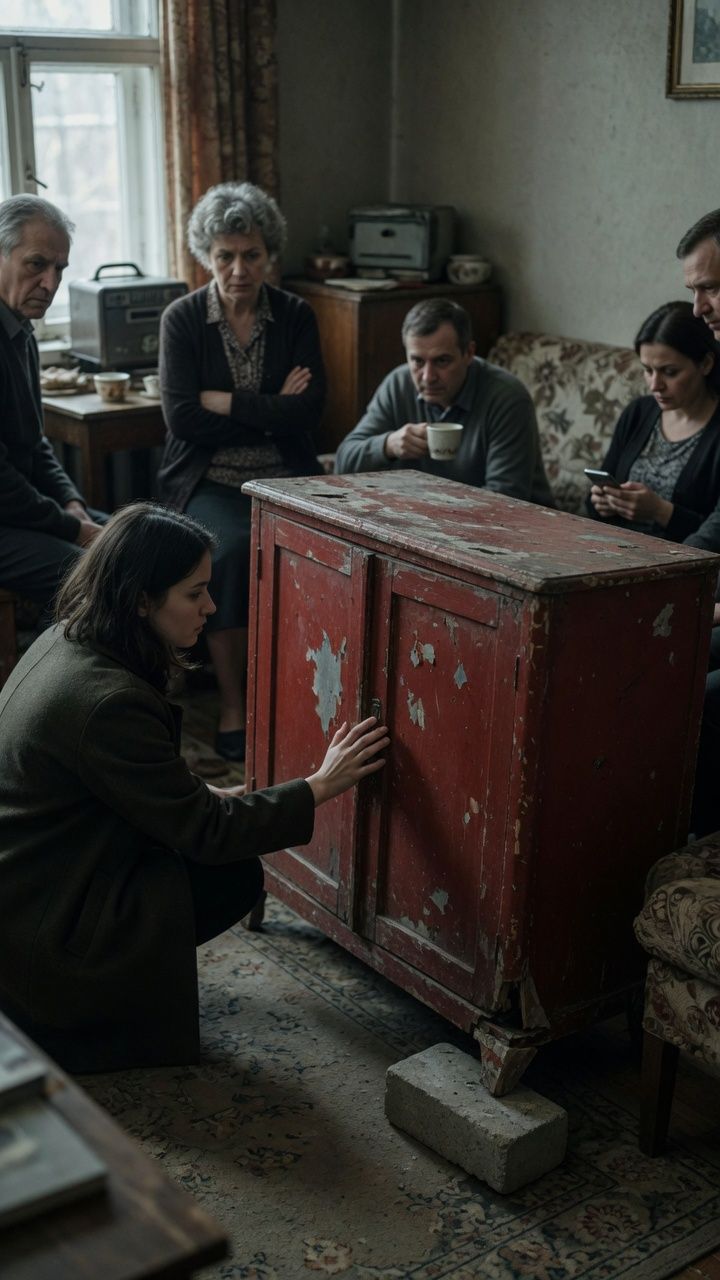
They distributed his house, his vehicle, his savings, and my grandmother’s gold as though I weren’t even sitting in the room. When they finally remembered me, the only thing remaining was an old red wardrobe with chipped paint, a warped frame, and one broken leg propped up by a brick.
I smiled and said, “I’ll take it.”
—
My father had been gone for exactly forty days.
Before his death, he spent seventy-three days in the county hospital. During those seventy-three days, I called my brother Daniel repeatedly. He always had some urgent problem at work. I called my sister Rachel too, but her children always needed her.
Neither of them stayed overnight. Not once.
I did.
For seventy-three nights, I slept in a freezing hospital corridor with my coat folded beneath my head, listening through the door for the sound of my father breathing. Near the end, he could barely speak. He would squeeze my hand and keep his eyes fixed on the doorway.
I knew who he was waiting for.
They never came.
When he died, my mother called Daniel first. His first question wasn’t about Dad. He wanted to know how much the funeral would cost.
Rachel didn’t contribute a single dollar.
I paid for the coffin, the service, the meal, and the burial plot. Four thousand five hundred dollars from savings I had spent years building. I recorded every expense in a small notebook – not because I intended to demand repayment, but because I knew that one day they would behave as though it had never happened.
When we gathered to divide Dad’s estate, that was exactly what they did.
No one mentioned the funeral expenses. No one mentioned the nights at the hospital. No one spoke about who had stayed beside him while he was dying.
—
My mother sat in the living room with a metal lockbox on the coffee table. Inside were the deed to the house, the title to Dad’s Chevy Tahoe, two bank passbooks, and my grandmother’s gold bracelets.
Daniel sat beside his wife. Rachel sat beside her husband. I sat near the edge of the room, in the place my family had always seemed to reserve for me.
My mother opened the box.
“Daniel has the biggest mortgage,” she said. “The house should go to him.”
And just like that, the home my father had spent decades paying for belonged to my brother. Daniel nodded, as if the decision had already been promised to him.
Then my mother slid the Tahoe’s title toward Rachel. “You have children. You need the extra room.”
Rachel smiled.
Next came the savings. Fifteen hundred dollars to Daniel. Twenty-five hundred to Rachel. Then my mother placed my grandmother’s gold bracelets into Rachel’s hands as well.
I remained silent and watched more than three hundred and fifty thousand dollars change hands while no one spoke my name.
Finally, my mother turned to me.
“Well,” she said, pointing into the corner, “that’s what’s left.”
Dad’s old wardrobe stood against the wall. It had once been painted a deep cherry red, but most of the color had flaked away. One leg was broken, propped up by a landscaping brick.
My sister-in-law laughed. “That thing probably isn’t even worth carrying.”
Rachel wrinkled her nose.
My mother looked at me with the same expression she had worn throughout my childhood whenever she wanted me to accept less and pretend it was fair. “You’re the youngest,” she said. “Don’t be greedy.”
Greedy.
For a moment, I nearly laughed.
Daniel had always been the important son. Rachel had always been the family princess. And I had always been expected to understand. To compromise. To step aside. To need less. My parents paid for Daniel’s private tutors and Rachel’s expensive dresses while I used secondhand textbooks, worked my way through college, and once lent Daniel money for the deposit on his home. Eight years later, he still hadn’t repaid me.
Whenever I questioned the unfairness, my mother gave me the same response.
“Family doesn’t keep score.”
But that afternoon, I did.
A house for Daniel. A Tahoe, savings, and gold for Rachel. And for me, a damaged wardrobe balanced on a brick.
—
I rose and crossed the room.
My fingertips brushed the peeling red paint. I knew that wardrobe. It had stood in our home for as long as I could remember. Dad kept his flannel shirts inside it. His old tools. Stacks of folded newspapers. Small boxes no one else had ever cared enough to open. The quiet remnants of a man who had never demanded much attention.
I crouched and pulled the brick from beneath the broken leg.
The wardrobe groaned and tilted. My uncle, who had stayed silent near the back of the room, frowned. Rachel kept scrolling on her phone. My sister-in-law laughed again.
But my mother stared at me, and for one brief moment her expression shifted. Not irritation. Not anger.
Fear.
That was when I understood. There was something inside that wardrobe – or connected to it – that she didn’t want me to find.
I straightened and looked around the room.
“Fine,” I said calmly. “I’ll take it.”
No one offered to help. Daniel kept drinking his coffee. Rachel kept staring at her phone. My mother stood on the porch with her arms folded while my uncle and I dragged the wardrobe into the rented truck, watching me the entire time as though silently willing me to change my mind.
I didn’t.
Because sometimes the thing everyone laughs at is the only thing worth keeping.
And sometimes the smallest inheritance holds the largest secret.
What I Found That Night
I drove home with the wardrobe rattling in the back of the truck, the broken leg scraping against the metal floor every time I hit a bump.
My apartment was on the third floor of a building with no elevator. My uncle had already gone home. So I did it alone, one end at a time, resting it against the stairwell wall between floors, catching my breath. It took forty minutes. My back screamed the whole way.
When I finally got it inside and upright, I stood there in my kitchen looking at it.
It was uglier in the fluorescent light. The red paint was almost entirely gone on the left side. The door hinges were thick with rust. It smelled like my father’s house, which meant it smelled like motor oil and old newspaper and the particular cold that lived in rooms nobody heated enough.
I stood there for a long time before I opened it.
His flannel shirts were still inside. Four of them, folded badly, the way he always folded things. A pair of work gloves. A coffee can with screws and washers in it. And at the bottom, beneath a folded moving blanket, a flat metal box about the size of a hardcover book.
No lock. Just a clasp.
I sat down on the kitchen floor and opened it.
The Box
Inside: a folded letter, a photograph, and a smaller envelope sealed with tape.
The letter was in my father’s handwriting. He had terrible handwriting, always had. It took me a while to read it.
It was dated eleven months before he died. Before he got sick. Before any of this.
If you’re reading this, you found the box. That means you took the wardrobe. That means I was right about you.
I had to stop there for a second.
He went on. He wrote that he had known for years how things worked in our family. He wasn’t blind, he wrote. He saw what my mother did, how she’d always tilted toward Daniel and Rachel, and he was ashamed he hadn’t done more to correct it when he had the chance. He wrote about the hospital nights. He said he knew I was there. He said he could hear me in the corridor when he couldn’t sleep.
I couldn’t say much near the end. But I heard you. Every night.
The photograph was the two of us. I was maybe seven years old. We were standing in front of that same wardrobe, back when it was still cherry red and all four legs were solid. He had his hand on my shoulder. I was squinting at the camera. He was laughing at something off to the side.
I don’t remember that day. I wish I did.
The sealed envelope had my name on the outside in his handwriting.
Inside was a bank statement. A separate account I’d never known about. In my name, not his. He must have opened it years ago and never told me.
Forty-three thousand dollars.
What He Knew
I sat on the kitchen floor for a long time.
The coffee can full of screws was sitting next to me. One of his flannel shirts was in my lap. I don’t remember picking it up.
My father had been a quiet man. Not cold, just quiet. He worked at the same machine shop for thirty-one years. He never talked about money. He drove the same truck for twelve years after the engine needed replacing and he just replaced the engine. He ate the same lunch every day. He didn’t complain. He didn’t explain himself.
But he had been watching.
He saw Daniel take the deposit money and never pay it back. He saw my mother hand Rachel the better birthday gifts and tell me I was old enough to understand. He saw me show up at that hospital night after night while his other children sent texts asking for updates.
He didn’t say anything. That was his way. But he did something.
He opened an account. He put money in it over years. Quietly. The way he did everything.
And then he hid the statement in a box in a wardrobe that nobody wanted.
He left it for me to find. He just had to trust that I’d be the one to take it.
The Part That Hit Hardest
The letter had one more paragraph.
He wrote that he was sorry the wardrobe was in such bad shape. He said the leg broke when he was moving it to get to the wall outlet behind it, and he never got around to fixing it. He said he meant to.
Then he wrote: Don’t let them make you feel small. You never were.
That was it. No signature. He must have figured I’d know his handwriting.
I stayed on the floor until after midnight. At some point I made coffee and didn’t drink it. The flannel shirt smelled like him, which was unbearable, and I kept holding it anyway.
What I Didn’t Do
I didn’t call Daniel.
I didn’t call Rachel.
I didn’t call my mother.
There was a version of this story where I marched back into that living room and laid the bank statement on the coffee table and watched their faces. I’d be lying if I said I didn’t think about it. I thought about it for a good hour.
But my father hadn’t done it that way. He’d been quiet. He’d done his thing without announcing it. He didn’t need them to know.
I figured I could learn something from that.
I transferred the money. Paid off the last of what I owed on my car. Put the rest somewhere safe. Kept the photograph and the letter in the metal box, which now sits on top of the wardrobe in my bedroom. I got a furniture leg kit from the hardware store and fixed the broken foot. It’s not perfect, slightly shorter than the others, but it stands on its own now.
The flannel shirts are still inside.
What the Wardrobe Holds Now
My mother called three weeks later. Casual, like nothing had happened. She wanted to know if I’d “settled in okay” and whether I was coming to Rachel’s birthday dinner.
I told her I was busy.
She said that was a shame. She said family was important.
I didn’t argue. I just said I’d let her know, and I got off the phone.
Daniel has never mentioned the deposit money. Rachel sent me a text on my birthday that said hope ur good!! with a balloon emoji.
Some things don’t change. That’s fine. I stopped waiting for them to.
The wardrobe stands in the corner of my bedroom, lopsided by maybe a quarter inch, painted a color that’s closer to rust than red now. Every morning I see it when I wake up. Every morning I think about a man who folded his shirts badly and ate the same lunch for thirty years and listened through a hospital door to his son sleeping in a corridor.
He didn’t make speeches. He didn’t demand anything. He just paid attention, and he made sure it counted.
That’s the whole inheritance, really. The forty-three thousand dollars was just the part that fit in an envelope.
—
If this one stayed with you, send it to someone who’s ever been handed the broken thing and told to be grateful. They’ll know exactly what it means.
If you’re still reeling from this family drama, you might find some solace (or at least more jaw-dropping stories) in these tales of familial betrayal, like when My Father Toasted to Removing Me From the Family. I Had One Email Ready., or when My Mom Said the Fire “Wasn’t Her Problem.” Then the Investigator Showed Me the Key.. And for another unbelievable twist, read about how My Own Mother Swore Under Oath That I Never Served My Country.