
When my apartment burned down, I called my parents from the curb with smoke still in my hair and ash stuck to my wet sweatshirt.
My hands were shaking so badly I could barely hold the phone.
“Mom,” I said when she answered. “There was a fire. My apartment is gone.”
There was a pause. Not shock. Not fear. Just silence, the kind she used when she wanted me to feel small before she spoke.
Then she said, “Not our problem. Should’ve been more careful.”
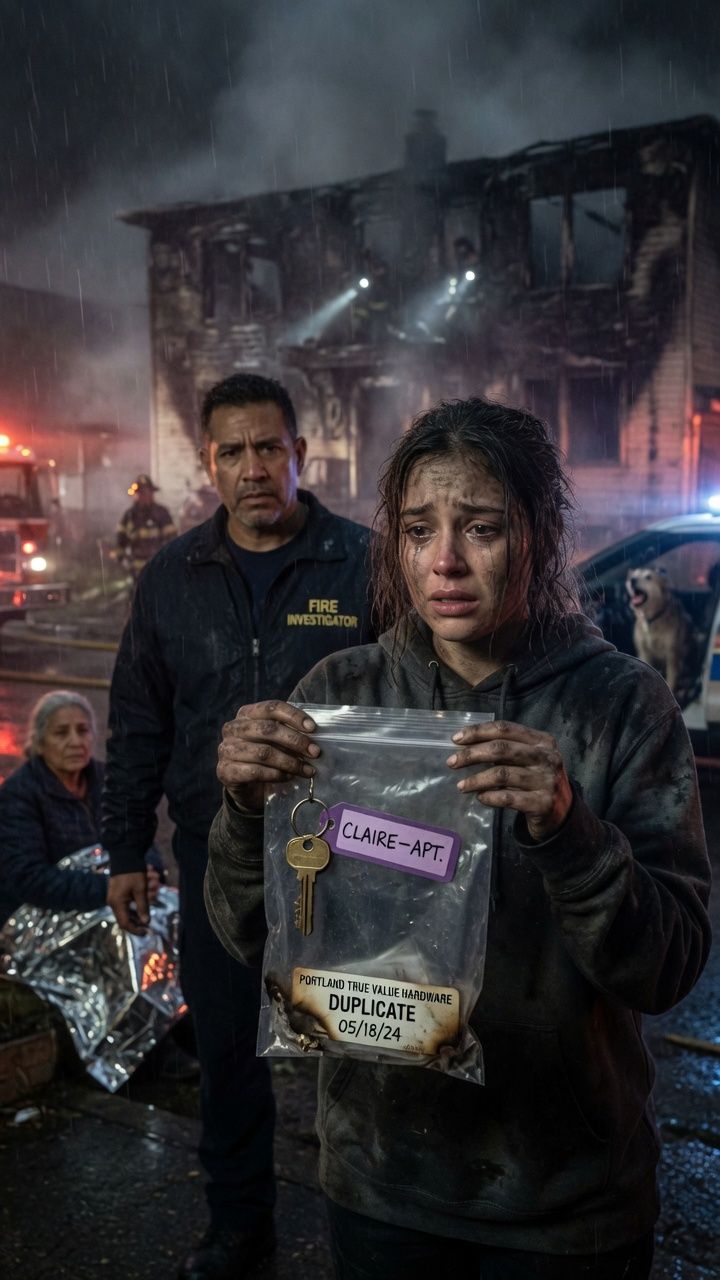
I stared at the blackened windows of what had been my second-floor apartment in Portland, Oregon. Firefighters moved through the building with flashlights. My neighbor, Mrs. Alvarez, sat wrapped in a blanket on the sidewalk. Someone’s dog was barking from a patrol car.
“Mom, I lost everything,” I whispered.
“You always make drama, Claire,” she said. “Call your brother. He has real responsibilities.”
Then she hung up.
My brother, Miles, did not answer. He rarely did unless he needed money.
I was still standing there when a man in a navy jacket approached me. “Claire Whitman?”
I nodded.
“I’m Fire Investigator Daniel Reyes. I’m sorry about your apartment. I need to ask you a few questions.”
I wiped my face, though I couldn’t tell if it was rain, sweat, or tears. “Was it electrical?”
He didn’t answer right away. That was my first warning.
“Do you know who had access to your apartment last week?” he asked. “Because we found something at the scene.”
My stomach tightened. “What do you mean?”
He opened a clear evidence bag. Inside was a small brass key with a purple plastic tag.
My key.
Except it wasn’t mine anymore.
I had given that spare key to my mother three years ago, after my surgery, when she said she needed it “for emergencies.” Two months ago, after a huge fight over my grandmother’s inheritance, I demanded it back. She tossed it at me across her kitchen table.
Or I thought she had.
The key in the bag had a burn mark along the edge, but I recognized the handwriting on the tag immediately.
Mom’s sharp black letters.
CLAIRE – APT.
My throat closed.
Investigator Reyes watched my face carefully. “You recognize it.”
“That was my mother’s key,” I said. “But she gave it back.”
“Did she?”
I looked again.
My blood ran cold.
Because beneath the melted plastic, still attached to the key ring, was a second tag.
A hardware store duplicate label dated six days ago.
What the Investigator Didn’t Say Out Loud
Reyes didn’t accuse anyone. He was careful that way. He asked questions in a flat, even tone and wrote everything in a small spiral notebook with a pen that had chew marks on the cap. He asked how long I’d lived there. Whether I had renters insurance. Whether I’d had any disputes with anyone recently.
I told him about the inheritance.
My grandmother, Doris, had died in February. She’d left me her house in Gresham and a savings account with around forty thousand dollars in it. My mother had expected to get both. She’d been managing Grandma Doris’s finances for the last year of her life, and somewhere in her head that managing had become owning. When the will was read and my name was on it, she’d gone completely still. That stillness was worse than yelling. I’d seen her do it once before, when my dad told her they couldn’t afford a vacation she’d already planned.
She didn’t speak to me for six weeks. Then she called out of nowhere and asked if I wanted to come to Sunday dinner.
I should’ve known that was the tell.
I went. We ate pot roast. She was pleasant. Miles was there with his girlfriend, a quiet woman named Tanya who kept her eyes on her plate. My mom talked about the neighborhood association and a new restaurant downtown. At the end of the night she hugged me at the door and said, “We should do this more often.”
I drove home thinking maybe things were actually okay.
That was seven weeks ago.
Reyes wrote down the date of the dinner without blinking.
The Hardware Store Receipt
Two days after the fire, Reyes called me at the Motel 6 off Powell where the Red Cross had put me up.
“We pulled security footage from a hardware store on Burnside,” he said. “A woman matching your mother’s description duplicated a key there on the fourteenth. We’d like you to come in and look at the footage.”
I sat on the edge of the motel bed. The carpet was that particular shade of brown that might have been beige before fifteen years of foot traffic. The TV was on with the sound off. I remember that detail clearly. A cooking show. Someone piping frosting onto a cake.
“Okay,” I said.
“Claire.” He paused. “Is there anything else you want to tell me before you come in?”
I thought about the dinner. The pot roast. The hug.
“She’s my mother,” I said.
“I know.”
That was all he said. But the way he said it told me he’d heard that sentence before, from other people, in other parking lots.
What I Saw on the Screen
The footage was grainy but it wasn’t ambiguous.
My mother, in her gray wool coat. The one she wore to church and to my college graduation and to my grandmother’s funeral. She was at the key-cutting counter. She handed the key to the guy behind the register. She stood there while he cut it, arms crossed, looking at her phone.
Calm as anything.
She paid cash.
Reyes let me watch it twice. I didn’t ask for a third time.
“The origin point of the fire was the kitchen,” he said. “Specifically, a dish towel placed on a gas burner. The knob had been turned to low, not off. Low burns slow. It takes a while before anything catches.”
I stared at the frozen image on the screen. My mother’s gray coat.
“She was at my apartment,” I said.
“We believe someone was.”
“I was at work. I work the Tuesday close shift at the bookstore. I get home at nine-thirty.” I stopped. “If I’d gotten home on time – “
“You didn’t,” Reyes said. “You were late.”
I had been. My coworker Patrice had locked her keys in her car and I’d waited with her for the locksmith because the parking lot was dark and she was nervous. I’d gotten home at eleven-fifteen instead of nine-thirty, and the building was already burning, and Mrs. Alvarez was already on the sidewalk.
Patrice’s locked keys.
I don’t know what to do with that. I’ve stopped trying to do anything with it.
My Father Didn’t Know
This is the part that broke something loose in me, some piece I hadn’t known was still intact.
My dad called me four days after the fire. He’d been traveling for work, a job site in Bend, and had just gotten back. He didn’t know what had happened. My mother hadn’t told him.
He found out from a neighbor who’d seen something on a local Facebook group.
He called me crying. My dad doesn’t cry. He’s sixty-three years old, a retired electrician named Gary, and in my entire life I have seen him cry twice. Once when his own father died, and once when our dog got hit by a car when I was nine.
He cried on the phone while I told him I was okay.
“Your mother told me you’d moved,” he said. “Last week. She said you’d moved to Seattle.”
I hadn’t moved anywhere. I’d lived in that apartment for four years.
“Dad,” I said carefully. “What did she tell you exactly?”
He couldn’t piece it together clearly. She’d mentioned Seattle, mentioned I’d been distant, mentioned something about me cutting off the family over the inheritance. He’d accepted it because he usually did. That’s how their marriage worked: she narrated reality and he absorbed it.
He hadn’t known about the key. He hadn’t known about the dinner. He hadn’t known about any of it.
I told him about the footage.
There was a long silence.
“Gary,” I said. That’s the first time I’ve called him by his first name in my life. I don’t know why I did it then. “She could have killed me.”
He didn’t argue.
He showed up at the Motel 6 the next morning with a bag of groceries and sat in the parking lot for twenty minutes before he came to the door. I watched him through the window. He just sat in the truck with his hands on the steering wheel.
I don’t know what he was working through. I didn’t ask.
The Part Nobody Tells You About
People hear a story like this and they expect a clean next chapter. Arrest, trial, justice, healing. A line you cross where things make sense again.
It doesn’t work that way.
My mother was questioned. She denied being at the hardware store. She denied having a key. She told the detective that I had always been unstable, that I’d fabricated stories about the family before, that the inheritance had made me paranoid. She said she was worried about me.
Miles backed her up. Tanya, his girlfriend, did not. She told investigators she had heard my mother on the phone the week before the fire saying something about “making things even.” Tanya and Miles broke up three weeks later.
The case is still open. That’s the correct phrase: still open. It sits somewhere in a filing system and occasionally Reyes calls me with an update that isn’t really an update.
I stay in Gresham now. Grandma Doris’s house. The one my mother expected to inherit.
It’s a small house. Pale yellow siding, a garden that went to weeds, a kitchen with a window over the sink that looks out at a neighbor’s maple tree. I’ve been clearing the garden. I don’t know much about plants but I’m learning.
My dad comes by on Saturdays sometimes. We don’t talk about my mother much. We talk about the garden and whether the fence needs replacing and what’s wrong with the gutters. He’s good with gutters.
Mrs. Alvarez lost most of her things too. She had renter’s insurance, which I didn’t. I gave her some of the money from the savings account. She tried to refuse and I told her not to be ridiculous. She made me tamales every week for two months after that.
I still have the bookstore job. Patrice still works there. I bought her a AAA membership for her birthday.
There’s a spare key to Grandma Doris’s house on a hook by the door.
Nobody else has a copy.
—
If this one hit somewhere uncomfortable, pass it along. Sometimes the right person needs to read it.
If you’re still reeling from family drama, you might want to check out these other shocking stories, like the one where a mother swore her child never served their country, or a tale about a brother who sold a house during a family dinner. And for another dose of parental disappointment, don’t miss the story of parents skipping a graduation and spreading rumors of failure.