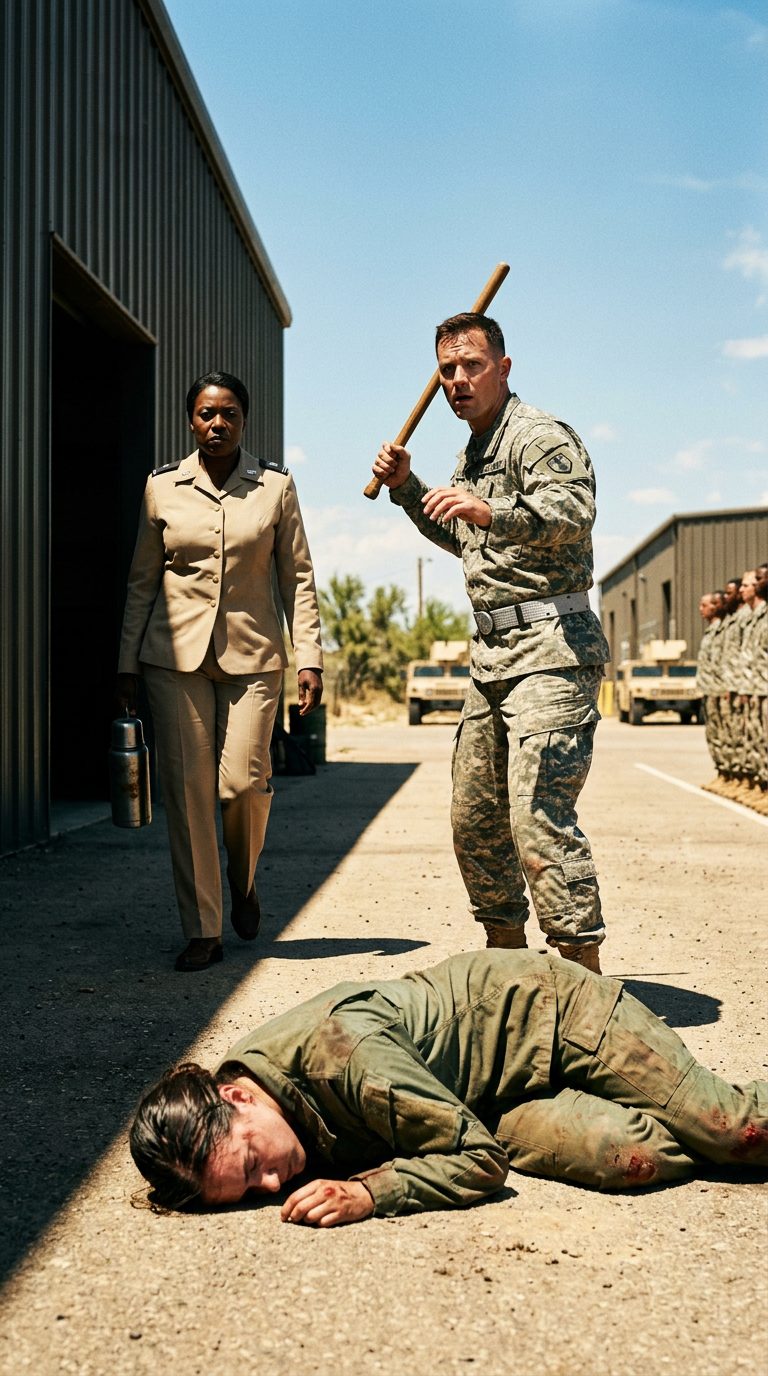

“Make Her Crawl Until She Forgets She’s A Soldier”
The copper taste of blood was the only thing keeping Private Sarah Jenkins conscious.
Her chest slammed into the razor-sharp desert gravel again, and she pressed her palms flat against the scorching earth, fighting to hold herself together. Above her, the midday Texas sun hammered down like an open furnace, turning the asphalt of Fort Bradley into something close to hell. But the heat was nothing compared to the shadow standing over her.
“Get up, Jenkins. Or did you forget how to use your legs the moment you put on that uniform?”
Sergeant Marcus Vance didn’t scream. That was the terrifying part. He spoke in a low, venomous calm that made the hairs on Sarah’s neck stand straight up – a voice designed not to frighten, but to unmake.
Sarah forced her knuckles into the jagged rocks, her fingernails already torn and bleeding. Every muscle in her twenty-two-year-old body screamed. Two days ago, a so-called training mishap – another one of Vance’s carefully orchestrated accidents – had fractured her rib. Every breath now felt like a shard of glass rotating slowly inside her chest.
“I said, up!”
His heavy combat boot came down hard on the small of her back.
The white-hot flash of agony shot straight up her spine. Sarah choked back a sob and pressed her face into the dirt, hiding her tears from the formation standing thirty yards away. She knew what people said about girls who cried in the modern American military. She refused to be a statistic. She refused to give him the satisfaction.
—
Corporal Caleb Ross watched from the rigid formation, his stomach twisting into a sickening knot.
He chewed furiously on an unlit wooden toothpick – a nervous habit he’d developed since arriving at Fort Bradley – and fought every instinct in his body. He wanted to break formation. He wanted to tackle Vance and drag Sarah away from the man. He wanted to scream until his lungs gave out.
But his mind flashed immediately to his mother back in Ohio, whose chemotherapy bills were paid entirely by his military healthcare benefits. One black mark on his record, and Vance would destroy his career before sundown. His mother’s lifeline would vanish with it.
So Caleb did the thing he hated himself most for doing. He fixed his eyes on the distant horizon and pretended he couldn’t hear the wet, ragged gasps of his friend.
—
As the pain threatened to drag her under, Sarah’s mind drifted somewhere far away.
She was eight years old again, standing in the hallway of her family’s small home in Colorado, the walls alive with orange light, the air thick and black with smoke. She could still hear Toby – her little brother – crying out her name from across the hall.
She had been too small. Too terrified. Too weak to move.
She had saved herself and left Toby behind in the ashes.
That guilt had never left her. It was a living, breathing thing inside her chest, older and heavier than the fractured rib. It was the ghost that had followed her into every recruiter’s office, that had whispered its demands into her ear every morning she laced up her boots.
Be strong. Be a shield. Never be helpless again.
But under Sergeant Vance’s boot, she felt smaller than she ever had in that burning house.
—
Vance crouched down, the suffocating stench of cheap peppermint and stale tobacco washing over her face. He tapped his heavy silver ring against his belt buckle – a slow, rhythmic metallic clicking that had become the soundtrack to her nightmares.
“You think you’re special, Jenkins?” he whispered, his eyes narrowing to slits. “You think because you passed the physical baseline, you belong in my squad?” He let the silence stretch. “You’re a liability. You’re weak. And I don’t tolerate weakness in my army.”
The truth, though Vance would never have admitted it, was that he didn’t hate Sarah because she was weak. He hated her because she wouldn’t break.
He was a man consumed by his own rotting failures. Years ago, a botched field operation under his command had cost him a promotion and exiled him to a training base, far from the career he believed he deserved. He couldn’t punish the generals who had buried him. So he punished the recruits who still had something left – their hope, their dignity, their fire.
And Sarah’s eyes, fierce and unbroken despite everything he threw at her, drove him to a state of quiet, festering madness.
“Please, Sergeant,” Sarah whispered, her voice cracking at the edges. “The drill… the drill is completed.”
Vance’s face twisted into sudden, ugly rage.
“It’s completed when I say it’s completed!”
He kicked a spray of sharp gravel directly into her face. The tiny rocks sliced across her cheek in thin, bright lines of red.
“Down on your belly, Private. Low crawl. From here to the obstacle fence.” He paused, savoring it. “And if your chest leaves the dirt even an inch, we start over.”
Sarah looked ahead. The fence was a football field away. Across open gravel. In the blazing heat. With a cracked rib.
“Move!”
She collapsed onto her stomach. The impact forced a ragged, involuntary scream from her throat. Then she began to drag herself forward – inch by agonizing inch – the gravel shredding through her uniform, tearing the fabric at her elbows and knees, biting directly into her flesh.
Vance walked slowly beside her, his boots clicking steadily next to her ear like a metronome counting down to something inevitable.
He glanced back at the frozen formation with the satisfied expression of a man who believed he was teaching a lesson.
“Look at her!” he called out, his voice ringing across the desolate courtyard. “This is what happens when you think you’re a soldier. This is what happens when you don’t know your place.”
He turned back to Sarah, dropping his voice just low enough that the front row of the formation could hear every word.
“Make her crawl until she forgets she’s a soldier,” he muttered, almost to himself. “Make her crawl until she remembers she’s nothing.”
—
In the formation, Caleb Ross closed his eyes.
A single tear slipped past his eyelids. He gripped his rifle so hard his hands trembled against the stock.
Sarah was slowing down. Her movements were becoming desperate, mechanical, the movements of a body running on nothing but stubbornness and borrowed time. Her forehead pressed into the dirt with every inch she gained. Her mind was drifting – he could see it in the way she moved, the way her focus was dissolving.
I’m sorry, she thought, her vision blurring at the edges. I wasn’t strong enough. I’m still not strong enough.
Toby’s voice faded somewhere in the smoke.
Vance raised his heavy leather pacing stick, positioning it above her shoulders. One sharp strike to force her forward. His arm swung downward.
The blow never landed.
—
A sudden, absolute stillness fell over the entire parade ground.
It happened in an instant – the ambient noise of the base, the distant hum of Humvees, the shouting of other platoons across the yard – all of it seemed to simply stop, as though the world had drawn in a breath and forgotten to release it.
From the deep, angular shadows of the tactical headquarters building, a figure stepped out into the blinding sunlight.
The footsteps were measured. Heavy. Deliberate. Not the pace of someone arriving – the pace of someone who had already decided how this would end.
Every soldier in the formation recognized the uniform before they could see the face. The razor-sharp creases. The rigid posture. The silver eagles gleaming on the shoulders like two small, cold suns.
Colonel Victoria Sterling. The Base Commander.
She was a living legend at Fort Bradley – a battlefield veteran who had survived an IED blast in Fallujah and walked with a subtle, rigid limp that somehow only added to the weight of her presence. She didn’t drink the base coffee. She carried a dented steel thermos of pitch-black brew everywhere she went, and it was said, only half-jokingly, that her eyes could see straight through a soldier’s soul.
She had been standing in the shadows of the awning for a long time.
Watching.
Vance froze mid-swing, his arm suspended in the air. The color drained from his face so completely and so quickly that he looked, for a moment, like a man who had just understood something he could never ununderstand.
Colonel Sterling didn’t look at him. Not yet.
She looked down at Sarah, who lay face-down in the dirt – unconscious now, her uniform soaked through with blood and sweat, her hands still curled into the gravel as though even her body refused to surrender.
The Colonel slowly unscrewed the cap of her steel thermos. She took one long, deliberate sip of black coffee. Then she raised her eyes to Sergeant Vance, and the temperature of the air between them seemed to drop by ten degrees.
When she spoke, her voice was quiet. Dangerously, terrifyingly quiet – the kind of quiet that doesn’t warn you before it destroys something.
“Sergeant Vance.” She let his name sit in the air for a moment, alone. “Tell me exactly what tactical objective requires you to torture a soldier under my command.”
What a Man Looks Like When His Story Runs Out
Vance opened his mouth.
Nothing came out.
His arm came down slowly, the pacing stick dropping to his side, and Caleb Ross watched from the formation as the man’s entire posture changed. The shoulders that had been squared and predatory for six months went loose. Not relaxed. Deflated. Like something structural had given way inside him.
“Colonel Sterling.” He tried to find the register he used on recruits. Couldn’t locate it. “This is a standard conditioning exercise. The private failed to complete–“
“I know what I watched, Sergeant.”
Four words. She didn’t raise her voice. She didn’t need to.
Sterling walked past him and crouched down in the gravel next to Sarah. Not the careful crouch of someone keeping their uniform clean. She went straight down, one knee in the dirt, her hand going to the side of Sarah’s neck to find a pulse. Her thermos sat on the ground beside her like she’d just set it down in her own kitchen.
“Medic!” she called, and the word cracked across the yard like a gunshot.
Two soldiers broke from the far end of the formation at a dead sprint. Nobody had given them permission to move. Nobody stopped them.
Sterling looked up at Vance from where she knelt.
“You’re relieved of duty, Sergeant. You will report to my office at fourteen hundred. You will bring nothing with you. You will say nothing to anyone between now and then.” She paused. “Do you understand what I’m telling you?”
Vance’s jaw worked. “Ma’am, with respect, this soldier has been underperforming since day one. My methods–“
“Were witnessed by thirty-four soldiers and one base commander.” She stood up, brushing gravel from her knee in one flat motion. “Your methods are now a matter of official record.”
The medics were already there, rolling Sarah carefully onto a stretcher. One of them, a young specialist named Dorsey with close-cropped hair and a face that looked about nineteen years old, kept his eyes down as he worked. His hands were fast and sure. He’d done this before.
Caleb watched them lift Sarah and felt the toothpick splinter between his back teeth.
Fourteen Hundred
Vance showed up at the Colonel’s office at 1:58.
He’d spent the two hours between trying to construct something that would hold. He’d talked to no one, per her instructions, which meant he’d spent the time alone in his quarters staring at the wall and running the same mental calculations over and over. He had friends on this base. He had twelve years in. He had a drawer full of commendations from before the Fallujah rotation that had reshuffled everything.
He had a story about a soldier who couldn’t hack it, and a sergeant doing what sergeants do.
He had nothing.
Sterling’s office was not what most people expected. No trophy wall. No framed citations arranged for maximum impression. One desk, government-issue. One chair across from it, government-issue. A single photograph on the wall behind her, small enough that you had to squint to make it out: a woman in full combat kit standing next to a destroyed vehicle in what looked like the outskirts of Ramadi, grinning like she’d just won something.
She was already seated when he came in. The thermos was on the desk.
She didn’t offer him a seat. He stood.
“Private Jenkins has two cracked ribs,” Sterling said. “She has lacerations on her hands, forearms, knees, and face. She has a mild concussion from losing consciousness in the heat.” She looked at him. “The base physician tells me the rib injuries are consistent with blunt trauma, not a training fall.”
Vance said nothing.
“You’ve had three formal complaints filed against you in the past eighteen months. All three were buried at the company level.” She opened a folder on her desk and turned it so he could see it, though she didn’t push it toward him. “I pulled them this morning.”
He looked at the folder. Three separate sheets. He recognized the names.
“Sergeant–“
“I’m not interested in your explanation.” She closed the folder. “I’m interested in one thing. Private Jenkins’ medical file shows she requested a transfer out of your unit eight weeks ago. The request was denied.” She leaned forward slightly. “Who denied it?”
A long silence.
“Captain Merritt,” Vance said.
“Was that at your request?”
Another silence. Shorter.
“Yes, ma’am.”
Sterling sat back. She picked up the thermos, turned it once in her hands, set it down without drinking.
“You’re going to write a full statement. Everything. The transfer denial, the rib incident, today. All of it.” She said it the way you’d say the sky is blue. Just a fact. “If the statement is complete, I’ll process your separation administratively. Twelve years, you keep your pension eligibility. If the statement is incomplete, or if I find out you’ve spoken to Merritt before he’s interviewed, I refer this to JAG this afternoon and you’re looking at a court-martial.”
Vance stared at her.
She stared back. She had the kind of eyes that didn’t blink on a schedule.
“Do you need me to repeat any part of that?” she asked.
He didn’t.
Room 114, Fort Bradley Medical
Sarah woke up at a little after five in the evening.
The ceiling was white and the air smelled like antiseptic and the AC was running too cold, the way it always did in military medical facilities, like they’d decided comfort was a distraction. Her hands were wrapped in white gauze. Her ribs were taped. There was an IV in her left arm and a monitor clipped to her finger that beeped at a steady, indifferent pace.
She lay there for a while, not moving. Just breathing. Each breath still hurt but it was a clean hurt now, a known quantity, not the panicked hurt of the gravel.
The door opened.
Caleb Ross came in carrying two cups of coffee from the vending machine down the hall. The bad kind, the kind that tasted like hot brown water, the kind that was all Fort Bradley’s medical wing had ever stocked in its history. He held one out to her.
She looked at it. Then at him.
“You broke formation,” she said. Her voice was rough.
“No.” He pulled the chair up next to the bed and sat down. “I didn’t break formation.”
She remembered, vaguely, that he hadn’t. She’d seen him standing there. She’d seen his face.
“I know,” she said.
He set the second cup on the tray beside her bed and wrapped both hands around his own. He didn’t say he was sorry. She was glad. She didn’t want sorry right now.
“Sterling was there the whole time,” he said. “You know that?”
“Someone told me.”
“She was standing in the shadow of the HQ awning. Just watching.” He shook his head slowly. “She let it go on long enough to see everything she needed to see.”
Sarah thought about that. There was something in it that should have bothered her, maybe. The Colonel waiting, watching, building her case while Sarah’s face was in the gravel. But she found she couldn’t hold onto the anger. Sterling had stopped it. Sterling had come.
“Vance?” she asked.
“Gone. Administrative.” Caleb picked at the rim of his cup. “Merritt’s being interviewed tomorrow.”
Sarah nodded. She looked at the ceiling for a while.
“Toby,” she said, and then stopped.
Caleb waited.
“My brother,” she said. “He didn’t die in the fire. I always thought he did. My parents told me he did.” She paused. “He didn’t. He got out the back window. I found out two years ago.”
Caleb looked at her.
“He’s twenty-six. Lives in Denver. We’ve talked twice.”
She said it flat. Not looking for a response. Just setting it down somewhere outside her own head, where it could exist in the room without crushing her.
“He doesn’t blame me,” she said. “He never did.”
The Next Morning
Sterling came by at seven-fifteen.
She didn’t stay long. She stood inside the door, thermos in hand, and looked at Sarah in the bed with the gauze hands and the taped ribs and the slightly too-big hospital gown.
“How are you feeling, Private?”
“Better, ma’am.”
“Good.” Sterling looked at her for a moment. Not the look of someone deciding what to say. The look of someone who has already said everything that needs saying and is just making sure the other person is still standing. “You have options going forward. Transfer, new unit, continued service with full documentation of what happened. The choice is yours and the timeline is yours. No one will rush you.”
Sarah nodded.
Sterling turned to go.
“Colonel.”
She stopped.
“Thank you,” Sarah said. “For coming out.”
Sterling didn’t turn back around. But she paused, her hand on the doorframe, and for just a second the rigid line of her shoulders changed.
“You were still moving,” she said. “The whole time. You never stopped.”
She walked out. The door swung shut behind her.
Sarah looked at her wrapped hands in her lap. The gauze was bright white against the grey of the hospital blanket.
Outside the window, across the yard, the parade ground sat empty in the early morning light. Just gravel and heat and silence, the obstacle fence in the distance, exactly where it had always been.
She thought about Toby in Denver. She thought about calling him tonight.
She thought about the way her hands had kept reaching forward, even when she’d stopped knowing why.
If this one hit you somewhere you didn’t expect, pass it along to someone who needs to read it.
For more stories of resilience in the face of adversity, check out what happened when My Sergeant Grabbed a Stranger’s Hair in the Mess Hall. Then She Stood Up. or when The Sergeant Leaned Over My Table and Said “You People”. You might also find strength in the tale of She Was Shaking Before She Even Touched the Rifle. Then She Fired..