
For fifteen years, my parents called me an unemployed failure.
They weren’t entirely wrong about the facts. I was thirty-five, still renting a one-bedroom apartment in Seattle, and I showed up to every Thanksgiving dinner in the same worn jacket. My mother, Helen, would wait until the potatoes were passed before delivering her annual assessment of my life.
“Maya, when are you going to get a real job?”
My father, Richard, never looked up from his plate when he added his part. “Your sister bought a house at twenty-eight.”
I smiled. I passed the potatoes. I said nothing.
What I couldn’t tell them was that I spent my days inside a federal task force office with no windows and a badge I wasn’t allowed to discuss at dinner parties. I was a cybercrime investigator. I traced financial abuse, identity theft, exploitation networks, and fraud schemes that fed on people who trusted too easily. I had arrested men who coached Little League. I had arrested a grandmother who ran a wire fraud operation out of her church basement every Sunday after the sermon. I had arrested sons who smiled at their mothers while emptying their accounts.
My family thought I repaired old laptops for cash.
Only one person knew the truth: my grandmother, Evelyn.
She had raised me more than my parents ever did, in the practical sense that mattered. She taught me chess on a board missing two pawns, Morse code on long summer afternoons, and something harder to name – the ability to keep your face still when your stomach is dropping. Years earlier, when I helped her recover money stolen through a fake charity scam, she had gripped my hand afterward and made me promise something.
“If I ever send you the words the blue bird stopped singing,” she said, “you come immediately. You don’t call first.”
I laughed. I thought she was being dramatic.
She didn’t laugh.
—
On a rainy Tuesday afternoon, I was reviewing transaction logs in a fraud case when my phone buzzed on the desk beside me.
A text from Grandma.
The blue bird stopped singing.
The cold moved through me before my mind had fully processed the words. I called her immediately. It rang four times and went to voicemail. I called again. Same result.
I pulled up the tracking application I had quietly installed on her emergency medical pendant two years earlier – a system she had consented to and we had never spoken of to anyone else. The GPS coordinates placed her not at her own home, but at my parents’ house in Portland.
I stared at the screen.
Grandma hated going there. She had made that clear after a falling-out with my mother three years ago that no one had fully explained to me and no one seemed eager to resolve. She had not been inside that house since.
I picked up my badge, walked to the door, and called Detective Luis Ramirez on the way to my car.
“I need two officers for a welfare check,” I said. “Possible elder coercion. I’ll explain on the way.”
—
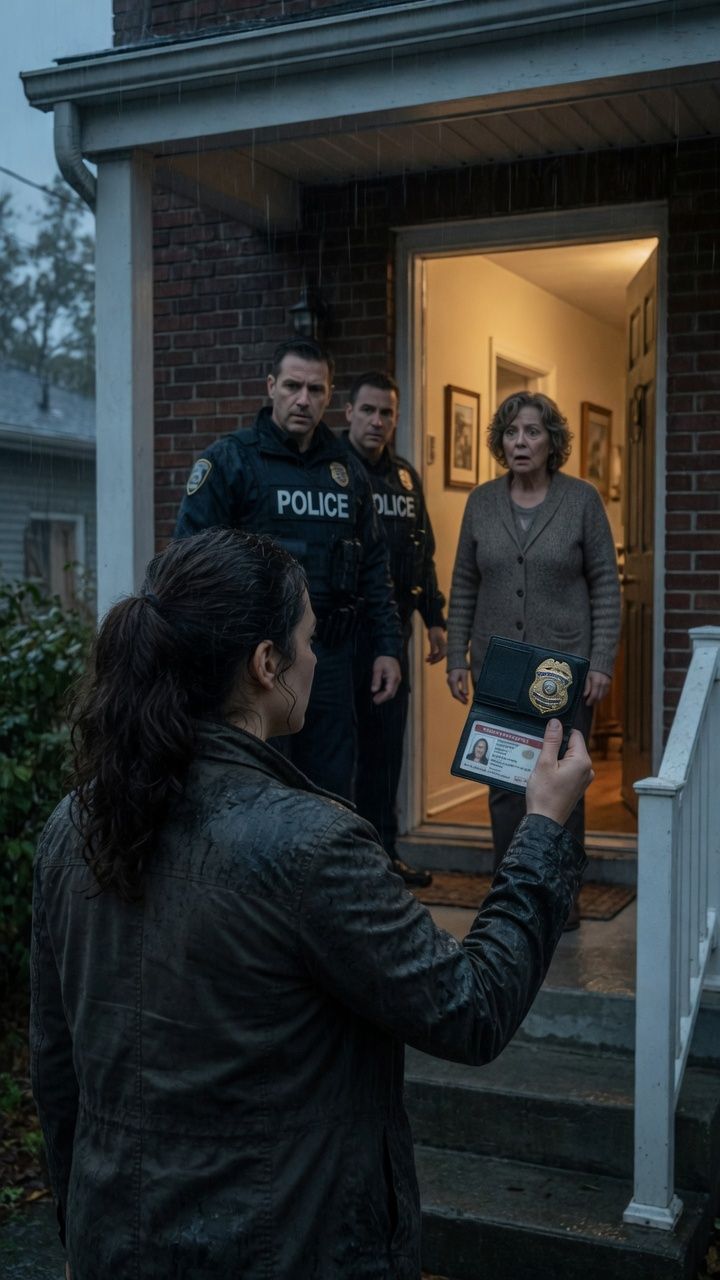
Thirty minutes later, I stood on my parents’ front porch.
The rain had softened to a mist. I could hear the television through the door – a home improvement show, the kind my father watched on Tuesday evenings. Behind me, two officers waited in silence.
I knocked.
My mother opened the door and went completely still. Her eyes moved from my face to the badge in my hand to the officers standing behind me, and something shifted in her expression that I had never seen there before. Not guilt, exactly. Something closer to the moment before guilt, when a person first understands that what they believed was private has become visible.
“Maya,” she whispered. “What are you doing here?”
From somewhere deeper in the house, I heard my grandmother’s voice – thin but steady, calling my name.
I looked at my mother.
“My job,” I said.
I stepped inside.
What I Found in the Living Room
Evelyn was sitting in the armchair by the window. The good one, the leather one my father had bought when my sister graduated from college. She was upright and composed, but her hands were folded in her lap with a stillness that I recognized. It was the same stillness she’d taught me. Keep your face still when your stomach is dropping.
On the coffee table in front of her: a manila folder, a pen, and a document I could read from six feet away without my glasses.
Power of attorney.
My father was standing near the fireplace. He’d muted the television. He had the look of a man who had rehearsed something and was now reconsidering whether to deliver it.
“We were just having a conversation,” he said.
I walked to the coffee table. I picked up the folder. The document inside was three pages. The signature line at the bottom was blank, but the name filled in above it was Helen Patricia Garrison. My mother.
“Evelyn,” I said, “are you here because you wanted to be?”
A pause. She looked at my mother, then back at me.
“They called this morning,” she said. “Your mother said there was something urgent. That I needed to come sign paperwork before the end of the week or there’d be complications with the property transfer.”
Property transfer. That was new.
I set the folder back down.
The Part Nobody Told Me
Evelyn owned a house in Northeast Portland. Had owned it for forty-one years. Three bedrooms, a garden in the back that she’d been tending since before my mother was born. On the current market, that house was worth somewhere between six hundred and seven hundred thousand dollars.
I had not known, until that moment standing in my parents’ living room, that my mother had been in conversation with Evelyn about that property for the better part of a year.
I found that out later. What I knew right then, looking at that document, was that the power of attorney being presented to my grandmother was not limited. It was broad. It covered financial decisions, property decisions, healthcare decisions. It named my mother as sole agent.
And the notary, according to the signature block at the bottom of page two, had already signed.
My mother was watching me read. She was very quiet.
“It’s just to make things easier,” she said. “In case something happens to her.”
“She’s seventy-nine,” my father said from across the room. “It’s just practical.”
Evelyn said nothing. Her hands were still folded.
I looked at the notary block again. The date on it was four days ago.
“Where was this notarized?” I asked.
My mother didn’t answer immediately. That half-second was enough.
“Here?” I said.
“A friend came by,” she said. “It was convenient.”
I set the folder down again. I turned to the two officers who had followed me inside and were standing near the entryway, quiet and watching.
“Give me a minute,” I said.
The Conversation in the Hallway
I walked my mother to the kitchen. My father started to follow and I told him, without turning around, that he should stay where he was. He stayed.
Helen stood by the sink. She had her arms crossed. She looked like she was waiting for me to accuse her of something so she could explain why the accusation was unfair.
“How long have you been planning this?” I asked.
“It’s not what you’re making it into.”
“How long.”
She exhaled. “We’ve been talking to her for months. She’s getting older, Maya. Someone needs to have authority to make decisions. You’re never here. Diane is in Boston.”
Diane is my sister. The one who bought a house at twenty-eight.
“Did Evelyn ask for this?” I said. “Did she come to you and say she wanted you to have power of attorney?”
My mother’s jaw moved.
“We suggested it,” she said.
“And the property transfer paperwork? Did she bring that up too?”
Silence.
“Helen.”
“There are expenses,” she said, and her voice had shifted into something I’d heard before, the particular register people use when they’ve convinced themselves that what they’re doing is reasonable. “This house costs money. We’ve been helping her for years. There’s nothing wrong with – “
“Stop.”
She stopped.
I leaned against the counter. My badge was still in my hand, which I hadn’t noticed until that moment. I set it on the counter between us.
“I need you to understand something,” I said. “What’s in that folder is not a favor. A broad POA obtained without independent legal counsel, with a pre-signed notary, from an elderly woman who was told she had to sign before the end of the week or face complications – that’s elder financial abuse. That’s what it’s called. That’s what it looks like in a case file.”
My mother’s face went a color I don’t have a word for.
“I’m not filing anything today,” I said. “But that document doesn’t get signed. Not today, not this week, not by a notary your friend sent over. If Evelyn wants to make estate decisions, she gets her own attorney. One she chooses. One who works for her.”
I picked up my badge.
“That’s how this works now.”
What Evelyn Said After
I drove her home.
She didn’t want to talk in the car, and I didn’t push it. She looked out the window at the wet streets and the October dark coming down over the hills east of the city, and I let her have the quiet.
When I pulled into her driveway, she sat for a moment without moving.
“I almost didn’t send it,” she said.
“The text?”
“I kept thinking, maybe I’m being foolish. Maybe they’re right that it’s just practical.” She looked at her hands. “But the notary had already signed. Before I had. That bothered me.”
It should have. That detail alone was enough to pull the document’s validity into question, and whoever prepared it knew that, which meant they were counting on Evelyn not knowing it.
“You weren’t foolish,” I said.
She nodded once. Then she looked at me with the expression she’d had when she taught me chess, when I made a move I thought was clever and she was about to show me what I’d missed.
“Fifteen years,” she said. “They called you a failure for fifteen years.”
I didn’t say anything.
“I never corrected them,” she said. “I thought it was your story to tell, not mine.” She paused. “I’m sorry I waited this long to be useful.”
I thought about telling her she’d always been useful. I thought about saying something about how she’d shaped every useful thing in me. But she knew all of that, and she hadn’t asked for reassurance. So I just sat with her for a minute in the dark driveway, and that was enough.
The Thanksgiving After
I did not file a formal complaint. I had a longer conversation with Evelyn and a family law attorney named Pat Sorensen, who specialized in elder estate planning and had an office two miles from Evelyn’s house. Evelyn hired Pat. She made her own decisions about her own property, with her own counsel, on her own timeline.
My parents were not named in any official capacity.
Thanksgiving that year was at Evelyn’s house. First time in four years. My sister flew in from Boston and spent most of the afternoon on her phone, which was normal. My father watched football in the back room, which was also normal.
My mother passed the potatoes.
She did not ask about my job.
At some point in the evening, my father found me in the kitchen and stood there for a while before saying anything. He’s not a man who apologizes, exactly. What he said was, “Your grandmother thinks very highly of you.”
I said, “I know.”
He nodded. He went back to the football game.
It wasn’t resolution. It wasn’t the moment where everything shifted and my family finally saw me clearly. Real life doesn’t really do that. What it was, was a kitchen. My father’s voice doing something slightly awkward and unfamiliar. The potatoes getting cold in the other room.
I’ll take it.
—
If this one hit close to home, pass it along – someone you know might need to hear it.
If you’re interested in more stories about familial complexities, you’ll find similar threads in My Family Gave Me a Broken Wardrobe While They Split Everything Else or even My Father Toasted to Removing Me From the Family. I Had One Email Ready. And for situations where family just isn’t there for you, check out My Mom Said the Fire “Wasn’t Her Problem.” Then the Investigator Showed Me the Key..