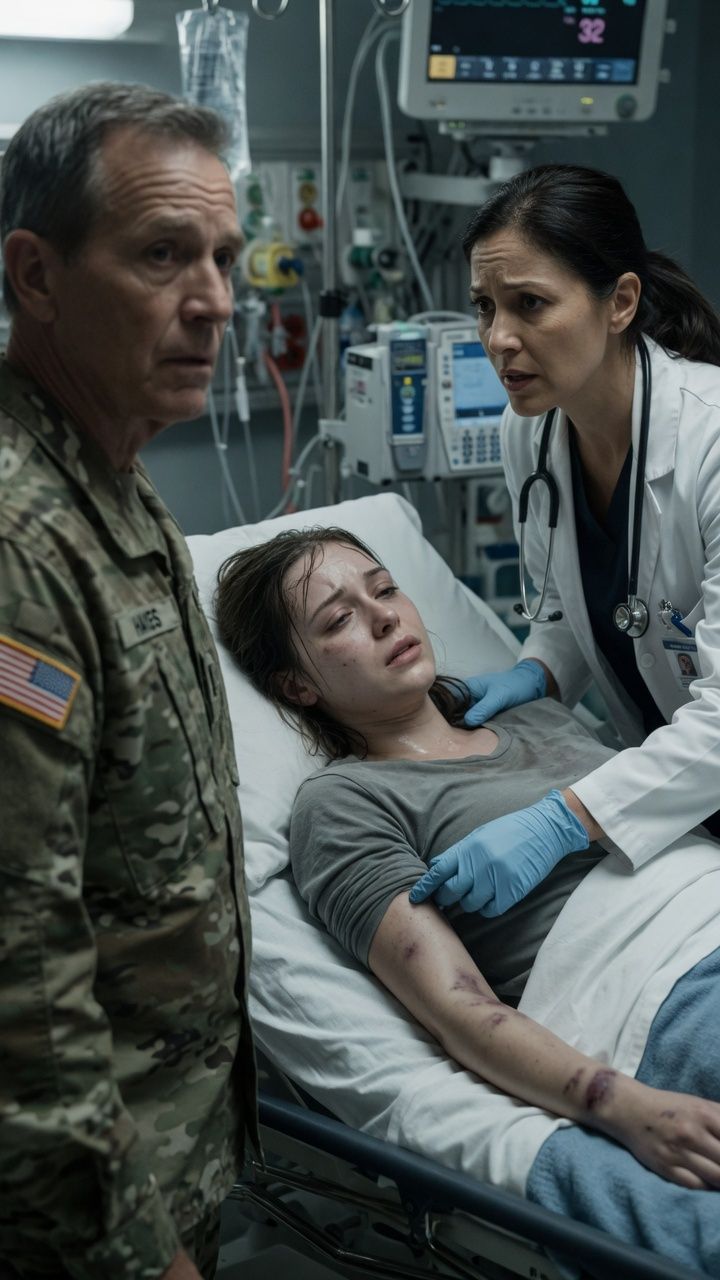

My name is Colonel Robert Hayes. I served in the United States Army for twenty-five years. I led soldiers through combat zones, made impossible decisions under fire, and watched people survive things most human beings will never have to imagine.
None of it prepared me for what I found that morning.
—
My daughter, Emily Carter, had given birth to her first child just days earlier. The delivery had been brutal, and she was still fragile – barely able to move without wincing. Even so, Emily kept insisting she was fine. She always did. She hated feeling like a burden to anyone.
Her husband, Daniel, had been called away on an unexpected business trip out of state.
That left Emily alone with Daniel’s mother, Margaret, and his younger sister, Vanessa.
Margaret had never truly accepted my daughter. She found Emily too independent, too direct, too sure of herself – never quite good enough for her son. Vanessa echoed every criticism with a pleasant smile, as though the cruelty tasted better that way.
Months before Noah was born, Margaret had pressured Daniel to purchase a house in her name using Emily’s savings. Wives come and go, she liked to say. Mothers don’t. Emily refused. She told Daniel plainly that she would not gamble her child’s future on a woman who had never respected her. Daniel waved it off. His mother meant well. She always meant well.
When Noah arrived, something in Margaret seemed to shift. She brought flowers to the hospital. She held my grandson with practiced tenderness and promised Daniel – promised him directly – that she would take wonderful care of Emily while he was away.
I wanted to believe her.
But something sat wrong in my chest, quiet and persistent, the way things do when you’ve spent enough years learning to trust that feeling.
For three days, every time I called, Margaret answered first.
Emily is sleeping.
The baby is fine.
There’s nothing to worry about.
Then on the fourth day, Emily answered.
Her voice was barely a whisper – less a sound than the shape of one.
“Dad… please come.”
Every instinct I had sharpened over twenty-five years of service came alive at once.
“Emily. What happened?”
Before she could answer, the phone was taken from her hand.
Margaret laughed – a light, dismissive sound. “She’s just emotional. You know how new mothers can be.”
I set down the phone and reached for my keys.
—
I drove to their house the next morning with diapers, groceries, Emily’s favorite pastries, and a stuffed bear for my grandson. Small things. The kinds of things you bring when you want someone to know you were thinking of them.
The front door was standing open.
Inside, the television roared at an empty room. Margaret and Vanessa were asleep on the couch beneath expensive blankets, dirty dishes spread across the table around them like a still life of indifference. Neither of them stirred.
Then I heard Noah.
Not fussing. Not the ordinary complaint of a hungry infant.
Screaming.
The sound moved through me like ice water.
I went down the hallway and pushed open Emily’s bedroom door.
She was lying half-conscious on the bed – pale, trembling, unable to lift her head. Noah screamed beside her, exhausted and desperate. An untouched bottle sat on the nightstand. Neither of them had been tended to. Not recently. Perhaps not for some time.
Margaret appeared in the doorway behind me. She looked at the scene with something closer to annoyance than concern.
“If one baby is too much for her,” she said, “maybe she was never meant to be a mother.”
I didn’t answer her. There was nothing to say – and no time to say it.
I lifted Noah into my arms, helped Emily as gently as I could manage, and drove them both directly to the emergency room.
—
The doctors moved quickly around my daughter.
At some point, one of the ER physicians – calm, experienced, unhurried in the way that only comes from having seen too much – reached down and gently rolled back Emily’s sleeve.
Dark bruises ringed both of her wrists. A complete circle on each one. The kind that doesn’t come from a fall.
The doctor’s expression changed. Not dramatically – just a subtle hardening around the eyes, a shift in the set of her jaw. She looked at the nurse beside her and spoke in a low, even voice.
“Document every injury.” A brief pause. “And call the police.”
What the Hospital Found
I stood in that corridor for a long time.
Not pacing. Just standing. I’ve done it before, outside operating tents in places I can’t name in polite company, waiting to hear whether someone I was responsible for was going to make it. You learn to stand still. You learn to keep your face neutral. You learn that falling apart is a luxury that helps exactly no one.
The nurse who came out to update me was young, maybe twenty-six, and she had the careful look of someone choosing every word before it left her mouth.
Emily was dehydrated. Running a low fever. Her blood pressure was wrong in the direction that meant her body had been under sustained stress for days, not hours. There was bruising on her arms, both of them, and additional bruising on her left shoulder that was older, already yellowing at the edges.
She hadn’t eaten a real meal in at least two days.
Noah was malnourished. Not critically, the nurse said quickly, watching my face. But he’d lost weight he couldn’t afford to lose, and he was going to need monitoring overnight.
I asked her to repeat that last part.
She did.
My grandson, four days old, was being monitored overnight because he hadn’t been fed properly.
I thanked her. I sat down in the chair nearest the wall. I put my hands on my knees and I looked at the floor, and I thought about Margaret asleep under her expensive blanket while my daughter lay ten feet away unable to lift her head.
The Call I Made
Daniel picked up on the second ring.
He sounded distracted. There was noise behind him, voices, the particular ambient blur of a hotel bar or a conference dinner.
I told him where I was. I told him what the doctors had found. I kept my voice at the same register I use when I’m briefing someone on a situation they don’t fully understand yet and need to.
He was quiet for a moment.
“My mother wouldn’t do that,” he said. “She loves Emily.”
I’ve heard that sentence before. Not those exact words, but that exact shape. The reflexive defense. The retreat into what a person needs to be true because the alternative is too expensive to look at directly.
I told him about the bruises.
Another silence. Longer.
“That could be from anything,” he said. “Emily bruises easily.”
I told him about Noah.
That one landed differently. I heard it in the way his breathing changed, the half-second before he said anything.
“I’ll get the first flight,” he said.
“Yes,” I said. “You will.”
I didn’t wait for him to say anything else. I ended the call and went back to sitting with my hands on my knees, looking at the floor, thinking about all the times Daniel had said his mother meant well.
What Margaret Said
Two officers arrived while I was still in the waiting room. A man and a woman, both of them unhurried, professional, the kind of unhurried that isn’t casual but controlled.
They spoke with the attending physician first, then with Emily, then with me.
I told them what I’d found when I walked in. The open door, the sleeping women, the dishes, the roaring television. Emily’s condition. Noah’s condition. The untouched bottle on the nightstand. Margaret’s remark in the doorway.
The female officer wrote everything down without comment.
Then she asked if Margaret was still at the house.
I didn’t know. I’d left without speaking to her again. I hadn’t trusted myself to.
They drove out there. I know because one of them called me an hour later to tell me they’d made contact. Margaret had been cooperative, the officer said carefully, using the word in the way that people use it when they mean something more complicated than cooperative.
Margaret’s version: Emily was difficult. Emily refused help. Emily had been combative and unreasonable since the moment she came home from the hospital. The bruises were from Emily grabbing at Margaret during an argument. Self-inflicted, essentially. And the baby had been fed – Margaret had fed him herself, several times, because Emily was too unstable to manage it.
I thought about the untouched bottle on the nightstand.
I thought about my daughter’s voice on the phone. Less a sound than the shape of one.
I thought about the yellowing bruise on her left shoulder, the one that was already a week old.
What Emily Told Me
She was more coherent by the second day. Still pale, still moving like everything hurt, but her eyes were clear and she wanted to talk.
I pulled a chair up beside her bed. Noah was in a bassinet to her left, asleep for once, small and furious-looking even in sleep, which is a Hayes family trait and I won’t apologize for it.
She told me about the first night Daniel left.
Margaret had taken Noah. Said Emily needed to rest, said she’d handle the nighttime feeding, said it in a tone that didn’t leave room for argument. Emily had been too exhausted to push back. She’d slept four hours, woken up in a panic, gone to find Noah and found him in the living room with Vanessa, both of them watching something on a laptop, the baby propped against a pillow.
She’d taken him back to her room.
After that, Margaret stopped being kind.
Not loudly. Not with scenes or shouting. Just a steady withdrawal of every small thing. Food that didn’t come. Help that was offered and then not given. A locked bathroom door when Emily needed it. A television turned up. Responses that arrived slightly too late to be useful.
And then, on the third day, the argument.
Emily had asked for her phone. She’d put it on the kitchen counter to charge and when she went to get it, it was gone. Margaret said she hadn’t touched it. Vanessa said the same. Emily pushed. Margaret grabbed her wrists.
Not hard enough to leave a mark, Margaret would have said.
Hard enough, Emily said, that she’d had to stop herself from crying out because she didn’t want to wake Noah.
She looked at me when she said that part. Not for my reaction. Just because she needed to say it to someone who wouldn’t explain it away.
I kept my face still. I’m good at that.
The Day Daniel Arrived
He came in looking like a man who’d rehearsed what he was going to say on the plane and then lost the notes somewhere over Ohio.
He hugged Emily carefully, the way you hug someone when you’re not sure where it hurts. He held Noah for a long time without saying anything. That part was real. I’ll give him that.
Then he said he needed to call his mother.
Emily looked at him.
He said she deserved a chance to explain her side.
I stood up from my chair. I’m six-foot-one and I spent twenty-five years making sure that when I stood up in a room, people noticed. Daniel noticed.
I told him that his mother’s side had already been heard. By two police officers. Who had written it down. And that what he did with that information was his decision to make, but that it was the only decision that was going to matter to me for the rest of whatever relationship we had going forward.
He didn’t call Margaret.
Not that day.
Where Things Stand
Margaret and Vanessa were not charged. The officers explained this to me with the kind of careful patience that told me they’d given this same explanation before, in other waiting rooms, to other fathers. The bruises were documented. The statements were on file. But bruising and neglect are hard to prosecute when the accused has a cooperative demeanor and a consistent story and there are no other witnesses.
Emily filed a restraining order. It was granted.
Daniel is in therapy. He goes twice a week, which is more than I expected and less than he needs. He and Emily are still together, which I have complicated feelings about, but it’s her life and her choice and I was raised to respect that even when it costs me something.
Noah is fine. He’s more than fine. He’s loud and stubborn and he has Emily’s eyes and he looks at me sometimes like he’s already sizing up whether I can be trusted, which, again, Hayes family trait.
I drove back to that house one more time, alone, a week after everything. Not to confront anyone. There was no one there to confront. I just needed to stand in the driveway for a minute.
The front door was closed this time.
I stood there in the cold, in the quiet, and I thought about a four-year-old Emily who used to fall asleep on my chest during long drives home. I thought about teaching her to drive in an empty parking lot on a Sunday morning. I thought about her face at her wedding, composed and certain, the way she always is.
I thought about her voice on the phone.
Dad. Please come.
I got back in my truck and I drove home.
—
If this one hit you somewhere real, pass it along. Someone out there needs to read it.
For more intense family drama, read about My Son-in-Law Announcing His Promotion at Dinner or the woman whose Husband Handed Her Divorce Papers the Day After She Gave Birth Alone. And if you’re looking for another story with a military twist, check out what happened when I Got Suspended for Claiming to Know the General in Room 912.