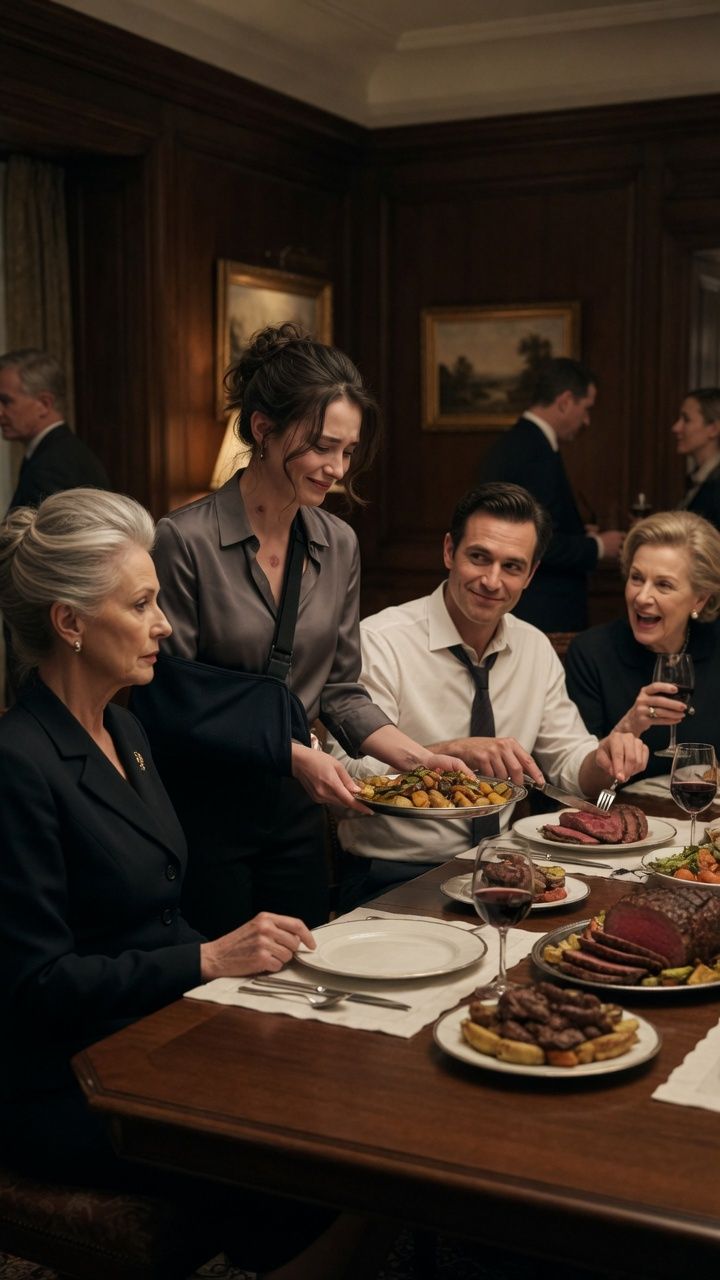

The sling was the first thing I saw.
The second was the careful, practiced smile on Claire’s face as she moved around the dining room, trying to serve her husband’s family with only one usable arm.
“Mom,” she said softly. “You’re early.”
Her voice trembled. When she turned slightly, the collar of her blouse shifted, and for less than a second I saw it – a bruise, dark as a storm cloud, spreading across her collarbone.
Grant Mercer sat at the head of the table, slicing roast beef as though the house, the meal, and every person in it existed purely for his convenience. His mother, Evelyn, held a crystal glass of wine and watched Claire struggle with the serving dish without offering so much as a glance of sympathy.
“Use your other arm,” Evelyn said sharply. “Women today make everything so dramatic.”
I set my handbag down slowly.
“What happened to her arm?”
Claire’s eyes moved to Grant. Just once, just briefly. But that single look told me everything any explanation could have.
Evelyn let out a small, bright laugh.
“My son had to teach her some obedience.”
Grant leaned back in his chair, perfectly at ease with himself.
“She knows better now.”
The table went quiet. Grant’s brother smirked. His sister stared down at her plate. Claire’s fingers tightened around the serving spoon until her knuckles went pale.
I had spent thirty years prosecuting men who mistook fear for respect. I knew every sign: the lowered eyes, the careful breathing, the rehearsed explanations, the terrible silence of someone too frightened to speak freely. I also knew that fury, however justified, was worthless unless it was controlled.
I had only ever seen Claire truly terrified once before – she was nine years old, and she had gotten lost in a crowded train station. The moment she heard my voice, she ran straight into my arms.
Now she was sitting three feet away from me, and she could not even meet my eyes.
Whatever had happened in this house had taught my daughter that reaching for me in front of these people was dangerous.
So I smiled.
“May I sit beside my daughter?”
Grant shrugged. “It’s your family funeral.”
Claire flinched.
I sat down beside her and took her hand beneath the table. Her fingers were ice-cold. Her pulse was racing. Without looking down, I opened my phone and typed a message to a number I hadn’t used in six months.
Come now. Bring the full board. Bring Daniel Ross. The police commissioner too, if he’ll come.
Then I dialed a second number.
“Dr. Patel,” I said quietly. “Please stay available. I may need you within the hour.”
Grant raised an eyebrow. “You’re calling a doctor because Claire tripped?”
Claire’s voice was barely a whisper. “I didn’t trip.”
Grant’s smile disappeared.
Evelyn set her glass down with a sharp little click.
“She became hysterical,” Evelyn said, smoothing her napkin across her lap. “Grant had to restrain her. A wife ought to know better than to threaten her husband’s career.”
There it was. The first real piece.
“What career?” I asked.
Grant’s smile returned, wider now, the smile of a man who believed he was untouchable.
“Chief operating officer. It becomes official tomorrow.” He reached for his wine glass. “Of Mercer Dynamics.”
“Mercer Dynamics,” I repeated.
His expression sharpened with pride. “You know it?”
I looked at Claire. Her eyes were bright with tears she was working very hard not to shed.
“Yes,” I said. “I know it well.”
What Grant did not know – what he had apparently never thought to find out – was that Mercer Dynamics was still a functioning company only because my late husband and I had pulled it from the edge of bankruptcy twenty-two years ago. In exchange, our family trust had retained thirty-eight percent of its voting shares.
The shares had never been sold.
And I was the sole trustee.
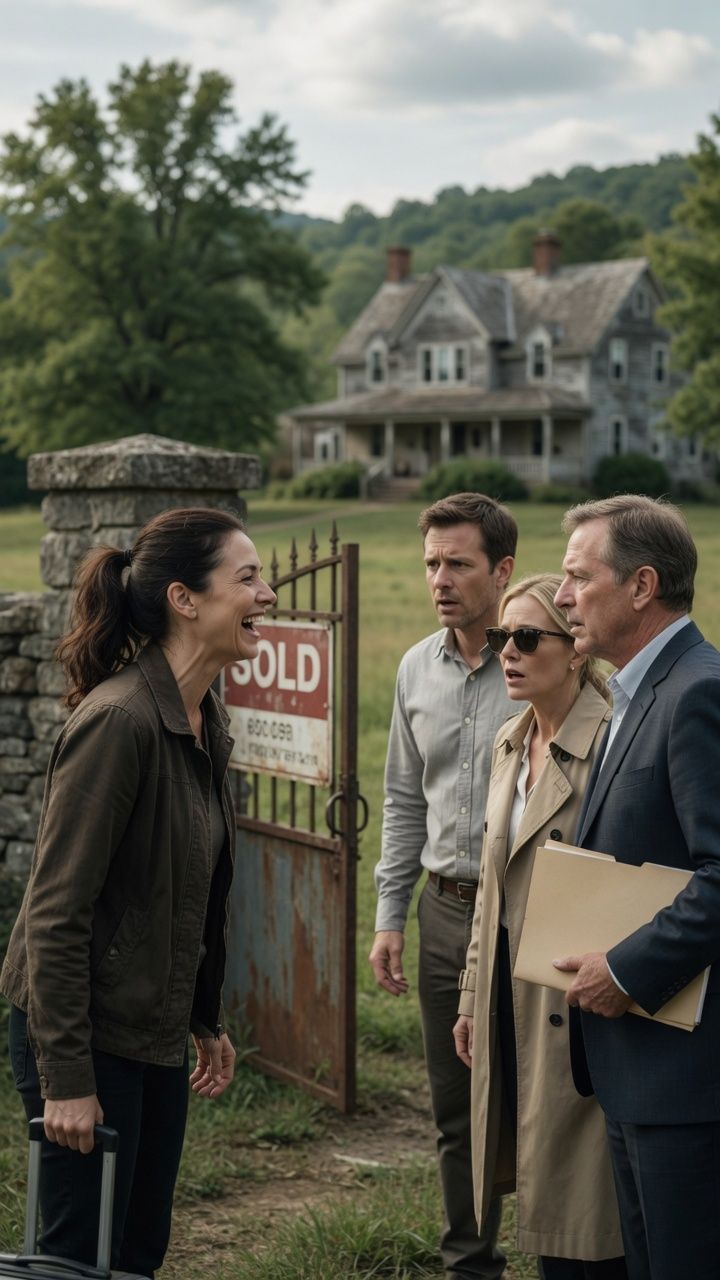
Thirty minutes later, the doorbell rang.
Grant pushed back his chair with the loose confidence of a man who had never once been held accountable for anything. He opened the door expecting a neighbor, or perhaps a delivery.
Instead, he found six members of the Mercer Dynamics board of directors standing on the front step. Beside them stood Daniel Ross, the company’s general counsel, holding a leather portfolio. And beside Daniel stood the police commissioner, still in his Sunday clothes, his expression grave.
The confidence left Grant’s face so completely it was almost startling – like a light being switched off.
I stood in the hallway behind him, my hand resting gently on Claire’s shoulder.
“You mentioned a promotion,” I said. “I thought we should discuss it.”
What Happened After the Door Opened
Grant did not speak for a long moment.
He looked at the board members. He looked at Daniel Ross. He looked at the commissioner, whose name was Hal Briggs and who had known me since we were both thirty-two years old and working late nights in the same building on Archer Street. Hal gave Grant nothing. Not a word, not a nod.
Then Grant looked at me.
“What is this?” His voice had dropped to something low and controlled, the register men use when they’re deciding whether they still have leverage.
“This is a board meeting,” I said. “Informal, but binding. Daniel will explain the procedural details.”
Daniel Ross was sixty years old, trim, and had the particular stillness of a man who had delivered bad news to powerful people so many times it no longer cost him anything. He opened the portfolio.
“Mr. Mercer. There’s a matter of shareholder consent that needs to be addressed before your appointment can be finalized.”
Grant’s jaw tightened. “My father built this company.”
“Your father also borrowed eleven million dollars from the Hartwell family trust in 2003,” Daniel said. “The terms of that arrangement were never dissolved. Margaret,” he said, glancing at me, “still holds thirty-eight percent of voting shares, which gives her effective veto power over any C-suite appointment.”
Evelyn had appeared in the hallway behind Grant. She was holding her wine glass. Her face had gone a color I’d call chalk.
“This is absurd,” she said. “Margaret, you have no right – “
“I have every right,” I said. “I’ve simply never used it before.”
The Things Evelyn Said Next
She tried four different arguments in about ninety seconds.
The first was that I had no standing because the trust was in my late husband’s name. Daniel corrected her on that point without raising his voice.
The second was that the shares were decorative, a courtesy arrangement, never meant to be exercised. Daniel produced the original agreement. Paragraph seven. It was not decorative.
The third was that I was doing this out of spite, out of grief, out of some personal vendetta against her family. I let that one sit without answering.
The fourth was quieter than the others. She said: “Claire is a difficult woman. You know that. You raised her.”
I heard Claire’s breath catch behind me.
I turned and looked at my daughter. The sling. The bruise at her collarbone. The way she was standing slightly sideways, her good hand pressed flat against her thigh, like she was trying to take up less space in her own hallway.
I turned back to Evelyn.
“Commissioner Briggs,” I said. “Would you like to speak to my daughter privately?”
Hal stepped forward.
Grant moved to block him. One step, instinctive, the muscle memory of a man used to being the largest obstacle in a room.
Hal Briggs was not a large man. He was five-ten, maybe one-seventy, with reading glasses pushed up on his forehead and a sport coat he’d clearly pulled on in a hurry. But he’d been a cop for thirty-five years before he became commissioner, and the way he looked at Grant had a particular quality to it. Patient. Absolute.
“Son,” Hal said. “Step aside.”
Grant stepped aside.
What Claire Said When No One Else Was Listening
Hal took Claire into the kitchen. I followed. Grant started to, and Daniel put a hand on his arm, not forcefully, just present, and said something quiet about the portfolio that needed reviewing.
The kitchen was Sunday-afternoon messy. Roasting pan on the stove, flour on the counter, a dish towel folded twice and laid over the oven handle the way Claire had done since she was twelve years old and helping me in my own kitchen. Some habits travel.
Hal sat down at the kitchen table. Claire sat across from him. I stood near the window.
He didn’t open with a question. He just said: “You don’t have to protect anyone in here.”
She looked at her hands. Then she looked at me.
“How long?” I asked.
“The bad ones,” she said. “About eight months.”
Eight months. I had seen her at Thanksgiving. At Christmas. At her birthday in March. I thought about all the phone calls, the texts, the careful way she’d said things are fine in a voice I’d registered somewhere in the back of my brain as slightly off but hadn’t pushed on because she was an adult, because she’d seemed okay, because I hadn’t wanted to be the mother who couldn’t let her daughter have her own life.
Eight months.
“He didn’t want me talking to you,” she said. “He said you’d make it about yourself.”
There was the unflattering detail. She wasn’t wrong that it landed. I filed it somewhere to look at later, when this was over.
“The arm,” Hal said.
“Thursday night.” She kept her voice even. Flat. The way people talk about things they’ve rehearsed telling themselves aren’t that bad. “I said I was going to call in sick to the Hendersons’ dinner. He didn’t want me to.”
“The Hendersons,” I said.
“His boss. Before the COO thing came through.” She paused. “He needed me there.”
Hal wrote something down. He asked her two more questions, both specific, both procedural, and she answered them the same flat way. Then he closed his notebook and said, “I’m going to need you to come with me and speak to someone tonight. Not tomorrow. Tonight.”
She looked at me again.
“I’ll come with you,” I said.
She nodded once. Small. The way she used to nod when she was little and scared and trying not to show it.
What the Board Decided
Back in the hallway, Daniel had walked Grant through the shareholder agreement twice. Grant had called his own lawyer, a man named Phil Dowd who I knew slightly and who was good but not good enough to find a door in a document that had no doors.
The board members had moved into the sitting room. Three of them had been on the board when my husband was alive. Two of them had been at his funeral. One of them, a woman named Renata Fischer who’d joined four years ago, had never met me before tonight. She shook my hand and said, “I want you to know we didn’t know about any of this,” and I believed her.
The vote on Grant’s appointment took four minutes.
Six to zero. Daniel abstained on procedural grounds.
Grant stood in the doorway of the sitting room and watched it happen.
He didn’t say anything. That surprised me, a little. I’d expected a scene, the kind of loud, furniture-rattling collapse I’d seen from men in courtrooms when the verdict came in wrong. But he just stood there, his hand on the doorframe, watching the thing he’d been building toward disappear.
Then he looked past the board members and found me.
“You’ll regret this,” he said.
The thing about men like Grant is they believe that. Genuinely. They believe the world owes them a correction, that whatever’s been taken from them will eventually be returned with interest, that there is always another move.
I’d spent thirty years watching what happened to men who believed that.
“No,” I said. “I won’t.”
After
Claire left with Hal Briggs at half past seven.
She took a bag she’d apparently packed three weeks ago and kept under a loose floorboard in the bedroom closet. She’d been planning. Some part of her had been planning, even when another part had been telling herself it wasn’t that bad, it would get better, she could manage it.
She’d packed her passport, her grandmother’s ring, and a photograph of the two of us from when she was maybe four years old, standing in the backyard of the house on Clement Street with ice cream on our faces.
She hadn’t packed much else.
Dr. Patel met us at the hospital. She was thorough and she was kind and she documented everything that needed documenting. The arm was a hairline fracture, not a full break. There were two older bruises on Claire’s ribs that hadn’t come from Thursday.
I sat in the waiting room for two hours and looked at the photograph on my phone of a woman and a four-year-old with ice cream on their faces.
When Claire came out, she sat down next to me and leaned her head against my shoulder. We didn’t say anything for a while.
Then she said: “I should have called you.”
I put my arm around her, careful of the sling.
“You called me now,” I said.
Outside, a cab pulled up to the hospital entrance. The driver sat with his window down, radio on low. Somewhere down the block a dog was barking at something it couldn’t reach.
Claire’s breathing slowed and steadied against my shoulder.
I didn’t move.
—
If this one stayed with you, pass it along to someone who needs to read it.
For more stories of family drama and unexpected twists, you might enjoy reading about how My Husband Handed Me Divorce Papers the Day After I Gave Birth Alone, or perhaps the time I Got Suspended for Claiming to Know the General in Room 912. Then He Woke Up.. And if you’re in the mood for another jaw-dropping tale, check out My Family Was Popping Champagne When My Doctor Said I Might Never Walk Again.