
The room erupted in mockery the moment I claimed to know the comatose four-star general dying in the ICU.
The staff dismissed me as desperate and attention-seeking – right up until he regained consciousness, raised his trembling hand, and saluted me in front of the very people who had just finished laughing. What none of them understood was the secret we shared, or the fact that his survival now rested entirely in my hands.
My name is Clara Hayes, and I never imagined the worst moment of my career would unfold during an ordinary double shift.
The laughter spread through the unit before I could even finish my sentence. It bounced off glass walls, medication carts, and polished floors while doctors exchanged amused glances and nurses dropped their eyes, too uncomfortable to defend me. All I had said was, General Richard Whitmore knows exactly who I am.
Apparently, everyone found that hilarious.
General Whitmore occupied Room 912 – unconscious, burning with a dangerously high fever, quietly transferred from a secure military hospital in Washington after his condition deteriorated beyond what they could manage there. He was a decorated war hero whose face appeared in documentaries and military history books, a man whose name carried weight in rooms I would never be invited into.
I was an ICU nurse working back-to-back shifts, driving a Toyota with a cracked side mirror, surviving on reheated coffee.
To hospital administrator Grant Keller, that contrast was all he needed to dismiss me entirely.
“Nurse Hayes,” he announced, loud enough to carry across the unit, “this hospital has enough problems without staff fabricating personal connections to federal patients.”
I held his gaze.
“I’m not fabricating anything.”
That made it worse. The laughter sharpened.
Dr. Evan Brooks unfolded his arms just long enough to cross them again. “Let’s keep our focus on medicine rather than fantasy.”
“I am,” I said, turning toward the cardiac monitor. “His QT interval is lengthening. With that fever and his electrolyte imbalance, he’s heading toward torsades. If his rhythm collapses and you follow standard protocol, you could kill him.”
No one thanked me.
No one checked.
Grant stepped closer, dropping his voice to something that was meant to sound like a warning. “You were told to stay away from Room 912.”
“I was told not to interfere with politics,” I said. “I’m trying to keep my patient alive.”
“You’re operating well outside your role, Nurse Hayes.”
Those words landed with the dull familiarity of an old bruise.
Just a nurse. Stay in your lane. You don’t understand how things work here.
I had heard every variation of it for two years. I had learned to absorb it and keep moving.
But standing at the glass of Room 912, watching the slow rise and fall of Richard Whitmore’s chest, I felt the past pressing forward through the carefully constructed walls I had built around it.
The last time I had seen this man, it was not in a quiet hospital room.
It was in the basement of a bombed-out building, somewhere that doesn’t appear on any map I’m allowed to reference.
I was twenty-five, deployed as a combat medic attached to a special operations unit during a classified mission that went wrong in the particular way that classified missions tend to. Four wounded soldiers surrounded me in the dark while the structure above us absorbed the percussion of explosions. One of those men was Lieutenant General Richard Whitmore – badly injured, barely conscious, and still attempting to issue commands to soldiers who could no longer hear him.
I worked on him for hours in that basement. I talked to him when his eyes went glassy. I told him to stay with me in a voice I kept deliberately steady, because steadiness was the only thing I had to offer.
When the rescue team finally broke through, he grabbed my wrist with a grip that surprised me given everything he had lost. His voice was barely a sound.
“Still here.”
I pressed his hand between both of mine.
“Still here, sir.”
Everything that followed disappeared behind classified reports and sealed records. The commendations I received became documents no civilian employer could verify. So I rebuilt my life quietly, methodically, one nursing certification at a time, and I never spoke about any of it.
No one at Riverside knew that version of me existed.
To them, I was simply the nurse who asked too many questions and didn’t know her place.
Twelve minutes later, Grant suspended me for insubordination.
I removed my badge without argument and set it on the nurses’ station counter.
“If his rhythm deteriorates,” I said, “give magnesium before you reach for the paddles. The standard shock protocol will make it worse.”
Grant smiled and gestured toward security.
I was halfway across the parking lot when every alarm in the building went off simultaneously.
Backup power. Security breach. Critical system failure. The kind of cascading failure that happens when a hospital’s infrastructure is older than anyone admits and the wrong thing trips at the wrong moment.
I was running before I had consciously decided to move.
By the time I pushed back through the ICU doors, monitors were flickering on emergency power and a young nurse I recognized from the morning shift grabbed my arm with both hands.
“Dr. Brooks left the floor,” she said, her voice cracking. “The general’s rhythm is crashing.”
I didn’t answer her. I was already moving.
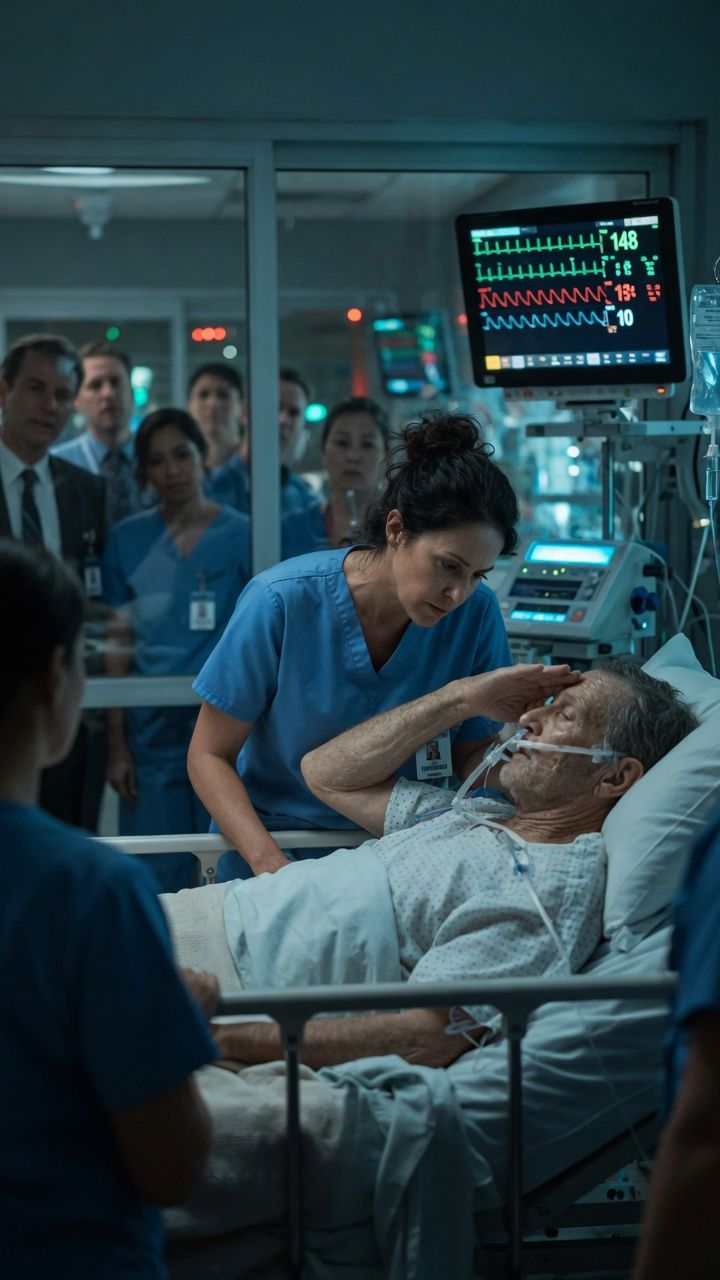
Room 912 looked exactly as I had feared it would. The monitor told the whole story in one glance – the chaotic, spiraling pattern of a heart losing its argument with itself.
I reached his bedside.
And then, in the half-dark of the failing room, General Richard Whitmore opened his eyes.
Slowly. With enormous effort. As though consciousness itself was something he had to fight his way back to.
He found my face.
And with the last reserves of whatever had always made him who he was, he raised his trembling hand toward his forehead.
Still Here
The salute was not crisp. His arm shook badly, elbow barely clearing the mattress, fingers not quite flat. A physician’s assistant named Donna stood three feet behind me and made a sound I won’t try to describe.
I put my hand over his.
“Not yet, sir,” I said. “Let me work first.”
His hand dropped. His eyes stayed open, watching me with the particular quality of attention I remembered from the basement. He hadn’t understood most of what I’d said to him down there. But he had tracked my movements the whole time. Like if he could just keep watching, he could hold himself together by sheer force of observation.
Same eyes. Fifteen years older. Same thing behind them.
I turned to Donna.
“Magnesium sulfate. Two grams IV push. Right now.”
She didn’t move immediately. She was still looking at his hand, at the place where he’d raised it.
“Donna.”
She moved.
The monitor was still screaming its ugly, irregular pattern. I pulled the crash cart closer with one hand and checked his line with the other. The IV in his right arm had infiltrated sometime in the last hour, the skin around the site raised and pale. Useless. I found a vein in his left forearm on the first try, probably because my hands weren’t shaking. I don’t know why they weren’t shaking. They should have been.
Grant appeared in the doorway sixty seconds later. Then Dr. Brooks behind him, slightly out of breath, still in his coat.
Neither of them said anything.
I pushed the magnesium and watched the monitor. Thirty seconds. Forty-five. The pattern kept its chaos, then stuttered, then began to slow its spiral. Not normal. But not the cliff edge anymore.
“He needs a temporary pacing wire if this doesn’t hold,” I said to Brooks. “His underlying rate is too slow to sustain without support.”
Brooks came to the bedside. He looked at the monitor for a long moment. Then he looked at me.
“How did you know?” he said. Not hostile. Actually asking.
“Because I’ve seen it before.”
He nodded once, slow, and reached for the phone to call the cath lab.
What Grant Did Next
Grant stood in the doorway another few minutes. I was aware of him the way you’re aware of weather coming in from the west. Not focused on it. Just knowing it’s there.
When I finally looked up, his expression had done something complicated. The administrative confidence was still present, because men like Grant Keller are professionally incapable of abandoning it entirely. But underneath, something had shifted. A small recalculation.
He picked up my badge from wherever it had ended up and set it on the bedside table without a word.
I didn’t touch it yet.
Richard’s eyes had closed again, but his color was better. The monitor showed something closer to a rhythm a human body could sustain. Donna was charting with the focused intensity of someone who needed something to do with her hands.
A man in a dark suit appeared at the glass. Then another. They had the particular quality of stillness that comes from training rather than personality, and they were both looking at me with expressions I couldn’t read.
One of them knocked on the glass.
I ignored him for another four minutes, until I was satisfied the rhythm was holding and the magnesium had done what I needed it to do. Then I stepped out.
“Ms. Hayes.” He knew my name already. Of course he did. “We need to speak with you.”
“In a minute.”
He blinked. Not used to that.
“It’s fairly urgent.”
“So is my patient,” I said. “One minute.”
The Thing About the File
I went back in, checked the line, adjusted the drip rate, and told Donna to get me the moment anything changed. Then I stepped into the hallway and let the two suits walk me to the family consultation room at the end of the unit.
The taller one introduced himself as Agent Dennis Pruitt, Department of Defense, and showed me credentials I didn’t have the clearance to fully interpret. The shorter one didn’t introduce himself at all, which told me something.
“General Whitmore’s medical record from his time in active service contains a notation,” Pruitt said. “A field medic. Classified operation, 2009. The notation says, and I’m quoting directly: If Hayes is available, get Hayes.”
He said it the way people say things they’ve been sitting on for a while.
I looked at the wall.
“He wrote that in?” I said.
“He had it written in. About eight months after the incident. It was added to his standing emergency medical directive.”
I thought about that. About him, somewhere in a Pentagon office or a military hospital, eight months after a basement in a country I can’t name, deciding that was worth putting on paper.
“Nobody told me,” I said.
“You were no longer in a position where we could tell you.”
Which meant I’d been out. Which meant the clearance had lapsed. Which meant that notation had been sitting in a file for fifteen years, waiting for a version of events that brought us to the same room again.
The shorter man finally spoke. “There’s also the matter of the protocol dispute. Your recommendation regarding the QT interval.”
“I was right,” I said.
“Yes.” He didn’t seem bothered by that. “We know.”
What Brooks Said
Brooks found me in the hallway around eleven that night. The unit had settled into its quieter register, the particular hum of machines doing their work without crisis attached.
He stood next to me at the window for a moment before he spoke.
“I should have listened to you this morning,” he said.
I didn’t tell him it was fine, because it wasn’t fine, and we both knew it.
“You had the information,” he said. “I dismissed it because of who was delivering it.”
“Yes.”
He was quiet for a bit. A monitor beeped somewhere down the hall and a nurse moved past us without looking up.
“The magnesium,” he said. “Where did you learn that specific protocol for torsades with concurrent fever?”
“Field medicine,” I said. “You work with what you have. You learn what the textbook doesn’t cover.”
He nodded slowly. He was putting something together, I could tell. Filing things into a new arrangement.
“I’d like to know more,” he said. “When you’re willing.”
I didn’t answer that directly. Some things take longer to become speakable.
Room 912, 2:14 A.M.
Richard was awake again when I came in for final checks.
Not alert the way he’d been earlier. Just conscious. Eyes open, tracking the ceiling with the slow attention of someone not yet fully back in their body.
I checked his line. Checked the monitor. Made a note in the chart.
“Clara,” he said. His voice was rough from the tube they’d pulled two days before I’d arrived on shift. Barely a word. But my name, clearly.
“Sir.”
“You’re still here.”
“Still here.”
He was quiet for a moment. His hands rested flat on the blanket, both of them, still now. The shaking had stopped once his electrolytes came back into range.
“They laughed,” he said. It wasn’t a question. He’d been more conscious earlier than anyone realized.
“It’s fine.”
“It isn’t.”
I looked at him. His eyes had moved from the ceiling to my face.
“No,” I said. “It isn’t. But it doesn’t matter right now.”
He seemed to accept that. His eyes drifted back up.
“The building,” he said. “I kept thinking about the building. All that noise and then you just. Kept talking.”
“I needed you to stay awake.”
“It worked.”
“Twice,” I said.
The corner of his mouth moved. Not quite a smile. The closest his face could manage at two in the morning after the week his body had put him through.
I finished the chart note and capped my pen.
“Get some sleep, sir.”
“General,” he said.
“You’re in my ICU,” I said. “You’re Richard.”
He didn’t argue. His eyes closed.
I stood there another few seconds, listening to the monitor keep its steady, unremarkable count. The rhythm of a heart that had decided, twice now, to stay in the game.
I picked up my badge from the table where Grant had left it and clipped it back onto my scrubs.
Then I went back to work.
—
If this one stayed with you, pass it along to someone who needs to read it.
For more stunning moments of vindication, check out My Family Was Popping Champagne When My Doctor Said I Might Never Walk Again and see how others handled being put in impossible situations like My Mother-in-Law Put $1,012 Worth of Groceries on the Belt and Waited for Me to Pay or even I Stood Up at My Own Engagement Party and Ended the Vales.