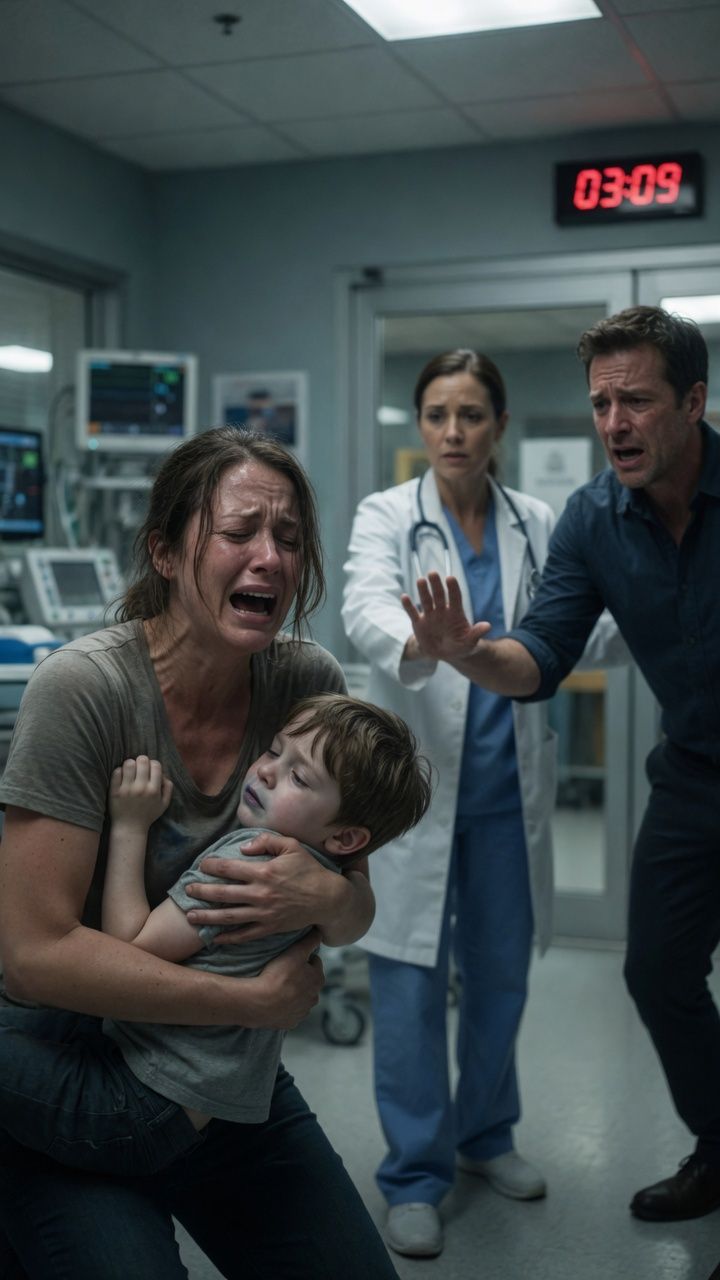

At 2:17 a.m., Claire Whitmore carried her five-year-old son through the sliding glass doors of St. Augustine Medical Center with his burning cheek pressed against her collarbone and his small fingers twisted into the fabric of her shirt.
Noah’s fever had climbed past 104. He had vomited twice in the car. Then, two blocks from the hospital, his body had gone rigid in her arms.
“Please!” She ran toward the ER desk, her voice breaking open. “My son is seizing!”
Behind her, her husband pushed through the doors.
Daniel was carrying another child.
Lily. Six years old. The daughter of Daniel’s mistress, Vanessa Reed.
Claire had discovered the truth about Vanessa three months earlier. She had stayed quiet since then – for Noah, for the mortgage, for the fragile illusion of a family that still made pancakes on Sunday mornings. She had told herself she was being practical. She had told herself she was being strong.
Lily had flushed cheeks and a rattling cough. She was conscious, whimpering, her arms looped around Daniel’s neck.
Daniel reached the desk first.
“She can’t breathe right.” His voice was sharp, urgent. “Her mother is on the way. I’m her emergency contact.”
Claire stared at the back of his head. “Daniel. Noah is convulsing.”
He did not turn around.
The triage nurse looked between them. “Which child arrived first?”
“She did,” Daniel said.
Claire’s mouth fell open. The words she needed simply weren’t there.
“That’s not true,” she finally managed. “He knows that’s not true.”
Daniel glanced back at her. His eyes were wet and cold at the same time – the eyes of a man who had already made his decision and was only now watching himself make it.
“Claire, Lily has asthma,” he said. “Noah gets fevers all the time.”
Noah’s body jerked again in her arms.
A second nurse came rushing over, but the first intake slot, the first available doctor, the first open room had already gone to Lily. Daniel had signed the paperwork. He had handed over Vanessa’s insurance information before Claire had finished her sentence.
She screamed until a security guard stepped toward her.
“Take my son!” she begged anyone who would look at her. “Please – somebody take my son!”
By the time a resident finally lifted Noah onto a gurney, his lips had begun to turn pale blue. Claire ran beside him down the corridor, barefoot – one sandal had fallen off near the entrance and she hadn’t noticed. Around her, doctors spoke in clipped, careful sentences that she would spend years trying to unhear.
Possible meningitis.
Prolonged seizure.
Respiratory compromise.
Prepare intubation.
Daniel appeared in the doorway twenty minutes later. Claire did not look at him. His shirt carried the faint trace of another woman’s perfume.
At 3:09 a.m., a monitor screamed.
At 3:22 a.m., Noah was moved to the pediatric ICU.
At sunrise, Dr. Elena Marsh sat across from Claire in a small consultation room and said the words that divided her life cleanly into before and after.
“Noah suffered severe oxygen deprivation during the seizure. We’re doing everything we can. But the delay mattered.”
She did not soften it. She did not look away.
The delay mattered.
—
The following afternoon, Daniel came back.
He was shaking. He had not slept. He moved through the hospital corridor like a man walking toward something he deserved, already rehearsing the words he would say to his son, the apology he had convinced himself Noah needed to hear.
Dr. Marsh was standing in the doorway of the ICU.
She did not move.
Her face held no anger – only the particular exhaustion of someone who had been awake all night trying to undo what a few minutes had cost.
Daniel opened his mouth.
She spoke first.
“You’re too late.”
He waited, as though she might mean something else, as though there might be more.
There wasn’t.
What “Too Late” Actually Meant
Noah was alive.
That is the thing Claire would have to remind herself of, for months afterward, every time the other words pushed back in. He was alive, he was breathing on his own by the third day, and by the end of the first week, he could squeeze her hand and ask for apple juice in that hoarse, raw voice that made her cry in the hallway so he wouldn’t see her.
But Dr. Marsh had not said too late to be cruel. She had said it because it was the most accurate word available.
The oxygen deprivation during the seizure – the minutes that ticked by while Daniel stood at a different desk, handing over a different child’s insurance card – had left a mark. Not catastrophic. Not the worst outcome. But real, and permanent, and measurable. Noah’s processing speed, the neurologist explained to Claire at a follow-up in October, would need monitoring. There could be learning difficulties. There would be therapy. There would be testing, re-testing, adjustments, setbacks.
“He’s going to need a lot of support,” the neurologist said. His name was Dr. Reyes, and he had the careful manner of someone who had delivered this kind of news before and had learned not to dress it up. “He’s young, and the brain is adaptable. But he’s going to need a lot of support.”
Claire nodded. She had already started making the calls.
The Night Claire Stayed Quiet
The thing people never understood, when she tried to explain it later, was why she hadn’t said anything sooner.
Three months. She’d known for three months.
She’d found the texts in early August, on a Thursday evening when Daniel was in the shower and his phone buzzed on the kitchen counter. She hadn’t meant to look. She’d reached for it automatically, the way you do when you live with someone, the way you do when your hands know the shape of their life as well as your own.
Vanessa’s name was already in his contacts. No last name. Just Vanessa.
Claire had put the phone face-down on the counter. She’d gone back to cutting the onions for dinner. Her hands hadn’t shaken. That part surprised her afterward – how still her hands had been.
She’d told herself she was waiting for the right moment. She’d told herself she needed more information, needed to be sure, needed a plan. But the honest answer, the one she gave her therapist eight months later, was simpler than that. She was scared. Not of Daniel. Not of the divorce, not really. She was scared of what it meant for Noah. She had this idea – irrational, she knew it even then – that if she just held the shape of the family together long enough, the inside might somehow fill back in.
She’d made pancakes that Sunday. And the Sunday after. And the Sunday after that.
Daniel had eaten them. He’d kissed her on the cheek. He’d taken Noah to the park on Saturday afternoons and come home smelling of grass and fresh air, and she had watched him and thought: he loves his son. She had held onto that. She had treated it like it was enough.
The ER, Again
The night of the ER, she’d gotten a call from Daniel at 11:40 p.m. He was at Vanessa’s apartment – he’d said he was working late, the same lie he’d been using since August – and Lily had woken up struggling to breathe. Vanessa was in a panic. The inhaler wasn’t working.
“I’m going to take her in,” Daniel said. “I just wanted you to know where I am.”
Not I’m sorry. Not I know this is wrong. Just the information, flat and practical, like a schedule change.
Claire had said okay. She didn’t know why. She had been sitting in the kitchen in the dark, and she’d said okay, and she’d hung up.
Twenty minutes later, Noah had woken up crying.
She’d gone to him and felt his forehead and known immediately it was bad. She’d taken his temperature: 103.1. She’d given him Tylenol and held him and watched the thermometer climb anyway. By 1:30 it was 104.2. By 2:00, when she’d bundled him into the car, it was higher, and he was shaking, and she’d called Daniel three times before he picked up.
“I need you at the hospital,” she said.
He’d shown up. She’d give him that. He had shown up.
But he’d brought Lily.
And when it came to the desk, to the one nurse and the one intake slot and the one decision that would matter more than any of the others, Daniel had made his choice so fast she barely saw it happen. She’d thought, for a fraction of a second, that he was going to defer to her. That he was going to say my son is seizing, he goes first. That whatever else he was, whatever he’d done, he was still Noah’s father.
His eyes had moved to Lily.
That was all.
What Daniel Said
He tried, over the following weeks, to explain himself.
He left voicemails. He sent texts. He showed up at Claire’s mother’s house, where she’d taken Noah after the discharge, and stood on the porch until her mother told him to leave.
His explanations were not dishonest, exactly. Lily did have severe asthma. She had been hospitalized twice before. He had genuinely believed, in that moment, that she was in greater danger.
He said he hadn’t known how serious Noah was. He said he’d thought it was another febrile seizure, the kind Noah had had once before at age three, brief and frightening but not dangerous. He said he’d made a medical judgment call in a moment of panic and he’d been wrong and he was sorry, he was so sorry, he didn’t know how to say how sorry he was.
Claire listened to one of the voicemails. Just the one.
Then she called a lawyer named Barbara Pruitt, who had been recommended by a woman in her mother’s book club, and she filed for divorce.
What the Hospital Did
The security guard who had stepped toward Claire that night, whose name was Marcus Webb, had filed an incident report by 4 a.m. He’d noted the sequence of events as he’d witnessed them. He’d noted that the child who arrived second had been triaged first, and that the father of the first child had provided false information to triage staff regarding arrival order.
The hospital’s patient advocacy office opened an inquiry.
It didn’t change anything about Noah’s outcome. Dr. Marsh was clear about that, in the meeting she had with Claire and Barbara Pruitt six weeks later. The inquiry was about process, about accountability, about whether the triage staff had done everything they could once the situation became clear. It wasn’t about assigning blame for the seizure itself.
But it was on record. All of it.
Barbara Pruitt was very interested in what was on record.
The Part Claire Didn’t Expect
In December, Vanessa Reed called her.
Claire almost didn’t pick up. She stood in her kitchen – her mother’s kitchen, technically, she was still staying there – and watched the name on the screen for four rings. Then she picked up.
Vanessa’s voice was quiet. She’d clearly been crying recently, or was about to. She said she hadn’t known Claire was at the hospital that night. She said Daniel had told her he’d dropped Lily off and left, that he hadn’t been there for the triage, that Claire had arrived separately. She said she hadn’t known about the seizure until she’d seen the incident report, which her own lawyer had obtained.
She said she was sorry.
Claire didn’t say anything for a long moment.
“How’s Lily?” she finally asked.
“She’s okay,” Vanessa said. “She’s home.”
“Good,” Claire said. And she meant it, actually. She was surprised to find that she meant it.
She hung up. She stood at the kitchen window. Outside, Noah was in the backyard with her mother, kicking a soccer ball in the November cold, his breath making small clouds in the air. He was wearing the red coat he’d picked out himself at Target back in September, the one with the reflective stripe on the sleeve.
He ran after the ball. He laughed at something her mother said.
Claire pressed her hand flat against the cold glass.
—
The divorce was finalized the following spring. Noah started occupational therapy in January and speech therapy in March. He was doing well, Dr. Reyes said. Better than the initial projections. His brain was young and it was working hard and he was, by every measure that mattered, still entirely himself.
He still asked for apple juice.
He still wanted pancakes on Sunday mornings.
Claire made them. Just the two of them now, in the apartment she’d moved into in February, with the yellow curtains she’d picked out herself and the small table by the window where Noah sat and kicked his feet against the chair rungs while he ate.
She did not think about Daniel every day. That surprised her too.
Some mornings she didn’t think about him at all.
—
If this stayed with you, send it to someone who needs to read it.
If you’re looking for more emotional stories, check out My Daughter Called Me in a Whisper. I Left Before She Finished the Word., My Son-in-Law Announced His Promotion at Dinner. I Made a Phone Call., or My Husband Handed Me Divorce Papers the Day After I Gave Birth Alone.