
The incident would later be recorded in whispers as the Fort Liberty Sergeants’ Rookie Humiliation. It began on a humid afternoon inside one of the busiest military mess halls on base.
Fort Liberty never truly rested. Soldiers moved in tight formations across sun-baked pavement, vehicles rumbled along distant roads, and the air carried the constant, layered noise of a place designed for perpetual motion. It was the kind of controlled chaos that most soldiers eventually stopped noticing.
Lieutenant Brooke Mitchell had stopped noticing a long time ago – but not because she’d grown comfortable. Because she’d grown careful.
She had just returned from an overseas classified operation that had stretched nearly four days without meaningful sleep. Officially, she didn’t exist in that capacity. On paper, she was assigned to administrative logistics support – a safe label, a forgettable one, the kind of identity engineered so that no one ever looked too closely or asked too many questions.
But Brooke was anything but administrative.
She moved through the mess hall quietly, her posture slightly lowered – not from fear, but from the particular weight of exhaustion that settles into the bones after days of sustained alertness. Her uniform was plain and unmarked, stripped of visible rank identifiers. Her blonde hair was tied back loosely, still carrying faint traces of dust and field conditions from a mission she couldn’t discuss – not even with people who theoretically shared her clearance level.
She didn’t want attention. She didn’t want conversation. She wanted food, a chair, and ten minutes of silence.
The mess hall was packed – hundreds of enlisted soldiers filling long tables beneath fluorescent lighting. The air was thick with the smell of fried food, metal trays, and industrial cleaning chemicals, a combination so familiar it barely registered anymore. Brooke picked up a tray on autopilot and moved toward the back of the hall, where the tables thinned out and the noise dropped half a degree.
She found one that looked available. Nothing special. Nothing claimed.
She sat down slowly, letting exhaustion settle fully into her shoulders for the first time in days. She allowed herself to breathe without scanning exits, without calculating angles, without preparing contingencies.
For one brief moment, there was quiet.
It didn’t last.
Heavy footsteps approached from her left – confident, unhurried, multiple sets moving in loose formation. Brooke didn’t look up immediately. She already understood the pattern. That particular stride belonged to people who had spent too long moving through spaces that always cleared ahead of them.
“Move.”
She looked up.
Six U.S. Army sergeants stood arranged around her table like a deliberate formation. The one at the front was Sergeant Colton Cole – broad-shouldered, jaw set hard, wearing the permanently immovable expression of someone who had gone too long without being questioned. His five companions held the same unit patch on their sleeves and the same expectant look in their eyes, watching her the way people watch something they’ve already decided is out of place.
“This table’s taken,” Cole said flatly.
Brooke glanced around the table without hurry. At least eight empty seats. The claim made no logical sense, and she understood immediately that it wasn’t meant to. This wasn’t about seating arrangements.
It was about dominance – the kind that requires an audience.
“There are other tables,” she replied.
Cole leaned forward slightly, closing the distance just enough to make the gesture feel like a warning. “You don’t tell me where you can sit. You’re new here. You don’t sit with us.”
The mess hall noise began to soften around them. Nearby conversations tapered off. Forks paused mid-air. The atmosphere shifted almost imperceptibly into something watchful and waiting, the way crowds go quiet when they sense something worth watching.
Brooke didn’t react. Her mind moved through the situation with the quiet, clinical efficiency of long conditioning – distances, angles, movement patterns. Not planning violence. Simply refusing to be caught unprepared for it.
“I’m just eating,” she said.
That was when Cole smiled.
It wasn’t a friendly expression. It was the kind of smile that appeared on faces accustomed to watching people fold.
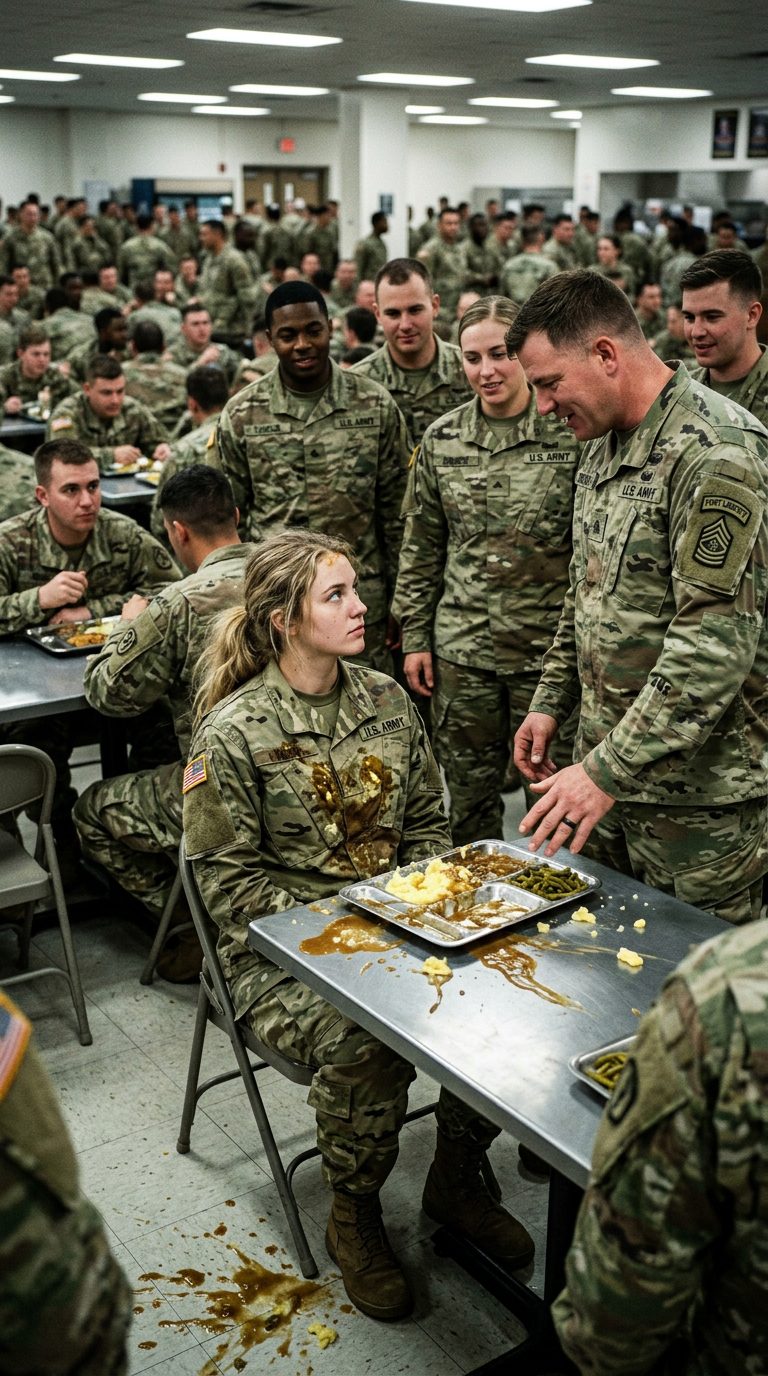
Without warning, he grabbed her tray and flipped it.
Food exploded across the table and clattered to the floor in a wet, ugly mess. Mashed potatoes splattered against her uniform. Gravy streaked down the side of the metal table and dripped steadily onto the concrete. The mess hall erupted in laughter almost before the tray stopped spinning.
Brooke didn’t move.
That stillness unsettled a few of them – a flicker of something uncertain crossing their faces before they buried it behind the noise of the crowd.
Cole stepped closer. “Clean it up and leave.”
The laughter continued.
Brooke remained exactly where she was.
Because in her world, silence was never weakness.
It was the last thing that happened before everything changed.
What Cole Didn’t Know
There were things about Brooke Mitchell that weren’t in her personnel file.
Not because they’d been omitted. Because the file itself was a construct. A carefully maintained fiction authored by people in offices with no windows and very specific jobs. The file said Fort Liberty, administrative logistics, eighteen months stateside. Nothing interesting. Nothing worth pulling.
The reality was a different architecture entirely.
Brooke had spent the last three years operating under a joint task force that didn’t appear on any organizational chart visible to base command. She’d done two rotations in environments where the U.S. government officially had no personnel. She spoke four languages at operational fluency and a fifth well enough to get by in a market or an interrogation room, depending on what the day required. She had been shot at in four countries, two of which she still couldn’t name in mixed company.
She was twenty-nine years old.
She looked, to Cole and his table of sergeants, like a tired nobody in a plain uniform who’d made the mistake of sitting somewhere she wasn’t wanted.
That was the point. That had always been the point.
The gravy finished dripping off the table edge. Brooke watched it hit the floor. Then she looked up at Cole with the same expression she used when she was waiting for something she’d already calculated was going to happen exactly this way.
“You done?” she said.
The laughter in the mess hall stuttered. Not all of it. But enough.
Cole’s jaw tightened. He hadn’t expected that. People who got their trays flipped usually did one of two things: they got loud, or they got small. This woman had done neither. She was just sitting there, watching him, with the flat and total patience of someone who’d waited out worse things than a sergeant with a temper.
“Get up,” he said.
“No.”
One word. No heat in it. Just a door closing.
The Moment the Room Changed
She didn’t stand up to fight him.
She stood up because the door to the mess hall opened.
Brooke clocked it before Cole did. Before any of them did. Her eyes moved to the entrance the way eyes move when they’ve been trained to track specific things, and what she saw made her set both palms flat on the table and rise slowly to her feet.
Not because she was obeying Cole.
Because the man who’d just walked through that door was Colonel Dennis Farrow, and behind him was a woman Brooke recognized even out of uniform: Major General Sandra Holt.
Two-star general.
Sandra Holt had been Brooke’s direct superior for eighteen months. Not the administrative fiction superior. The real one. The one who signed off on operations that didn’t have names yet.
Cole hadn’t turned around. He was still watching Brooke stand up, still reading it as capitulation, still wearing that smile.
“Smart choice,” he said.
Brooke said nothing. She was watching Holt scan the room with the practiced efficiency of someone who never walked into a space without immediately understanding it. Holt’s eyes found Brooke across two hundred feet of mess hall. They stayed there.
Then they moved to Cole.
Then back to Brooke.
Holt said something to Farrow. Farrow looked. His expression didn’t change much but his posture did, just slightly, the way posture changes when someone recalculates a situation fast.
They started walking toward the table.
Cole still hadn’t turned around. He was saying something to his group, some follow-up remark designed to land with the audience still watching. His guys were laughing again.
Brooke stood very still and waited.
“Do You Know Who You Just Did That To”
Holt didn’t announce herself.
She didn’t need to. The mess hall had already begun its wave of recognition, that particular ripple that moves through a room full of military personnel when someone with serious rank enters and starts moving with purpose. Heads turned. Backs straightened. Conversations dropped mid-sentence.
Cole heard the silence before he understood it.
He turned around.
Holt stopped two feet from him. She was a compact woman, mid-fifties, grey at her temples, with the kind of face that had stopped performing patience somewhere around her third deployment. She looked at Cole the way a person looks at a problem they’re already solving.
“Sergeant,” she said.
Cole’s spine went rigid. His eyes pulled rank insignia fast – too fast, the way eyes move when the brain is catching up to something the body already understands. Two stars. He snapped to attention so hard it was almost audible.
“Ma’am.”
Holt didn’t acknowledge the salute. She looked at the mess on the floor. The overturned tray. The gravy still wet on the table edge. She looked at Brooke’s uniform, spotted with mashed potato.
She looked back at Cole.
“That’s yours?” she said.
Cole’s eyes cut sideways to Brooke, then back. “Ma’am, the officer was sitting at a -“
“I didn’t ask for context.” Holt’s voice hadn’t risen. It didn’t need to. “I asked if that mess is yours.”
Silence.
“Yes, ma’am.”
Holt nodded slowly, like she was filing something. Then she turned to Brooke, and something shifted in her face. Not warmth exactly. Something more specific.
“Lieutenant Mitchell,” she said. “You’ve been back what, six hours?”
“Closer to four, ma’am.”
“Four hours.” Holt repeated it without looking away from Cole. “She came off a ninety-six-hour classified operation four hours ago, Sergeant. She hasn’t slept. She hasn’t eaten. And the first thing she’s had to deal with on American soil is you.”
Cole said nothing. There was nothing to say.
Farrow stood slightly behind Holt, arms clasped behind his back, watching Cole with the expression of a man watching someone step on a rake in slow motion.
What Nobody in That Mess Hall Knew
Cole didn’t know about the operation.
He couldn’t. Nobody at his level could. But Holt let the silence run long enough that the shape of it became clear to everyone watching: whatever this woman had been doing, it was above his ceiling. Significantly above.
Brooke hadn’t moved. She was still standing at the table, uniform still dirty, posture still carrying those four days of no sleep. She looked, if anything, faintly uncomfortable with the attention. That part wasn’t performance.
She genuinely didn’t want any of this.
She’d wanted mashed potatoes and ten minutes of quiet.
Holt turned back to Brooke. “Sit down, Mitchell. Finish eating.”
“Ma’am, I don’t really need -“
“That wasn’t a suggestion.”
Brooke sat.
Holt looked at Cole again. At his five guys, who had gone the particular shade of still that soldiers go when they’re hoping to become invisible. She took her time with each of them.
“You six,” she said, “will report to Colonel Farrow’s office at 0600 tomorrow. You’ll bring documentation of your current assignment, your conduct record, and a written account of this incident.” She paused. “Accurate. I’ll know if it isn’t.”
Cole’s throat moved. “Yes, ma’am.”
“And Sergeant.”
He looked at her.
“You’ll also clean that up.” She gestured at the floor. “Now. While she eats.”
After
Brooke got a new tray.
She sat at the same table and ate while Cole and two of his guys cleaned gravy off the floor six feet away from her. Nobody in the mess hall was pretending to have a different conversation anymore. The whole room was watching, but quietly, the way people watch something they know they’ll be describing later.
Holt and Farrow sat down across from her.
“You could have handled that,” Holt said. Not a question.
“Yes, ma’am.”
“But you didn’t.”
“I was eating.”
Holt almost smiled. It was a small thing, quick, gone before it fully arrived. “How was the op.”
“Fine.”
“Casualties?”
“None ours.”
Holt nodded. She picked up a cup of coffee that Farrow had set in front of her and drank it like she had somewhere to be in twenty minutes. Which she probably did.
“Take three days,” she said. “Actual days. Not the kind where you check in twice.”
“I’m fine.”
“Mitchell.”
Brooke looked up.
“Three days,” Holt said. “That’s an order.”
Brooke ate her mashed potatoes. They were cold now, and slightly gritty from the tray flip, but she ate them anyway because she was hungry enough that it didn’t matter.
Behind her, she could hear Cole wringing out a mop.
She didn’t look back.
She didn’t need to.
—
If this one got you, pass it along to someone who’d appreciate it.
For more tales of unexpected turns and powerful moments, check out what happened when The Colonel Stepped Out of the Shadows and Nobody on That Parade Ground Made a Sound or discover the unforgettable reaction when My Sergeant Grabbed a Stranger’s Hair in the Mess Hall. Then She Stood Up. You might also be interested in the story where The Sergeant Leaned Over My Table and Said “You People”.