
The first time a Navy SEAL called me useless, I smiled like I hadn’t heard him.
That was my gift – long before the rifle ever came back into my hands.
Silence.
I could sit in a room full of arrogant men, absorb their laughter, their insults, their failures dumped on my desk like trash, and never give them the satisfaction of watching me break. They saw a quiet communications specialist at a dusty forward base in Afghanistan. Background noise. Furniture with a headset.
They didn’t know my father was Marcus Ashford.
The Ghost.
And they had no idea that in eighteen minutes, I would become the nightmare that saved their lives.
The Girl They Called Useless
“Try not to get anyone killed, sweetheart.”
Chief Garrett Kane dropped his coffee cup on my desk like I was his maid instead of a soldier, then stood back and waited to see what I’d do with that.
The communications bunker went still. Every radio operator in the room froze. Private Wyatt Fletcher – twenty-one years old, still young enough to believe unfairness deserved a response – looked like he wanted to vault the desk and put his fist through Kane’s jaw.
I didn’t move.
I didn’t blink.
I looked up at Kane, calm as church bells on a Sunday morning.
“Yes, Chief,” I said.
His mouth curled. Not a smile. A warning.
Kane was a Navy SEAL – the kind of man who wore his contempt like body armor. Six feet of muscle, scar tissue, and ego. His voice sounded like gravel in a blender, and his eyes had a way of making younger soldiers suddenly remember somewhere else they urgently needed to be. To him, support staff were a punch line. Communications people were soft. And I was the worst kind of joke – a quiet woman with a headset, a keyboard, and no visible interest in proving myself to men who had already decided I was nothing.
“You hear that, boys?” Kane said, turning to the SEALs clustered behind him. “Specialist Ashford says she understands. That makes me feel so safe.”
A few of them laughed.
Not all.
The man at the back didn’t. Petty Officer Ethan Burke, their sniper, watched me without expression – his eyes moving across my face, my hands, my posture, reading things he had no business reading.
That made him dangerous.
Kane leaned in closer. His breath smelled like burnt coffee and absolute certainty.
“You know what happens when people like you panic?” he asked. “Real operators die.”
My hand moved beneath the desk and found the dog tags under my uniform.
Marcus Ashford. Staff Sergeant. United States Army.
My father.
I felt the metal warm against my fingers, and for half a second I was twelve years old again, lying in a Montana field with my cheek pressed against a rifle stock and my father’s voice low in my ear.
Breathe, Kira. Feel the wind before it moves. Let the world get quiet.
I let my hand fall.
“I don’t panic, Chief,” I said.
That wiped the smile off his face.
Only for a second.
But I saw it.
“You’d better hope that’s true,” he said. “Thursday, you’re on forward relay for my convoy. Alone. Exposed. Four hours minimum.”
Wyatt stood up. “Chief, that position is – “
Kane turned his head slowly.
Wyatt sat back down.
“Smart kid,” Kane said. Then his eyes came back to me, flat and final. “If the shooting starts, Ashford, don’t cry into the radio. We’ll be busy.”
He walked out. The steel door slammed behind him like an exclamation point.
Wyatt exploded the second the echo died.
“That was garbage,” he snapped. “He cannot talk to you like that.”
“He can,” I said, opening the folder Kane had thrown on my desk. “He just did.”
“Those frequency reports are Sergeant Moss’s work. He dumped them on you because he’s too lazy to finish them himself.”
I started typing.
“Then they’ll still get done.”
Wyatt stared at me like I was speaking a language he’d never encountered.
“How do you take it?” he asked. “How do you just sit there?”
I kept my eyes on the screen.
Because anger wastes breath. Because pride misses shots. Because the person who stays calm is the person who wins.
My father had taught me that before I was old enough to understand what it cost him to learn it.
But I didn’t say any of that.
“The mission matters more than my ego,” I said.
Wyatt’s expression softened into something close to wonder.
“Your dad teach you that?”
I stopped typing.
Just for a second.
Then I nodded. “He taught me a lot of things.”
The Name I Didn’t Say Out Loud
What I didn’t tell Wyatt:
My father had been called The Ghost during Desert Storm. Marcus Ashford. Forty-seven confirmed kills. Zero misses. The kind of record that gets spoken about in hushed tones by men who don’t impress easily.
Before he died in Afghanistan seven years ago, he spent every summer, every weekend, every leave training me. From the time I was eight years old. Montana fields at dawn. Cold mornings that turned our breath to smoke. Tin cans at two hundred meters. Steel plates at six hundred. Targets so far away they looked like bad memories.
I didn’t tell Wyatt any of that.
I also didn’t tell him about the promise.
My mother’s hands crushing mine beside the folded flag, her voice barely holding together inside that black dress.
“Promise me, Kira. Don’t follow him into the dark. I can’t bury you too.”
“I promise, Mama.”
And I meant it. Every word.
So I became communications. Radios, encryption, signal relays – anything that kept me useful and invisible. Seven years of hiding the one thing I was born to do.
That evening, after chow, Dr. Paige Sullivan found me outside the medical station.
She was Army medical – thirty years old, sharp-eyed, with the particular brand of directness that comes from spending too much time around people pretending they’re fine when they’re not.
“You look like you swallowed barbed wire,” she said.
“I’m fine.”
“Women who are fine don’t stare at mountains like they personally wronged them.”
I almost smiled. Almost.
She handed me a paper cup of coffee from the little machine near the chapel. It tasted burned. Everything at FOB Liberty tasted burned.
“Kane’s setting you up,” Paige said. Not a question.
I watched a helicopter lift off beyond the wire, its running lights blinking against the darkening sky.
“I know.”
“That relay point – I saw the route map. It’s ugly.”
“It is.”
“Then why aren’t you fighting it?”
Because if I fight, they look closer. Because if they look closer, they see him. Because if they see him, they see me.
Before I could answer, my name cut through the evening air.
“Specialist Ashford.”
Lieutenant Commander Lawrence Mitchell stood outside the operations building, arms folded, face unreadable. Paige squeezed my arm once and slipped away. Mitchell waited until she was out of earshot, then studied me the way good commanders study things they haven’t figured out yet.
“I reviewed your file today,” he said.
My pulse didn’t change. I had trained it not to.
“Communications specialist. Top marks. Excellent field reports.” He paused. “Strange thing, though.”
I said nothing.
“You study terrain like an operator. In yesterday’s briefing, you weren’t looking at signal range.” His voice was careful, deliberate. “You were looking at sightlines. Elevation. Kill zones.”
The air between us tightened.
“My father was military, sir.”
“What branch?”
“Army Rangers.”
“Name?”
There it was. The door I had kept bolted shut for seven years, and here was a man with his hand on the latch.
“Staff Sergeant Marcus Ashford.”
Mitchell’s face changed. Respect arrived first, then recognition, moving across his features like weather.
“The Ghost,” he said quietly.
I hated how much it hurt to hear that name out loud.
“Yes, sir.”
“He was one of the finest snipers this country ever produced.”
I looked past him at the mountains, black and indifferent against the fading light.
“He was my dad.”
Mitchell studied me for a long moment. When he spoke again, his voice was careful, like a man approaching something he didn’t want to startle.
“What else did he teach you?”
The answer sat between us like a loaded weapon.
“Observation,” I said. “Discipline. Staying calm under pressure.”
He didn’t believe that was all. Good commanders rarely believed easy answers.
“Thursday,” he said finally, “if anything feels wrong out there, you call it in. Immediately. Understood?”
“Yes, sir.”
He left me standing in the dust with the mountains at my back.
That night, I opened the dented metal box hidden at the bottom of my locker.
A photograph.
Me at twelve, squinting into the sun. My father beside me, his hand resting on my shoulder, a rifle in my hands and matching grins on both our faces. I could still feel the weight of that rifle. Still hear him laughing.
I touched the edge of the photograph.
“I’m not going back, Dad,” I whispered.
But I could already feel it – the way you feel weather before it arrives. Something shifting in the air. The wind changing direction.
And somewhere else on base, an old SEAL named Donovan “Duke” Brennan was sitting with a yellowed envelope in his hands. A letter my father had written before he died. A letter addressed to me, held in trust for seven years.
Waiting for the day I stopped hiding.
What Duke Knew
Duke Brennan found me at 0530 Thursday morning.
I was running gear checks on the relay equipment, the kind of pre-mission work you do in the dark because sleep has already given up on you. The sky over the mountains was that flat gray that comes before color decides to show up.
He was sixty-something, built like a man who had once been enormous and was now just dense. Retired SEAL, now a contractor doing some kind of coordination work nobody discussed at meals. He had a face like crumpled paper and hands that never looked like they were resting.
He sat down on an equipment crate without asking if he could.
“You’re Kira,” he said.
“Yes, Sergeant.”
“Don’t Sergeant me. I’ve been out for twelve years.” He reached into his jacket. “Your father wrote this in Kandahar. Four months before he died.” He held out the envelope. “He asked me to hold it until you were ready.”
I looked at the envelope. My name on the front in my father’s handwriting – the cramped, slanting letters I used to trace with my finger on birthday cards.
“I’m not ready,” I said.
“I know.” He set it on the crate beside me anyway. “He said you’d say that.”
I kept loading equipment. My hands were steady. My chest was not.
“He also said,” Duke continued, “that when the day came, you’d already know what to do. You’d just need to stop arguing with yourself about it.”
He stood up. Knees cracking.
“Kane’s an idiot,” he said. “But the threat on that route is real. Intel came in at 0200. Your convoy’s flagged.”
He walked away before I could ask him anything else.
I stood there with my father’s letter in my hand, the mountains going pink at the edges, and something cold and clear settling into my bones.
I put the letter in my chest pocket.
I’d read it after.
Eighteen Minutes
The convoy rolled out at 0730.
My relay position was a ridge outcropping two hundred meters off the main track – high ground, good signal, terrible cover. A folding table, two radio units, a laptop, and a sidearm I was technically authorized to carry and had never once drawn on deployment.
Kane’s convoy: three vehicles. Twelve personnel. Six SEALs, four Army support, plus the driver and Kane himself in the lead Humvee.
By 0900 they were four kilometers out, moving through a dry riverbed flanked by rock walls.
I was watching the ridge to the northeast when the radio went sideways.
Static. Broken transmission. Kane’s voice in pieces.
“—contact, we have—east wall, three—“
Then nothing.
I switched frequencies. Checked the relay unit. The signal was being jammed – not hardware failure, not terrain interference. Jammed. Which meant someone had military-grade equipment and was close enough to use it.
I stood up.
The ridge to the northeast. Elevation roughly 1,400 meters. Two kilometers from the convoy’s current position.
I saw them before I consciously understood what I was seeing. Small movements. The particular stillness of men trying to hold still.
Seven of them.
Spread across 300 meters of ridge. Staggered positioning. They weren’t there for a firefight. They were there for a kill box. The convoy would hit the narrowest point of the riverbed in approximately four minutes, and from that ridge, with that spread, there would be no cover and no exit.
The radio was dead.
The convoy had no idea.
I looked at my sidearm.
Useless at this range. Worse than useless.
Then I looked at the equipment case I had packed that morning without quite letting myself think about why.
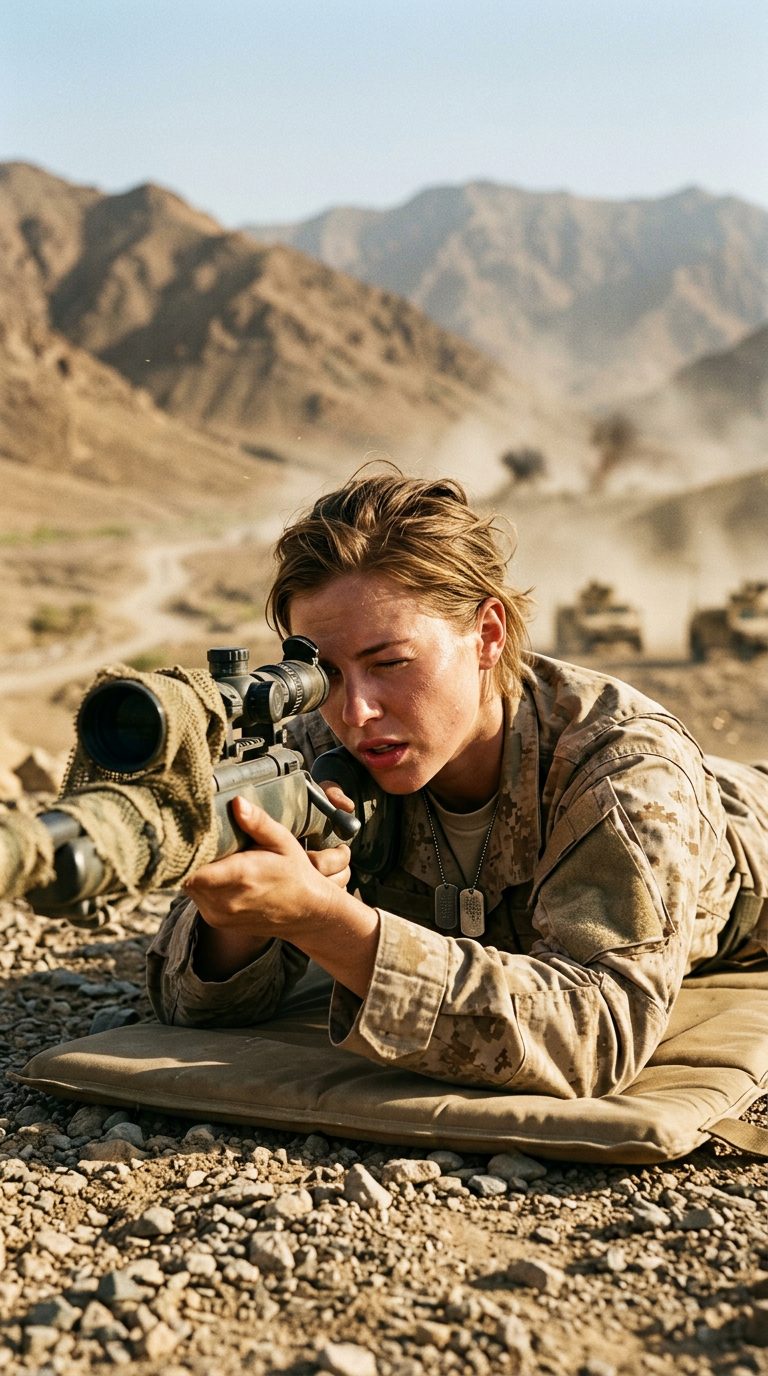
My father’s rifle. An M24, old enough to have his initials scratched into the stock. I had carried it on every deployment folded into a duffel, the way some people carry photographs. A comfort object I had sworn I would never use.
I unzipped the case.
The stock settled against my shoulder like it had been waiting.
Breathe, Kira. Feel the wind before it moves. Let the world get quiet.
The wind was coming northeast at roughly twelve kilometers per hour. Temperature 34 Celsius. Elevation differential putting the targets at a slight uphill angle.
I found the first one in the scope.
He was lying prone behind a rock shelf, RPG launcher already shouldered, waiting for the convoy to enter range.
My father used to say that a clean shot isn’t about the shooter. It’s about the space between the shooter and the target, and whether you’ve bothered to understand it.
I understood it.
I breathed out.
Fired.
The first man went still.
I was already moving the scope before the sound finished traveling.
The second man was standing, turning toward the sound of the shot. I gave him two seconds to finish turning. Then I fired.
The third and fourth were together – bad position discipline, the kind of mistake that gets made when you’ve never faced a shooter you couldn’t see. I took the one on the left first because he had the better angle on the convoy. Then the right.
Four down. Three minutes elapsed. The convoy was still moving, still blind.
The fifth man broke cover and ran.
Running targets are harder. My father had a saying about running targets: they’re telling you they’re scared, and scared people run in straight lines.
He ran in a straight line.
Five.
The sixth and seventh had figured out the direction by now. They split – one going north along the ridge, one dropping behind the rock shelf and going flat.
The one going flat was the problem. I lost him in the scope for eleven seconds. Eleven seconds is a long time when a convoy is thirty seconds from a kill box.
I found him when he moved to reposition.
Six.
The seventh was still running north. He’d covered maybe 400 meters. Almost out of my effective range on a moving target with a crosswind that had shifted three degrees in the last ninety seconds.
I made the adjustment.
Seven.
The convoy entered the narrowest point of the riverbed.
Nothing happened.
Thirty seconds of nothing. Then the radio crackled back to life as the jamming equipment went offline – the seventh man had been carrying it.
Kane’s voice: “—anyone read, we have a jammer situation, requesting—“
“This is Ashford,” I said. “Jammer is down. Threat on the northeast ridge is neutralized. You’re clear to proceed.”
Silence.
A long silence.
Then: “Say again, Ashford.”
“You’re clear to proceed, Chief.”
After
They found me on the ridge at 1100, still sitting with the rifle across my knees, my father’s letter open in my lap.
He had written it in the same cramped slant as the birthday cards. Three pages. I had read it twice already.
The last paragraph:
You’re going to tell yourself you became comms to keep a promise. But you became comms because you were afraid of what it meant to be good at the thing I was good at. The promise was just a door you hid behind. Kira, I know you. I know what you can do. And I know that when the day comes, you’ll do it – not because you want to, but because you’re your father’s daughter, and your father’s daughter doesn’t let people die when she can stop it. That’s not darkness, baby girl. That’s the opposite.
Burke was the first one up the ridge. He stopped ten meters out, looked at the rifle, looked at the seven positions I had worked, then looked at me.
He didn’t say anything for a while.
Then: “Your father was Marcus Ashford.”
“Yes.”
“I knew it when I watched you in the bunker.” He sat down on a rock. “The way you don’t move when Kane runs his mouth. That’s not comms training. That’s shooter discipline.”
I folded the letter.
Kane came up the ridge last. He stood at the edge of the cleared ground and looked at the positions. Counted them. Looked at the distance. Looked at me.
His face did something I hadn’t seen it do before.
He didn’t apologize. Men like Kane don’t apologize. But he looked at me the way you look at something you completely misjudged, and he had the basic decency to let me see him do it.
“Eighteen minutes,” he said.
“Yes, Chief.”
He picked up his coffee cup from where he’d set it on a rock – he’d carried it up the ridge, which struck me as insane – and drank the rest of it cold.
“Next time,” he said, “bring the rifle.”
He walked back down.
Mitchell found me last. He read the situation in about four seconds, then sat beside me and looked out at the mountains.
“Your father would’ve made that shot,” he said.
I watched the convoy reassembling on the track below.
“He taught me to make it.”
Mitchell nodded slowly.
“What are you going to do now?”
I looked down at the letter in my hands. My father’s handwriting. His voice, still reaching across seven years and one war and a promise I had kept until I couldn’t.
“I’m going to call my mother,” I said.
Mitchell left me alone with the mountains and the wind and the echo of seven shots that had already stopped being something I could take back.
I pulled out my phone.
She picked up on the second ring.
“Kira.” Her voice soft, morning-slow, six thousand miles away. “Is everything okay?”
I looked at the rifle. At the letter. At the empty ridge.
“Yeah, Mama,” I said. “I think it is.”
—
If this hit you somewhere real, pass it along to someone who needs it today.
If you’re looking for more stories about underestimated people proving their worth, you’ll love He Humiliated Me In Front of Fifty Soldiers – Then Went Pale the Second He Heard My Last Name, The Janitor Took the Pistol. Then Nobody Was Laughing., and They Covered the Cameras Before They Realized Who She Was.