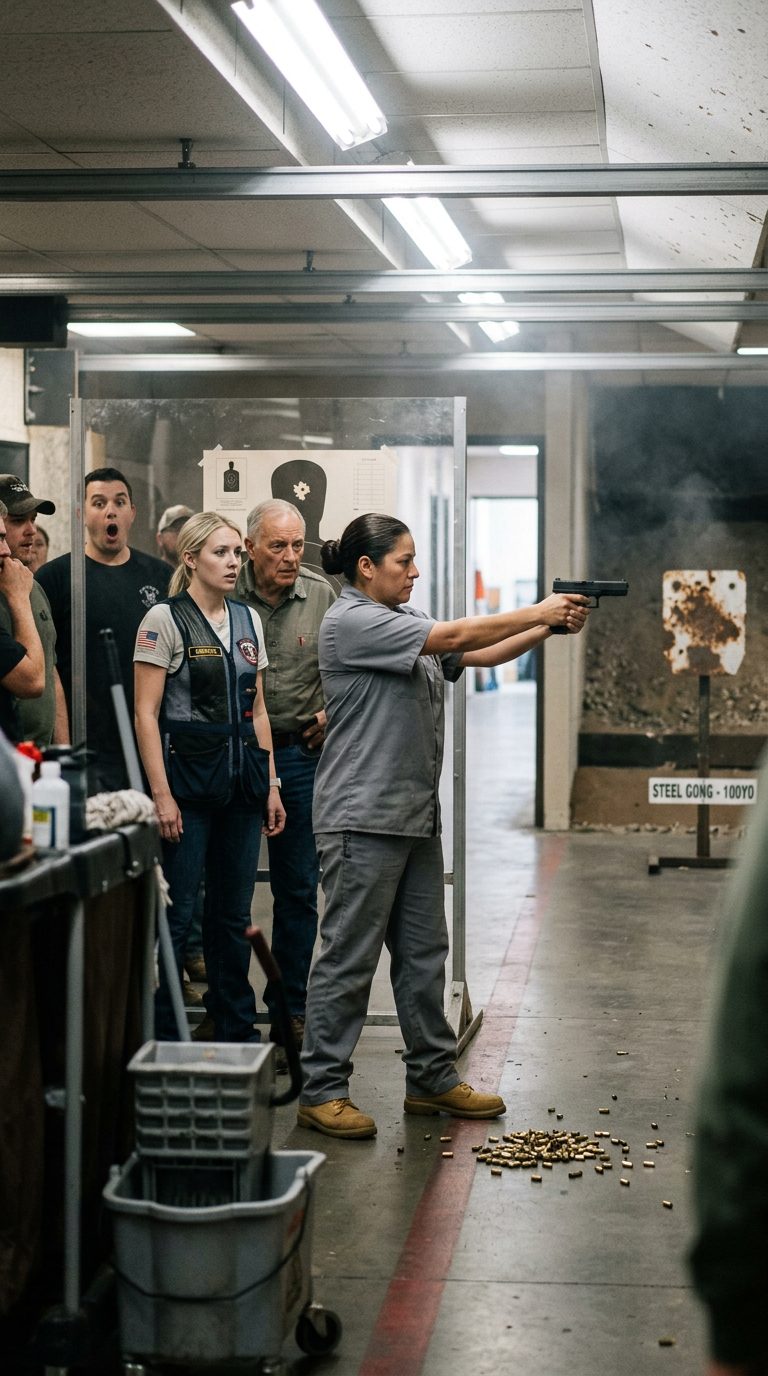

They laughed when the janitor picked up the pistol.
Then she fired.
—
The regional shooting finals drew a full house. Sponsors lined the gallery. Cameras swept the crowd. And Chloe Mercer – three-time champion, the kind of woman who entered a room like she expected applause – stood at center lane and soaked in every second of it.
At Lane 12, a woman in a gray uniform swept spent brass into a dustpan and said nothing.
That silence bothered Chloe more than she could explain.
She nudged the broom with her boot. Just enough. Just to see what would happen.
The woman didn’t look up.
So Chloe smiled at the crowd, plucked a pistol from the bench, and held it out like an offering.
“Hit the center,” she said, loud enough for everyone to hear, “and I’ll give you fifty bucks.”
Laughter rippled through the stands. Because of course it did. Gray uniform. Cleaning cart. Wrong side of the range.
The woman looked at the pistol for a moment.
Then she took it.
Too naturally. Too comfortably. The way you hold something you’ve held ten thousand times before.
She stepped to the firing line.
One breath.
One shot.
Silence.
The range operator leaned toward his monitor, squinted, and went pale.
Dead center. Not close to center. Dead center.
The laughter didn’t fade – it stopped. All at once, like a switch had been thrown.
The woman didn’t lower the pistol. She turned from the competition target, slow and deliberate, and aimed at the steel plate mounted at the far end of the range. The one no one challenged with a handgun. The one that existed mostly as decoration, a relic from a different era of shooting.
Chloe’s smile was gone.
For the first time, she looked – really looked – at the woman holding the gun. At the way she stood. At the way she breathed. At the stillness in her hands.
The janitor didn’t move like someone who cleaned a range.
She moved like someone who used to own one.
The steel plate was still ringing when the black SUV rolled through the gate.
The man inside didn’t scan the crowd or check his phone. He looked straight across the range, found the woman in the gray uniform, and stopped.
She hadn’t turned around yet.
But somehow, she already knew.
What Nobody Bothered to Read
Her name badge said Deb.
That was it. No last name. Just Deb, in block letters on a laminate clip, same as every other facilities worker who cycled through the Hargrove Regional Shooting Complex on a seasonal contract. The range manager, a guy named Phil Stuckey who wore the same Carhartt vest three hundred days a year, had hired her in March without much ceremony. She showed up on time. She kept the lanes clean. She didn’t talk much.
Phil thought she was maybe sixty. Could’ve been fifty-two. The kind of face that had been weathered into a specific expression and stayed there.
She worked Tuesdays, Thursdays, and Saturday mornings. She drove a 2009 Civic the color of old concrete. She ate lunch alone at the far table in the break room, the one next to the fire exit, always facing the door.
Nobody asked questions. People who work cleaning jobs at shooting ranges aren’t usually there because life handed them options.
So nobody read the badge more carefully. Nobody noticed the last name wasn’t there because she’d asked Phil to print it without one.
He’d thought that was a little strange but hadn’t pushed it.
You don’t push people who show up on time.
The Thing About Chloe Mercer
She was good. That part was real.
Three regional titles, a national semifinal appearance in 2019, a sponsorship from a mid-tier optics company that had her face on a banner near the entrance. She trained four days a week with a coach named Dale who used to shoot for the Army and now charged two hundred dollars an hour and was worth every cent of it.
She was also, by most accounts, a lot.
The kind of competitor who remembered every score and recited them in conversation. Who’d correct the range officer if he misread a split time. Who’d once filed a formal complaint because a woman in the adjacent lane had a cough.
The people who liked her called her focused.
The people who didn’t called her other things.
She’d nudged the broom on purpose. Anyone who knew her understood that. It wasn’t idle cruelty – it was a test, the same way she tested everything. She wanted to see the flinch. Wanted to confirm the hierarchy of the room, the way she always did, the way she’d been doing since she was seventeen and realized that most people would look away if you held their gaze long enough.
Deb hadn’t flinched.
That was the problem.
Fifty Bucks
The pistol was a Walther PDP. Chloe’s own, set up exactly the way she liked it: trigger at four pounds, fiber optic front sight, grip tape on the backstrap. She’d held it out like it was a joke prop, like she was offering a child a toy they’d have no idea what to do with.
Deb had looked at it for maybe two seconds.
Then she’d taken it, and the first thing she’d done was press-check it, smoothly, without thinking, just a half-second glance at the chamber, and then her thumb had found the safety and she’d already been turning toward the lane.
Chloe had noticed. She’d been the only one.
Everyone else was still laughing.
Deb’s stance was older than what you saw on the competition circuit now. Not wrong. Just from a different school. Feet wider than modern technique called for, weight slightly different, the gun held just a fraction higher. The kind of form that got drilled into you somewhere specific, by someone specific, a long time ago, and then stayed.
She breathed out.
Shot once.
The monitor showed the hit before the sound finished bouncing off the walls.
X-ring. The absolute center of the absolute center, the scoring ring that existed mostly to settle ties and arguments. Phil Stuckey said later that he’d been running this range for eleven years and he could count on one hand the number of times he’d seen a cold shot – no warm-up, unfamiliar gun, random ammo – land there.
Deb set the pistol on the bench.
She didn’t say anything.
She didn’t look at Chloe.
She looked at the steel plate at the end of the range – forty-two yards out, eight inches across, hung there since 2003 when the complex was built, unofficially considered a handgun no-go – and something in her face shifted. Not much. Just a small rearrangement around the eyes.
She picked the pistol back up.
Chloe said, “Wait-“
The shot hit the plate so hard it spun on its chain.
The SUV
The vehicle was a black Suburban, government plates, no markings. It came through the side gate, not the public entrance. The gate that was supposed to be locked.
The man who stepped out was somewhere in his mid-fifties, gray at the temples, wearing a jacket that was slightly too good for the venue. He moved the way people move when they’ve spent a long time in places where moving wrong gets you killed – not fast, not slow, just deliberate. Every step placed.
He’d found Deb with his eyes before he was fully out of the car.
She was still at the firing line. Still holding the pistol. The crowd had gone quiet in that particular way crowds go quiet when they understand they’ve stumbled into something that isn’t for them.
The man walked toward her.
He didn’t call out. Didn’t wave. He just walked, and when he was close enough he stopped and stood there and waited.
Deb finally turned around.
Whatever passed between them, it didn’t need words. Not right away. He looked at her face. She looked at his. Two people doing the math of how much time had gone by and what it had cost.
“Donna,” he said.
Not Deb.
Donna.
Chloe heard it from eight feet away and understood exactly nothing except that she’d made a significant error somewhere and the shape of it was only now becoming clear.
What Phil Stuckey Found Out Later
He made some calls that evening. He wasn’t sure why, exactly. Professional curiosity, maybe. Or the look on the government man’s face.
It took him three calls to get to someone who’d talk.
The name was Donna Pruitt. Not the name on her badge, not the name on her contract, but the name she’d had before, the one attached to a career that had ended – officially – in 2011 when she’d resigned from a federal firearms training unit that Phil had heard of but couldn’t fully explain to his wife when he tried.
She’d been, from what he could gather, the kind of instructor they brought in when they needed someone to teach people who already knew how to shoot how to shoot better. The kind of work that didn’t show up in press releases.
There’d been an incident. Phil couldn’t get the details. Something operational, something that went wrong in the specific way things go wrong when the decisions being made are above your pay grade and you’re the one standing in the room when they land.
She’d resigned. Or been asked to resign. The person Phil talked to was careful about that distinction in a way that told him not to push.
And then she’d just. Stopped.
Moved around for a few years. Took jobs that kept her invisible. Ended up here, in a gray uniform, sweeping brass on Tuesday and Thursday mornings.
Phil sat with that for a while.
Then he thought about the way she’d taken that pistol, the press-check she’d done without thinking, the shot she’d put through the X-ring on a cold gun she’d never handled, and he thought: some things don’t go away.
What Happened at the Gate
They stood by the Suburban for twenty minutes. Phil watched from the window of the range office. He couldn’t hear anything.
Deb – Donna – had her arms crossed. Not defensive. Just contained. The man talked. She listened. At one point she looked away, out past the fence line, at nothing in particular, and he stopped talking and let her.
She asked him something.
He answered.
She looked back at him.
Then she went to her car – the gray Civic, parked in the far corner of the lot, always the same spot – and she got the bag she kept in the back seat. Not a cleaning bag. A duffel, military-style, the kind with the compression straps.
She hadn’t left it in her locker. She’d kept it in the car.
Phil thought about that later too.
She walked back to the Suburban, put the duffel in the back, and got in the passenger seat.
She didn’t come back inside. Didn’t get her last check, didn’t clear out her locker. Didn’t say goodbye.
The Suburban pulled out through the side gate.
Phil stood in the window until the brake lights disappeared.
The Fifty Dollars
Chloe Mercer found the bill on the bench at Lane 12. Folded once. No note.
She stood there holding it for a long time while the range went back to its ordinary noise around her – the range officer calling a cold range, the competitors drifting back to their lanes, the whole afternoon resuming as if nothing had interrupted it.
Her name was still on the banner near the entrance. Three-time champion. Optics sponsorship. Two hundred dollar coaching sessions with Dale.
She put the fifty in her jacket pocket.
She didn’t shoot again that day.
—
If this one got under your skin, pass it along to someone who’d understand why.
For more unexpected twists and turns, perhaps you’d enjoy discovering who she really was when they covered the cameras or the incredible story of a soldier who wasn’t who they thought she was. And if you’re a fan of long-lost connections, you might be fascinated by the woman standing at the next lane, sought for 40 years.