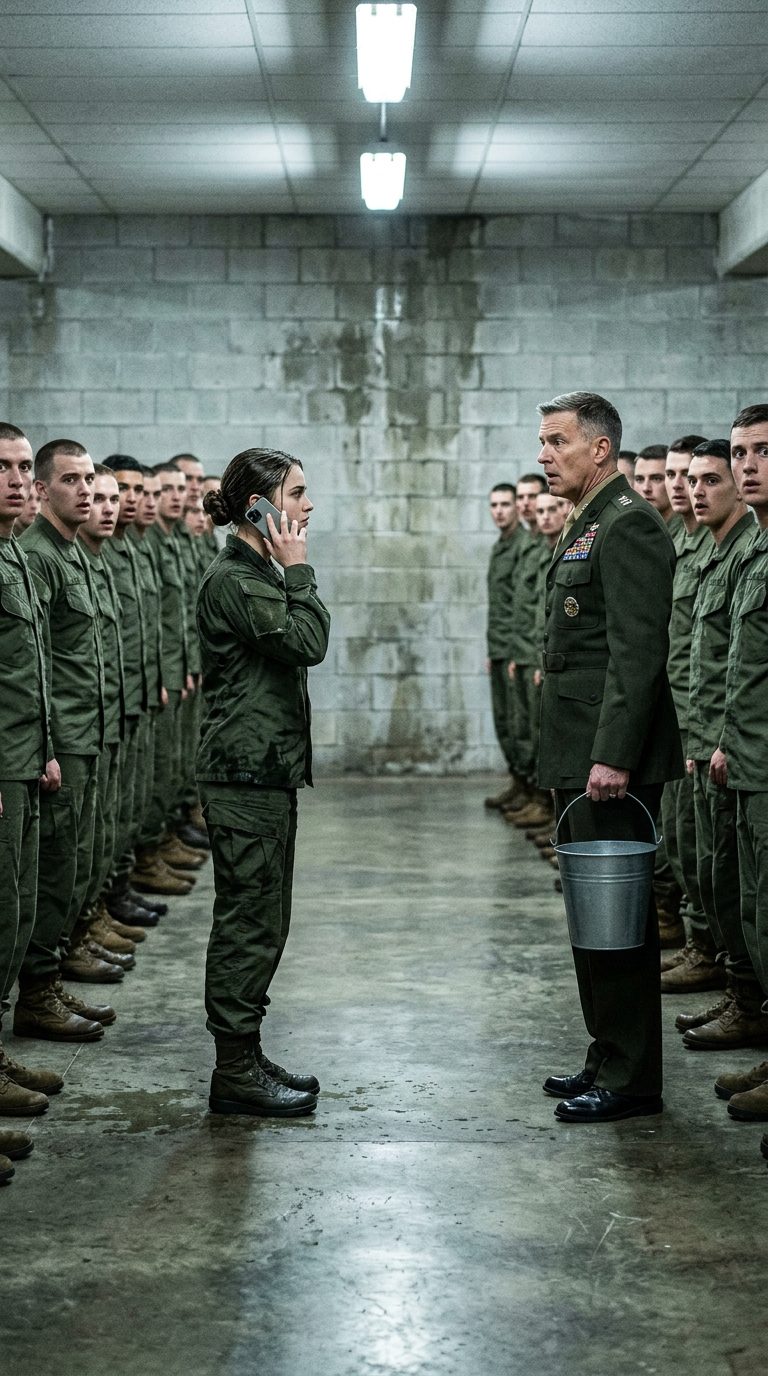

The water hit her like a slap.
Hot – scalding, even – soaking through her uniform in an instant, burning against her skin while every muscle in her body screamed to recoil. She didn’t move. Refused to give him the satisfaction.
The entire hall went silent.
Fifty soldiers stood frozen, watching General Harris Thorne lower the empty metal bucket to his side. His face glowed red – anger and pride fused together – like a man who believed he had just delivered a masterclass.
“I’ve seen weak recruits before,” he barked, his voice bouncing off the walls, “but you? You are an embarrassment to this uniform.”
Ava kept her jaw tight.
This is what he wants, she thought. Not just the water. The witnesses.
Thorne began circling her, boots scraping a slow rhythm against the concrete.
“I can only imagine how disgusted your family must be.” He let the words hang in the air before driving them home. “If your father could see you standing here right now, he’d probably deny you were ever his daughter.”
A few soldiers dropped their eyes. Others stared straight ahead, rigid. Nobody spoke. Nobody ever did.
Thorne stopped circling. He leaned in close enough that she could smell the coffee on his breath, close enough that his voice dropped to something almost intimate – the particular register of cruelty that doesn’t need an audience, even when it has one.
“You know what your problem is?” he said quietly. “You thought showing up was enough. You thought just being here meant something.” He straightened and turned to address the room. “Let me tell you what I see. I see a girl playing soldier. I see someone who will never be anything more than a cautionary tale these men tell their kids someday.”
He reached out and flicked the rank insignia on her shoulder.
A small gesture. Somehow worse than the water.
“Take that off when you quit.” A pause, deliberate and satisfied. “And you will quit.”
A few soldiers let out short, uncomfortable sounds – half laugh, half something they’d swallow back later and regret. Others went very still, the kind of still that comes from trying to disappear inside your own uniform.
Then Thorne laughed – a broad, generous laugh, like a man enjoying a meal.
“Go on,” he said, spreading his arms wide. “Call your daddy. Maybe he can come rescue you.”
That’s exactly what I’m going to do.
But she didn’t move. Not yet.
Because here was the thing nobody in this room understood: she had spent years keeping her father’s name out of her mouth. Years refusing to use it as a shield, refusing to let it open doors, refusing to let anyone hand her something she hadn’t bled for. She had wanted to do this herself. She had needed to do this herself.
And now this man – this small, loud, cruelty-dressed-as-discipline man – was going to make her spend it. On him.
The unfairness of it settled in her chest like a hot coal.
She let it sit there for one more second.
Then she let it go.
She didn’t react. She simply wiped a drop of scalding water from her cheek, reached into her pocket, and pulled out her phone with steady hands.
Her voice came out calm. Almost dangerously calm.
“Dad,” she said quietly into the receiver. “There’s a general here who’d like to meet you.”
Across the room, Thorne smirked.
“Oh,” he said, loud enough for everyone to hear, “this should be entertaining.”
—
Five minutes later, the massive double doors at the far end of the hall burst open.
Heavy footsteps filled the chamber.
And the moment the man walked through – the moment Thorne’s eyes found his face and registered what they were seeing – the General stopped smiling.
The color left him like a tide going out.
The Name She Never Used
Ava Mercer.
That’s how she’d enrolled. That’s the name on her bunk assignment, her training file, the roster Thorne had probably glanced at once and forgotten. Mercer was her mother’s name, taken back after the divorce, and Ava had kept it deliberately. Not out of bitterness toward her father. Out of something more complicated than that.
She loved her father. That was never the question.
The question was whether she could live in his shadow and still become something. Whether anyone would ever look at her and see her, specifically, or just the long reach of a name that had been printed on the front page of every major military publication for the last twenty-two years.
She’d decided the answer was no. Not unless she built something first.
So she’d gone through basic under Mercer. Gone through officer candidate school under Mercer. Taken every assignment that came her way, the hard postings, the ugly ones, the ones with no glory attached, and done them under Mercer. She’d been stationed in four countries. She’d been shot at twice. She’d spent fourteen months coordinating logistics in a forward operating base where the temperature hit 118 degrees and the coffee was always cold and nobody cared who your father was because survival was a full-time job.
She’d done all of it clean.
Until today.
What Thorne Didn’t Know
The thing about General Harris Thorne was that he was good at his job. She’d give him that. His record was clean, his unit’s performance numbers were solid, and by every measurable standard he was exactly what the Army said he was: a competent, decorated, mid-level general with another five years left in him before retirement.
He was also the kind of man who’d been allowed to be cruel for so long that he’d stopped recognizing it as cruelty. He thought it was training. He thought the bucket of scalding water was a lesson in composure. He thought the comments about her father were just pressure, the kind that either broke you or built you, and either way he was doing her a favor.
She’d met men like him before. Plenty of them.
What Thorne didn’t know – what he couldn’t have known, because she’d made sure of it – was that three weeks ago her father had been appointed Chairman of the Joint Chiefs of Staff.
She’d found out the same way everyone else did. Read it on her phone at 6 AM while sitting on the edge of her bunk, coffee in hand, still half asleep. Felt a complicated surge of something she couldn’t name – pride, and underneath it, the faint dread of what it meant for the careful, invisible life she’d built.
She’d called him that night.
“Congratulations,” she’d said.
“Don’t congratulate me yet,” he’d said. “Come visit when you can.”
She hadn’t told him where she was stationed. He hadn’t asked directly, because that was the agreement they’d had for years, unspoken but firm: he didn’t pull strings, she didn’t ask him to, and they both pretended the wall between his world and hers was thicker than it actually was.
She’d been planning to visit in three weeks.
Instead, she was calling him now, soaking wet, standing in front of fifty people, doing the one thing she’d promised herself she’d never do.
She could feel the coal in her chest the whole time the phone rang.
The Doors Open
He walked in alone.
That was the first thing. No aide, no escort, no entourage. Just General Raymond Voss – four stars, Chairman of the Joint Chiefs, the single most senior uniformed officer in the United States military – walking through those double doors in his service dress blues like he’d been in the neighborhood.
He wasn’t a large man. Medium height, lean, the kind of face that had been weathered by decades of things he didn’t talk about at dinner. He was sixty-one years old and he moved like someone who had long since stopped needing to prove anything to anyone.
Thorne’s mouth opened.
Nothing came out.
The room did something Ava had never seen a room full of soldiers do before: it collectively forgot how to breathe. Fifty people, all trained to function under pressure, and every single one of them went blank. Somewhere behind her she heard a boot scrape concrete as someone involuntarily straightened to attention.
Her father’s eyes found her immediately.
Took in the wet uniform. The reddened skin at her collar. The way she was standing – still, controlled, chin up.
Something passed across his face. Fast. Gone before most people would’ve caught it.
But she caught it.
She’d been reading that face her whole life.
The Part Nobody Talked About Afterward
Thorne found his voice. Barely.
“Sir, I – ” He stopped. Started again. “I wasn’t aware that – “
“I know you weren’t,” her father said.
He crossed the floor at a pace that was almost leisurely. Stopped about four feet from Thorne. Looked at him the way you look at a thing you’re trying to categorize.
“General Thorne,” he said. “Harris Thorne. Fort Benning, 2009. You were a colonel then. I reviewed your unit’s assessment. You wrote in your notes that psychological pressure was the most underutilized tool in officer development.” He paused. “I remember thinking at the time that you had a point.”
Thorne’s jaw was doing something complicated.
“I still think you had a point,” her father said. “The application is where we differ.”
He turned then and looked at Ava for a long moment. She waited for him to say something. Something fatherly, maybe. Something that would land in front of all these people and either embarrass her or redeem her, and either way make this about him instead of her.
He didn’t.
He just looked at her the way he always did when she’d done something he respected: like he was filing it away somewhere.
Then he looked back at Thorne.
“My daughter will finish her training,” he said. “Under the same conditions as every other officer candidate in this facility. No adjustments, no accommodations.” He let that settle. “And you will treat her exactly as you would treat any other candidate.” A beat. “Which I trust means you’ll be reviewing your methods.”
Thorne nodded. Once. The nod of a man who understood exactly what was happening and had no moves left.
Her father turned to go.
He stopped at the doors.
Didn’t turn around, but his voice carried.
“She didn’t call me because she needed help,” he said. “She called me because she wanted you to know who you were dealing with. There’s a difference.” A pause. “Think about that.”
The doors closed behind him.
What Came After
The hall stayed silent for a long time.
Long enough that Ava could hear the hum of the ventilation system overhead, could feel the water cooling in her uniform, could feel every set of eyes in the room trying to decide where to land.
Thorne stood with his back to her for a moment. Then he turned around.
His face had gone through several things and settled on something she hadn’t expected: not rage, not humiliation exactly, but something quieter. Something that looked, if she was being honest, a little like a man catching himself in a mirror at the wrong angle.
He looked at her for a long time.
“Dismissed,” he said. His voice was flat. “Get cleaned up.”
She didn’t move immediately. Gave him one beat – not defiant, just steady – and then turned and walked toward the door at the far end of the hall.
She heard the room begin to breathe again behind her.
In the corridor, alone, she stopped walking. Leaned her back against the concrete wall. The burn on her collarbone had gone from sharp to a dull, persistent heat. Her uniform was cold now, the fabric stiff where it had dried at the edges.
She pulled out her phone.
Typed: Thank you.
Her father’s reply came back in under a minute, which meant he was still in the building, probably in the parking lot, probably sitting in the back of a car he hadn’t needed to drive himself in years.
The message said: You were already handling it.
Then, after a second: But it’s good to be useful sometimes.
She read it twice.
Then she pushed off the wall, squared her shoulders, and went to find a change of clothes.
She had training in forty minutes. She wasn’t going to be late.
—
If this one hit somewhere – pass it on to someone who’d get it.
For more tales of unexpected turns and hidden strengths, check out The Janitor Took the Pistol. Then Nobody Was Laughing. or see what happens when They Covered the Cameras Before They Realized Who She Was. And if you love a good twist of fate, you won’t want to miss My Grandfather Spent 40 Years Looking For Someone. She Was Standing At The Next Lane..